
应用化学专业英语-无机物的命名
- 格式:ppt
- 大小:364.00 KB
- 文档页数:22

.
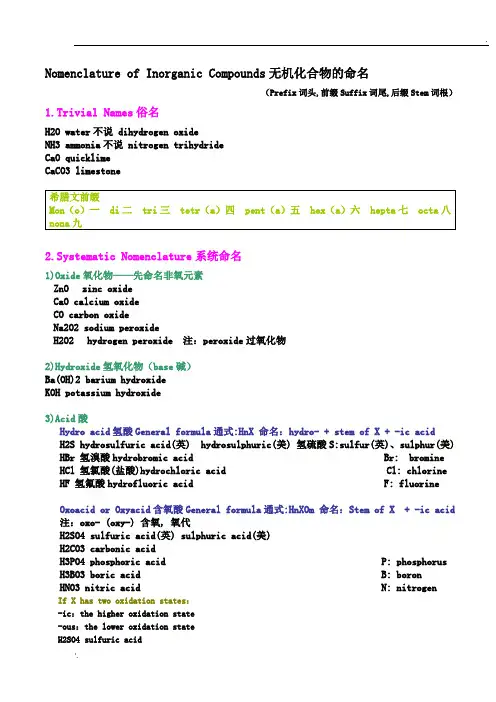
'. Nomenclature of Inorganic Compounds无机化合物的命名
(Prefix词头,前缀Suffix词尾,后缀Stem词根)
1.Trivial Names俗名
H2O water不说 dihydrogen oxide
NH3 ammonia不说 nitrogen trihydride
CaO quicklime
CaCO3 limestone
希腊文前缀
Mon(o)一 di二 tri三 tetr(a)四 pent(a)五 hex(a)六 hepta七 octa八
nona九
2.Systematic Nomenclature系统命名
1)Oxide氧化物——先命名非氧元素
ZnO zinc oxide
CaO calcium oxide
CO carbon oxide
Na2O2 sodium peroxide
H2O2 hydrogen peroxide 注:peroxide过氧化物
2)Hydroxide氢氧化物(base碱)
Ba(OH)2 barium hydroxide
KOH potassium hydroxide
3)Acid酸
Hydro acid氢酸General formula通式:HnX 命名:hydro- + stem of X + -ic acid
H2S hydrosulfuric acid(英) hydrosulphuric(美) 氢硫酸S:sulfur(英)、sulphur(美)
HBr 氢溴酸hydrobromic acid Br: bromine
HCl 氢氯酸(盐酸)hydrochloric acid Cl: chlorine
HF 氢氟酸hydrofluoric acid F: fluorine

Lesson 6
Nomenclature of Inorganic Chemistry(无机命名法则)
The IUPAC nomenclature of inorganic chemistry is a systematic method of naming
inorganic chemical compounds, as recommended by the International Union of Pure and Applied
Chemistry (IUPAC). Ideally, every inorganic compound should have a name from which an
unambiguous formula can be determined.
译文:无机化学国际纯粹与应用化学联合会命名法是国际纯粹与应用化学联合会(IUPAC)推荐的系统命名无机化合物。理想上,每一个无机化合物都应该有一个从中可确定的名称的明确的法则。
The names "caffeine" and "3,7-dihydro-1,3,7-trimethyl-1H-purine-2,6-dione" both signify the
same chemical. The systematic name encodes the structure and composition of the caffeine
molecule in some detail, and provides an unambiguous reference to this compound, whereas the
name "caffeine" just names it. These advantages make the systematic name far superior to the
common name when absolute clarity and precision are required. However, for the sake of brevity,

黄冈师范学院
2009—2010学年度第一学期期末试卷
考试课程:专业英语 考核类型:考试A卷
考试形式:闭卷 出卷教师:杨一思
考试专业:化学 考试班级:应用化学200601
一、Translate the following into English(20 points)
1.过滤
2.浓缩
3.结晶化
4.吸附
5. 蒸馏 6.超临界的
7.二氯甲烷
8.热力学平衡
9.亲电性
10.表面张力 11.共轭的
12.酮
13.平衡常数
14.丙基
15.丁基 16.亚甲基
18.环己酮
19.同位素
20.标准熵
二、Translate the following into Chinese(20 points)
1. methyl propanoate
2. rate constant
3. ethyl methyl ketone
4. free energy
5. radical intermediate
6. isobutyl methyl ether
7. 3-chloropropene
8. primary radical
9. n-propyl bromide
10. bond energy 11. circulating electrons
12. local magnetic fields
13. tetramethylsilane
14. mass to charge ratios
15 phenylamine
16 amide
17. amine
18. nucleophile
19. perchlorate
20. carbocation
三、Translation the following into chinese (40 points) A卷 【第1页 共 3 页】 1. We can see why benzene is stable: according to resonance theory,

(7)hepata- (8)octa- (9)nona- (10)deca-
无机物英语命名法
一单原子离子
1 正离子
Cu+ copper( I )
Cu2+ copper( n )
2 负离子 -ide
Sulfide S2-
Nitride N3-
Oxide O2-
氟 fluorine F- fluoride
氯 chlorine Cl- chloride
溴 bromine Br- bromide
二多原子离子
1
-ate
-ite
NO3- nitrate 2- CO3 carbonate
NO2- nitrite
OH- hydroxide
SO42- sulfate
SO32- sulfite
HCO3-
hydrogen carbonate
hydrogen sulfate
3- H2PO4 dihydrogen phosphate
lead(IV) oxide
金属氢化物一般命名规则:金属名+ hydride
CaH2 calcium hydride
NaH sodium hydride 非金属氢化物一般命名规则:
hydrogen+ 非金属 +ide
HCl hydrogen chloride
H2S hydrogen sulfide (sulphide)
HF hydrogen fluoride
SiC 非金属氧化物命名: silicon carbide
非金属名+ n-oxide
(l)mono- (2)di- (3)tri-
(4)tetra- (5)penta- (6) hexa- HSO4
Fewest Oxygen Atoms hypo—ite
Fewer Oxygen Atoms
More Oxygen Atoms —ite
— ate
Most Oxygen Atoms per — ate
ClO hypochlorite