
化学专业英语-无机化合物的命名
- 格式:ppt
- 大小:2.12 MB
- 文档页数:15

1 无机化学专业英语词汇
1. 化学原理 chemical principles
2. 气体,液体和溶液的性质 the
behaviors of gas ,liquid and
solution
3. 理想气体定律 ideal gas law
4. 道尔顿分压定律 Dalton’s Law
of Partial pressures
5. 液体的蒸汽压 vapor pressure of
liquid
6. 液体的凝固点 freezing point of
liquid
7. 体系和环境 system and
surrounding
8. 状态和状态函数 states and
state functions
9. 化学热力学基础 the basis of
chemical thermodynamics
10. 化学平衡 chemical equilibrium
11. 体系与状态 system and state
12. 热力学定理 law of
thermodynamics
13. 热化学 thermochemistry
14. 焓 enthalpy
15. 混乱度 disorder
16. 熵 entropy
17. 吉布斯自由能 Gibbs free
energy
18. 化学平衡 chemical equilibrium
19. 标准平衡常数 standard
equilibrium constant
20. 同离子效应 the common ion
effect
21. 缓冲溶液 buffered solution
22. 酸碱理论与电离平衡 the
theories of acids &bases and
ionization equilibrium
23. 盐的水解 the hydrolysis of salts
24. 沉淀反应 the precipitation
reactions
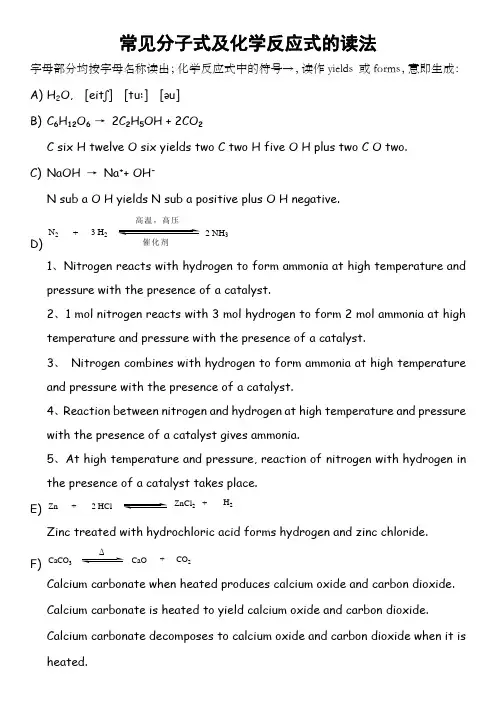
常见分子式及化学反应式的读法
字母部分均按字母名称读出;化学反应式中的符号→,读作yields 或forms,意即生成:
A) H2O, [eitʃ] [tu:] [əu]
B) C6H12O6 → 2C2H5OH + 2CO2
C six H twelve O six yields two C two H five O H plus two C O two.
C) NaOH → Na++ OH-
N sub a O H yields N sub a positive plus O H negative.
D) 1、Nitrogen reacts with hydrogen to form ammonia at high temperature and pressure with the presence of a catalyst. 2、1 mol nitrogen reacts with 3 mol hydrogen to form 2 mol ammonia at high temperature and pressure with the presence of a catalyst. 3、 Nitrogen combines with hydrogen to form ammonia at high temperature and pressure with the presence of a catalyst. 4、Reaction between nitrogen and hydrogen at high temperature and pressure with the presence of a catalyst gives ammonia. 5、At high temperature and pressure, reaction of nitrogen with hydrogen in the presence of a catalyst takes place. E) Zinc treated with hydrochloric acid forms hydrogen and zinc chloride.

1 无机化学专业英语词汇
1. 化学原理·chemical principles
2. 气体,液体和溶液的性质·the behaviors of gas ,liquid and
solution
3. 理想气体定律·ideal gas law
4. 道尔顿分压定律·Dalton’s Law of Partial pressures
5. 液体的蒸汽压·vapor pressure of liquid
6. 液体的凝固点·freezing point of liquid
7. 体系和环境·system and surrounding
8. 状态和状态函数·states and state functions
9. 化学热力学基础·the basis of chemical thermodynamics
10. 化学平衡·chemical equilibrium
11. 体系与状态·system and state
12. 热力学定理·law of thermodynamics
13. 热化学·thermochemistry
14. 焓·enthalpy
15. 混乱度·disorder
16. 熵·entropy
17. 吉布斯自由能·Gibbs free energy
18. 化学平衡·chemical equilibrium
19. 标准平衡常数·standard equilibrium constant
20. 同离子效应·the common ion effect 2 21. 缓冲溶液·buffered solution
22. 酸碱理论与电离平衡·the theories of acids &bases and
ionization equilibrium
23. 盐的水解·the hydrolysis of salts
24. 沉淀反应·the precipitation reactions

第三节 有机化合物的命名
一、烷烃命名时要注意哪些问题?命名的基本原则有哪些?
1.烷烃命名的步骤
口诀为:选主链,称某烷;编号位,定支链;取代基,写在前;标位置,短线连;不同基,简到繁;相同基,合并算。
(1)找主链:最长、最多定主链
①选择最长碳链作为主链。
应选含6个碳原子的碳链为主链,如虚线所示。
②当有几个不同的碳链时,选择含支链最多的一个作为主链。如 含7个碳原子的链有A、B、C三条,因A有三个支链,含支链最多,故应选A为主链。
(2)编碳号:编号位要遵循“近”、“简”、“小”
①以离支链较近的主链一端为起点编号,即首先要考虑“近”。如:
②有两个不同的支链,且分别处于距主链两端同近的位置,则从较简单的支链一端开始编号。即同“近”,考虑“简”。如
③若有两个相同的支链,且分别处于距主链两端同近的位置,而中间还有其他支链,从主链的两个方向编号,可得两种不同的编号系列,两系列中各位次和最小者即为正确的编号,即同“近”、同“简”,考虑“小”。如:
(3)写名称
按主链的碳原子数称为相应的某烷,在其前写出支链的位号和名称。原则是:先简后繁,相同合并,位号指明。阿拉伯数字之间用“,”相隔,汉字与阿拉伯数字用“-”连接。如
命名为:2,4,6-三甲基-3-乙基庚烷。 2.烷烃命名的5个原则和5个必须
(1)5个原则
①最长原则:应选最长的碳链作主链;
②最近原则:应从离支链最近的一端对主链碳原子编号;
③最多原则:若存在多条等长主链时,应选择含支链较多的碳链作主链;
④最小原则:若相同的支链距主链两端等长时,应以支链位号之和为最小为原则,对主链碳原子编号;
⑤最简原则:若不同的支链距主链两端等长时,应从靠近简单支链的一端对主链碳原子编号。
(2)5个必须
①取代基的位号必须用阿拉伯数字“2,3,4……”表示;
②相同取代基的个数,必须用中文数字“二,三,四,……”表示;
③位号2,3,4等相邻时,必须用逗号“,”表示(不能用顿号“、”);