used-to用法详解
- 格式:doc
- 大小:15.00 KB
- 文档页数:3
used to用法详解
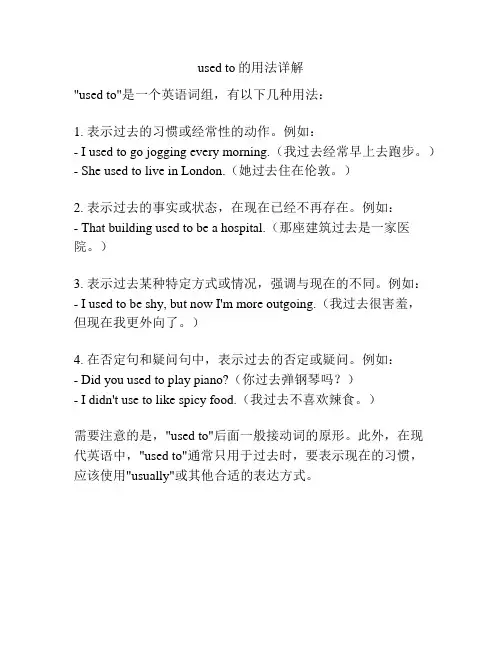
在《英语(新目标)》九年级Unit2中,我们学习到了used to do sth. 意思是“过去常常做某事”,表示过去经常做或一直做而现在不做,它只用于过去时态。
今天,我们就来对used to的用法注意事项做一次详细讲解。
一、used to的基本用法:
1、used to的肯定句结构
主语+used to+动词原形……例如:
I used to go to the cinema, but I never have time now.
我过去经常去看电影,但现在没有时间了。
2、used to的否定句结构
A) 主语+did not use to+动词原形……
B) 主语+used not to+动词原形……
第一种否定句型,就是把used当做实义动词来看,所以变否定句要用助动词did;第二种否定句是把used当做情态动词,变否定句直接在used后面加not即可,used not可以缩写成usedn't或usen't。
美式英语通常用A种形式,英式英语常用B种形式。
例如:
You didn't use to drink.
你过去不喝酒。
The shop usedn't to open on Sundays.
过去这家商店星期天不营业。
3、used to的一般疑问句结构
A) Did+主语+use to+动词原形……?
B) Used+主语+to+动词原形……?
美式英语通常用A种形式,英式英语用B种形式。
例如:
Did you use to go swimming in the river when you were young?
你小时候经常在河里游泳吗?
Used he go to school by bike?
他过去骑车上学吗?
4、used to用于省略句时,肯定式保留to,否定式不保留to。
例如:
——Used you play basketball?
你过去常打篮球吗?
——Yes, I used to.(No,I usedn't.)
是的,经常打。
(不,不常打。
)
二、区分be used to与used to
1、be used to 意为“习惯于”,其中的to 是介词,所以其后要接名词或动名词(不能接动词原形);若要强调从不习惯到习惯的过程,可用get, become 等代替动词get, become be。
如:
He is used to looking after himself.
他已习惯于自己照顾自己。
I’m sure I’ll get used to the hard work.
我相信我会习惯这艰苦工作的。
2、used to 意为“过去经常”,其中的to 是不定式符号,而不是介词,所以其后只接动词原形(不能接动名词)。
如:
He used to live in Paris.
他过去一直住在巴黎。
I always used [used always] to be afraid of dogs.
我过去总是怕狗。
三、used to与would的不同用法
1、used to可表示过去的习惯动作或状态;而would只表示过去的习惯动作,不接表示认识或状态的动词。
例如:
Kate used to be a model worker.
凯特曾是一位模范工人。
(例句中的used to不能用would代替。
因为所用的动词都是静态动词,只是说明一种事实或状态。
)
2、used to表过去与现在或过去某时与后来的情况不同,强调“现在已无此习惯了”;而would只表示过去的情况,与现在无关。
只表示说话人对过去的一种回想心情。
例如:
When he was young, he would smoke a lot.
他年轻时,总是吸很多烟。
(现在可能吸,也可能不吸了。
)
(句中的used to不能用would代替,因为would不含有“现在不再这样了”之意。
)
3、used to泛指过去的习惯性动作或状态,可无时间状语,不能与表示一段时间的状语连用;而would表示过去的习惯性动作时,往往要带有时间状语,常与often, frequently, sometimes, for hours等连用。
例如:
He would sit for hours, deeply thinking.
他过去经常一坐好几个小时沉思着。
(句中用了介词短语做时间状语,具体限定了动作发生的时间,在这种句子中通常不使用used to.)
People___ think that the sun went round the earth.
A. would
B. are used to
C. used to
D. are used
答案:C根据句意“人们过去常常认为,太阳绕着地球转”,used to 意为“过去经常”。