
2022年中考英语复习专题---被动语态课件
- 格式:pptx
- 大小:2.12 MB
- 文档页数:35


被动语态
学习目标:掌握被动语态结构以及时态变换
预习导学:举例把字句和被字句
知识梳理
一.被动语态的句法功能
1. 当不知道谁是动作的执行者,或没有必要指出谁是动作的执行者时。
e.g.: Japanese is taught in that school. (类似warming up中的“饭吃过了”,英汉说话习惯的相似性)
2. 当需要强调动作的承受者而不是执行者时。
e.g.: Her book will be brought tomorrow morning.
看图学知识,来发挥你的潜力吧,找到主动变被动语态的小技巧!!
He can carry the basket.
The basket can be carried by him.
They can sing some beautiful songs.
Some beautiful songs can be sung by them.
总结:上面例句的小规律:
△ 主动语态变为被动语态的方法:
主动语态: 主语 + 谓语动词 + 宾语
(执行者) (承受者)
被动语态: 主语 + be + 过去分词(+ by + 执行者) (承受者)一般省略
【例题精讲】
例1.Children (not allow) to play frightening games.
例2. The Great Wall (know) by people all over the world.
例3. All the buildings (turn) into hospitals recently.
例4.How long can these magazines (keep)?
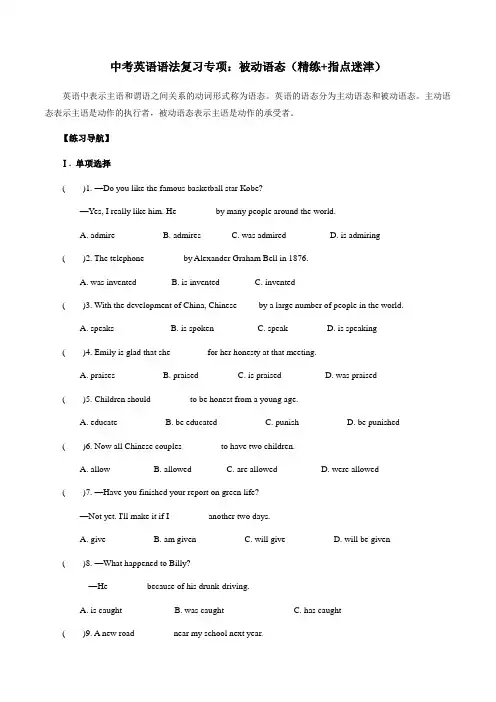
中考英语语法复习专项:被动语态(精练+指点迷津)
英语中表示主语和谓语之间关系的动词形式称为语态。英语的语态分为主动语态和被动语态。主动语态表示主语是动作的执行者,被动语态表示主语是动作的承受者。
【练习导航】
Ⅰ. 单项选择
( )1. —Do you like the famous basketball star Kobe?
—Yes, I really like him. He ________ by many people around the world.
A. admire B. admires C. was admired D. is admiring
( )2. The telephone ________ by Alexander Graham Bell in 1876.
A. was invented B. is invented C. invented
( )3. With the development of China, Chinese_____by a large number of people in the world.
A. speaks B. is spoken C. speak D. is speaking
( )4. Emily is glad that she________ for her honesty at that meeting.
A. praises B. praised C. is praised D. was praised
( )5. Children should ________ to be honest from a young age.
A. educate B. be educated C. punish D. be punished

被动语态
教学
目标 1、掌握主动语态与被动语态的区别
2、熟练掌握被动式的构成
重点
难点 熟练运用不同时态的被动语态
教 学 过 程
StepⅠWarming up
让学生写出六种时态的被动式结构
StepⅡ.复习内容
1、概述:语态表示主语和谓语动词之间的关系。英语有两种语态,即主动语态和被动语态。
主动语态:表示主语是动作的执行者。 被动语态:表示主语是动作的承受者。
如: Many students study English. (主动语态)
English is studied by many students. (被动语态)
2、构成:be + 动词的过去分词
3、用法:
1)不知道或没有必要说明动作的执行者是谁。Such books are written for children.
2)强调动作的承受者,这时应用by短语。The cup was broken by David.
4、时态:主动语态有不同的时态,被动语态也有不同的时态。被动语态的不同时态主要体现在“be + 动词的过去分词”的be上。
时态 被动语态结构
一般现在时 am / is / are + 动词的过去分词
一般过去时 were / was + 动词的过去分词
现在进行时 am / is / are being + 动词的过去分词
过去进行时 were / was being + 动词的过去分词
一般将来时 will be + 动词的过去分词
过去将来时 would be + 动词的过去分词
现在完成时 have / has been + 动词的过去分词
过去完成时 had been + 动词的过去分词 含有情态动词的句型 情态动词+ be + 动词的过去分词

被动语态学案
【学习目标】
1. 掌握被动语态在六种时态中的用法。2. 熟练运用情态动词的被动语态。
3. 掌握“get+过去分词 ”结构的用法。
【重点难点】
1. 被动语态在六种时态中的用法。2. 情态动词的被动语态。
【知识铺垫】
被动语态由“be+过去分词”构成,be随时态的变化而变化。
【课堂探究】
探究1一般现在时的被动语态由“am/is/are+及物动词的过去分词(+by+实施者)”构成。
【针对练习】 The Olympic Games ___________every four years.
A. are held B. were held C. are holding D. will hold
探究2 一般过去时的被动语态由“was/were+及物动词的过去分词(+by+实施者)”构成。
【针对练习】—I feel very happy that I _______to be the host. —Congratulations!
A. choose B. am chosen C. was chosen D. haven chosen
探究3 一般将来时的被动语态由“will/shall be+及物动词的过去分词(+by+实施者)或am/is/are going to be+及物动词的过去分词(+by+实施者)”构成。
【针对练习】Some famous paintings __________in the hall next week.
A. will show B. were shown C. is shown D. will be shown
探究4 现在完成时的被动语态由“has/have been+及物动词的过去分词(+by+实施者)”构成。
【针对练习】—Great changes have taken place in this city.