
Chapter V(2)
- 格式:ppt
- 大小:359.00 KB
- 文档页数:57
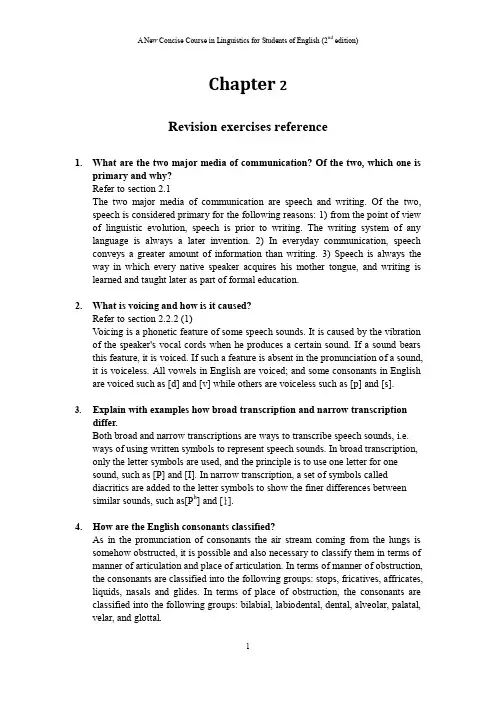
Chapter 2Revision exercises reference1.What are the two major media of communication? Of the two, which one isprimary and why?Refer to section 2.1The two major media of communication are speech and writing. Of the two, speech is considered primary for the following reasons: 1) from the point of view of linguistic evolution, speech is prior to writing. The writing system of any language is always a later invention. 2) In everyday communication, speech conveys a greater amount of information than writing. 3) Speech is always the way in which every native speaker acquires his mother tongue, and writing is learned and taught later as part of formal education.2.What is voicing and how is it caused?Refer to section 2.2.2 (1)V oicing is a phonetic feature of some speech sounds. It is caused by the vibration of the speaker's vocal cords when he produces a certain sound. If a sound bears this feature, it is voiced. If such a feature is absent in the pronunciation of a sound, it is voiceless. All vowels in English are voiced; and some consonants in English are voiced such as [d] and [v] while others are voiceless such as [p] and [s].3.Explain with examples how broad transcription and narrow transcriptiondiffer.Both broad and narrow transcriptions are ways to transcribe speech sounds, i.e.ways of using written symbols to represent speech sounds. In broad transcription, only the letter symbols are used, and the principle is to use one letter for onesound, such as [P] and [I]. In narrow transcription, a set of symbols calleddiacritics are added to the letter symbols to show the finer differences between similar sounds, such as[P h] and [ɫ].4.How are the English consonants classified?As in the pronunciation of consonants the air stream coming from the lungs is somehow obstructed, it is possible and also necessary to classify them in terms of manner of articulation and place of articulation. In terms of manner of obstruction, the consonants are classified into the following groups: stops, fricatives, affricates, liquids, nasals and glides. In terms of place of obstruction, the consonants are classified into the following groups: bilabial, labiodental, dental, alveolar, palatal, velar, and glottal.5.What criteria are used to classify the English vowels?To classify the English vowels, the following criteria can be applied: position of the tongue, openness of the mouth, length of the vowels, and the shape of the lips.According to the position of the tongue, the vowels are classified into front, central and back vowels; according to the openness of the mouth, the vowels are classified into close, semi-close, semi-open, and open vowels; and according to the length of the vowels, they are classified into long vowels and short vowels;and according to the shape of the lips, and the vowels are classified into rounded and unrounded vowels.6.Give the phonetic symbol for each of the following sound descriptions:1)voiced palatal affricate--- [dʒ]2)voiceless labiodental fricative---[f]3)voiced alveolar stop---[d]4)front, close, short---[i]5)back ,semi-open, long ---[ɔ:]6)voiceless bilabial stop---[p]Given the phonetic features of each of the following sounds:1)[d]---voiced alveolar stop2)[l]---voiced alveolar liquid3)[tʃ]---voiceless palatal/alveolar affricate4)[w]---voiced bilabial glide5)[u]---back,close,short(rounded)6)[æ]---front,short,open(unrounded)7.How do phonetics and phonology differ in their focus of study? Who do youthink will be more interested in the difference between, say, [l]and[ɫ], [pʰ]and[P],a phonetician or a phonologist? Why?Refer to section 2.3.1Though both dealing with speech sounds, phonetics and phonology differ in their focus of study in that the former focuses on the speech sounds themselves, their ways of pronunciation, their differences, their classifications, etc., while the latter focuses on the sound system of particular languages and the role sounds play in conveying meaning. Therefore, a phonetician will be more interested in the difference between two sounds.8.What is a phone? How is it different from a phoneme? How are allophonesrelated to a phoneme?Refer to section 2.3.2A phone is simply a speech sound, every actual sound we use or hear inmeaningful linguistic communication. For example, in pronouncing the two words “feel” and “leaf”, we actually use or hear four phones:[f][i:][l]and[~l].A phone differs from a phoneme in that the former is an actual sound we hear andit is the unit of study in phonetics, and the latter is not an audible sound, but an abstract entity, a collection of phonetic features, used as a unit of study in phonology. Take the “feel” and “leaf” example again. While four phones are used or heard in the pronunciation of these two words, only three phonemes are involved, i.e. /f/ /i: / and /l/.A phoneme, though as an abstract entity, is realized as different phones indifferent phonetic contexts. All these different phones are called the allophones of the same one phoneme. For example, the aspirated [pʰ] and the unaspirated [p] are allophones of the same phoneme/p/.9.Explain with examples the sequential rules, the assimilation rule, and thedeletion rule.Sequential rules are rules that govern the combination of sounds in a particular language. For exam ple, why “klib” is a permissible combination of the four sounds in English and why “kbli” is not can only be accounted for by a sequential rule.The assimilation rule assimilates one sound to another by “copying” a feature of a sequential phoneme, thus making the two phones similar. For example, the actual pronunciation of the letter “n” in the word “ incorrect” is not the alveolar [n] but the velar nasal [ŋ] is a manifestation of the assimilation rule at work.The deletion tells us when a sound is deleted although it is orthographically represented. For example, in the pronunciation of such words as sign, design, and paradigm, there is no [g] sound although it is represented in spelling by the letterg. But in their corresponding noun forms signature, designation and paradigmatic,the [g] represented by the letter g is pronounced.10.What are Suprasegmental features? How do the major Suprasegmentalfeatures of English function in conveying meaning?Suprasegmental features refer to those phonological features occurring above the sound segment level. The major Suprasegmental features in English are stress and intonation. The shift of word stress may change the part of speech of words of the same spelling, such as “'progress n.” and “pro'gress v.” , and different stress may cause difference in the meaning of some compound nouns and noun phrases with the same components, such as “'hotdog” and “hot 'dog”. Stressing words that are normally unstressed in a sentence may convey some extra meaning by the speaker.For exam ple, by stressing the pronoun “my” in the sentence “He is driving 'my car” the speaker is emphasizing the fact that the car he is driving is no one else`s but the speaker`s.The three often-used intonations in English are the falling tone, the rising tone, and the fall-rise tone. The basic role they each play is that the falling tone states a fact, the rising tone raises a question, and the fall-raise tone implies some meaning not literally expressed. For example, the same sentence “That`s not the book he w ants” said in the three different intonations convey three different meanings.Supplementary ExercisesI. Decide whether each of the following statements is True or False:1.If two phonetically similar sounds occur in the same environments and they distinguishmeaning, they are said to be in complementary distribution.2. A phone is a phonetic unit that distinguishes meaning.3.English is a tone language while Chinese is not.4.In linguistic evolution, speech is prior to writing.5.In everyday communication, speech plays a greater role than writing in terms of the amountof information conveyed.6.Articulatory phonetics tries to describe the physical properties of the stream of sounds whicha speaker issues with the help of a machine called spectrograph.7.The articulatory apparatus of a human being are contained in three important areas: the throat,the mouth and the chest.8.Vibration of the vocal cords results in a quality of speech sounds called voicing.9.English consonants can be classified in terms of place of articulation and the part of thetongue that is raised the highest.10.According to the manner of articulation, some of the types into which the consonants can beclassified are stops, fricatives, bilabial and alveolar.11.Any sound produced by a human being is a phoneme.12.Distinctive features of sound segments can be found running over a sequence of two or morephonemic segments.II. Fill in each of the following blanks with one word which begins with the letter given:13. A ____ refers to a strong puff of air stream in the production of speech sounds.14.The four sounds /p/,/b/,/m/ and /w/ have one feature in common, i.e., they are all b_______sounds.15.S_________ features are the phonemic features that occur above the level of the segments.They include stress, tone, intonation, etc.16.The rules that govern the combination of sounds in a particular language are called s ____rules.17.P___________ is a discipline which studies the system of sounds of a particular language andhow sounds are combined into meaningful units to effect linguistic communication.18.Depending on the context in which stress is considered, there are two kinds of stress: wordstress and s_________ stress.III. There are four choices following each of the statements below. Mark the choice that can best complete the statement:19.Of all the speech organs, the _______ is/ are the most flexible.A. mouthB. lipsC. tongueD. vocal cords20.__________ is a voiced alveolar stop.A. /z/B. /d/C. /k/D. /b/21.Since /p/ and /b/ are phonetically similar, occur in the same environments and they candistinguish meaning, they are said to be ___________.A. in phonemic contrastB. in complementary distributionC. the allophonesD. minimal pair22. A ____ vowel is one that is produced with the front part of the tongue maintaining the highestposition.A. backB. centralC. frontD. middle23.Distinctive features can be found running over a sequence of two or more phonemicsegments. The phonemic features that occur above the level of the segments are called ____________.A. phonetic componentsB. immediate constituentsC. Suprasegmental featuresD. semantic features24.A(n) ___________ is a unit that is of distinctive value. It is an abstract unit, a collection ofdistinctive phonetic features.A. phoneB. soundC. allophoneD. phoneme。

Chapter2 protecting our environment一、课文重点语言点1.Pollution means.... making things dirty and unhealthy.Make的用法:★重点▲ make sth.\sb. + adj. 使...处于某种状态,如:the good news made me happy.▲做使役动词:make/let/ have sb.do sth. 使某人做某事(使役动词后接动词原形),如:The boss made his workers work 15 hours a day.Don't let him do the job.2. The best-known flowers in ....these sweet-smelling flowers are known as the flowers of Shenzhen city.▲best-known 最有名的(well-known的最高级well-known=famous著名的)▲be know n as=be famous as 作为...而著名be known for= be famous for 因为....而著名3.Trees give out harmful gases. ★重点▲give out ①发出光、热、气味等,如:the sun gives out light and heat. ②分发he gave out all his money to the poor. ③被耗尽,用光:our food has given out▲拓展和give 相关的词组:give off= give out, give up doing放弃,停止做某事4.Trees can pass information to one another.▲pass sb. sth. = pass sth. to sb. 向某人传递某物如:Pass me the book.=Pass the book to me.▲可接双宾的还有give, buy, show, offer, provide,bring等词▲ one another和each other:都表示“互相”,可通用。
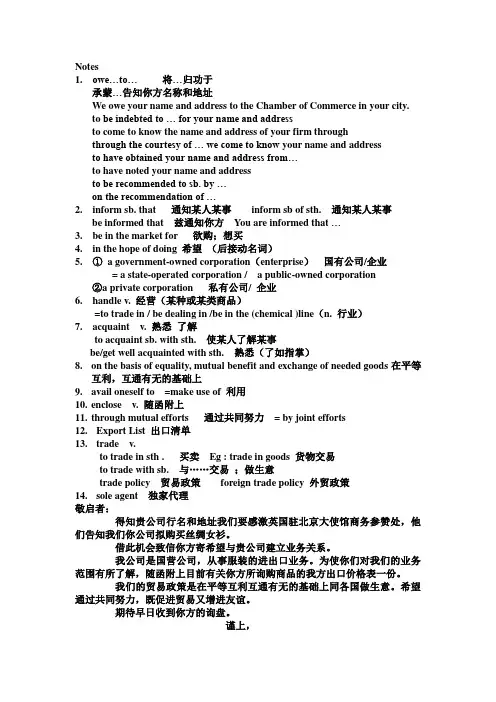
Notes1. owe…to… 将…归功于承蒙…告知你方名称和地址We owe your name and address to the Chamber of Commerce in your city.to be indebted to … for your name and addressto come to know the name and address of your firm throughthrough the courtesy of … we come to know your name and addressto have obtained your name and address from…to have noted your name and addressto be recommended to sb. by …on the recommendation of …2. inform sb. that 通知某人某事inform sb of sth. 通知某人某事be informed that 兹通知你方You are informed that …3. be in the market for 欲购;想买4. in the hope of doing 希望(后接动名词)5. ①a government-owned corporation(enterprise)国有公司/企业= a state-operated corporation / a public-owned corporation②a private corporation 私有公司/ 企业6. handle v. 经营(某种或某类商品)=to trade in / be dealing in /be in the (chemical )line(n. 行业)7. acquaint v. 熟悉了解to acquaint sb. with sth. 使某人了解某事be/get well acquainted with sth. 熟悉(了如指掌)8.on the basis of equality, mutual benefit and exchange of needed goods在平等互利,互通有无的基础上9.avail oneself to =make use of 利用10.enclose v. 随函附上11.through mutual efforts 通过共同努力= by joint efforts12.Export List 出口清单13.trade v.to trade in sth . 买卖Eg : trade in goods 货物交易to trade with sb. 与……交易;做生意trade policy 贸易政策foreign trade policy 外贸政策14.sole agent 独家代理敬启者:得知贵公司行名和地址我们要感激英国驻北京大使馆商务参赞处,他们告知我们你公司拟购买丝绸女衫。
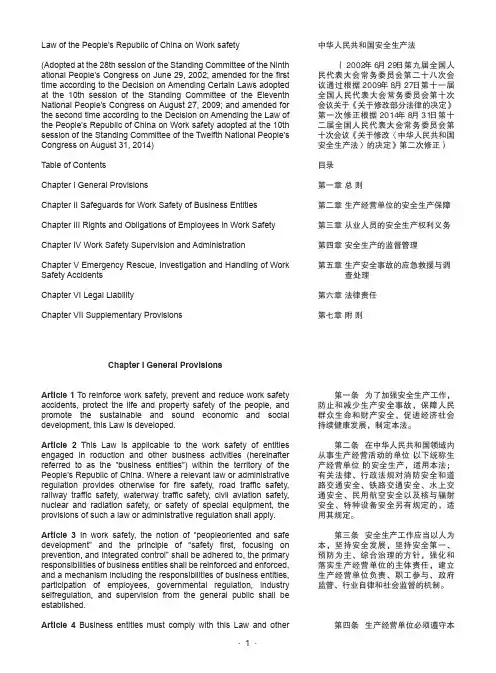
中华人民共和国安全生产法(2002年6月29日第九届全国人民代表大会常务委员会第二十八次会议通过根据2009年8月27日第十一届全国人民代表大会常务委员会第十次会议关于《关于修改部分法律的决定》第一次修正根据2014年8月31日第十二届全国人民代表大会常务委员会第十次会议《关于修改〈中华人民共和国安全生产法〉的决定》第二次修正)目录第一章 总 则第二章 生产经营单位的安全生产保障第三章 从业人员的安全生产权利义务第四章 安全生产的监督管理第五章 生产安全事故的应急救援与调 查处理第六章 法律责任第七章 附 则第一章 总 则第一条 为了加强安全生产工作,防止和减少生产安全事故,保障人民群众生命和财产安全,促进经济社会持续健康发展,制定本法。
第二条 在中华人民共和国领域内从事生产经营活动的单位(以下统称生产经营单位)的安全生产,适用本法;有关法律、行政法规对消防安全和道路交通安全、铁路交通安全、水上交通安全、民用航空安全以及核与辐射安全、特种设备安全另有规定的,适用其规定。
第三条 安全生产工作应当以人为本,坚持安全发展,坚持安全第一、预防为主、综合治理的方针,强化和落实生产经营单位的主体责任,建立生产经营单位负责、职工参与、政府监管、行业自律和社会监督的机制。
第四条 生产经营单位必须遵守本Law of the People's Republic of China on Work safety(Adopted at the 28th session of the Standing Committee of the Ninth ational People's Congress on June 29, 2002; amended for the first time according to the Decision on Amending Certain Laws adopted at the 10th session of the Standing Committee of the Eleventh National People's Congress on August 27, 2009; and amended for the second time according to the Decision on Amending the Law of the People's Republic of China on Work safety adopted at the 10th session of the Standing Committee of the Twelfth National People's Congress on August 31, 2014)Table of ContentsChapter I General ProvisionsChapter II Safeguards for Work Safety of Business Entities Chapter III Rights and Obligations of Employees in Work Safety Chapter IV Work Safety Supervision and AdministrationChapter V Emergency Rescue, Investigation and Handling of Work Safety Accidents Chapter VI Legal LiabilityChapter VII Supplementary ProvisionsChapter I General ProvisionsArticle 1 To reinforce work safety, prevent and reduce work safety accidents, protect the life and property safety of the people, and promote the sustainable and sound economic and social development, this Law is developed.Article 2 This Law is applicable to the work safety of entities engaged in roduction and other business activities (hereinafter referred to as the “business entities”) within the territory of the People's Republic of China. Where a relevant law or administrative regulation provides otherwise for fire safety, road traffic safety, railway traffic safety, waterway traffic safety, civil aviation safety, nuclear and radiation safety, or safety of special equipment, the provisions of such a law or administrative regulation shall apply.Article 3 In work safety, the notion of “peopleoriented and safe development” and the principle of “safety first, focusing on prevention, and integrated control” shall be adhered to, the primary responsibilities of business entities shall be reinforced and enforced, and a mechanism including the responsibilities of business entities, participation of employees, governmental regulation, industry selfregulation, and supervision from the general public shall be established.Article 4 Business entities must comply with this Law and other· 1 ·laws and regulations related to work safety, strengthen work safety management, establish and improve their work safety responsibility systems and work safety polices and rules, enhance work safety conditions, promote work safety standardization, improve their work safety levels, and ensure work safety.Article 5 The primary person in charge of a business entity shall be fully responsible for the business entity's work safety.Article 6 Employees of a business entity shall be entitled to safeguards for work safety according to the law, and perform work safety obligations according to the law.Article 7 Trade unions shall oversee work safety.The trade union of a business entity shall organize employees to participate in the democratic management and oversight of work safety of the business entity, and protect the lawful rights and interests of employees in terms of work safety. To develop or amend polices and rules related to work safety, a business entity shall hear the opinions of its trade union.Article 8 The State Council and the local people's governments at and above the county level shall develop and organize the implementation of general plans on work safety in accordance with the national economic and social development plans. General plans on work safety shall be connected with general plans on urban and rural development.The State Council and the local people's governments at and above the county level shall strengthen their leadership in work safety, support and supervise the relevant departments in performing their regulatory duties in work safety according to the law, establish and improve work safety coordination mechanisms, and provide timely coordination and solutions to the major issues existing in work safety supervision and administration.The people's governments of townships and towns and the branch offices of the local people's governments such as subdistrict offices and development zone management institutions shall, according to their duties, strengthen the supervisory inspection on work safety of business entities within their respective administrative regions, and assist the relevant departments of the people's governments at a higher level in performing their regulatory duties in work safety according to the law.Article 9 The work safety administrative department of the State Council shall conduct comprehensive supervision and administration of work safety nationwide in accordance with this Law; and the work safety administrative departments of the local people's governments at and above the county level shall conduct comprehensive supervision and administration of work safety within their respective administrative regions in accordance with this Law. The relevant departments of the State Council shall, in accordance with this Law and other relevant laws and administrative regulations, conduct supervision and administration of work safety in the 法和其他有关安全生产的法律、法规,加强安全生产管理,建立、健全安全生产责任制和安全生产规章制度,改善安全生产条件,推进安全生产标准化建设,提高安全生产水平,确保安全生产。