THE NOTES ON INTERNATIONAL FINANCEreview
- 格式:pdf
- 大小:12.44 KB
- 文档页数:3
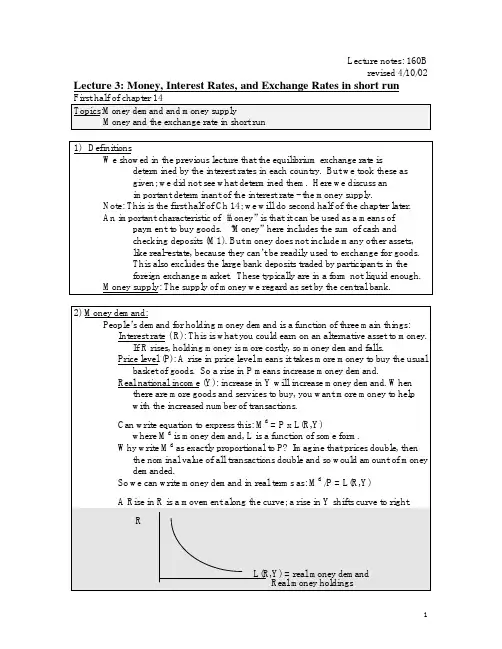
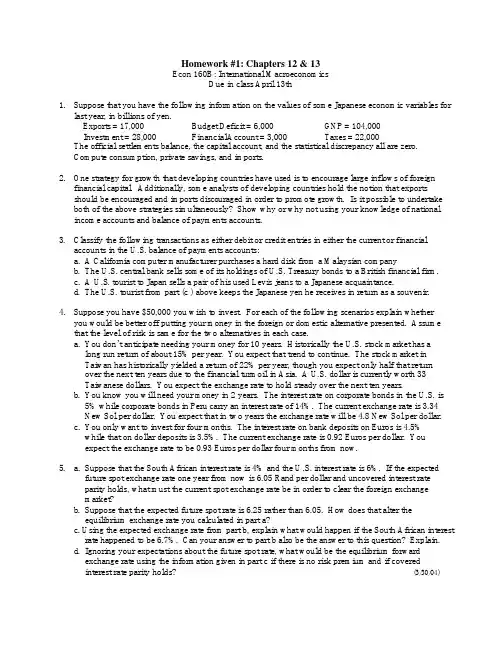
Questions for Review (6/3/02)I suggest you write out answers to the following questions, looking back at your book only afterward to check yourself. The questions on the exam also may ask you to apply the concepts here to particular situations.Chapter 12: National Income Accounting and Balance of Payments (whole chapter)1) Write the national income account identity for an open economy. Define the components.2) Use the above to show that national saving does not need to equal national investment.3) Use the above to show the relationship between the government budget deficit and the current accountdeficit.4) Under what conditions might a large current account deficit be justified?5) In balance of payments accounting, list the components of the current account balance and the capitalaccount balance.Chapter 13: Foreign Exchange Market (whole chapter and appendix)1)Define the following: forward exchange rate, swap, futures contract, currency call option.2) In words, characterize the difference between the asset approach to exchange rate determination andthe monetary approach.3)Write the interest parity condition, and explain why it holds as an equilibrium condition for theforeign exchange market.4) Draw a graph of this market, and explain how it corresponds to the interest parity condition.5)How is covered interest parity different from the above?First half of Chapter 14: The Asset Approach and Monetary Policy in the Short Run (pp.363-378)1)Why is money demand a function of the interest rate and output?2)How is equilibrium in the money market achieved in the short run? Draw a graph.3)Combine graphs for the money market and foreign exchange market (interest rate parity), and use itto tell the short-run story of a temporary increase in money supply.Chapter 15 and the rest of chapter 14: The Monetary Approach, and Monetary Policy in the Long Run (pp.378-390, 394-428)1)What is the law of one price, and under what three conditions does it hold?2)What is PPP, and under what four conditions does it hold?3)What are the predictions of the monetary approach for exchange rates and price level from a moneysupply increase?4) What is the real exchange rate?5)What is the equilibrium approach to exchange rates?6)Combine the monetary and asset approach to tell the story of a permanent increase in money supply.7) Why do we get exchange rate overshooting? What is the role of the interest parity condition in this?Of prices that adjust slowly?Chapter 16 Including Output: AA and DD Curves: (whole chapter and appendix I)1)Show in a graph equilibrium in the goods market, as aggregate demand equal production.2)Use this graph to derive the DD curve. Why is the DD curve upsloping?3)List four things that could shift the DD curve to the right.4)Use the asset market graph to derive the AA curve? Why is it downsloping?5)How is equilibrium achieved jointly in the asset and goods markets?6)Graph and tell the story of a temporary increase in money supply.7)Do the same for a temporary fiscal policy.8)Show a taste shock. Show how monetary and fiscal policy could be used to keep equilibrium outputfrom changing. What is the difference between the two policies?9)Do the same for a money demand shock.10)Graph and tell the story of a permanent increase in money supply.11)What does an XX curve represent? Use it to show what happens to the current account under amonetary expansion. Then under a fiscal expansion.12) How does the effect of monetary policy change if consumption or investment demand are functions ofthe interest rate?13)Explain the J-curve.Chapter 17: Fixed Exchange Rates (whole chapter)1)How does a central bank intervene in the foreign exchange market to keep the market exchange rateat the officially fixed level?2)Use a central bank balance sheet to show a sale of foreign reserves. What will this do to the moneysupply?3)Why can’t monetary policy be used under a fixed exchange regime?4) Use the AA-DD graph to depict a temporary fiscal policy under fixed exchange rates? Use the assetmarket graph to show what happens to the money supply and interest rate.Chapter 18: History of Fixed Exchange Rates (whole chapter)1)List all the benefits of fixed exchange rates, and all the costs.2)How does the price-specie-flow mechanism work?3)How did the gold standard amplify the Great Depression?4)How is the Bretton Woods system different from the Gold Standard?5)What is the difference between internal and external balance?6)How did U.S. policy during the 1970s undermine the Bretton Woods system?7)What are the steps of a currency crisis?Chapter 19: History of Flexible Exchange Rates (whole chapter and current events discussed in class)1)give an explanation for why the dollar had a high value in the 1980s.2)How can governments affect the equilibrium exchange rate just by making announcements of theirintentions?3)What is the approximate current value of the dollar against the Yen and Deutschmark. What has thetrend been over the last two years?Chapter 20: EMS and EMU (whole chapter plus current events discussed in class)1)What are the differences between the mechanics of the EMS and the Bretton Woods system?2)Explain how German policies after unification caused trouble for its neighbors. How did this spark acurrency crisis in 1992.3)What are the main differences between the current condition of economies in Europe and that of theU.S. economy?4)What factors determines an optimal currency area?5)How do these apply to Europe?Chapter 21: International Capital Markets (not responsible for this chapter in spring 2002)1) What is the benefit of intertemporal trade?2)What is the benefit of portfolio diversification?3)How are Eurocurrencies created, and what effect do they have on the money supply?4)Why is international banking difficult to regulate?Chapter 22: Developing Country issues (whole chapter plus current events discussed in class)1)What is seigniorage?2)Describe the causes of the Mexican debt crisis of the 1980s.3)What are the novel features of the Brady plan?4)How has the role of the IMF changed from under the Bretton-Woods system?5)Describe the Mexican currency crisis of the 1990s.6)How does a program of inflation stabilization typically work?。