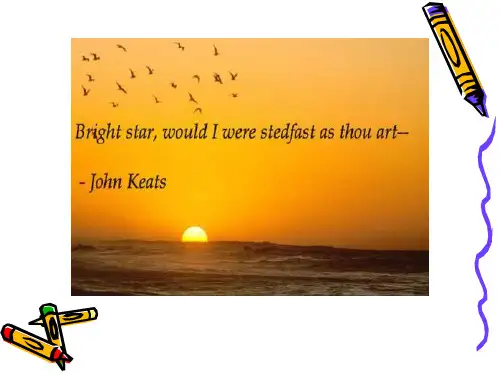
John Keats (1795-1821), renowned poet of the English Romantic Movement, wrote some of the greatest English language poems including "La Belle Dame Sans Merci", "Ode To A Nightingale", and "Ode On a Grecian Urn";O Attic shape! Fair attitude! with bredeOf marble men and maidens overwrought,With forest branches and the trodden weed;Thou, silent form, dost tease us out of thoughtAs doth eternity: Cold pastoral!When old age shall this generation waste,Thou shalt remain, in midst of other woeThan ours, a friend to man, to whom thou sayst,"Beauty is truth, truth beauty,--that is allYe know on earth, and all ye need to know."、John Keats was born on 31 October 1795 in Moorgate, London, England, the first child born to Frances Jennings (b.1775-d.1810) and Thomas Keats (d.1804), an employee of a livery stable. He had three siblings: George (1797-1841), Thomas (1799-1818), and Frances Mary "Fanny" (1803-1889). After leaving school in Enfield, Keats went on to apprentice with Dr. Hammond, a surgeon in Edmonton. After his father died in a riding accident, and his mother died of tuberculosis, John and his brothers moved to Hampstead. It was here that Keats met Charles Armitage Brown (1787-1842) who would become a great friend. Remembering his first meeting with him, Brown writes "His full fine eyes were lustrously intellectual, and beaming (at that time!)". Much grieved by his death, Brown worked for many years on his memoir and biography, Life of John Keats (1841). In it Brown claims that it was not until Keats read Edmund Spencer's Faery Queen that he realised his own gift for the poetic. Keats was an avid student in the fields of medicine and natural history, but he then turned his attentions to the literary works of such authors as William Shakespeare and Geoffrey Chaucer.Keats had his poems published in the magazines of the day at the encouragement of many including James Henry Leigh Hunt Esq. (1784-1859), editor of the Examiner and to whom Keats dedicated his first collection Poems (1817). It includes "To My Brother George", "O Solitude! If I Must With Thee Dwell", and "Happy is England! I Could Be Content". Upon its appearance a series of personal attacks directed at Keats ensued in the pages of Blackwood's Magazine. Despite the controversy surrounding his life, Keats's literary merit prevailed. That sameto stay with him and his family in Italy, he declined. When Shelley's body was washed ashore after drowning, a volume of Keats's poetry was found in his pocket.Having worked on it for many months, Keats finished his epic poem comprising four books, Endymion: A Poetic Romance--"A thing of beauty is a joy for ever"--in 1818. That summer he travelled to the Lake District of England and on to Ireland and Scotland on a walking tour with Brown. They visited the grave of Robert Burns and reminisced upon John Milton's poetry. While he was not aware of the seriousness of it, Keats was suffering from the initial stages of the deadly infectious disease tuberculosis. He cut his trip short and upon return to Hampstead immediately tended to his brother Tom who was then in the last stages of the disease. After Tom's death in December of 1818, Keats lived with Brown.Life of John Keats.Around this time Keats met, fell in love with, and became engaged to eighteen year old Frances "Fanny" Brawne (1800-1865). He wrote one of his more famous sonnets to her titled "Bright Star, would I were steadfast as thou art". While their relationship inspired much spiritual development for Keats, it also proved to be tempestuous, filled with the highs and lows from jealousy and infatuation of first love. Brown was not impressed and tried to provide some emotional stability to Keats. Many for a time were convinced that Fanny was the cause of his illness, or, used that as an excuse to try to keep her away from him. For a while even Keats entertained the possibility that he was merely suffering physical manifestations of emotional anxieties--but after suffering a hemorrhage he gave Fanny permission to break their engagement. She would hear nothing of it and by her word provided much comfort to Keats in his last days that she was ultimately loyal to him.Although 1819 proved to be his most prolific year of writing, Keats was also in dire financial straits. His brother George had borrowed money he could ill-afford to part with. His earning Fanny's mother's approval to marrydepended on his earning as a writer and he started plans with his publisher John Taylor (1781-1864) for his next volume of poems. At the beginning of 1820 Keats started to show more pronounced signs of the deadly tuberculosis that had killed his mother and brother. After a lung hemorrhage, Keats calmly accepted his fate, and he enjoyed several weeks of respite under Brown's watchful eye. As was common belief at the time that bleeding a patient was beneficial to healing, Keats was bled and given opium to relieve his anxiety and pain. He was at times put on a starvation diet, then at other times prescribed to eat meat and drink red wine to gain strength. Despite these ill-advised good-intentions, and suffering increasing weakness and fever, Keats was able to emerge from his fugue and organise the publication of his next volume of poetry.Lamia, Isabella, The Eve of St. Agnes, and Other Poems (1820) includes some of his best-known and oft-quoted works: "Hyperion", "To Autumn", and "Ode To A Nightingale". "Nightingale" evokes all the pain and suffering that Keats experienced during his short life-time: the death of his mother; the physical anguish he saw as a young apprentice tending to the sick and dying at St. Guy's Hospital; the death of his brother; and ultimately his own physical and spiritual suffering in love and illness. Keats lived to see positive reviews of Lamia, even in Blackwood's magazine. But the positivity was not to last long; Brown left for Scotland and the ailing Keats lived with Hunt for a time. But it was unbearable to him and only exacerbated his condition--he was unable to see Fanny, so, when he showed up at the Brawne's residence in much emotional agitation, sick, and feverish, they could not refuse him. He enjoyed a month with them, blissfully under the constant care of his beloved Fanny. Possibly bolstered by his finally having unrestricted time with her, and able to imagine a happy future with her, Keats considered his last hope of recovery of a rest cure in the warm climes of Italy. As a parting gift Fanny gave him a piece of marble which she had often clasped to cool her hand. In September of 1820 Keats sailed to Rome with friend and painter Joseph Severn (1793-1879, who was unaware of his circumstances with Fanny and the gravity of his health.Keats put on a bold front but it soon became apparent to Severn that he was terminally ill. They stayed in rooms on the Piazza Navona near the Spanish Steps, and enjoyed the lively sights and sounds of the people and culture, but Keats soon fell into a deep depression. When his attending doctor James Clark (1788-1870) finally voiced aloud the grim prognosis, Keats's medical background came to the fore and he longed to end his life and avoid the humiliating physical and mental torments of tuberculosis. By early 1821 he was confined to bed, Severn a devoted nurse. Keats had resolved not to write to Fanny and would not read a letter from her for fear of the pain it would cause him, although he constantly clasped her marble. During bouts of coughing, fever, nightmares, Keats also tried to cheer his friend, who held him till the end.John Keats died on 23 February 1821 in Rome, Italy, and now rests in the Protestant Cemetery in Rome, by the pyramid of Caius Cestius, near his friend Shelley. His epitaph reads "Here lies one whose name was writ in water", inspired by the line "all your better deeds, Shall be in water writ" from Francis Beaumont (1584-1616) and John Fletcher's (1579-1625) five act play Philaster or: Love Lies A-bleeding. Just a year later, Shelley was buried in the same cemetery, not long after he had written "Adonais" (1821) in tribute to his friend;I weep for Adonais--he is dead!O, weep for Adonais! though our tearsThaw not the frost which binds so dear a head!And thou, sad Hour, selected from all yearsTo mourn our loss, rouse thy obscure compeers,And teach them thine own sorrow, say: "With meDied Adonais; till the Future daresForget the Past, his fate and fame shall beAn echo and a light unto eternity!"Fanny Brawne married in 1833 and died at the age of sixty-five. English poet and friend of Brown's, Richard Monckton Milnes (1809-1885) wrote Life, Letters, and Literary Remains of John Keats (1848). During his lifetime and since, John Keats inspired numerous other authors, poets, and artists, and remains one of the most widely read and studied 19th century poets.Biography written by C. D. Merriman for Jalic Inc. Copyright Jalic Inc. 2007. All Rights Reserved.Works:长篇叙事诗Endymion《恩底弥翁》;The Eve of St.Agnes《圣艾格尼丝节前夜》;Lamia《拉米亚》;(颂诗)Ode to Psyche《普赛克颂》;《希腊古瓮颂》Sleep and Poetry《睡与诗》"As I lay in my bed slepe full unmete Was unto me, but why that I ne might Rest I ne wist, for there n'as erthly wight[As I suppose] had more of hertis ese Than I, for I n'ad sicknesse nor disese."CHAUCER.What is more gentle than a wind in summer? What is more soothing than the pretty hummer That stays one moment in an open flower,And buzzes cheerily from bower to bower?What is more tranquil than a musk-rose blowing In a green island, far from all men's knowing? More healthful than the leafiness of dales?More secret than a nest of nightingales?More serene than Cordelia's countenance?More full of visions than a high romance? What, but thee Sleep? Soft closer of our eyes! Low murmurer of tender lullabies!Light hoverer around our happy pillows! Wreather of poppy buds, and weeping willows! Silent entangler of a beauty's tresses!Most happy listener! when the morning blesses Thee for enlivening all the cheerful eyesThat glance so brightly at the new sun-rise. But what is higher beyond thought than thee? Fresher than berries of a mountain tree?More strange, more beautiful, more smooth, more regal,Than wings of swans, than doves, than dim-seen eagle?What is it? And to what shall I compare it?It has a glory, and nought else can share it:The thought thereof is awful, sweet, and holy, Chacing away all worldliness and folly;Coming sometimes like fearful claps of thunder,Or the low rumblings earth's regions under;And sometimes like a gentle whisperingOf all the secrets of some wond'rous thingThat breathes about us in the vacant air;So that we look around with prying stare,Perhaps to see shapes of light, aerial lymning,And catch soft floatings from a faint-heard hymning; To see the laurel wreath, on high suspended,That is to crown our name when life is ended. Sometimes it gives a glory to the voice,And from the heart up-springs, rejoice! rejoice! Sounds which will reach the Framer of all things, And die away in ardent mutterings.No one who once the glorious sun has seen,And all the clouds, and felt his bosom cleanFor his great Maker's presence, but must know What 'tis I mean, and feel his being glow:Therefore no insult will I give his spirit,By telling what he sees from native merit.O Poesy! for thee I hold my penThat am not yet a glorious denizenOf thy wide heaven--Should I rather kneelUpon some mountain-top until I feelA glowing splendour round about me hung,And echo back the voice of thine own tongue?O Poesy! for thee I grasp my penThat am not yet a glorious denizenOf thy wide heaven; yet, to my ardent prayer, Yield from thy sanctuary some clear air, Smoothed for intoxication by the breathOf flowering bays, that I may die a deathOf luxury, and my young spirit followThe morning sun-beams to the great ApolloLike a fresh sacrifice; or, if I can bearThe o'erwhelming sweets, 'twill bring to me the fair Visions of all places: a bowery nookWill be elysium--an eternal bookWhence I may copy many a lovely sayingAbout the leaves, and flowers--about the playing Of nymphs in woods, and fountains; and the shade Keeping a silence round a sleeping maid;And many a verse from so strange influenceThat we must ever wonder how, and whenceIt came. Also imaginings will hoverRound my fire-side, and haply there discover Vistas of solemn beauty, where I'd wanderIn happy silence, like the clear meanderThrough its lone vales; and where I found a spot Of awfuller shade, or an enchanted grot,Or a green hill o'erspread with chequered dressOf flowers, and fearful from its loveliness,Write on my tablets all that was permitted,All that was for our human senses fitted.Then the events of this wide world I'd seizeLike a strong giant, and my spirit teazeTill at its shoulders it should proudly seeWings to find out an immortality. Stop and consider! life is but a day;A fragile dew-drop on its perilous wayFrom a tree's summit; a poor Indian's sleep While his boat hastens to the monstrous steepOf Montmorenci. Why so sad a moan?Life is the rose's hope while yet unblown;The reading of an ever-changing tale;The light uplifting of a maiden's veil;A pigeon tumbling in clear summer air;A laughing school-boy, without grief or care, Riding the springy branches of an elm.O for ten years, that I may overwhelmMyself in poesy; so I may do the deedThat my own soul has to itself decreed.Then will I pass the countries that I seeIn long perspective, and continuallyTaste their pure fountains. First the realm I'll pass Of Flora, and old Pan: sleep in the grass,Feed upon apples red, and strawberries,And choose each pleasure that my fancy sees; Catch the white-handed nymphs in shady places, To woo sweet kisses from averted faces,--Play with their fingers, touch their shoulders white Into a pretty shrinking with a biteAs hard as lips can make it: till agreed,A lovely tale of human life we'll read.And one will teach a tame dove how it bestMay fan the cool air gently o'er my rest; Another, bending o'er her nimble tread,Will set a green robe floating round her head, And still will dance with ever varied case,Smiling upon the flowers and the trees:Another will entice me on, and onThrough almond blossoms and rich cinnamon;Till in the bosom of a leafy worldWe rest in silence, like two gems upcurl'dIn the recesses of a pearly shell.And can I ever bid these joys farewell?Yes, I must pass them for a nobler life,Where I may find the agonies, the strifeOf human hearts: for lo! I see afar,O'er sailing the blue cragginess, a carAnd steeds with streamy manes--the charioteer Looks out upon the winds with glorious fear:And now the numerous tramplings quiver lightly Along a huge cloud's ridge; and now with sprightly Wheel downward come they into fresher skies,Tipt round with silver from the sun's bright eyes. Still downward with capacious whirl they glide, And now I see them on a green-hill's sideIn breezy rest among the nodding stalks.The charioteer with wond'rous gesture talksTo the trees and mountains; and there soon appear Shapes of delight, of mystery, and fear,Passing along before a dusky spaceMade by some mighty oaks: as they would chase Some ever-fleeting music on they sweep.Lo! how they murmur, laugh, and smile, and weep: Some with upholden hand and mouth severe; Some with their faces muffled to the earBetween their arms; some, clear in youthful bloom, Go glad and smilingly, athwart the gloom;Some looking back, and some with upward gaze; Yes, thousands in a thousand different waysFlit onward--now a lovely wreath of girlsDancing their sleek hair into tangled curls;And now broad wings. Most awfully intentThe driver, of those steeds is forward bent,And seems to listen: O that I might knowAll that he writes with such a hurrying glow.The visions all are fled--the car is fledInto the light of heaven, and in their steadA sense of real things comes doubly strong,And, like a muddy stream, would bear alongMy soul to nothingness: but I will striveAgainst all doublings, and will keep aliveThe thought of that same chariot, and the strange Journey it went.Is there so small a rangeIn the present strength of manhood, that the high Imagination cannot freely flyAs she was wont of old? prepare her steeds, Paw up against the light, and do strange deeds Upon the clouds? Has she not shewn us all? From the clear space of ether, to the small Breath of new buds unfolding? From the meaning Of Jove's large eye-brow, to the tender greening Of April meadows? Here her altar shone,E'en in this isle; and who could paragonThe fervid choir that lifted up a noiseOf harmony, to where it aye will poiseIts mighty self of convoluting sound,Huge as a planet, and like that roll round, Eternally around a dizzy void?Ay, in those days the Muses were nigh cloy'd With honors; nor had any other careThan to sing out and sooth their wavy hair.Could all this be forgotten? Yes, a schism Nurtured by foppery and barbarism,Made great Apollo blush for this his land.Men were thought wise who could not understand His glories: with a puling infant's forceThey sway'd about upon a rocking horse,And thought it Pegasus. Ah dismal soul'd!The winds of heaven blew, the ocean roll'dIts gathering waves--ye felt it not. The blue Bared its eternal bosom, and the dewOf summer nights collected still to makeThe morning precious: beauty was awake!Why were ye not awake? But ye were deadTo things ye knew not of,--were closely wedTo musty laws lined out with wretched ruleAnd compass vile: so that ye taught a schoolOf dolts to smooth, inlay, and clip, and fit,Till, like the certain wands of Jacob's wit,Their verses tallied. Easy was the task:A thousand handicraftsmen wore the maskOf Poesy. Ill-fated, impious race!That blasphemed the bright Lyrist to his face, And did not know it,--no, they went about, Holding a poor, decrepid standard outMark'd with most flimsy mottos, and in largeThe name of one Boileau!O ye whose chargeIt is to hover round our pleasant hills!Whose congregated majesty so fillsMy boundly reverence, that I cannot traceYour hallowed names, in this unholy place,So near those common folk; did not their shames Affright you? Did our old lamenting Thames Delight you? Did ye never cluster roundDelicious Avon, with a mournful sound,And weep? Or did ye wholly bid adieuTo regions where no more the laurel grew?Or did ye stay to give a welcomingTo some lone spirits who could proudly singTheir youth away, and die? 'Twas even so:But let me think away those times of woe:Now 'tis a fairer season; ye have breathedRich benedictions o'er us; ye have wreathedFresh garlands: for sweet music has been heardIn many places;--some has been upstirr'dFrom out its crystal dwelling in a lake,By a swan's ebon bill; from a thick brake,Nested and quiet in a valley mild,Bubbles a pipe; fine sounds are floating wildAbout the earth: happy are ye and glad.These things are doubtless: yet in truth we've had Strange thunders from the potency of song; Mingled indeed with what is sweet and strong, From majesty: but in clear truth the themesAre ugly clubs, the Poets PolyphemesDisturbing the grand sea. A drainless showerOf light is poesy; 'tis the supreme of power;'Tis might half slumb'ring on its own right arm. The very archings of her eye-lids charmA thousand willing agents to obey,And still she governs with the mildest sway:But strength alone though of the Muses bornIs like a fallen angel: trees uptorn,Darkness, and worms, and shrouds, and sepulchres Delight it; for it feeds upon the burrs,And thorns of life; forgetting the great endOf poesy, that it should be a friendTo sooth the cares, and lift the thoughts of man. Yet I rejoice: a myrtle fairer thanE'er grew in Paphos, from the bitter weedsLifts its sweet head into the air, and feedsA silent space with ever sprouting green.All tenderest birds there find a pleasant screen, Creep through the shade with jaunty fluttering, Nibble the little cupped flowers and sing.Then let us clear away the choaking thornsFrom round its gentle stem; let the young fawns, Yeaned in after times, when we are flown,Find a fresh sward beneath it, overgrownWith simple flowers: let there nothing beMore boisterous than a lover's bended knee; Nought more ungentle than the placid lookOf one who leans upon a closed book;Nought more untranquil than the grassy slopes Between two hills. All hail delightful hopes!As she was wont, th' imaginationInto most lovely labyrinths will be gone,And they shall be accounted poet kingsWho simply tell the most heart-easing things.O may these joys be ripe before I die.Will not some say that I presumptuouslyHave spoken? that from hastening disgrace'Twere better far to hide my foolish face?That whining boyhood should with reverence bow Ere the dread thunderbolt could reach? How!If I do hide myself, it sure shall beIn the very fane, the light of Poesy:If I do fall, at least I will be laidBeneath the silence of a poplar shade;And over me the grass shall be smooth shaven; And there shall be a kind memorial graven.But oft' Despondence! miserable bane!They should not know thee, who athirst to gain A noble end, are thirsty every hour.What though I am not wealthy in the dowerOf spanning wisdom; though I do not knowThe shiftings of the mighty winds, that blow Hither and thither all the changing thoughtsOf man: though no great minist'ring reason sorts Out the dark mysteries of human soulsTo clear conceiving: yet there ever rollsA vast idea before me, and I gleanTherefrom my liberty; thence too I've seenThe end and aim of Poesy. 'Tis clearAs any thing most true; as that the yearIs made of the four seasons--manifestAs a large cross, some old cathedral's crest, Lifted to the white clouds. Therefore should IBe but the essence of deformity,A coward, did my very eye-lids winkAt speaking out what I have dared to think.Ah! rather let me like a madman runOver some precipice; let the hot sunMelt my Dedalian wings, and drive me down Convuls'd and headlong! Stay! an inward frown Of conscience bids me be more calm awhile.An ocean dim, sprinkled with many an isle, Spreads awfully before me. How much toil!How many days! what desperate turmoil!Ere I can have explored its widenesses.Ah, what a task! upon my bended knees,I could unsay those--no, impossible! Impossible!For sweet relief I'll dwellOn humbler thoughts, and let this strange assay Begun in gentleness die so away.E'en now all tumult from my bosom fades:I turn full hearted to the friendly aidsThat smooth the path of honour; brotherhood, And friendliness the nurse of mutual good.The hearty grasp that sends a pleasant sonnet Into the brain ere one can think upon it;The silence when some rhymes are coming out; And when they're come, the very pleasant rout: The message certain to be done to-morrow.'Tis perhaps as well that it should be to borrow Some precious book from out its snug retreat, To cluster round it when we next shall meet. Scarce can I scribble on; for lovely airsAre fluttering round the room like doves in pairs; Many delights of that glad day recalling,When first my senses caught their tender falling. And with these airs come forms of elegance Stooping their shoulders o'er a horse's prance, Careless, and grand--fingers soft and round Parting luxuriant curls;--and the swift bound Of Bacchus from his chariot, when his eye Made Ariadne's cheek look blushingly.Thus I remember all the pleasant flowOf words at opening a portfolio.Things such as these are ever harbingersTo trains of peaceful images: the stirsOf a swan's neck unseen among the rushes:A linnet starting all about the bushes:A butterfly, with golden wings broad parted, Nestling a rose, convuls'd as though it smarted With over pleasure--many, many more,Might I indulge at large in all my storeOf luxuries: yet I must not forgetSleep, quiet with his poppy coronet:For what there may be worthy in these rhymes I partly owe to him: and thus, the chimesOf friendly voices had just given placeTo as sweet a silence, when I 'gan retraceThe pleasant day, upon a couch at ease.It was a poet's house who keeps the keysOf pleasure's temple. Round about were hung The glorious features of the bards who sungIn other ages--cold and sacred bustsSmiled at each other. Happy he who trustsTo clear Futurity his darling fame!Then there were fauns and satyrs taking aim At swelling apples with a frisky leapAnd reaching fingers, 'mid a luscious heapOf vine leaves. Then there rose to view a fane Of liny marble, and thereto a trainOf nymphs approaching fairly o'er the sward: One, loveliest, holding her white band toward The dazzling sun-rise: two sisters sweet Bending their graceful figures till they meet Over the trippings of a little child:And some are hearing, eagerly, the wild Thrilling liquidity of dewy piping.See, in another picture, nymphs are wipingCherishingly Diana's timorous limbs;--A fold of lawny mantle dabbling swimsAt the bath's edge, and keeps a gentle motionWith the subsiding crystal: as when oceanHeaves calmly its broad swelling smoothiness o'er Its rocky marge, and balances once moreThe patient weeds; that now unshent by foamFeel all about their undulating home.Sappho's meek head was there half smiling downAt nothing; just as though the earnest frownOf over thinking had that moment goneFrom off her brow, and left her all alone.Great Alfred's too, with anxious, pitying eyes,As if he always listened to the sighsOf the goaded world; and Kosciusko's wornBy horrid suffrance--mightily forlorn.Petrarch, outstepping from the shady green,Starts at the sight of Laura; nor can weanHis eyes from her sweet face. Most happy they!For over them was seen a free displayOf out-spread wings, and from between them shone The face of Poesy: from off her throneShe overlook'd things that I scarce could tell.The very sense of where I was might wellKeep Sleep aloof: but more than that there came Thought after thought to nourish up the flame Within my breast; so that the morning light Surprised me even from a sleepless night;And up I rose refresh'd, and glad, and gay, Resolving to begin that very dayThese lines; and howsoever they be done,I leave them as a father does his son. Ode to a Nightingale《夜莺颂》My heart aches, and a drowsy numbness painsMy sense, as though of hemlock I had drunk,Or emptied some dull opiate to the drainsOne minute past, and Lethe-wards had sunk:'Tis not through envy of thy happy lot,But being too happy in thy happiness, -That thou, light-winged Dryad of the trees,In some melodious plotOf beechen green, and shadows numberless, Singest of summer in full-throated ease.O for a draught of vintage! that hath beenCooled a long age in the deep-delved earth,Tasting of Flora and the country-green,Dance, and Provencal song, and sunburnt mirth.O for a beaker full of the warm South,Full of the true, the blushful Hippocrene,With beaded bubbles winking at the brimAnd purple-stained mouth;That I might drink, and leave the world unseen,And with thee fade away into the forest dim.Fade far away, dissolve, and quite forgetWhat thou among the leaves hast never known,The weariness, the fever, and the fretHere, where men sit and hear each other groan; Where palsy shakes a few, sad, last grey hairs, Where youth grows pale, and spectre-thin, and dies; Where but to think is to be full of sorrowAnd leaden-eyed despairs;Where Beauty cannot keep her lustrous eyes,Or new Love pine at them beyond tomorrow.Away! away! for I will fly to thee,Not charioted by Bacchus and his pards,But on the viewless wings of Poesy,Though the dull brain perplexes and retards: Already with thee! tender is the night,And haply the Queen-Moon is on her throne, Clustered around by all her starry Fays;But here there is no lightSave what from heaven is with the breezes blown Through verdurous glooms and winding mossy ways.I cannot see what flowers are at my feet,Nor what soft incense hangs upon the boughs, But, in embalmed darkness, guess each sweet Wherewith the seasonable month endowsThe grass, the thicket, and the fruit-tree wild;White hawthorn, and the pastoral eglantine;Fast-fading violets covered up in leaves;And mid-May's eldest childThe coming musk-rose, full of dewy wine,The murmurous haunt of flies on summer eves. Darkling I listen; and for many a timeI have been half in love with easeful Death,Called him soft names in many a mused rhyme,To take into the air my quiet breath;Now more than ever seems it rich to die,To cease upon the midnight with no pain,While thou art pouring forth thy soul abroadIn such an ecstasy!Still wouldst thou sing, and I have ears in vain -To thy high requiem become a sod.Thou wast not born for death, immortal Bird!。