英文 节日
- 格式:doc
- 大小:230.50 KB
- 文档页数:9
春节 the Sprilng Festival ( New
Year’s Day of the Chinese lunar calendar) 农历正月初一
元宵节(灯节) the Lantern Festival 农历正月十五
清明节 the Qing Ming Festival 四月五日前后 Tomb-sweeping Day
端午节 the Dragon-Boat Festival 农历五月初五
中秋节 the Mid Autumn Festival
(the Moon Festival) 农历八月十五
重阳节 the Double Ninth Festival 农历九月初九
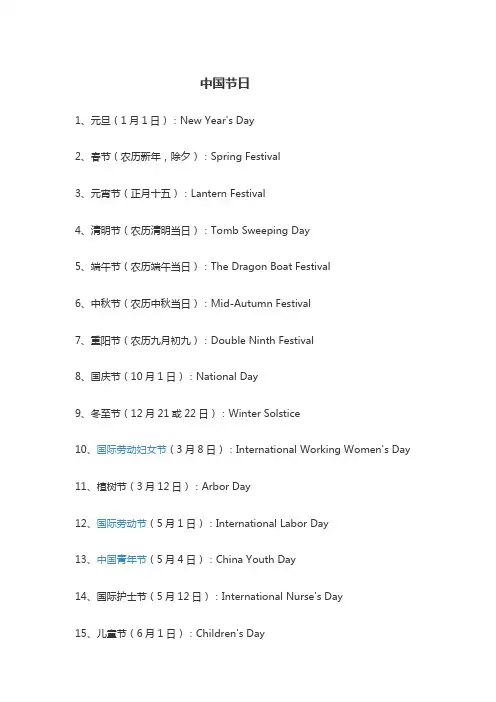
元旦(1月1日)New Year's Day
春节(农历一月一日)the Spring Festival
元宵节(农历一月十五日)the Lantern Festival
国际劳动妇女节(3月8日)International Working Women'sDay
植树节(3月12日)ArborDay
邮政节(3月20日)PostalDay
世界气象节(3月23日)WorldMeteorologyDay
清明节(4月5日)ChingMingFestival;Tomb-sweepingFestival
国际劳动节(5月1日)InternationalLabourDay
中国青年节(5月4日)ChineseYouthDay
护士节(5月12日)Nurses'Festival
端午节(农历五月初五)theDragonBoatFestival
国际儿童节(6月1日)InternationalChildren'sDay
中国共产党成立纪念日(7月1日)theParty'sBirthday
建军节(8月1日)theArmy'sDay
中秋节(农历八月十五)Mid-autumn(Moon)Festival
教师节(9月10日)Teachers'Day
重阳节(农历九月九日)Double-ninthDay
国庆节(10月1日)NationalDay
除夕(农历十二月三十日)NewYear'sEve
1. Spring Festival
Spring Festival is known as the most important Festival in China. During the holiday, people go back to hometown from everywhere no matter how far the distance is. They prepare various delicious food and presents for the Spring Festival Eve. Chinese will have a happy family union in the Spring Festival Eve, they believe that’s the end day of last year and they will stay up for good luck until the first day of next year.
In China, the most traditional and popular Spring Festival food
is dumpling, which looks like the moon with vegetables and meat mixed in it. The Chinese name of dumpling is “JIAO ZI”, ”JIAO” means ”cross”, ”ZI” is Chinese traditional time represents
“24:, so the Chinese word “JIAO ZI” means “cross 24:, just the
dividing point of last year and next year. So when it comes to 24:00, every family begins eating dumplings. Firecracker is also
necessary for Spring Festival, the story of Firecracker is: Long
ago, in a small village, there appeared a savage animal called
“NIAN”, this animal always came out to eat people in the Eve.
One day, villagers found three things can make “NIAN” scared: Red color, Fire and noise. So when “NIAN” came again, villagers put up red paper on the door and set firecracker everywhere. After that, “NIAN” disappeared from that village. Now putting
up red paper on the door and setting firecracker becomes Spring Festival customs and people believe doing these will bring their family safety.
Spring Festival is also the happiest time for children, because
they can get red envelope containing money as a gift from the
elder. During the Spring Festival, any unfortunate word cannot
be heard because it will make people upset and unhappy. People also make use of this holiday to visit their relatives and bring them some presents and well-wishing.
2. The Lantern Festival
The Lantern Festival is January 15 on the lunar calendar. The lunar January is the first month of a year and 15this the first day of full moon. Therefore, Lantern Festival is an important Festival right after Spring Festival.
During Lantern Festival, people go along the street to watch lanterns and children light their own small lanterns for some fun. The biggest and most beautiful lantern is the dragon lantern,
which looks like a flying dragon, held by several young guys. One with a ball in hand leads the dragon to move.
Some lanterns have puzzles on them, called lantern puzzle, the one who gets the answer could receive small presents and be
happy for his intelligence.
The traditional food for Lantern Festival is rice glue ball. Rice
glue ball is a flavor ball with filling in it, for example, peanut filling, sesame filling and jam filling…,the rice glue ball’s shape is just like the full moon appears in the sky. This kind of dessert is especially welcomed by children.
3. Tomb- sweeping Day
Tomb–sweep Day is an ancient festival in spring, also called Qing Ming Festival. In ancient China, the emperor worshipped heaven and earth in order to bless for harvest. People worshipped their ancestors with sacrifice and showed their missing for ancestors.
Tomb-sweeping Day, are always rainy days, just like the sky crying for dead people. A Chinese poem described as following:
Qing Ming usually comes with rainy days
Passengers on the way are full of soreness
I ask a Buffalo boy for tavern to release my sadness
He points to the village covered by apricot blossoms
This poem “The Day of Qing Ming” is written by a poet called Du Mu in Tang Dynasty. Qing Ming Festival is the day to worship his mother with family, but the writer goes alone in the rainy days as a passenger far from his hometown, he felt deeply upset and sorrowed. He has to find a tavern to have a drink, perhaps in this way he will release himself from sadness.