
Lesson Seven The Greatest Invention
- 格式:ppt
- 大小:1.01 MB
- 文档页数:14


外研版七年级上册《Module 9 Great inventions Unit 3》课时教学设计一. 教材分析外研版七年级上册《Module 9 Great inventions Unit 3》主要介绍了四大发明:造纸术、印刷术、指南针和火药。
本课时的教学内容围绕着四大发明的历史背景、发明者、发明过程以及四大发明对世界的影响展开。
教材通过生动的插图、丰富的语言和真实的例子,使学生能够更好地理解和掌握四大发明的相关知识。
二. 学情分析七年级的学生已经具备了一定的历史知识,对四大发明有一定的了解。
但学生在英语表达方面可能存在一定的困难,因此需要教师在教学中给予引导和帮助。
此外,学生可能对四大发明的历史背景和影响的理解不够深入,需要在教学中进行进一步的拓展和讲解。
三. 教学目标1.知识目标:学生能够掌握四大发明的英文表达,了解四大发明的历史背景、发明者、发明过程以及对世界的影响。
2.能力目标:学生能够运用英语进行简单的交流和讨论,提高学生的英语口语表达能力。
3.情感目标:培养学生对我国古代科技的自豪感,激发学生对历史和科技的兴趣。
四. 教学重难点1.重点:学生能够掌握四大发明的英文表达,了解四大发明的历史背景、发明者、发明过程以及对世界的影响。
2.难点:学生能够运用英语进行关于四大发明的交流和讨论。
五. 教学方法1.情境教学法:通过创设情境,让学生在真实的语境中学习和使用英语。
2.互动教学法:引导学生进行小组合作、讨论和交流,提高学生的参与度和积极性。
3.任务型教学法:通过完成任务,培养学生运用英语进行实际交流的能力。
六. 教学准备1.教学PPT:制作含有四大发明相关图片、文字和例子的PPT,方便学生直观地了解四大发明。
2.课文录音:准备课文录音,以便学生在听力方面进行训练。
3.教学卡片:制作四大发明的英文卡片,方便学生进行单词学习和记忆。
七. 教学过程1.导入(5分钟)教师通过提问方式引导学生回顾四大发明,激发学生的兴趣。
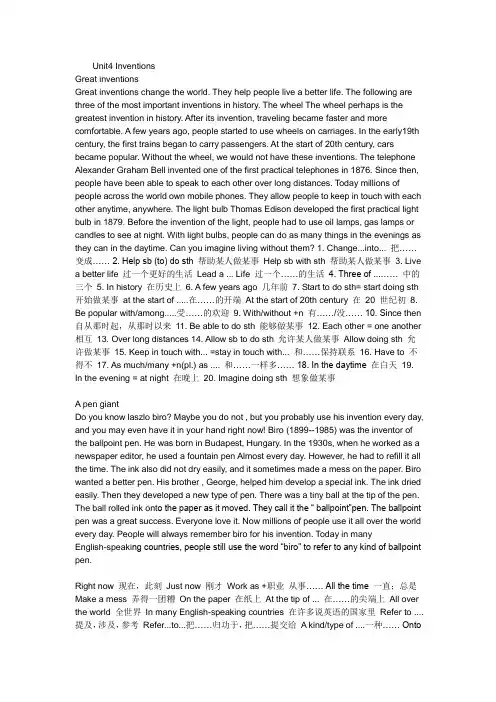
Unit4 InventionsGreat inventionsGreat inventions change the world. They help people live a better life. The following are three of the most important inventions in history. The wheel The wheel perhaps is the greatest invention in history. After its invention, traveling became faster and more comfortable. A few years ago, people started to use wheels on carriages. In the early19th century, the first trains began to carry passengers. At the start of 20th century, cars became popular. Without the wheel, we would not have these inventions. The telephone Alexander Graham Bell invented one of the first practical telephones in 1876. Since then, people have been able to speak to each other over long distances. Today millions of people across the world own mobile phones. They allow people to keep in touch with each other anytime, anywhere. The light bulb Thomas Edison developed the first practical light bulb in 1879. Before the invention of the light, people had to use oil lamps, gas lamps or candles to see at night. With light bulbs, people can do as many things in the evenings as they can in the daytime. Can you imagine living without them? 1. Change...into... 把……变成…… 2. Help sb (to) do sth 帮助某人做某事Help sb with sth 帮助某人做某事3. Live a better life 过一个更好的生活Lead a ... Life 过一个……的生活4. Three of ...…… 中的三个5. In history 在历史上6. A few years ago 几年前7. Start to do sth= start doing sth 开始做某事at the start of .....在……的开端At the start of 20th century 在20 世纪初8. Be popular with/among.....受……的欢迎9. With/without +n 有……/没…… 10. Si nce then 自从那时起,从那时以来11. Be able to do sth 能够做某事12. Each other = one another 相互13. Over long distances 14. Allow sb to do sth 允许某人做某事Allow doing sth 允许做某事15. Keep in touch with... =stay in touch with... 和……保持联系16. Have to 不得不17. As much/many +n(pl.) as .... 和……一样多…… 18. In the daytime 在白天19. In the evening = at night 在晚上20. Imagine doing sth 想象做某事A pen giantDo you know laszlo biro? Maybe you do not , but you probably use his invention every day, and you may even have it in your hand right now! Biro (1899--1985) was the inventor of the ballpoint pen. He was born in Budapest, Hungary. In the 1930s, when he worked as a newspaper editor, he used a fountain pen Almost every day. However, he had to refill it all the time. The ink also did not dry easily, and it sometimes made a mess on the paper. Biro wanted a better pen. His brother , George, helped him develop a special ink. The ink dried easily. Then they developed a new type of pen. There was a tiny ball at the tip of the pen. The ball rolled ink ont o the paper as it moved. They call it the “ ballpoint”pen. The ballpoint pen was a great success. Everyone love it. Now millions of people use it all over the world every day. People will always remember biro for his invention. Today in manyEnglish-speaki ng countries, people still use the word “biro” to refer to any kind of ballpoint pen.Right now 现在,此刻Just now 刚才Work as +职业从事…… All the time 一直;总是Make a mess 弄得一团糟On the paper 在纸上At the tip of ... 在……的尖端上All over the world 全世界In many English-speaking countries 在许多说英语的国家里Refer to ....提及,涉及,参考Refer...to...把……归功于,把……提交给A kind/type of ....一种…… Ontoprep 到……上去Into prep. 进入到……里面去As 作为当=when 像More words and phrases Advertisement funny create dust rise raise refill 1. Be suppose to...应该…… 2. Do you think 在句中做插入语,放在特殊疑问词的后面3. Think of .... 认为4. What do you think of ....你认为……怎么样?5. What do you use it for? 你用它做什么?6. Mobile phone 手机7. Light bulb 电泡8. Keep ...off.....使……远离,不接近9. At the same time 同时10. So many +n.(pl) 如此多的…… 11. So much +n.(不可数)如此多…… 12.Feel+adj 觉得…… 13. Make noises=make a noise=make noise 制造噪音14. As many +n.(pl) as one can 尽可能多的…… 15. Such +a/an +adj.+n 如此…… 16. So +adj/adv 如此…… 17. So+adj+a/an+n.(sing.)如此…… 18. Lead to...导致,引起,通向19. Lead sb to do sth 带领某人做某事20. Lead a ....life 过……的生活1. 2. 3. 4. 5. 6. 7. 8. 9. 10. 11. 12.13. 14. 15.阅读理解There have been many great inventions, things that changed the way we live. The first great invention was one that is still very important today- the wheel. This made it easier to carry heavy things and to travel long distances.For hundreds of years after that there were few inventions that had as much effect(影响) as the wheel. Then in the early 1800’s the world started to change. There was little unknown land left in the world. People didn’t have to explore(探测) much any more. They began to work instead to make life better.In the second half of the 19th century many great inventions were made. Among them were the camera, the light and the radio. These all became a big part of our life today.The first part of the 20th century saw more great inventions. The helicopter in 1909. Movies with sound in 1926. The computer in 1928. And jet planes in 1930. This was also a time when a new material was first made. Nylon came in 1935. It changed the kind of clothes people wear.The world was known to man but the stars were not. Man began looking for ways to go into space. Russia made the first step. Then the United States took a step.Since then other countries, including China and Japan m have made their steps into space.In 1969 man took his biggest step from the earth. Americans first walked on the moon. This is certainly just a beginning thought. New inventions will some day allow us to do things we have never yet dreamed of.1. This passage talks mainly about________.A. why cars were very importantB. when light was inventedC. which country made the first step into spaceD. how inventions effect people’s life2. Nylon came out nearly at the same time as _______.A. radioB. cameraC. jet planesD. movies3. Which of the statements is not true?A. The wheel was the first great invention that is still very important today.B. America, Russia, Japan and China began to explore the stars before 1969.C. In the early 1800’s people began to work instead of exploring more unknown land to make life better.D. New invention will change our life greatly in the future.4. What does the underlined words“a desire”mean in the fifth paragrph?A. A good wayB. A new inventionC. A strong wishD. A wonderful idea5. Man didn’t have a desire to explore a lot_______.A. at the beginning of the 1800’sB. in the 1960’sC. since the 1900’sD. from the 1800’s to the 1960’s Scan thepassage and answer them.1.The passage is probably in the _____ part of a newspaper.A. Fashion and shoppingB. Sports and sportsmanC. Culture and communication2.From the second paragraph, we learn that _____.A. Liu Xiang was very successful all the time.B. Liu Xiang was good at high jump when she was young.C. Liu Xiang had an unhappy childhood that changed him completely.3.The main reason for his coach Sun Haiping noticing him was______.A. His training experienceB. His life attitudeC. His ability in hurdling4.The last sentence of the fourth paragraph suggest that_____.A. Liu Xiang was the first sportsman who won an Olympic gold medal for hurdling.B. Liu Xiang was the first Asian sportsman who hung an Olympic gold medal round his neck.C. Liu Xiang was the first Asian sportsman who won an Olympic gold medal for hurdling.5.What’s the main idea of the passage?A. Liu Xiang was helped by his sports school to win a gold medal.B. Liu Xiang will be a star not a sports hero.C. Liu Xiang has trained for many years and won many gold medals.。

九年级英语上册课unit7的重点单词1. InventionDefinition: A new device, process, or method created by human effort. Example: The invention of the telephone revolutionized communication.2. RevolutionizeDefinition: To completely change something in a positive way.Example: The Internet has revolutionized the way we access information.3. InventorDefinition: A person who creates or develops new ideas, devices, or methods. Example: Thomas Edison is known as a great inventor for inventing the light bulb.4. DiscoverDefinition: To find or uncover something previously unknown or hidden. Example: Columbus discovered America in 1492.5. ExplorationDefinition: The act of traveling to unfamiliar places in order to learn more about them.Example: Astronauts go on space exploration to discover new planets.6. EnvironmentalistDefinition: A person who advocates for the protection and preservation of the natural environment.Example: Jane Goodall is a well-known environmentalist who has worked to protect chimpanzees and their habitats.7. PollutionDefinition: The presence of harmful substances in the environment, often caused by human activities.Example: Air pollution is a major issue in many cities due to vehicle emissions.8. RecycleDefinition: To convert waste into reusable materials.Example: It's important to recycle paper, plastic, and glass to reduce waste.9. RenewableDefinition: Able to be replenished or replaced naturally over time.Example: Solar and wind energy are examples of renewable energy sources.10. EfficientDefinition: Achieving maximum productivity with minimum wasted effort or expense.Example: LED light bulbs are more efficient and use less energy thantraditional incandescent bulbs.11. Pollution-freeDefinition: Not causing pollution or not being affected by pollution. Example: Electric cars are considered pollution-free vehicles because they do not emit harmful gases.12. RobotDefinition: A machine capable of carrying out complex actions automatically. Example: Robots are commonly used in factories to perform repetitive tasks.13. Virtual RealityDefinition: A computer-generated environment that simulates a realistic experience.Example: Virtual reality headsets allow users to immerse themselves in a virtual world.14. Artificial Intelligence (AI)Definition: The theory and development of computer systems capable of performing tasks that normally require human intelligence.Example: Siri and Alexa are examples of AI-powered software that can interact with users.15. Genetic EngineeringDefinition: The manipulation of an organism's genetic material to achieve desirable traits.Example: Genetic engineering has allowed scientists to create crops with improved resistance to pests.16. Global WarmingDefinition: The long-term increase in Earth's average temperature due to human activities.Example: Some scientists believe that global warming is causing the polar icecaps to melt.17. SustainableDefinition: Able to be maintained at a certain rate or level without depleting resources.Example: Using renewable energy sources instead of fossil fuels is more sustainable for the environment.18. PopulationDefinition: The total number of people living in a particular area.Example: China has the largest population in the world.19. OverpopulationDefinition: The condition where the number of people in an area exceeds the capacity of the environment to support them at a decent standard of living. Example: Overpopulation can lead to food shortages and overcrowding in cities.20. PredictionDefinition: A statement about what will happen or might happen in the future. Example: Weather forecasts are predictions about the expected weather conditions.21. InnovationDefinition: The introduction of something new or the improvement of anexisting product, idea, or technology.Example: The smartphone was a major innovation that changed the way we communicate and access information.22. EmissionDefinition: The release of gases, particles, or radiation into the atmosphere. Example: Factories and vehicles are major sources of carbon emissions, which contribute to climate change.23. ConservationDefinition: The act of protecting and preserving natural resources and wildlife.Example: National parks and nature reserves are established to conserve endangered species and their habitats.24. SustainabilityDefinition: The ability to maintain balance and harmony between humanactivities and the natural environment.Example: Sustainable farming practices help protect the soil and water resources for future generations.25. Alternative EnergyDefinition: Energy derived from renewable sources such as sunlight, wind, water, and biomass.Example: Solar panels and wind turbines are examples of alternative energy technologies.26. Carbon FootprintDefinition: The total amount of greenhouse gases, especially carbon dioxide, emitted by an individual, organization, or country.Example: Individuals can reduce their carbon footprint by using public transportation instead of driving.27. DeforestationDefinition: The clearing or cutting down of trees in a forest, usually to make way for agriculture or urban development.Example: Deforestation has a negative impact on the environment, including loss of biodiversity and increased carbon dioxide levels.28. WildlifeDefinition: Animals and plants that live in natural habitats, especially those not domesticallyated or cultivated.Example: The Amazon rainforest is home to a rich diversity of wildlife, including jaguars, monkeys, and exotic birds.29. Endangered SpeciesDefinition: A species at risk of extinction because of environmental pressures or human activities.Example: The giant panda is an endangered species due to habitat loss and poaching.30. Eco-friendlyDefinition: Not harmful to the environment.Example: Using reusable bags and water bottles instead of disposable ones is an eco-friendly choice.31. Green TechnologyDefinition: Technology that is designed to minimize environmental impact and promote sustainable practices.Example: Electric cars and hybrid vehicles are examples of green technology in transportation.32. Waste ManagementDefinition: The collection, transportation, processing, and disposal of waste materials.Example: Proper waste management is important to prevent pollution and protect public health.33. Climate ChangeDefinition: Long-term shifts in weather patterns and global temperatures, usually caused by human activities.Example: Rising sea levels and more frequent extreme weather events areeffects of climate change.34. BiodiversityDefinition: The variety of plant and animal life in the world or in aparticular habitat.Example: Coral reefs are known for their high biodiversity, hosting a wide range of marine species.35. Habitat DestructionDefinition: The process of destroying or altering a natural habitat in a way that makes it unsuitable for the original species.Example: Habitat destruction due to urbanization is a major threat to many wildlife species.36. Eco-systemDefinition: A community of living organisms and their interactions with the environment.Example: A healthy ecosystem supports a balanced and diverse range of species.37. Carbon NeutralDefinition: Achieving a balance between carbon emissions and carbon absorption, resulting in a net zero carbon footprint.Example: Some companies aim to become carbon neutral by offsetting their emissions through tree planting or investing in renewable energy projects.38. Environmental ImpactDefinition: The effect that human activities have on the natural environment. Example: Constructing a new highway can have a significant environmental impact, including noise pollution and habitat destruction.39. Circular EconomyDefinition: An economic system aimed at eliminating waste and the continualuse of resources.Example: In a circular economy, products are designed to be repaired, reused, or recycled, rather than thrown away.40. Fossil FuelsDefinition: Fuels such as coal, oil, and natural gas, formed from the remains of ancient plants and animals.Example: Burning fossil fuels for energy is a major contributor to airpollution and climate change.。