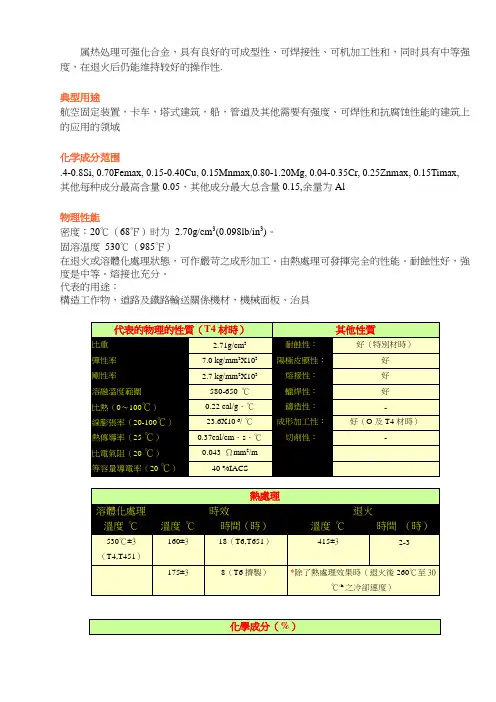
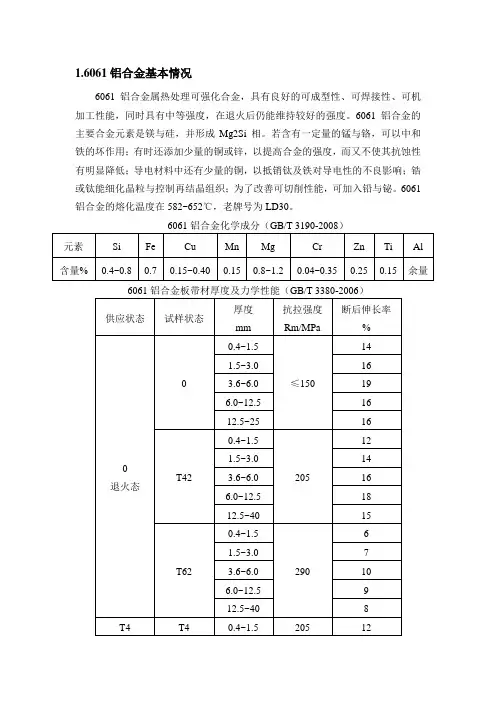
Brazing of 6061 aluminum alloy
- 格式:pdf
- 大小:2.03 MB
- 文档页数:7
Journal of Materials Processing Technology 212 (2012) 8–14Contents lists available at ScienceDirectJournal of Materials ProcessingTechnologyj o u r n a l h o m e p a g e :w w w.e l s e v i e r.c o m /l o c a t e /j m a t p r o t ecBrazing of 6061aluminum alloy/Ti–6Al–4V using Al–Si–Cu–Ge filler metalsS.Y.Chang a ,∗,L.C.Tsao b ,Y.H.Lei a ,S.M.Mao a ,C.H.Huang caDepartment of Mechanical Engineering,National Yunlin University of Science &Technology,64002Touliu,Yunlin,Taiwan bDepartment of Materials Engineering,National Pingtung University of Science &Technology,91201Neipu,Pingtung,Taiwan cMetal Industries Research &Development Centre,81160Kaohsiung,Taiwana r t i c l ei n f oArticle history:Received 7July 2010Received in revised form 6July 2011Accepted 27July 2011Available online 3 August 2011Keywords:BrazingAluminum alloys Ti–6Al–4VAl–Si–Cu–Ge alloys Rare-earth elementsa b s t r a c tAl–8.4Si–20Cu–10Ge and mixed rare-earth elements (Re)containing Al–8.4Si–20Cu–10Ge–0.1Re filler metals were used for brazing of 6061aluminum alloy/Ti–6Al–4V.The addition of 20wt.%copper and 10wt.%germanium into the Al–12Si filler metal lowered the solidus temperature from 586◦C to 489◦C and the liquidus temperature from 592◦C to 513◦C.The addition of 0.1wt.%rare-earth elements into Al–8.4Si–20Cu–10Ge alloy caused remarkable Al-rich phase refinement and trans-formed the needle-like Al 2Cu intermetallic compounds into block-like shapes.Shear strengths of the 6061aluminum alloy/Ti–6Al–4V joints with the two brazing filler metals,Al–8.4Si–20Cu–10Ge and Al–8.4Si–20Cu–10Ge–0.1Re,varied insignificantly with brazing periods of 10–60min.The average shear strength of the 6061aluminum alloy/Ti–6Al–4V joints brazed with Al–8.4Si–20Cu–10Ge at 530◦C was about 20MPa.Rare-earth elements appeared to improve the reaction of the Al–8.4Si–20Cu–10Ge filler metal with Ti–6Al–4V.The joint shear strength of the 6061aluminum alloy/Ti–6Al–4V with Al–8.4Si–20Cu–10Ge–0.1Re reached about 51MPa.© 2011 Elsevier B.V. All rights reserved.1.IntroductionDue to properties such as high-specific strength and good cor-rosion resistance,titanium alloys are widely used in aerospace and chemical industries.To use titanium alloys in many lightweight components,it is necessary to develop reliable joining techniques.Kahraman et al.(2007)indicated that the joining of titanium alloys with aluminum alloys could lead to lightweight structures with high strength,good corrosion resistance,and low cost.However,titanium and aluminum alloys are difficult to weld together due to the differences in the melting points and the coefficients of heat conductivity.In addition,Sohn et al.(2003)indicated that joints consisting of titanium alloys and aluminum alloys suffer from poor mechanical properties,the result of brittle intermetallic compounds and high residual stresses caused by the large dif-ference of thermal expansion coefficient in the fusion welding zone.Brazing with the Al–12Si filler metal has been recognized as a reliable method for joining aluminum components.How-ever,that traditional filler metal has a working temperature above 590◦C,so the brazing temperature is too high relative to the most commercial aluminum alloys.A series of low-melting-point filler metals for brazing aluminum alloys has been developed by adding copper,germanium,zinc,or tin into Al–Si alloys by Chang∗Corresponding author.Tel.:+88655342601x4148;fax:+88655312062.E-mail address:changsy@.tw (S.Y.Chang).et al.(2009),Jacobson et al.(1996),Tsao et al.(2002)and Chuang et al.(2000).Recently,it has been demonstrated by Shi et al.(2009)and Wang et al.(2003)that trace amounts of rare-earth elements in aluminum brazes promote the wetting of the filler metals on aluminum alloys and improve the joining strengths.This study employed two filler metals,Al–8.4Si–20Cu–10Ge and Al–8.4Si–20Cu–10Ge–0.1Re,which contains rare-earth elements,to join 6061Aluminum alloy/Ti–6Al–4V.The effects of rare-earth elements on the microstructure and melting temperature of the Al–8.4Si–20Cu–10Ge alloy were investigated.The influence of brazing duration on the joint reliability was carried out by measur-ing the joint shear strengths as well as characterizing the interfacial microstructures and fractography.2.ExperimentalThe chemical compositions of 6061aluminum alloy and Ti–6Al–4V used for joining,supplied by Tekstart Co.,Ltd.,Taiwan,were given in Tables 1and 2according to the data provided by the manufacturer.In a previous study,Chang et al.(2009)carried out that the solidus and liquidus temperatures of the 6061aluminum alloy used in this study were 592and 654◦C,respectively.The Al–8.4Si–20Cu–10Ge and Al–8.4Si–20Cu–10Ge–0.1Re filler metals were prepared by melting metals of 99.99%purity in a vac-uum arc furnace under a high-purity argon atmosphere.The mixed rare earth elements (Re)used in the study had a composition by mass of 77.82%La,16.84%Pr,3.24%Ce,and 2.10%Nd.In order to get0924-0136/$–see front matter © 2011 Elsevier B.V. All rights reserved.doi:10.1016/j.jmatprotec.2011.07.014S.Y.Chang et al./Journal of Materials Processing Technology 212 (2012) 8–149Table 1Chemical compositions of the 6061aluminum alloy used in the study.AlloyChemical composition (wt.%)AlSiCrCuMgMn 6061Aluminum alloyBal.0.610.120.25 1.10.01Table 2Chemical compositions of the Ti–6Al–4V used in the study.Alloy Chemical composition (wt.%)TiAlVNCHFeOYTi–6Al–4VBal.6.39 4.010.0120.0180.0020.160.150.001a homogenous composition within the filler metals,the alloys were remelted at least 3times.After the filler metal was solidified in a water-cooled copper mold,the cast ingots,20mm in diameter and about 40g in weight,were rolled into 0.2mm thick foil.The chemi-cal compositions and chemical distributions of the elements of the filler metals in the study were analyzed with an electron probe microanalyzer (EPMA).The microstructural observations of the filler metals were carried out with a field-emission scanning elec-tron microscope (FE-SEM,Philips XL40).The existing phases were identified using a Siemens D5000X-ray diffractometer with Mo K ␣radiation,scanning at a step size of 0.023◦and a step time of 2s.Dif-ferential thermal analysis (DTA)was used to determine the melting temperature of the filler metals at a heating rate of 10◦C/min under an argon atmosphere.The microhardness of the filler metal was measured with a Shimadzu microsclerometer (Shimadzu HMV-2),using Vickers diamond–pyramid indenters,a 50g load,and a load time of 10s.Average hardness values obtained from 5inden-tations were realized.The materials supplied for brazing were processed into plates with a size of 40mm ×6.5mm ×3mm for 6061aluminum alloy and 40mm ×6.5mm ×1mm for Ti–6Al–4V,respectively.6061Aluminum alloy and Ti–6Al–4V specimens were overlapped with an overlap length of 3mm.The geometry and dimensions of the brazing specimens subjected to shear testing are shown in Fig.1.A stainless steel fixture was used during braz-ing,as shown in Fig.2.Prior to brazing,both bonding surfaces and the surfaces of filler metals were ground with SiC paper down to grade 1200.The 200m thick foils of the filler metals werethenFig.1.Schematic representation of the brazed specimens for shear testing in thisstudy.Fig.2.Schematic representation of the geometry of the fixture in thetest.Fig.3.Microstructure of the Al–8.4Si–20Cu–10Ge filler metal.placed between the 6061aluminum and Ti–6Al–4V plate speci-mens.The brazing process was conducted in a vacuum furnace under a protective atmosphere of high-purity argon at 530◦C.After various brazing periods,the joining strengths were measured by shear testing,which was carried out using a tensile testing machine (Hung Ta Instrument HT-2402).In order to ascertain reproducibil-ity,at least two measurements were performed.Fractography of the joints was characterized by a field-emission scanning electron microscope (FE-SEM,Philips XL40)coupled to an energy dispersion X-ray (EDX).For the metallographic study of the joint interfaces,a set of the brazed specimens was cross-sectioned and analyzed with an electron probe microanalyzer (EPMA).Table 3Chemical compositions of the filler metals used in the study.Alloy Chemical composition (wt.%)AlSiCuGeLaPrAl–8.4Si–20Cu–10GeBal.8.2±0.120.1±0.39.6±0.2––Al–8.4Si–20Cu–10Ge–0.1ReBal.8.1±0.120.5±0.29.3±0.10.09±0.030.03±0.0210S.Y.Chang et al./Journal of Materials Processing Technology 212 (2012) 8–14Fig.4.Microstructure of the Al–8.4Si–20Cu–10Ge–0.1Re filler metal.3.Results and discussionThe chemical compositions of the filler metals in the study,as measured by electron probe microanalyzer (EPMA),are shown in Table 3.Except for La and Pr,the elements in the mixed rare earth elements were not measured due to the limit detection for EPMA.Average values and the standard deviation values of the contents of the filler metals were realized from 3measurements.Figs.3and 4show the microstructures of the Al–8.4Si–20Cu–10Ge and Al–8.4Si–20Cu–10Ge–0.1Re filler metals,respectively.The microstructures of both filler metals consisted of an Al-rich phase (dark),Al 2Cu intermetallic compounds (white),and some solid solution Si–Ge particles in the gray region.The EPMA analyses indi-cated that the composition of the Si–Ge solid solution phase was about Si:Ge =90:10at.%.The addition of small amount rare-earth elements into Al–8.4Si–20Cu–10Ge alloy may decrease surface tension and offer preferred sites for nucleation,thus producing remarkable Al-rich phase refinement.Moreover,the rare-earth elements may cause the transformation of the needle-like Al 2Cu particles into block-like shapes,as shown in Fig.4.The X-ray diffraction patterns for Al–8.4Si–20Cu–10Ge and Al–8.4Si–20Cu–10Ge–0.1Re filler metals are giveninFig.5.XRD analysis for the Al–8.4Si–20Cu–10Ge and Al–8.4Si–20Cu–10Ge–0.1Re fillermetals.Fig. 6.DTA curves of the Al–12Si,Al–9.6Si–20Cu,Al–8.4Si–20Cu–10Ge and Al–8.4Si–20Cu–10Ge–0.1Re fillermetals.Fig.7.Shear strengths of 6061aluminum alloy/Ti–6Al–4V joints after brazing with Al–8.4Si–20Cu–10Ge and Al–8.4Si–20Cu–10Ge–0.1Re filler metals.Fig.5.The results of the XRD analyses confirmed the phases observed in the microstructures of the Al–8.4Si–20Cu–10Ge and Al–8.4Si–20Cu–10Ge–0.1Re,which contained an Al-rich solid solu-tion,Si–Ge solid solution,and Al 2Cu intermetallic compounds.The Al–8.4Si–20Cu–10Ge and Al–8.4Si–20Cu–10Ge–0.1Re filler metals consisted of a large number of coarse clusters of Al 2Cu and some solid solution Si–Ge particles.Thus,the average hardness values from 5indentations of the filler metals were higher than that of the 6061aluminum substrate.The average hardness value of the 6061aluminum alloy was about 54±4Hv.The hardness values of the Al–8.4Si–20Cu–10Ge filler metal were 141±7Hv,much higher than that of the 6061aluminum substrate.The added rare earthTable 4Solidus,liquidus,and melting range of the Al–12Si,Al–9.6Si–20Cu,Al–8.4Si–20Cu–10Ge and Al–8.4Si–20Cu–10Ge–0.1Re filler metals.MaterialsSolidus (◦C)Liquidus (◦C)T (◦C)Al–12Si5865926Al–9.6Si–20Cu52353512Al–8.4Si–20Cu–10Ge48951324Al–8.4Si–20Cu–10Ge–0.1Re47951435S.Y.Chang et al./Journal of Materials Processing Technology212 (2012) 8–1411Fig.8.Micrographs of the6061aluminum alloy/Ti–6Al–4V joints after brazing with the Al–8.4Si–20Cu–10Gefiller metal at530◦C for(a)10min,(b)30min,and(c)60min.elements reduced the grain size of the Al–8.4Si–20Cu–10Ge alloy. Due to the fact that grain refinement can significantly increase yield strength and ultimate strength of metals,the hardness of the Al–8.4Si–20Cu–10Ge–0.1Re alloy,about154±18Hv,was higher than that of the Al–8.4Si–20Cu–10Ge alloy.Fig.6shows the differential thermal analysis(DTA)curves of the Al–12Si,Al–9.6Si–20Cu,Al–8.4Si–20Cu–10Ge,and Al–8.4Si–20Cu–10Ge–0.1Refiller metals.The solidus temper-atures(T S)and liquidus temperatures(T L)are marked by arrows in DTA traces.The solidus,liquidus,and melting ranges oftheFig.9.Micrographs of the6061aluminum alloy/Ti–6Al–4V joints after brazing with the Al–8.4Si–20Cu–10Ge–0.1Refiller metal at530◦C for(a)10min,(b)30min,and(c) 60min.12S.Y.Chang et al./Journal of Materials Processing Technology 212 (2012) 8–14Fig.10.Fractographs of the 6061aluminum alloy/Ti–6Al–4V joints bonded with Al–8.4Si–20Cu–10Ge filler metal at 530◦C:(a)the 6061aluminum alloy side for 10min brazing,(b)the 6061aluminum alloy side for 30min brazing,(c)the 6061aluminum alloy side for 60min brazing,(d)the Ti–6Al–4V side for 10min brazing,(e)the Ti–6Al–4V side for 30min brazing,and (f)the Ti–6Al–4V side for 60min brazing.filler metals,as determined by differential thermal analysis,are summarized in Table 4.The melting temperature range of Al–12Si alloy was from 586◦C to 592◦C.The addition of 20wt.%copper into the Al–12Si filler metal resulted in decreases of the solidus and liquidus temperatures of about 63and 57◦C,respectively.A further addition of 10%Ge to the ternary Al–Si–Cu alloy caused the solidus and liquidus to drop about 34and 22◦C,respectively.When the 0.1wt.%rare-earth elements was added into Al–8.4Si–20Cu–10Ge alloy,the solidus temperature decreased from 489◦C to 479◦C,while the liquidus temperature remained almost constant at 513◦C,as shown in Fig.6.The shear strengths of the 6061aluminum alloy/Ti–6Al–4V joints using Al–8.4Si–20Cu–10Ge and Al–8.4Si–20Cu–10Ge–0.1Re filler metals are given in Fig.7.The 6061aluminum alloy/Ti–6Al–4V joint possessed an average shear strength of about 23MPa after 10min of brazing,and one of about 17MPa and 20MPa after 30and 60min of brazing with Al–8.4Si–20Cu–10Ge filler metal at 530◦C,respectively.Joint strengths of the 6061aluminum alloy/Ti–6Al–4V brazed with rare-earth elements containing Al–8.4Si–20Cu–10Ge–0.1Re filler metal reached average shearstrengths of 49,55,and 48MPa after 10,30,and 60min of braz-ing at 530◦C,respectively.The test results indicated that adding the rare-earth elements to the filler metal remarkably increased the shear strengths of the 6061aluminum alloy/Ti–6Al–4V joints for various periods.The cross-sectional SEM micrograph of the 6061aluminum alloy/Ti–6Al–4V joints with Al–8.4Si–20Cu–10Ge filler metal after brazing at 530◦C for various periods are given in Fig.8a–c.A large number of coarse clusters of Al 2Cu and some solid solution Si–Ge particles can be seen embedded in the filler metal.Al 2Cu precipitated in the aluminum alloy after diffusion of the brazing alloy elements inward the aluminum alloy,notably Cu.The thickness of the Al 2Cu intermetallic compounds in 6061alu-minum alloy increased as brazing period increased.The precipitate width of the Al 2Cu into the 6061aluminum alloy reached 100m after brazing at 530◦C for 60min.A width of about 1–3m inter-metallic compound was found at the Al–8.4Si–20Cu–10Ge filler metal/Ti–6Al–4V interface.The EPMA analyses indicated that the composition of the reaction layer was Al:Si:Ti =13.7:55.4:30.9at.%,corresponding to a ternary intermetallic compound Al 5Si 12Ti 7phase as reported by Sohn et al.(2003).Short brazing periodsS.Y.Chang et al./Journal of Materials Processing Technology212 (2012) 8–1413Fig.11.Fractographs of the6061aluminum alloy joints bonded with Al–8.4Si–20Cu–10Ge–0.1Refiller metal at530◦C:(a)the6061aluminum alloy side for10min brazing, (b)the6061aluminum alloy side for30min brazing,(c)the6061aluminum alloy side for60min brazing,(d)the Ti–6Al–4V side for10min brazing,(e)the Ti–6Al–4V side for30min brazing,and(f)the Ti–6Al–4V side for60min brazing.leaded to an incomplete reaction layer between6061aluminum alloy and Ti6Al4V.Lower reproducibility was within the short braz-ing periods.The thickness of intermetallic compound Al5Si12Ti7 increased with increasing the brazing time.After brazing at530◦C, intermetallic compound Al5Si12Ti7was formed as a very thin layer between the aluminumfiller metals and Ti–6Al–4V.Hence, a detrimental effect due to embrittlement in coalescence of fay-ing surfaces did not cause any decrease in joint strength.About5% Cu can be dissolved in Al at the brazing temperature.So the Cu belonging to thefiller alloy diffused easily in the6061aluminum alloy.The solubility limit of Cu in Ti is less than1%.Moreover,the intermetallic compound layer Al5Si12Ti7acted as a diffusion barrier. Thus,the Cu diffused in the6061aluminum alloy and absolutely not in the Ti6Al4V.In general,the particle size of the Al2Cu and Al-rich phase tended to be large and block-like shapes in relation-ship to the brazing.In Fig.9,frames a–c show the microstructures of the interface of the6061aluminum alloy/Ti–6Al–4V joints with Al–8.4Si–20Cu–10Ge–0.1Refiller metal after brazing at530◦C for various periods.The rare-earth elements in thefiller metal lowered the energy of interfacial reaction,which caused the copper to pen-etrate easily into the6061aluminum alloy,forming a larger Al2Cu intermetallic compound layer.Moreover,the rare-earth elements promoted the reaction of Ti–6Al–4V with the aluminum alloyfiller metal.Hence,the ternary intermetallic compound Al5Si12Ti7phase with a width of about3–6m was found at the interface of the aluminum alloyfiller metal/Ti–6Al–4V.In Fig.10,frames a–c show the SEM fractographs of the6061 aluminum alloy surfaces of the6061aluminum alloy/Ti–6Al–4V joints brazed with Al–8.4Si–20Cu–10Ge for various periods,after shear tests.Frames d–f show the microstructures of the frac-ture surfaces on the Ti–6Al–4V side.The fractures exhibited on the surfaces of the6061aluminum alloy and Ti–6Al–4V speci-mens were covered with some Al5Si12Ti7intermetallic compound particles,which were identified by EPMA analysis,as shown by arrows in Figs.10and11.This indicates that the6061aluminum alloy/Ti–6Al–4V joints brazed with Al–8.4Si–20Cu–10Ge were frac-tured at the interface of the aluminumfiller metal/Ti–6Al–4V.The fractographs of the joints brazed with Al–8.4Si–20Cu–10Ge–0.1Re filler metal indicates that the fractured surfaces of both the6061 aluminum alloy and the Ti–6Al–4V specimens were covered with14S.Y.Chang et al./Journal of Materials Processing Technology212 (2012) 8–14Al5Si12Ti7intermetallic compound,as shown in Fig.11a–f.In con-trast,the fractograph of6061aluminum alloy/Ti–6Al–4V joints brazed with Al–8.4Si–20Cu–10Ge–0.1Re comprised mainly quasi-cleavage fractures.It is argued that the addition of rare-earth elements in thefiller metals raised the reaction offiller metals with Ti–6Al–4V and resulted in the increase in joining shear strength. The thickness of intermetallic compound Al5Si12Ti7increased with increasing the brazing time.After brazing at530◦C,intermetallic compound Al5Si12Ti7was formed as a very thin layer between the aluminumfiller metals and Ti–6Al–4V.Hence,a detrimental effect due to embrittlement in coalescence of faying surfaces did not cause any decrease in joint strength.4.ConclusionThe furnace brazing of6061aluminum alloy with Ti6Al4V was achieved at530◦C using the developed Al–8.4Si–20Cu–10Ge and Al–8.4Si–20Cu–10Ge–0.1Re low-melting-pointfiller metals. The addition of trace amounts of rare-earth elements to the alu-minumfiller can improve strength of6061aluminum alloy and Ti6Al4V brazed joints.The addition of20wt.%copper and10wt.% germanium into the Al–12Sifiller metal resulted in decreases of the solidus temperature from586◦C to489◦C and the liq-uidus temperature from592◦C to513◦C.The solidus temperature of Al–8.4Si–20Cu–10Ge alloy was reduced from489◦C to479◦C by adding0.1wt.%mixed rare-earth elements.The addition of 0.1wt.%rare-earth elements into Al–8.4Si–20Cu–10Ge alloy pro-duced remarkable Al-rich phase refinement and transformed the needle-like Al2Cu intermetallic compounds to block-like.Due to the grain refinement caused by the rare-earth elements, the hardness increased from141to154Hv.Moreover,rare-earth elements appear to have improved the reaction of the Al–8.4Si–20Cu–10Ge–0.1Refiller metal with Ti–6Al–4V.Al2Cu pre-cipitated in the aluminum alloy after diffusion of the brazing alloy elements inward the aluminum alloy,notably Cu.The thickness of the Al2Cu intermetallic compounds in6061aluminum alloy increased as brazing period increased.The rare-earth elements in thefiller metal lowered the energy of interfacial reaction,which caused the copper to penetrate easily into the6061aluminum alloy and promoted the reaction of Ti–6Al–4V with the aluminum alloyfiller metal.A ternary intermetallic compound Al5Si12Ti7 phase with a width of about3–6m was formed at the inter-face of aluminum alloyfiller metal/Ti–6Al–4V brazed with the Al–8.4Si–20Cu–10Ge–0.1Refiller metal.AcknowledgementSpecial thanks go to Metal Industries Research&Development Centre,Taiwan,for sponsoring this research.ReferencesChang,S.Y.,Tsao,L.C.,Li,T.Y.,Chuang,T.H.,2009.Joining6061aluminum alloy with Al–Si–Cufiller metals.Properties of aluminum brazed joints.J.Alloys Compd.408(1),174–180.Chuang,T.H.,Yeh,M.S.,Tsao,L.C.,Tsai,T.C.,Wu,C.S.,2000.Development of a low-melting-pointfiller metal for brazing aluminum alloys.Metall.Mater.Trans.A 31A(9),2239–2245.Jacobson,D.M.,Humpston,G.,Sangha,S.P.S.,1996.A new low-melting-point alu-minum braze.Weld.J.75(8),243s–250s.Kahraman,N.,Gulenc,B.,Findik,F.,2007.Corrosion and mechanical-microstructural aspects of dissimilar joints of Ti–6Al–4V and Al plates.Int.J.Impact Eng.34, 1423–1432.Shi,Y.,Yu,Y.,Li,Y.,Xia,Z.,Lei,Y.,Li,X.,Guo,F.,2009.Study on the microstructure and wettability of an Al–Cu–Si braze containing small amounts of rare earth erbium.J.Mater.Eng.Perform.18(3),278–281.Sohn,W.H.,Bong,H.H.,Hong,S.H.,2003.Microstructure and bonding mechanism of Al/Ti bonded joint using Al–10Si–1Mgfiller metal.Mater.Sci.Eng.A A355, 231–240.Tsao,L.C.,Weng,W.P.,Cheng,M.D.,Tsao,C.W.,Chuang,T.H.,2002.Brazeability of a 3003aluminum alloy with Al–Si–Cu-basedfiller metals.J.Mater.Eng.Perform.11(4),360–364.Wang,S.,Zhou,H.,Kang,Y.,2003.The influence of rare earth elements on microstruc-tures and properties of6061aluminum alloy vacuum-brazed joints.J.Alloys Compd.352,79–83.。