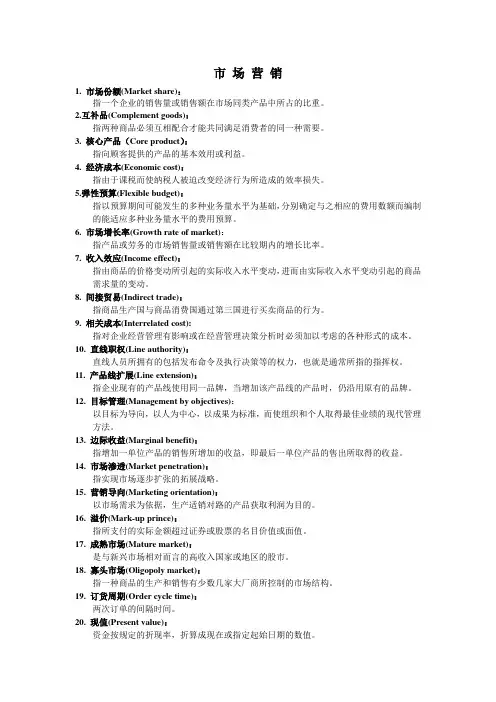
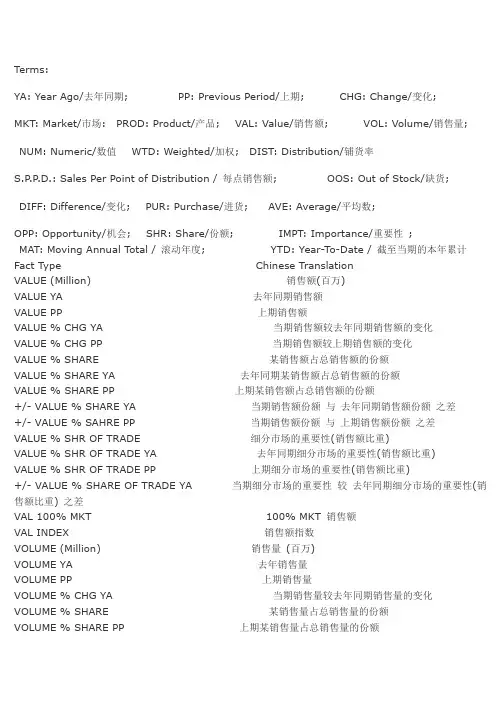
stock market terms
- 格式:pdf
- 大小:95.51 KB
- 文档页数:5
TCYONLINE
WE COACH THE NATION STOCK TERMS
A group The A group consists of 150 scrips in which carry forward (badla) facility is provided. Acid test ratio It is the ratio indicated by dividing a company's current assets to current liabilities. It reflects the financial strength of a company and hence called Acid test ratio. Also known as quick ratio. Active market Heavy volume for a specific share or the entire exchange. Annual report Audited document sent to the share holders at the end of each fiscal year reporting the financial results of the company. Asking price The lowest price at which someone is willing to sell a security. Also known as Offer. Assumed bond Bond which is issued by one company but whose liability is taken over by another company. B1 group This is also called as non-specified group and consists of good quality, high volume scrips. B2 group This is also called as non-specified group and these are low market captialisation, thinly traded stocks. Badla Carry Forward Trading. Bear market A bear market refers to a continuous phase of declining share prices. Bear markets are characterised by overall pessimism as market participants expect prices to decline in the future. Bid The highest price at which someone is willing to buy a security. Blue-chip The term 'Blue-chip' refers to stock of well-known companies with stable businesses. These shares are actively traded, as the company's growth prospects are considered good. Bonds They are loan instruments. A bond holder is the creditor of the company. Bonds are normally issued for a minimum period of three-years for a specific interest rate. Bonus shares Bonus shares are the shares given to share holders free of cost. Book building The process of securing the optimum price for a company's share. The issuing company decides the price of the security by asking investors how many shares and at what price they would be interested in. Book runner Institution that arranges and manages the book building process for the new public issue. Book value It is the value at which an asset is carried on a balance sheet. The book value of a share is obtained by dividing the equity reserves of the company by the number of shares issued.
TOP CAREERS & YOU
/topedge topedge@ +91-161-460-908,461-364
TCYONLINE
WE COACH THE NATION
Dividend Dividend is the amount of money or stock that a company distributes to its shareholders, in the ratio that they hold shares in the company. Equity Same as Stock. Ex dividend shares Ex dividend is the price of the share which does not contain dividend declared by the company. The buyer is not entitled to the dividend amount. Face value The nominal value printed on the face of the share, debenture or bond. Also known as Par Value. Forward trading Forward trading refers to trading where contracts traded today are settled at some future date at prices decided today. GDR (Global Depository Receipt) It is an instrument issued abroad, listed and traded on foreign stock markets. A GDR is convertible into shares, which are listed and traded on the domestic exchange, the dividend being paid in the domestic currency. IPO Initial Public Offer. It is the first offering of equity shares made by a company to the general public. Prior to the IPO the company's shares are held by a select group of people and are not available to the public. Liquidity Liquidity refers to the amount of transactions in a particular counter, the larger the volume of trading, higher the liquidity. Listed securities Securities listed on a stock exchange, as opposed to 'permitted securities', which are not listed but can be traded on the exchange. Lyon's Range Calcutta Stock Exchange. Market capitalisation Market Capitalisation is the total market value, at the current stock exchange list price multiplied by the total number of equity shares issued by a company. NASDAQ Short for National Association of Securities Dealer Automated Quotations system, a USbased computerised stock exchange designed to facilitate over-the-counter stock trading. Net worth It is the total of equity share capital and reserves. It is also the value of total assets minus total liabilities. Nifty Fifty selected stocks of National Stock Exchange. Non- convertible bonds Regular bonds are also called non-convertible bonds NSE National Stock Exchange.
WE COACH THE NATION STOCK TERMS
A group The A group consists of 150 scrips in which carry forward (badla) facility is provided. Acid test ratio It is the ratio indicated by dividing a company's current assets to current liabilities. It reflects the financial strength of a company and hence called Acid test ratio. Also known as quick ratio. Active market Heavy volume for a specific share or the entire exchange. Annual report Audited document sent to the share holders at the end of each fiscal year reporting the financial results of the company. Asking price The lowest price at which someone is willing to sell a security. Also known as Offer. Assumed bond Bond which is issued by one company but whose liability is taken over by another company. B1 group This is also called as non-specified group and consists of good quality, high volume scrips. B2 group This is also called as non-specified group and these are low market captialisation, thinly traded stocks. Badla Carry Forward Trading. Bear market A bear market refers to a continuous phase of declining share prices. Bear markets are characterised by overall pessimism as market participants expect prices to decline in the future. Bid The highest price at which someone is willing to buy a security. Blue-chip The term 'Blue-chip' refers to stock of well-known companies with stable businesses. These shares are actively traded, as the company's growth prospects are considered good. Bonds They are loan instruments. A bond holder is the creditor of the company. Bonds are normally issued for a minimum period of three-years for a specific interest rate. Bonus shares Bonus shares are the shares given to share holders free of cost. Book building The process of securing the optimum price for a company's share. The issuing company decides the price of the security by asking investors how many shares and at what price they would be interested in. Book runner Institution that arranges and manages the book building process for the new public issue. Book value It is the value at which an asset is carried on a balance sheet. The book value of a share is obtained by dividing the equity reserves of the company by the number of shares issued.
TOP CAREERS & YOU
/topedge topedge@ +91-161-460-908,461-364
TCYONLINE
WE COACH THE NATION
Dividend Dividend is the amount of money or stock that a company distributes to its shareholders, in the ratio that they hold shares in the company. Equity Same as Stock. Ex dividend shares Ex dividend is the price of the share which does not contain dividend declared by the company. The buyer is not entitled to the dividend amount. Face value The nominal value printed on the face of the share, debenture or bond. Also known as Par Value. Forward trading Forward trading refers to trading where contracts traded today are settled at some future date at prices decided today. GDR (Global Depository Receipt) It is an instrument issued abroad, listed and traded on foreign stock markets. A GDR is convertible into shares, which are listed and traded on the domestic exchange, the dividend being paid in the domestic currency. IPO Initial Public Offer. It is the first offering of equity shares made by a company to the general public. Prior to the IPO the company's shares are held by a select group of people and are not available to the public. Liquidity Liquidity refers to the amount of transactions in a particular counter, the larger the volume of trading, higher the liquidity. Listed securities Securities listed on a stock exchange, as opposed to 'permitted securities', which are not listed but can be traded on the exchange. Lyon's Range Calcutta Stock Exchange. Market capitalisation Market Capitalisation is the total market value, at the current stock exchange list price multiplied by the total number of equity shares issued by a company. NASDAQ Short for National Association of Securities Dealer Automated Quotations system, a USbased computerised stock exchange designed to facilitate over-the-counter stock trading. Net worth It is the total of equity share capital and reserves. It is also the value of total assets minus total liabilities. Nifty Fifty selected stocks of National Stock Exchange. Non- convertible bonds Regular bonds are also called non-convertible bonds NSE National Stock Exchange.