
汉语言学导论全解
- 格式:ppt
- 大小:501.00 KB
- 文档页数:88

《语言学导论》中文笔记语言学导论中文笔记(完整)什么是语言学?- 语言学是研究语言的科学- 研究语言的性质、结构和功能- 研究语言的发展、变化和使用语言学的分支1. 语音学: 研究语音的产生、传播和认知2. 词汇学: 研究单词的构成、意义和使用3. 句法学: 研究句子的结构和语法规则4. 语义学: 研究词语和句子的意义5. 语用学: 研究语言在特定情境中的使用方式语言的特点1. 语言是人类特有的沟通工具2. 语言具有拟态性,即能通过语言表达事物的形状、动作等特征3. 语言具有符号性,即语言中的单词和语法符号代表着特定的意义4. 语言是可以研究和教授的,通过语言能够传递文化和知识语言的功能1. 意指功能: 通过语言表达思想、情感和意图2. 表示功能: 通过语言描述和描绘事物、现象和过程3. 交际功能: 通过语言实现沟通和交流4. 记忆功能: 通过语言记录和传递信息5. 心理功能: 通过语言影响和塑造个体的心理活动语言与文化- 语言是文化的一部分,反映了社会和文化的价值观和观念- 不同的语言体现了不同的文化方式和思维方式- 语言的变化和发展与文化的变迁和演变相互关联语言的变化和发展- 语言是动态的,不断发展和变化- 语言变化的原因包括:社会文化变迁、语言接触和语言演化- 语言变化常常由语言使用者的创新和共同接受推动语言的使用- 语言使用涉及语言使用者的语法知识、语境理解和交际目的- 语言的使用方式受到社会、文化、地域等因素的影响- 语言的使用也受到个体因素和语言使用者之间的关系影响以上是《语言学导论》的简要笔记,介绍了语言学的定义、分支、特点、功能、与文化关系、变化和使用等方面的内容。
对于进一步学习语言学的人来说,这份笔记能够提供一个全面的概览,并为深入研究打下基础。

第一章语言和语言学一、什么是语言音义结合的符号系统,人类用于交际和思维的工具。
(一)符号1、含义符号就是人们约定的,代表某种事物的标记。
2、特点(1)符号都具有形式和内容两个方面。
内容即是符号所代表的意义,即“所指”;形式是可以为人的感觉器官感知到的外在形式,即“能指”。
(2)符号的内容和形式之间一般没有天然的联系。
3、分类(1)从符号的形式作用的感觉器官不同,可以分为听觉符号、视觉符号、触觉符号等。
(2)从符号的内容和形式之间有无联系上,可以把符号分为象征性符号和任意性符号。
语言是音义结合的听觉符号,形式是语音,内容是语义。
(二)语言符号的特点1、音义结合的任意性语言符号具有任意性,这是源于索绪尔的观点。
所谓任意性即音义结合的任意性。
什么样的声音表达什么样的意义完全是任意的。
它们之间没有本质的、必然的联系,也即是它们之间的结合是不可论证的,完全是由使用语言的社会成员约定俗成的。
我们这里所说的语言符号的任意性主要是就语言符号的单位语素、词来说的。
这也不是绝对的,各种语言中都有一些叹词和拟声词,这些词的音义之间有一定的联系。
但在不同的语言或方言里,同样的人的激情本能的反应和模拟事物的声音的词也是有差别的。
这些词可归入象征性符号。
但因为这些词在整个词汇系统中数量是非常有限的,所以语言中的词音义结合基本上都是任意的。
另外,语言规则的形成也有任意性。
汉语缺少形态变化,印欧语有丰富的词形变化等。
说不出道理。
这些都是使用语言的不同民族约定俗成的。
语言符号的任意性指的是音义(或内容和形式)之间没有必然的联系,因此不能把语言符号的任意性误解为人们可以随意改变语言符号的音义结合关系的随意性。
语言的音义结合一旦形成并进入交际以后,对于使用它的人来说就具有强制性。
2、线条性当符号与符号组合,形成更大的单位时,只能在一条线上延伸,不能在两维的面上或三维的立体空间里摆开。
(三)语言符号的系统性1、语言符号的层级性语言共分两层:底层和上层。
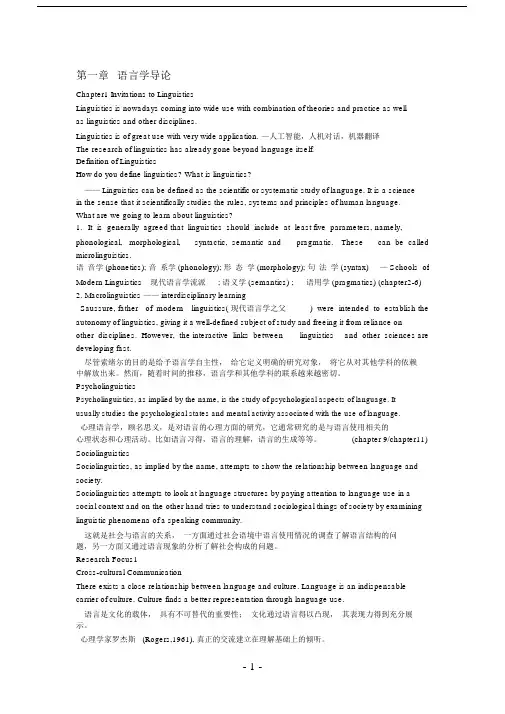
第一章语言学导论Chapter1 Invitations to LinguisticsLinguistics is nowadays coming into wide use with combination of theories and practice as wellas linguistics and other disciplines.Linguistics is of great use with very wide application. —人工智能,人机对话,机器翻译The research of linguistics has already gone beyond language itself.Definition of LinguisticsHow do you define linguistics? What is linguistics?—— Linguistics can be defined as the scientific or systematic study of language. It is a sciencein the sense that it scientifically studies the rules, systems and principles of human language.What are we going to learn about linguistics?1.It is generally agreed that linguistics should include at least five parameters, namely, phonological, morphological, syntactic, semantic and pragmatic. These can be called microlinguistics.语音学 (phonetics); 音系学 (phonology); 形态学 (morphology); 句法学 (syntax) — Schools of Modern Linguistics 现代语言学流派; 语义学 (semantics) ; 语用学 (pragmatics) (chapter2-6) 2. Macrolinguistics —— interdisciplinary learningSaussure, father of modern linguistics( 现代语言学之父) were intended to establish the autonomy of linguistics, giving it a well-defined subject of study and freeing it from reliance onother disciplines. However, the interactive links between linguistics and other sciences are developing fast.尽管索绪尔的目的是给予语言学自主性,给它定义明确的研究对象,将它从对其他学科的依赖中解放出来。

A-bar movement(A-棒儿移位)306 Ablaut(元音交替)164Abney, S.(人名,阿伯尼)360accent (see phrasal stress)(重读)accusative case (宾格)248, 251, 265–6, 356, 360–1accusative possessors in Child English(儿童英语中宾格性领属者)359–61accusative subjects(儿童英语中宾格性主语)in Child English355–8in infinitive clauses(非定式小句)251 acquired language disorders(获得性语言错乱)13, 213acquisition of language(语言的获得)(see also developmental linguistics(发展语言学)) 408acrolect(上层方言)234activation in psycholinguistics(心理语言学中的激活作用)202, 209active articulator(主动性发音器官)31 active voice(主动语态)137additions in speech errors(言语失误中的追加)115Adger, D. (人名,阿杰尔)267 adjacency pairs(邻接对)401adjectives(形容词)130comparative form of ((形容词)的比较级形式)130and derivational morphology((形容词)和派生形态学)144dimensional(程度(形容词))175–6, 177, 179incorporation((形容词)并入)161in language acquisition((语言习中的)形容词)187superlative form of (形容词的最高级)130adjuncts(附加语)249, 331adverbs(副词)130, 144Affected Object(蒙受性宾语)334–5affix(词缀)140Affix Attachment(词缀附接)273, 319 affricates(塞擦音)29African American Vernacular English (AA VE)(非裔美国人英语方言土语)agreement in(AAVE的一致关系)233, 237double negation in(AA VE的双重否定)297empty T in(AA VE中的空语类T)271–2 inversion in(AA VE中的倒装)311–13 possessives in(AA VE中的所有格或属格)237age and variation in language use(年龄与语言运用中的变异)235–6age-graded sociolinguistic variables(与年龄段相关的社会语言学变量)16Agent(施事)305, 333, 334–5 agglutinating languages(黏着语)156–7 agrammatism(语法缺失)(see also Broca’s aphasia(布洛卡失语症)) 214–17,377–82, 385, 408comprehension errors in(语法缺失中的理解错误)215, 216–17, 378–80production errors in(语法缺失中的发音错误)215–16, 378agreement (一致关系)135, 137, 144–5, 233, 248in AA VE(AA VE中的一致关系)233, 237 in complement clauses(补语小句中的一致关系)251in East Anglian English(东央格鲁英语中的一致关系)233in EME(EME中的一致关系)320 operations in syntax(句法中一致关系演算或操作)264–5, 267–8, 306, 345, 407in SLI(SLI中的一致关系)219, 385in south western English (东南部英语中的一致关系)233allomorphs(语素变体)152allomorphy(语素音位变化)151–2 lexically conditioned(词汇制约的语素音位变化)152phonologically conditioned(音系制约的语素音位变化)152, 220plural(复数的语素音位变化)188–9 third person singular present(第三人称单数现在时的语素音位变化)220allophones(音位变体)77allophonic variation(音位的变化)77 allophony(音位变化)77alternation in phonology(音系(学)中的交替)26, 83–5, 90, 152alveolars(齿龈音)30, 109 alveopalatals(齿龈硬腭音)(see palato-alveolars)ambiguity(歧义)(see also structural ambiguity(结构歧义)) 5, 232 amelioration in semantic change(语义变化中的改进现象)231American English(美国英语)55, 63, 71, 227 A-movement(论元移位)306Ancient Egyptian(古埃及人)119 Antecedent(先行语)277local for reflexives(约束反身代词的局部先行语)277–8anterior as phonological feature(作为音系特征的前部性)86, 413anticipations in speech errors(言语错失中的先兆)115, 117antonyms(反义词)176, 208, 209 antonymy(反义关系,反义现象)176, 177–8 aphasia(失语症)11–13, 213–19 selective impairment in(失语症中的缺陷或障碍选择性)213apophony (元音交替,元音弱化)(see ablaut) apparent-time method(视时方法后手段)16, 66approximant as phonological feature(无擦通音作为音系特征)412approximants(无擦通音)33in child phonology(儿童音系中的无擦通音)100–4Arabic (阿拉伯语)81, 224 arbitrariness of the linguistic sign(语言符号的任意性)205argument movement(论元移位)(see A-movement)arguments(论元)130, 247Armenian alphabet(亚美尼亚字母或文字)119Articles(冠词)( see also determiners(限定语)) 130, 133Ash, S. (人名,阿施)237aspect (体)252perfect(完成(体))252, 261 progressive(进行(体))252aspirated as phonological feature(送气作为音系特征)87, 413aspiration(送气音)35, 75–7, 87–90, 90–1 assimilation(同化现象)(see also harmony (和谐发音)) 5in Farsi (Farsi中的同化现象)49 partial(部分同化)100target of (同化对象)100total(整体同化)100trigger for(同化的触发者)100 audience design((面向受众的设计))53–4, 409Austin, J. L. (人名,奥斯汀)394 Australian English(澳大利亚英语)62, 64, 71, 227auxiliary copying in children(儿童语言中的助动词拷贝)295auxiliary inversion(助动词倒装)294–6 auxiliary verbs(助动词)133difficulties with in SLI(特定语言障碍中助动词使用上的困难)219, 385dummy(假性助动词)319errors in SLI (SLI中助动词的错失)385 as finite T(助动词作为定式的T)259, 261and gapping(助动词和空位)272 perfect (完成体)136progressive(进行体)136babbling(婴儿发出的咿哑声)96back as phonological feature(后部(音)作为音系特征)413backtracking in parsing(切分中的回溯法)373back vowels(后元音)36, 109–10Bailey(贝利), B. 313Bantu(班图语)156bare nominals(光杆名词性成分)284–5 in Child English(儿童英语中的光杆名词型成分)358–9base form of verbs(动词的基础形式/基式)147basic level of categorisation((范畴化的基本层级)194–6, 226, 232in Wernicke’s aphasia(维尼克失语症中范畴化的基本层级)217–18basilect(下层方言)235behaviourism(行为主义)115Belfast(贝尔法斯特)51Belfast English(贝尔法斯特英语)300Bell(贝尔), A. 53Bengali(孟加拉人(的),孟加拉语(的))71–2, 87Berko(拨库), J. 189Bidialectalism(双方言现象)409 Bilabials(双唇音)30Bilingualism(双语现象)409Binarity(二分性)of parametric values(参数值的二分性)314, 317, 320, 321, 325,349, 351of phonological features(音系特征的二分性)85blends(融合)207–8, 209in paragrammatism(语法倒错性言语障碍中融合现象)382Bloom(布龙姆), L. 355body of tongue (舌面)(see dorsum) borrowing(借用)224–5bound morphemes(粘着语素)140in aphasia (失语症者话语中的)216in SLI(特定语言损伤中的)219–21 bound variable interpretation of pronouns(约束代词阐释的变量)342–4bound word(粘着词)150Bradford(布莱德福德)47–8Braine, M.(人名)351Bresnan, J. (人名)246British English ( 英国英语see also Contemporary Standard English) 62 , 69 –70, 71,227–8, 230broad transcription(宽式标音)76 Broca, P. (人名)12Broca’s aphasia (布洛卡失语症see also agrammatism) 214– 17, 377–82 Broca’s area (布洛卡区)12Brown, R. (人名)189Bucholtz, M. (人名)51Bulgarian (保加利亚语)85calque(仿造,语义转借)225 Cambodian (柬埔寨语)38Canadian English (加拿大英语)227–8 Cantonese (广东话,粤语)79, 81Cardiff (加迪夫,地名)53Caribbean English(加勒比式英语)66 case (格see also genitive case(属格), nominative case(主格),objective case(宾格)) 248assignment of(格指派)264, 265–6, 267–8, 345, 356–8,360–1errors in agrammatism (语法缺失中的格错误)216errors in SLI(特定语言损伤中的格错误)385(拉丁语中的格)in Latin 158marking in Child English(儿童英语中的格标记)355–8structural(结构格)356in Turkish(土耳其语中格)158 categorical perception(范畴感知)113 causative verb(致使动词)274–5Celtic languages(凯饵特语族语言)164 central vowels(央元音)36centre-embedding(中心内嵌现象)370, 373–4cerebral cortex(大脑皮层)11cerebral hemispheres(大脑半球)11, 214 chain shift(链移)66–7Chambers, J. (人名)227child grammar(儿童语法)349–61child phonology(儿童音系)96–106 Cherokee(切罗基语)119Chicago(芝加哥)66Chinese (汉语)43, 119, 156, 224 Chomsky, N. (人名,乔姆斯基)1, 2, 7, 11, 213, 245–6, 314, 325, 377, 407Chukchee(楚克其人[语])160–1 circumfix (框架式词缀see confix)citation form(引用形式,基础形式,原形)134clauses(小句)247bare infinitive(光杆不定试小句)275–6 complement (小句补语)250–2, 275, 276 as CPs (充任CPs的小句)279, 280, 282, 283, 293, 304, 349, 356, 361declarative(陈述小句)279, 280finite in German SLI(德语SLI小句中的限定性)385finite verb in (小句中的限定动词)251, 265–6force of(小句的语力)279function of(小句的功能)253in German(德语中的小句)321–4 infinitive(不定式小句)275, 276–8 interrogative (疑问小句)279main(主要小句,主句)250, 280–1 non-finite verb in(小句中的非定式动词)251, 281–2v. phrases(小句和短语)261–2 relative(关系小句)253, 367in sentence perception(句子感知过程中的小句)367, 368tensed (v. untensed)(时态小句和非时态小句)251as TPs(小句作为TPs)273, 274, 275–6, 278click studies(点击调查)367–8 cliticisation(附着化)274–6and copies(附着化和拷贝)296, 298–9 clitics(附着成分)150–1in Spanish(西班牙语中的附着成分)151 cluster (see consonant cluster) 音丛(参见辅音丛)codas of syllables(音节的节尾(音))79–82 in child language(儿童语言中的节尾音)104–5cognitive effects of utterances(话语的认知效应)399cognitive synonymy(认知同义关系或现象)174–5cognitive system(认知系统)language as(语言作为认知系统)1–14, 409 coherence in discourse(语篇中的连贯)397 co-hyponyms(共存性下义词/下位词)172, 209in Wernicke’s aphasia(维尼克失语症中的共存性下义词)218co-indexing(同指标/同标引)341 Comanche(科曼奇族/语)225co-meronyms(共存性局部关系词)174, 208 comment (v. topic)(话题和评述/述题)249, 281Communicative Principle of Relevance(交际的关联原则)399–400communities of practice(实践社群)52 commutation test(接换测试)390 competence (v. performance)((语言能力)和语言行为/运用)2–3, 9, 264, 339, 367, 370, 375, 388, 408, 409complement(补语)130, 247–9, 262 covert(隐性补语)278interrogative expressions as(疑问表达式充任补语)297complementaries(互补性反义词)176 complementarity(互补性/关系)176, 177–8 complementary distribution(互补分布)76 complement clause(补语小句)250–2in German(德语中的补语小句)322 complement clause question(疑问型补语小句)299–300complement clause yes-no question(是非型疑问补语小句)303complementiser(标句词)135 declarative(陈述句的标句词)279 empty(空标句词)278–83, 284, 299 interrogative(疑问型标句词)279 complex sentence(复合句)250–3 compounds(复合词)148–50, 379, 408in language acquisition (语言习得中的复合词)191–2structural ambiguity in(复合词中的结构歧义)149synthetic(合成性复合词)162 comprehension of language (see sentence comprehension, speech perception)(语言理解(参见句子理解、言语感知))concatenative morphology(并置形态学)163 concept (v. lexical entry)(概念(和词条))205–6, 209, 225, 233confix(框架词缀/环缀)162 conjugation (接合)159consonants(辅音)28–35categorical perception of (辅音的类别感知)113syllabic(成音节性辅音)41three-term description of(辅音的三个方面的描写)34, 61in writing systems (书写系统中的辅音)119consonant change (辅音变化)61–4 consonant cluster (辅音丛)41deletion in(辅音丛中的删除现象)54–6 simplification in child language(儿童语言中的辅音丛简化现象)98consonant harmony(辅音和谐/辅音的协同发音)99consonant insertion(辅音插入)64 consonant loss(辅音丢失)63 consonant mutation(辅音变换)164–5 consonantal as phonological feature(作为音系特征的辅音性)412constituency tests(成分性测试)263–4 constituents(结构成分)249, 263–4 covert (see empty constituents)(隐性成分(参见空成分))in sentence comprehension(句子了解中的隐性成分)366constraints(限制(条件))in phonology (音系中的限制条件)90–1 in syntax (句法中的限制条件)263, 312–13, 318Contemporary Standard English (CSE) (当代标准英语)311questions in(CSE中的疑问句)311, 313, 316strong C in(CSE中的强C)314weak T in (CSE中的弱T)317, 319 content words (内容词、实词)132in aphasias (失语症中的内容词或实词)214–15 continuous perception of vowels(元音的连续性感知)110–11contour tone(轮廓调或曲折型声调)43 contrastive sounds(对立音)77control(控制)276clause(控制小句)277, 282–3verbs (控制动词)277conversation(会话)245, 388logic of(会话的逻辑)395–7 Conversational Analysis (CA)(会话分析)246, 401–2conversational implicature(会话涵义)397 conversational maxims(会话准则)396–7, 399, 409conversational particles(会话中的小品词)400conversion((词性)转换)143Co-operative Principle(合作原则)396co-ordinating conjunction(并列连词)134 co-ordination test(并列关系测试)263–4, 279–80, 283, 333copy (trace) of movement(移位拷贝(语迹))295, 298–9, 340in Child English(儿童英语中的移位拷贝)295in sentence perception(句子感知中的移位拷贝)368–70as variable(移位拷贝作为变量)341co-referential interpretation of pronouns(代词的同指阐释)342, 343coronal(前舌音/舌冠音)34count noun(可数名词)285Coupland, N. (人名)53covert movement (隐性移位)339, 343–5 covert question operator(隐性疑问算子)302–3, 324Crossover Principle(跨越原则)343–4C Strength Parameter(C强度参数)314 cumulation(堆积现象)158Cutler, A.(人名)207Czech(捷克(语))81data of linguistics(语言学语料/数据)1–2, 117, 170declarative(陈述句/式)253–4, 394–5 declension(形态变化,尤其指格变化)158–9, 160default cases in phonology(音系(学)中的缺省情况)90definitions(定义)179–81, 193deictic words(指示性词语)389, 398 delinking in child phonology(儿童音系中的链接解除现象)103demonstratives(指示语)133dentals(牙齿,齿音)31, 109 derivational morphology(派生形态学)131, 143, 144in compounds(复合词中的派生形态)150 in language acquisition(语言习得中的派生形态)190–2Derivational Theory of Complexity (DTC)(复杂性推导理论)367Derivations(派生(式),推导(式))in phonology(音系学中的推导(式))85 in syntax(句法中的推导(式))306 despecification in child phonology(儿童音系中的描写(式))103determiner phrase (DP)(限定词短语/词组)262, 283–7in Child English(儿童英语中的限定词词组)286determiners (see also articles) (限定词(参见冠词))133, 297empty(空限定词)283–7null in Child English (儿童英语中的空限定词)358as operators(限定词作为算子)297 prenominal(名词前的限定词)286–7 pronominal(代词性限定词)286–7 quantifying(量化限定词)284–5, 303in SLI (SLI中的限定词)219Detroit (底特律)52, 66developmental linguistics(发展论语言学)1, 6–9DhoLuo(卢奥语,东苏丹语族,尼罗语支)164diachronic method in historical linguistics(历史语言学中的历时方法)15–16 diacritic (附加符号)35dialect contact(方言接触)227dialects(方言)regional (地域方言)14rhotic(翘舌音方言)77rural (乡村方言)228social(社会方言)14urban(城市方言)228dictionaries(词典、辞书)179–81 diphthongisation in language change(语言变化中的双元音化)64diphthongs(双元音)38–9discourse markers(话语标记)15 discourses(话语)245discrimination experiment(辨别力实验)111 distinctive features(区别性特征)85, 412, 414in child phonology(儿童音系中的区别性特征)101distribution(分布)76dorsals(舌面音)34dorsum(舌背、舌面)31Do-support(Do支撑)274D-projections(D投射)287, 349drag chain(拉链)67dual-lexicon model of child phonology(音系学中的双词库模型)104–5Dutch(荷兰语)231Early Modern English (EME)(早期现代英语,初期现代英语)negation in(EME中的否定)314–20 null subjects in (EME中的空主语)319–20, 351, 352questions in(EME中的疑问句)316 strong T in(EME中的强T)317East Anglian English(东盎格鲁英语)63, 64–5echo question(回声问)297, 299 Eckert, P. (人名)51–2Economy Principle(经济原则)301–2, 314, 318–19, 324‘edge’ as target of movement (边缘位置作为移位的目的地)306education level and language use(教育水平和语言运用/使用)49Egyptian cuneiform(古埃及楔形文字)119 Eimas, P.(人名)96elision (省缺)4ellipsis(省略)278, 371Elsewhere Condition(另处原则)89–90 empty constituents (空成分)246, 271–86, 407, 408in psycholinguistics(心理语言学中的空成分)271in sentence perception(句子感知中的空成分)368–70enclitic(后附着)151entailment(衍推/蕴含)170–1, 392–3 environment (context) in phonological rules (音系规则中的环境(语境))87errors in speech (言语中的偏误/失误,口误)114–17, 199, 207–9Estonian(爱沙尼亚语)38ethnic group and language use(族群和语言运用/使用)49–50exchanges in speech errors (see also word exchanges) (言语失误中的换位现象(参见词的换位))11 4 –16, 11 7exclamative(感叹句,感叹式)254 exponent(体现)145, 152–3, 252, 259, 261 extended exponence(扩展了的体现)159 extraction site(提取部位)298Farsi (Persian) (波斯语(波斯语的))49 Fasold, R.(人名)272feature matrix (特征矩阵)86features(特征)distinctive in phonology(音系学中的区别性特征)86–90, 177functional in agrammatism(语法缺失中的功能性特征)380–2morphological(形态特征)153, 163 semantic(语义特征)176–9semantic in acquisition(习得中的语义特征)193filler-gap dependencies(填充词-空位依存性/关系)369–70finite (v. non-finite) verb forms(定式(非-定式)动词形式)251–3 finiteness in language acquisition (语言习得中的有定性)359–61Finnish (芬兰语)99, 156flap (闪音)34flapping(闪音化)61floating features(漂移特征)101–4, 106 flouting of conversational maxims(对会话准则的藐视)397, 399focus(焦点)282, 389–92position(位置)282focus bar(焦点棒儿)88Fodor, J. (人名)201form (v. lemma)(形式(和内容))in lexical entries(词条中的形式和内容)128, 205–7free morphemes (自由语素)140Frege, G. (人名)338, 339, 344French (法语)90–1, 215, 224, 225, 230 frequency effect(频率效应)in paraphasias(言语错乱中的频率效应)217, 218in substitution errors(替换语误中的频率效应)208fricatives(擦音)29, 31–3Frisian(弗里斯兰语)231Fromkin, V. (人名)207front vowels (前(部)元音)36, 109–10 functional categories(功能语类)132–5, 247, 385in aphasia(失语症中的功能语类)214–17, 378–82comprehension of in agrammatism (语法缺失中功能语类的理解)378–80in language acquisition(语言习得中的功能语类)187–8and pragmatic presupposition(功能语类和语用预设)393production of in agrammatism(语法缺失中功能语类的产生)378in SLI (SLI中的功能语类)219–21 function words(功能词)132gapping(功能词缺项)272garden-path sentences(花园幽径句)10, 370, 374, 408gender(性范畴)errors in agrammatism(语法缺失中的性范畴错误)380, 381–2errors in SLI(SLI中的性范畴错误)385 in Old English(古英语中的性范畴)233 gender and language use (性范畴和语言的使用/运用)49, 234generative grammar(生成语法)4, 245 generative phonology(生成音系学)97–8 generic interpretation(通指阐释)of determiners(限定词的通指阐释)284 genetic endowment and language(遗传本能与语言)7, 13–14, 188, 311and language disorders(遗传本能与语言错乱)213genitive case(领属格)248, 265, 267, 356, 360–1and possessors in Child English(儿童英语中的领属格和领有者)359–61Georgian alphabet(乔治亚字母表)119 German(德语)81, 162, 164, 206, 231, 321–4 clause structure in(德语中的小句结构)321–4movement in (德语中移位)322–3 operator questions in (德语中的算子疑问句)323–4SLI in(德语中的SLI)383–5strong C in finite clauses in(德语中的强C)323strong T in finite clauses in(德语中的强T)323yes-no questions in(德语中的是非问句)324Germanic (日耳曼语)164, 224, 231 Glides(滑音)33global aphasia(全局性失语症)11glottal fricative(声门擦音)33, 47 glottalisation(声门化)82glottal plosive (glottal stop) (声门爆破音(声门塞音))34Goal(目标/终点)334Gordon, P. (人名)192grammar of a language(一种语言的语法)2–6, 81, 83, 120, 238, 306, 345, 350, 407 grammatical categories(语法语类)247in acquisition(习得中的语法语类)186–8 in sentence comprehension(句子理解中的语法语类)200grammatical functions(语法功能)247–50, 262grammatical (morphosyntactic) word(语法(形态-句法)词)146, 159Greek (希腊语)160, 225Greek alphabet(希腊字母表)119 Grice, P. (人名)396–7, 398, 402 Grimshaw, J. (人名)302Grodzinsky, Y. (人名)380–2gutturals(侯音,腭音)78Halliday, M.(人名)97hard palate(硬腭)31harmony(和谐)consonant (辅音和谐)99lateral(边音和谐)101–4velar(软腭音和谐)99, 101vowel(元音和谐)99–100Hawaiian(夏威夷语)81Head(核心成分)of compounds(复合词的核心)148of phrases(短语或词组的核心)257–61 head-driven phrase structure grammar(核心驱动短语结构语法)246head first word order(核心在首的词序)321, 350head last word order(核心在尾的词序)321 head movement(核心移位)293–6, 298, 306 Head Movement Constraint (HMC)(核心移位限制)318, 324Head Position Parameter(核心位置参数)321, 349, 350–1, 361Head Strength Parameter(核心强度参数)314Hebrew(希伯莱语)215, 380, 381 Henry, A. (人名)300high as phonological feature(高舌位作为音系特征)413high vowels(高元音)36, 109–10 historical linguistics(历史语言学)15–16 Hoekstra, T. (人名)373Holmes, J. (人名)49host for clitic(附着形式的宿主)151 Hungarian(西班牙语)38, 99, 156, 224, 267, 360Hyams, N. (人名)351–2, 359–61 Hyponyms(下位词)172in Wernicke’s aphasia(维尼克失语症中的下位词)218hyponymy(上下位关系)170–3, 177, 178, 194Icelandic(冰岛语)230Idealisation(理想化)409identification experiment(鉴别/识别实验)110–11, 112identification of null subject(空主语的识别)320, 352identity of meaning (see synonymy)(意义的同一性(参见同义关系))imaging techniques (成像技术)13 imperative (祈使句/式)254, 394–5 implicational scale(含义等级)55–6 implicit (understood) subject(隐性(理解出来的)主语)277, 351incomplete phrase(未完成短语/词组)261–2 incorporation(并入)160–1 independence of language faculty(语言能力的独立性)11, 377indirect speech acts(间接言语行为)394–5 inferences in conversation(会话中的推理)400infinite nature of language(语言的无限性)3–4, 260infinitive(不定式)134infinitive particle(不定式小品词)259–60 as non-finite T(不定式作为非有定的T)259 infinitive phrase (不定式短语/词组)259 infix(中缀)163INFL as grammatical category(屈折语素作为语法的语类)261inflection (屈折)143in English(英语中的屈折)137in grammar(语法中的屈折)136 inflectional categories(屈折语类)136as deictic(屈折语类终于哦为指示语)389 inflectional errors(屈折错误)in agrammatism (语法缺失中的屈折错误)378in SLI(SLI中的屈折错误)219–21, 385 inflectional formative(屈折的构成)145 inflectional languages(屈折语)156, 158–9, 160inflectional morphology(屈折形态学)143, 144–8in compounds (复合词中的屈折形态学)150in language acquisition(语言习得中的曲折形态学)187, 188–92inflectional paradigms in aphasia(失语症中的屈折变化表)216inflectional properties(屈折特征)137 inflectional rules (see morphological processes)(屈折规则)(参见形态过程)inflectional systems (屈折系统)156 informational encapsulation(信息封装)201 ‘information’ i n categories(语类中的信息)195–6information structure(信息结构)390–1 innateness hypothesis(内在性假说)7, 11, 213, 349–50, 361, 408input representations in child phonology (儿童音系中的输入表达式)103–6 Instrument(工具/用事)333interaction and variation(互动和变异)54 interdentals (齿间音)31interrogative(疑问(句))253–4, 394–5 interrogative complement(疑问性补语)299–300, 303interrogative interpretation(疑问句阐释)300–2, 341interrogative operator(疑问算子)302–3 intonation(语调)43–4intonational change (语调变化)71–2Inuit(因纽特语)119inversion(倒置、倒装)in questions(疑问句中的倒置现象)294–6, 300, 316, 322in varieties of English(英语变异中的倒置)311–14IPA (International Phonetic Association)(国际语音学会)27–44, 411Irish Gaelic (爱尔兰盖尔语)225Irony(反语)397Iroquoian(伊洛魁语的)161isolating languages(孤立语)156, 157 Italian(意大利语)214, 224, 230, 380 aphasic speech in(意大利语中的失语症者的言语)215, 380, 381–2Jamaican Vernacular English (JVE)(牙买加英语土语)313–14weak C in(牙买加英语土语中的弱C)314Japanese(日语)38, 78, 81, 160topic marking in(日语中的话题)391–2 Jones, D. (人名)27labelled bracketing(带标签的加方括弧法)141, 258labelled tree diagram(带标签的树形图)141–2, 258labials(唇音)34labiodentals(唇齿音)31Labov, W. (人名)16, 56, 57–8, 66–7, 68, 70 language contact(语言接触)227 language change(语言变化)15–16, 56–8, 61–72language disorders(语言错乱)11–14, 408 Language Faculty(语言官能)7–9, 280, 349–50language games(语言游戏)117 language shift(语言变换)15language use(语言运用)and the structure of society(语言运用与社会结构)14–16language variation(语言变异)15 laryngeal fricative (see glottal fricative)(喉擦音(参见声门擦音))larynx(喉)28Lashley, K.(人名)116–17lateral as phonological feature(边音作为音系特征)413lateral harmony(边音和谐)101–4 laterals(边音)33in child phonology(儿童音系中的边音)100–4Latin(拉丁语)157–60, 165, 224, 225, 391 Latin alphabet (拉丁语字母(表))119lax vowels(松元音)38, 77lemma(词条的内容)205–7retrieval of(词条内容的恢复)207–9 lesions of the brain(大脑的损伤)11 levels of linguistic analysis(语言分析的层次/级)76–7, 78, 106, 120Levelt, P.(人名)205level tones(直线调,水平调)43lexeme (词位)143–4, 145, 146, 205 lexical attrition(词汇磨损)228lexical categories(词汇语类)129–32, 247 lexical diffusion(词汇扩散)68–70lexical entry(词条)4, 78, 128, 129, 131, 138, 147–8, 152, 170, 176–8, 191–2, 219–20, 238, 287, 335, 407v. concept(词条和概念)205, 225 lexical functional grammar (词汇功能语法)245lexical gap(词汇空缺)174lexical learning(词汇学习)349lexical recognition(词汇认知)201–3, 207–9 lexical stress (see word stress)(词汇重音)(参见词重音)lexical substitutions in speech errors(语误中的词汇替换)207lexical tone(词调)43lexical verbs(词汇性动词)133lexicon(词库)4, 128, 131, 137–8, 147–8, 170–6, 199, 203, 217–18, 238, 345, 354, 407 grammatical properties in(词库中的语法特征)4, 147phonological properties in(词库中的音系特征)4, 147psycholinguistics and(心理语言学和词库)204–10semantic properties in (语义特征)4, 147 LF component of a grammar(语法的LF部分)5, 407Linear B(线性B)119linguistically determined variation(由语言决定着的变异,语言性质的变异)54–6linguistic experience of the child(儿童的语言经验)7–8linguistic variables and language use (语言的可变性和语言应用)47–58Linking Rules(链接规则)335Liquids(流音)33Literary Welsh (威尔士文学语言)164–5 Litotes(间接肯定法)397Liverpool(利物浦)63local attachment preferences(局部附加优势)372–3localisation of brain function(大脑功能的侧化)11–13Location(处所,位置)334Logical Form (LF) (逻辑形式)5, 246, 330, 339–45, 407logical object (逻辑宾语)5logical subject(逻辑主语)5, 374logic of conversation(会话逻辑)395–7 London(伦敦)65long vowels(长元音)37–8low as phonological feature(低舌位作为音系特征)413low vowels(低元音)36, 109–10 McMahon, A. (人名)232–3McNeill, D. (人名)286Malay(马来语)224Manner, Maxim of(方式,方式准则)397 manner of articulation(发音方式)29–30, 33 and language change(发音方式和语音变化)62–3Maori(毛利语)161, 225Maximal Onset Principle(首音最大化原则)82Meaning(意义)in sentence perception(句子感知中的意义)200meaning inclusion ( see also hyponymy) (意义包含(参见上下位关系))172, 178 meaning opposites(意义对立)175–6 memory for syntax(句法记忆)366 merger(合并)257–62, 306, 345, 407 constraints on (合并的条件限制)264 meronyms(部分关系词)174 meronymy(整体-部分关系)173–4, 208 metalanguage(元语言)336–7, 339 Meyerhoff, M. (人名)51mid closed vowels(中闭元音/半闭元音)38 Middle English(中古英语)231mid open vowels(中开元音/半开元音)38 mid vowels(中元音)36Milroy, J.(人名)51Milroy, L.(人名)51minimal pair(最小比对)75–6minimal responses(小型应对语)15 modifiers in compounds(复合词中的修饰语)148monophthongisation(单元音化)64–5 monophthongs(单元音)38 monosyllabic words(单音节词)41mood and speech acts(语气和言语行为)394–5morphemes(语素)140–3in aphasia(失语症中的语素)214–17 bound(粘着语素)140free(自由语素)140as minimal linguistic sign (语素作为最小的语言符号)140, 145morphological change(形态变化)233–7 morphological development in children (儿童的形态发展)188–92morphological irregularity (形态的不规则性)137morphological operations(形态操作)162–5 morphological processes(形态过程)140–50, 157–65, 407dissociation of in SLI(SLI中的形态的分离)219–20as features(形态作为特征)153 phonological conditioning of(形态的音系限制)152, 220realisations of(形态的实现)152 voicing as(浊化作为形态)164vowel change as(作为形态的元音变化)163–4morphological properties in sentence perception (句子感知中的形态特征)200 morphological variation(形态变异)233–7social contact and (社会接触和形态变异)237morphology(形态学)140, 165 phonological processes in(形态学中的音系过程)162–5morphs(形素)152motor control (运动神经控制)109, 113 movement in syntax (句法中的移位)246, 293–306, 340covert(句法中的隐性移位)345, 407in German(德语中句法移位)322–3 overt(显性句法移位)345, 407in sentence comprehension(句子理解过程中的句法移位)366Myhill, J. (人名)237Nahuatl (那瓦特语)161, 224narrow transcription(严式音标)77nasal as phonological feature(鼻音作为音系特征)85, 412nasalisation(鼻音化)40–1nasals(鼻,鼻音)30native speakers as sources of data(母语者作为语言数据的来源)1natural classes in phonology(音系中的自然类)88–9Navajo(纳瓦霍语)83, 160Negation(否定)133in Child English(儿童英语中的否定)104 in CSE(CSE中的否定)312, 314–20in EME(EME中的否定)314–20 negative concord in AA VE(AA VE中的否定一致)312negative operator(否定算子)297 Neogrammarians(新语法学派学者)68 Neurolinguistics(神经语言学)1, 11–14 neutral context in lexical decision task(词汇确定任务中的中性语境)202new (v. old) information(新信息和旧信息)390New York(纽约)57New Zealand English(新西兰英语)66, 71–2, 227, 230nodes in tree diagrams(树形图中的节点)258 nominal phrases(名词性短语/词组)in Child English(儿童英语中的名词性词组或短语)358–61as D-projections(名词性短语或词组作为D投射)286, 287, 349, 358, 361 nominative case(主格)248, 251, 265–6, 356, 360in AA VE(AA VE中的主格)272 nominative subjects in Child English(儿童语言中的主格主语)355–8noun incorporation(名词并入)161nouns(名词)129–30and derivational morphology(名词和派生形态学)144in language acquisition(语言习得中的名词)186, 192–6and person(名词和人称)135in taxonomies(分析体系中的名词)173 non-concatenative morphology(非并置形态学)165non-count nouns(非复数名词)285non-finite clauses(非定式小句)in Child English(儿童英语中的非定式小句)353–61non-finite (v. finite) verb forms(非定式(和定式)动词形式)251–3in German SLI(德语SLI中的非定式动词形式)384–5non-rhotic dialects(非翘舌音方言)37–8, 57 non-standard dialects(非标准方言)15 non-words(非词)perception of (非词的感知)206–7 Norfolk(诺福克)66, 228Northern Cities Chain Shift(北城市链移)66–7, 68Northern English(北部英语)65, 69 Norwich(诺威奇)49, 235nucleus of syllable(音节的节核)41, 79 null constituents (see empty constituents)(空结构成分(参见空成分))null determiners(空限定词)283–7in Child English(儿童英语中的空限定词)358null infinitive particle(空不定式小品词)275null operator questions in Child English(儿童英语中的空疑问算子)352null subject language (空主语语言)320, 351 null subject parameter(空主语参数)319–20, 349, 352, 353, 361null subjects(空主语)in Child English(儿童英语中的空主语)352in Child Italian(儿童意大利语中的空主语)353identification of(空主语的识别)320, 352 in Japanese(日语中的空主语)392in non-finite clauses(非定式小句中的空主语)353–61in wh-questions(wh-疑问句中的空主语)353–4number(数)134errors in agrammatism(语法缺失中的数范畴错误)380errors in SLI(SLI中的数范畴错误)219 object(宾语)137objective case (see also accusative case)(宾格)248object language(对象语言)336–7, 339 obstruents(阻塞音)34, 79Old English(古英语)230, 231, 232, 233, 236Old French (古法语)229, 231old (v. new) information(旧信息)390Old Norse(古斯堪的那维亚语)230 omissions in speech errors(言语失误中的省减现象)115onsets of syllables(音节的首音)79–82in child language(儿童语言中的节首音)104in poetic systems(艺术表达手段系统中的节首音)118in speech errors(言语失误中的节首音)115operator expressions(算子表达)297, 340 in German(德语中的算子表达)323 operator movement(算子移位)297–302, 304, 306Optimality Theory(优选论)90–1 Optional Infinitive (OI) stage(不定式选择性使用阶段)357–8orthographic representation(规范书写法,正字法表示法)84orthography ( see also writing systems) (正字法(参见书写系统))27output representations in child phonology (儿童音系中的输出表达式)103–6 overextension in children’s word use(儿童词语运用中的泛化现象)192–3, 232 overregularisation(过渡规则化)lack of in SLI(SLI中过渡规则化的缺乏)220in morphological development(形态发展中的过渡规则化)190palatals(腭音,舌面中音)31palato-alveolars(舌面-齿龈音)31 paragrammatism(语法倒错型言语障碍)377, 382–3, 385parallel-interactive processing models (平行-交互式处理模式)199–204parameters(参数0 314–24in language acquisition(语言习得中的参数)349–54parameter setting(参数设定)350–4 parametric variation(参数变异)314–24 paraphasia(语言错乱)214–15, 217–19 parser(语法分析器)9, 372–5locality and(局部性和语法分析器)373–5 parsing(句法分析)366partitive interpretation of determiners(限定词的部分释义)284, 303part–whole relationship (see meronymy)(部分-整体关系(参见整体-部分关系))passive articulator(被动发音体)31 passive construction(被动结构)304–5 passive participle(被动分词)137, 146, 148 in German(德语中的被动分词)162 passive voice(被动语态)137, 146, 305 passivisation(被动化)306past participle(过去分词)136past tense morpheme in acquisition(习得过程中的过去时语素)189–90Patient (see Affected Object)(受事(参见受。