译林牛津英语8B Unit 7重点短语及重要句型
- 格式:docx
- 大小:1.86 MB
- 文档页数:7
译林牛津英语8B Unit 7重点短语及重要句型
第 2 页 译林牛津英语8B
Unit 7 International charities重点短语及重要句型
【重点短语】
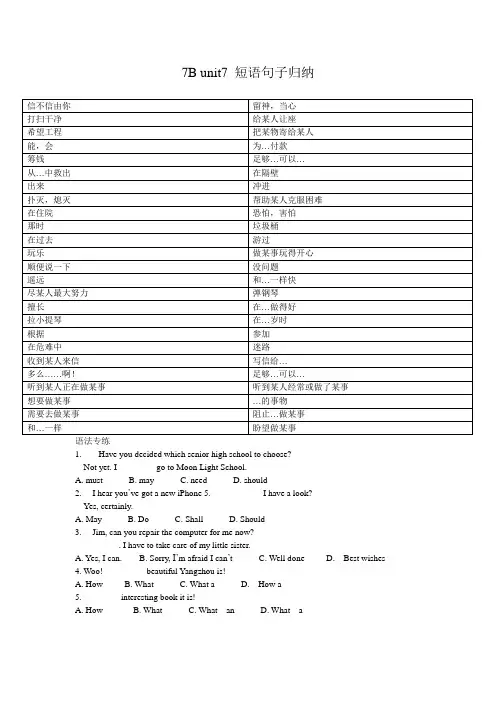
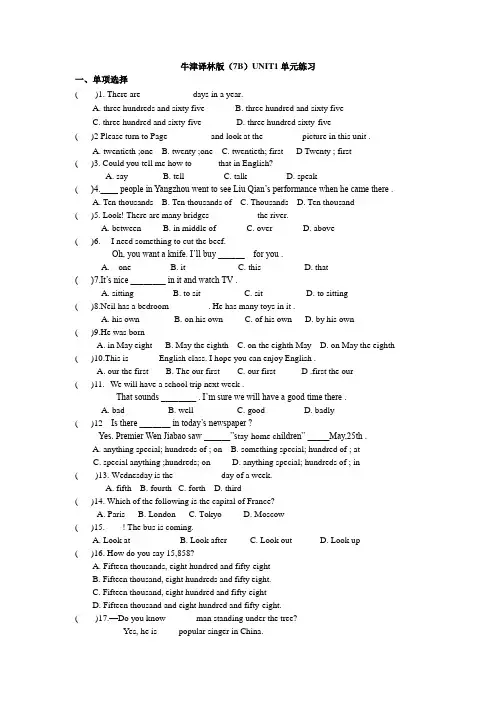
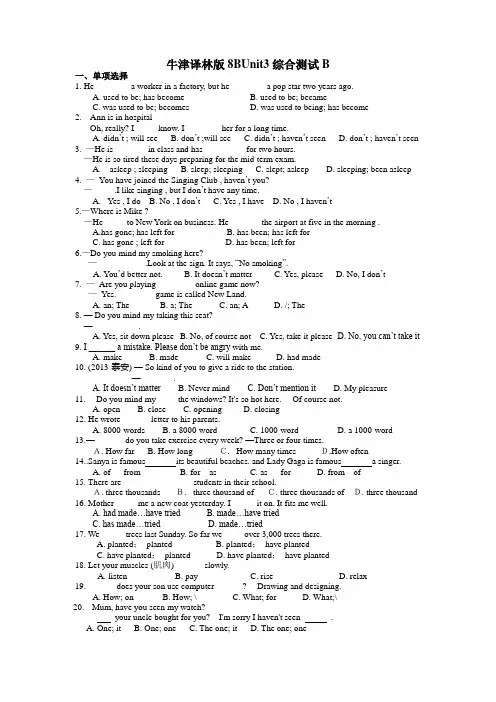
1.international charities 国际慈善机构
2.have some pocket money left还剩些零花钱
3.be used to going out before lunch 习惯于午饭前出去
4.be used to be kind to somebody 习惯于对某人友好
5. so … that 如此…… 以至于……
6.can′t walk any further 不能走远
7.next to the Oxfam shop 紧挨着乐施会商店
8. First->then -> afterwards ->finally 首先->其次 ->后来 ->最后
9.ORBIS奥比斯
10.Oxfam乐施会
11.UNICEF联合国儿童基金会
12.World Vision世界宣明会
13.World Wide Fund for Nature世界自然基金会
14.the most/least important最(不)重要
15.health care 保健
16.mostly in poor countries主要在贫穷国家
17.80 percent 百分之八十
18.be cured or prevented被治愈或挽救
19.cure somebody/cure of +病 治愈某人/ 病
20.have the money for medical treatment 有钱进行药物治疗
e a flying eye hospital to visit poor countries 用飞行眼科医院到各贫穷国家去
22.Perform operations 做手术 (on somebody for +病)
第 3 页
第 4 页 49.be far away from …远离
50.the long working hours 长的工作时间
51.the unusual lifestyle 不寻常的生活方式
52.feel sick on a bus/ on a plane / on a ship 晕车、机、船
53.such …that… 如此……以至于……
54.an operation can be a long process手术可能是长的过程
55.make a donation 募捐
56.do some voluntary work 做志愿工作
57.United Nations 联合国
58.be set up in成立(被动语态)
59.try to save some money for charities 试图为慈善节约一些钱
60.ought to do something /should do something (就)应该做某事
61.instead of…代替 ,而不是
62.care about…关心,惦念
63.hope to have a job like Mary′s 希望有一个玛丽一样的工作
64.finish school 毕业
65.go back to school /return to school 返回学校
66.train as a nurse 训练成为一个护士
67.congratulations to somebody on something/congratulate somebody on something 祝贺某人某事
68.get good grades on…在……方面得到高分
69. remember to do sth. 记得要做某事 remember doing sth. 记得做过某事
used to do sth 过去经常做某事(现在不做了) 否定形式: didn’t use ,或 usedn’t 但反意疑问句用didn’t
70.so & such
so: a. so +adj. +a/an +可数n 单数
b. so + adj./adv.
第 5 页 c. so many/much/few/little + n.
such : a. such+ a/an +adj. +可数n 单数
b. such +adj. +可数n复数
c. such +adj. + 不可数n
【重要句型】
1. It also works to prevent the spread of some serious diseases, like AIDS, among young
people.(P93)
原句意为:它也可以防止—些严重疾病在年轻人中传播,像艾滋病。这里的prevent是及物动词,意为“防止,阻止,预防”,其后可接名词、代词或动词-i ng形式作宾语,也可接复合宾语,它常与介词from连用,即prevent... from...,相当于stop... from...,keep...from ...,其中from可以省略。但keep... from...中的from不能省略。如:
We must do something to prevent him from playing computer games.
我们必须做些事情来阻止他玩电脑游戏。
2 .The plane is used as a training centre.(P98)
原句意为:飞机被用作培训中心。句中的be used as...意为“被用作……”。如:
English is used as a second language in many countries.
在许多国家,英语被用作第二语言。
另外,be used for...意为“被用来……”,有时可以与be used to do sth.互换。如:
A knife is used for cutting things.
= A knife is used to cut things.
小刀是用来切割东西的。
be used by...意为“被……所使用”。如:
Chinese is used by more and more foreigners.
汉语被越来越多的外国人使用。
be used in...意为“被用于……方面”。如:
I hope that the money is used in medical research.
我希望这些钱用在医学研究上。
be used to doing sth.意为“习惯于做某事”。如:
My father is used to getting up early.
第 6 页 我爸爸习惯于早起。
used to do sth.意为“过去常常做某事”。如:
Tom used to be late for school.
汤姆过去常常上学迟到。
3. I kept asking myself. ( P103 )
原句意为:……我—直在问我自己。keep doing sth.为固定结构,意为“持续做某事,不停做某事”。如:
He kept nodding when he listened to me.
他听我说的时候,不断地点头。
keep sth.意为“保存/保管某物”;keep sb. doing sth.意为“使某人—直做某事”;keep
sb./sth.+宾语补足语(形容词或介词短语等),意为“使某人/某物保持某种状态”。如:
You can keep that book, because I don't need it.
你可以留下那本书,因为我不用。
You shouldn't keep them waiting outside.
你不该让他们—直在外面等。
You must keep the baby warm.
不要让孩子冻着。
4. I could not sleep at all that night because I was so excited. ( P103)
原句意为:那天晚上,我根本没睡着,因为我太兴奋了。句中的not...at all意为“—点也不,根本不”。其中not通常与主语后面的be动词、情态动词或助动词do,does或did等连用,构成缩写形式。如:
He isn't good at swimming at all.
他—点也不擅长游泳。
I can't sing at all.
我根本不会唱歌。
He doesn't want to stay here at all.
他根本不想待在这里。
Not at all.意为“不客气,不用谢”,相当于You're welcome.。如:
—Thank you for helping me with my homework.
第 7 页 谢谢你帮我做家庭作业。
—Not at all.不用谢。
5. She is getting used to travelling by plane.(P104)
原句意为:她正习惯于乘飞机来往各地。这里的get used to doing sth.意为“习惯于做某事”,相当于be used to doing sth.。如:
My father gets used to going to work on foot.
我爸爸习惯于步行去上班。
辨析:be/get used to doing sth,used to do sth.与be used to do sth.。
be/get used to doing sth.意为“习惯于做某事”。如:
His father is used to watching TV before going to bed.
他爸爸习惯于睡觉前看电视。
used to do sth.意为“过去常常做某事”。如:
The boy used to play computer games.
这个男孩过去经常玩电脑游戏。
be used to do sth.意为“被用来做某事”。如:
More and more wood is used to make paper.
越来越多的木材被用来造纸。