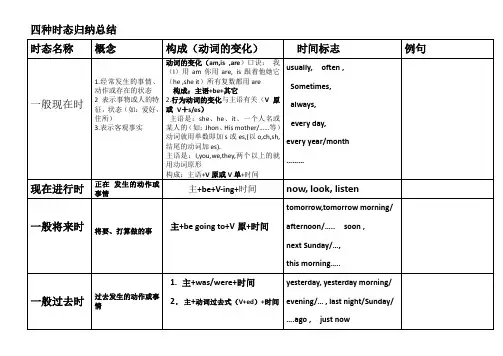
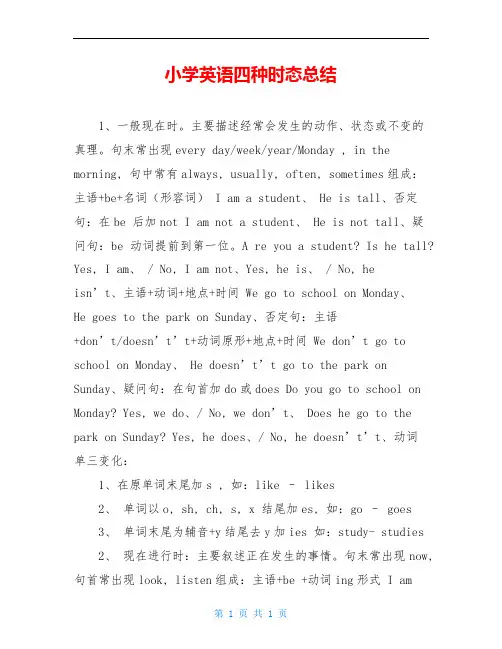
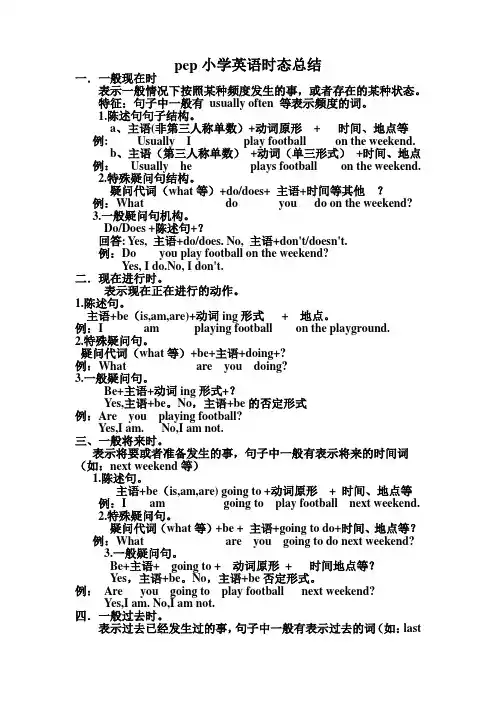
小学英语四种时态表格式总结及讲义
- 格式:docx
- 大小:393.34 KB
- 文档页数:28
小学英语四种时态表格式总结及讲义
二〇二二 年
小学英语四种时态表格总结及讲义
2
目 录
一般现在时 ...................................................................... 3
一、知识整合 ................................................................ 3
二、句型转换 ................................................................ 4
三、同步练习 ................................................................ 5
现在进行时 ...................................................................... 6
一、知识整合 ................................................................ 6
二、同步练习 ................................................................ 6
三、巩固练习 ................................................................ 7
四、课后作业 ................................................................ 9
五、参考答案 ............................................................... 14
一般过去时 ..................................................................... 15
一、知识整合 ............................................................... 15
二、同步练习 ............................................................... 18
一般将来时 ..................................................................... 19
一、知识整合 ............................................................... 19
二、同步练习 ............................................................... 20
三、巩固练习 ............................................................... 21
四、课后作业 ............................................................... 24
五、参考答案 ............................................................... 28
小学英语四种时态表格总结及讲义
3
一般现在时
一、知识整合
(一)概念
一般现在时表示现在的时间内经常发生的动作或存在的状态。具体为:
1.表示经常性或习惯性的动作。如:
I get up at five every morning.我每天早上五点钟起床。
It often rains there in spring.那儿春天经常下雨。
2.表示人或事物现在的特征、状态或能力等。如:
He likes drawing.他喜欢画画。
They can play basketball.他们会打篮球。
3.表示客观存在的事实或真理等。如:
Twenty and thirty is fifty.二十加三十等于五十。
The Earth goes around the Sun.地球绕着太阳转。
易错提示:含有表示想法、喜好或者感觉的动作一般用一般现在时表达,而不用现在进行时。常见的动词有:want(想要),like(喜欢),love(爱),wish(希望),hope(希望),think(认为),understand(理解),mean(意思是),need(需要),see(看见),hear(听到),feel(感觉到)等。
(二)基本结构
1.一般现在时的肯定句的基本结构
(1)be动词:主语+is/am/are+其他。如:
He is a clever boy.他是个聪明的男孩。
We are from Australia.我们来自澳大利亚。
(2)行为动词:主语十行为动词(+其他)。如:
I have breakfast at seven o'clock in the morning.我早上七点钟吃早饭。
They help keep the air clean.它们帮助保持空气干净。
(3)当主语为第三人称单数时,其谓语动词也要变成对应的第三人称单数形式。如:
Nancy likes singing and dancing.南希喜欢唱歌和跳舞。
Su Hai eats an egg every day.苏海每天吃一个鸡蛋。
在一般现在时的肯定句的基本结构中,应注意不同人称be动词或实义动词的正确使用。如下表:
小学英语四种时态表格总结及讲义
4
实义动词 be 动词
I like it. I am a student.
You like it. You are a student.
He/She likes it. He/She is a student.
We/ You/ They like it. We/ You/They are students.
二、句型转换
1.一般现在时的否定句的基本结构
一般现在时的否定句一般在实义动词前加助动词do(es) not,后跟实义动词原形;或在be动词后面加not。如下表:
实义动词 be动词
I/You/We/They do not like it.
I am not a student.
You are not a student.
We/You/They are not students.
He/She is not a student. He/She does not like it.
2.一般现在时的一般疑问句的基本结构
一般现在时的一般疑问句一般在句首加助动词do或does,后跟动词原形;be动词只需要与主语位置对调,句末用问号。如下表:
实义动词 be 动词
Do you/they like it? Are you/they students?
Are you a student?
Does he/she like it? Is he/she a student?
3.一般现在时的特殊疑问句的基本结构
一般现在时的特殊疑问句由“疑问词+一般疑问句?”构成。如:
She comes to school on foot.
小学英语四种时态表格总结及讲义
5
→How does she come to school?
方法归纳:实义动词的一般现在时用法
用好一般现在时,时间状语须牢记。
基本用法要记清,动作习惯经常性。
谓语若为实义动,形式要由主语定。
主语人称是三单,动词要把-s/-es加。
句中若把助词用,谓语动词用原形。
三、同步练习
(一)用所给单词的正确形式填空。
1. you (wash)your clothes every morning?
2.Lucy usually (get)up late on the weekend and (watch)TV in the afternoon.
3.Harry (go)to work at 8:00 every morning.
4.Everyone (say)she is a good girl.
5.Susan (do)some listening practice in the evening every day.
6. Mr Smith (go)to work by car?
7.The man (teach)us science on Saturdays.
8.Which one (do)you like?
9.Tracy and Linda (be)in Group 2,Class 4.
10.You always (sing)well.
小学英语四种时态表格总结及讲义
6
现在进行时
一、知识整合
1.含义:用于表示现在正在进行的动作或在现阶段持续发生的动作或存在的状态。
2.谓语部分结构:am/is/are+动词的现在分词形式
3.用法:
(1)表示正在进行的动作。如:My father is cooking the dinner at the moment.
(2)表示现阶段正在进行的动作。如:The students are working on the farm these days.
(3)用现在进行时表示将来。
常用这种结构的动词有:go,come,leave,arrive,start,begin等,表示即将发生或安排好要做的事情。如:
We are leaving for Shanghai.
The bus is coming soon.
4.标志语:当时间状语为now, at the moment, these days等或当句子中含有look,listen,can you see,can’t you
see之类的暗示词时,要用现在进行时。如:
Listen! Lily is singing in the classroom.
Can’t you see they are doing their homework?
批注:不是看到look就一定用现在进行时。如: look! Our teacher looks beautiful.
5.一般不能用于现在进行时的动词
①表示感觉的动词,如see,hear等
①表示喜欢或厌恶的动词,如like,love,hate等;表示希望的动词,如want,would like等
①表示状态的动词,如be, live, keep等
①表示归属的动词,如have(拥有), belong to等
①表示思维,知识或理解能力的动词,如know,think(认为),forget等
二、同步练习
(一)单项选择
1.—Millie, where is Miss Li?
—She _________ a speech on Chinese art to the first-year students in the hall.