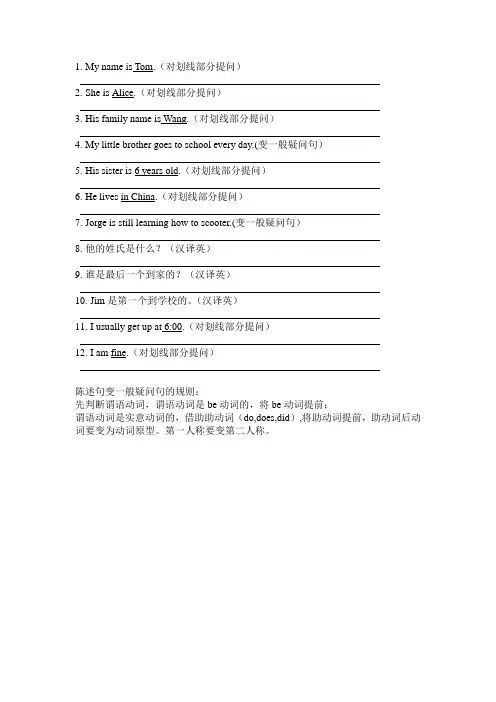
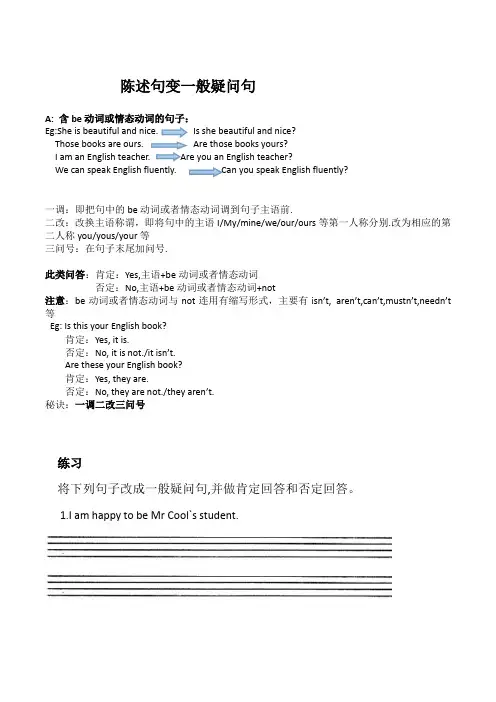
陈述句变一般疑问句
- 格式:doc
- 大小:21.47 KB
- 文档页数:8
.
..... 陈述句变一般疑问句
遵循下列步骤:
1.看句中有没有be动词(am、is、 are、 was、 were)、助动词(do、does、did、 have一、要将陈述句变成一般疑问句,可以、
had)或情态动词(can、must、will、may等),如果有,将其提到句首,句末打上问号即可。
例:It was rainy yesterday.
→Was it rainy yesterday?
Tom's father can play the piano.
→Can Tom's father play the piano?
I have finished my homework.
→Have you finished your homework?
2.如果句中没有be动词、助动词或情态动词,则根据谓语动词的形式借助do的相应形式放在句首。
具体方法是:
①如果谓语动词是原形,则借do;
②如果谓语动词是一般现在时第三人称单数形式,则借does;
③如果谓语动词是过去式,则借did.
需要注意的是,借does或did后,原句的谓语动词要变回原形。
例:They go to school by bike.
→Do they go to school by bike? .
..... Bill gets up at 6:30 every day.
→Does bill gets up at 6:30 every day?
The students saw a film yesterday.
→Did the students see a film yesterday?
二、陈述句变一般疑问句应注意的事项
陈述句变成一般疑问句除了遵循上述规则以外,还应注意下列几点:
1.如果陈述句中有第一人称,则变问句时最好要变为第二人称。
例:I usually have lunch at school.
→Do you usually have lunch at school?
My father is playing soccer.
→Is your father playing soccer?
2.如果陈述句中有some, 则变问句时往往要变成any 。
例: There is some water on the playground.
→Is there any water on the playground?
3.复合句变一般疑问句通常只变主句,从句不变。
例:I know he comes from Canada.
→Do you know he comes from Canada?
4.如果句中含有实义动词have且表示“有”时,除借do外,也可将其直接提到句首。
例:I have some friends in America.
→Have you any friends in America?/Do you have any .
..... friends in America?
三.一般疑问句的回答
一般疑问句往往采用简短回答,共由三部分(三个单词)组成,对这三部分(三个单词)的确定可以概括例下:
1.第一个词:不是Yes就是No(有时根据语气的不同,Yes可由Sure, Certainly, Of course等代替.NO可由sorry 代替.)
2.第二个词:问谁答谁。即答语中的主语须与问句的主语一致(但必须用主格代词)。
例:Does she clean her room every day? Yes, she does.
Is Anna′s father a doctor? No,he isn′t.
如果主语是 this that,回答时用 it 代替,如果问句中主语these, those,回答时用 they′ 代替。
3.第三个词:用什么问,用什么答。即沿用问句中的引导词。
Can Jim play soccer? Yes, he can.
Does Mr Bean speak English? Yes, he does.
需要注意问题:
(1)用 may 引导的问句,肯定回答用may,否定回答用 can′t 或mustn′t,
May I go to the park now?
Yes, you may. /No, you mustn′t.
(2)用 must 引导的问句,肯定回答用 must,否定回答用needn′t. .
..... 例: Must I wash my clothes now?
Yes, you must. /No, you needn′t.
4.用No开头作否定回答时,结尾要加上 not。因为回答必须是三部分,所以否定回答必须缩写,而肯定回答不能缩写。
例:Did Thomas come here yesterday?
Yes, he did./ No ,he didn′t.
Is Lin Lin in Class 3?
Yes, she is./No, she isn′t.或(No, she′s not).
四、总结:将陈述句改成一般疑问句的方法: 三步法
1、有be动词,则遵循下列步骤:
1.看句中有没有be动词(am、is、 are、 was、 were)、助动词(do、does、did、 have一、要将陈述句变成一般疑问句,可以、
had)或情态动词(can、must、will、may等),如果有,将其提到句首,句末打上问号即可。
例:It was rainy yesterday.
→Was it rainy yesterday?
Tom's father can play the piano.
→Can Tom's father play the piano?
I have finished my homework.
→Have you finished your homework?
2.如果句中没有be动词、助动词或情态动词,则根据谓语动词的形式借助do的相应形式放在句首。 .
..... 具体方法是:
①如果谓语动词是原形,则借do;
②如果谓语动词是一般现在时第三人称单数形式,则借does;
③如果谓语动词是过去式,则借did.
需要注意的是,借does或did后,原句的谓语动词要变回原形。
例:They go to school by bike.
→Do they go to school by bike?
Bill gets up at 6:30 every day.
→Does bill gets up at 6:30 every day?
The students saw a film yesterday.
→Did the students see a film yesterday?
二、陈述句变一般疑问句应注意的事项
陈述句变成一般疑问句除了遵循上述规则以外,还应注意下列几点:
1.如果陈述句中有第一人称,则变问句时最好要变为第二人称。
例:I usually have lunch at school.
→Do you usually have lunch at school?
My father is playing soccer.
→Is your father playing soccer?
2.如果陈述句中有some, 则变问句时往往要变成any 。
例: There is some water on the playground.
→Is there any water on the playground? .
..... 3.复合句变一般疑问句通常只变主句,从句不变。
例:I know he comes from Canada.
→Do you know he comes from Canada?
4.如果句中含有实义动词have且表示“有”时,除借do外,也可将其直接提到句首。
例:I have some friends in America.
→Have you any friends in America?/Do you have any
friends in America?
三.一般疑问句的回答
一般疑问句往往采用简短回答,共由三部分(三个单词)组成,对这三部分(三个单词)的确定可以概括例下:
1.第一个词:不是Yes就是No(有时根据语气的不同,Yes可由Sure, Certainly, Of course等代替.NO可由sorry 代替.)
2.第二个词:问谁答谁。即答语中的主语须与问句的主语一致(但必须用主格代词)。
例:Does she clean her room every day? Yes, she does.
Is Anna′s father a doctor? No,he isn′t.
如果主语是 this that,回答时用 it 代替,如果问句中主语these, those,回答时用 they′ 代替。
3.第三个词:用什么问,用什么答。即沿用问句中的引导词。
Can Jim play soccer? Yes, he can.
Does Mr Bean speak English? Yes, he does. .
..... 需要注意问题:
(1)用 may 引导的问句,肯定回答用may,否定回答用 can′t 或mustn′t,
May I go to the park now?
Yes, you may. /No, you mustn′t.
(2)用 must 引导的问句,肯定回答用 must,否定回答用needn′t.
例: Must I wash my clothes now?