PEP小学英语六年级上册重点句型及词汇
- 格式:doc
- 大小:60.00 KB
- 文档页数:4
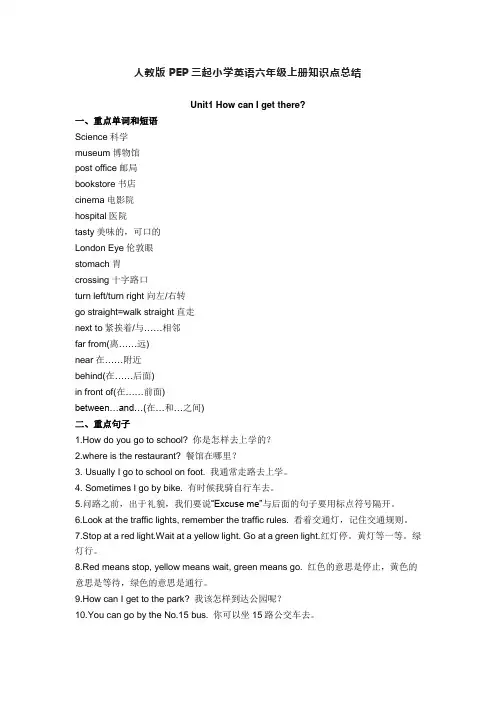
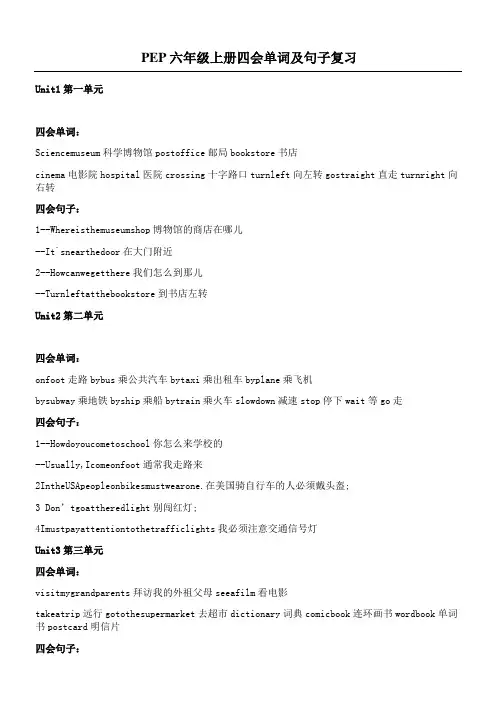
PEP六年级上册四会单词Unit 1:by (经……,乘……) foot(脚) bike(自行车) bus(公共汽车) train(火车) how(怎样) go to school(上学) traffic(交通) traffic light (交通灯) traffic rule(交通规则)stop(停;停车站)wait(等;等待) get to(到达) by plane(乘飞机) by ship(乘轮船) by subway(乘地铁)Unit 2:library(图书馆) post office(邮局) hospital(医院) cinema(电影院) bookstore(书店)turn(转弯) then(然后) where(在哪里,到哪里) please(请) next to(与……相邻) turn right (向右转) turn left(向左转) go straight(直走) north(北) south(南) east(东) west(西)Unit 3:next week(下周) this morning(今天上午) this afternoon(今天下午) this evening (今天晚上) comic book(漫画书) post card(明信片) newspaper(报纸) buy(购买)Unit 4:hobby(爱好) ride a bike—riding a bike(骑自行车) play the violin—playing the violin(拉小提琴) dive—diving(跳水) make kites—making kites(制作风筝) collect stamps—collecting stamps(集邮) live—lives(居住) teach—teaches(教) go—goes(去) watch—watches(看) read—reads(读,看) does(助动词,无义) doesn’t=does notUnit 5:singer(歌唱家) writer(作家) actor(男演员) actress(女演员) artist(画家) TV reporter(电视台记者) engineer(工程师) accountant(会计) salesperson(销售员) policeman(男警察) cleaner(清洁工) where(在哪里) work(工作)Unit 6:rain(雨;下雨) cloud (云;云彩) sun(太阳) stream((小)河;(小)溪) come from(来自……;从……来) seed(种子) soil(土壤) sprout (苗;芽;嫩芽) plant(植物;种植) should (应该) then(然后)二、句型:Unit11.—How do you go to school?(你怎么去上学?)—Usually I go to school on foot. Sometimes I go by bike.(通常我走路去学校。
)(有时我骑车去。
)2.Stop at a red light. Wait at a yellow light. Go at a green light.(红灯停。
)(黄灯等待。
)(绿灯行。
)3.—How can I get to Zhongshan Park? —You can go by the No.15 bus.(我怎样才能到达中山公园?)(你可以乘15路公交车去。
)Unit21.—Where is the cinema, please? —It’s next to the hospital.(请问,电影院在哪儿?)(它在医院旁。
)2.—Is it far from here ? —No, it’s not far.(它离这儿远吗?)(不,不远。
)3.Turn left at the cinema, then go straight. It’s on the left.在电影院左转,然后直走。
它就在左边。
Unit31.—What are you going to do on the weekend?(周末你准备做什么?)—I’m going to visit my grandparents this weekend.(这个周末我将要去看望我祖父母。
)2.—Where are you going this afternoon? —I’m going to the bookstore.(今天下午你去哪儿?)(我将要去书店。
)3.—What are you going to buy? —I am going to buy a comic book. (你将要去买什么?)(我要去买一本漫画书。
)4.—When are you going ? —I am going at 3 o’ clock.(你将什么时候去?)(我将三点钟去。
)5.主要句式:What/Where/ When is sb.(某人)going…?Unit41.—What is your hobby? —I like collecting stamps.(你的爱好是什么?)(我喜欢集邮。
)2.—What is her/ his hobby? —She/ He likes collecting stamps.(她/她的爱好是什么?)(她/他喜欢集邮。
)3.—Does she teach English? —Yes, she does. / No, she doesn’t.(她教英语吗?)(是的,她是。
/ 不,她不是。
)Unit51.—What does your mother do? —She is a TV reporter.(你妈妈是干什么的?) (她是一个电视台记者。
) 2.—What are you going to be? —I am going to be a/an…(你将成为什么?)(我将成为一个……)3.—Where does she work? —She works in a car company.(她在哪儿工作?)(她在汽车公司工作。
)4.—How does she go to work? —She goes to work by bus.(她怎么去工作?)(她乘公交车去工作。
)Unit61.—Where does the rain come from? —It comes from the clouds.(雨来自哪里? )(它来自云.)2.—How do you do that? —First, put the seeds in the soil. Then, …(你是怎么做那件事的? 首先,把种子放在泥土里. 然后,……3.—What should you do then? —Water them…(然后你应做什么?)(给他们浇水…../)语法复习一、现在进行时态(3种变化规律)be (am, is, are) + 动词ingI am eating. He/ she/ it is eating. They are eating.1. 直接加ing:do—doing draw—drawing cook—cooking answer—answering read—reading listen—listening fly—flying sing—singing play—playing2. 去掉末尾的e加ing:write—writing dance—dancing take—taking have—having make—making ride—riding dive—diving3. 双写末尾字母加ing: get—getting runrunning swim—swimming sit—sitting put—putting你正在干什么?What are you doing? I’m answering the phone.他/她/它正在干什么? What is he/she/it doing? He’s/She’s/It’s …他(她、它)们正在干什么?What are they doing? They are …看到like或likes后面的动词要加上ing二、一般将来时态 (be going to/will + 动词原形)表示一般将来时的时间状语有:this morning, this afternoon, this evening, tomorrow, tonight, this weekend, on the weekend, next week, next month, next year, next weekend.(今晚)你将要做什么?What are you going to do (this evening)?I’m going to visit my grandparents.你将什么时候去? When are you going?I’m going at 7:10.你将怎样去呢?How are you going?I’m going by bus.今天下午你将要去哪里?Where are you going this afternoon?I’m going to the bookstore.你将要买什么呢? What are you going to buy?I’m going to buy a comic book.你将和谁一起去?Who are you going with?I’m going with my parents.三、第三人称单数后面的动词要加s或es1. 一般情况加s,如:read—reads;live—lives;play—plays;sing—sings2. 动词末尾以s,x,ch,sh或部分以o结尾的加es。
(记住课本中出现的这几个:watches, teaches, goes, does, washes, passes)3. 辅音字母+y结尾的把y变i再加es,如:fly—flies;study—studies4. 特殊情况:have--has5. 第三人称单数包括:he; she; it; my father/friend; Amy/Hangzhou等一个人名或地名。
例如:He likes drawing pictures.She works in a car company.It comes from the clouds.My father goes to work on foot.Li Lei often plays computer games after lunch.6. 一般疑问句记住:前面助动词加了es,后面动词就不变化了。