
Listeningin-精
- 格式:ppt
- 大小:962.00 KB
- 文档页数:1
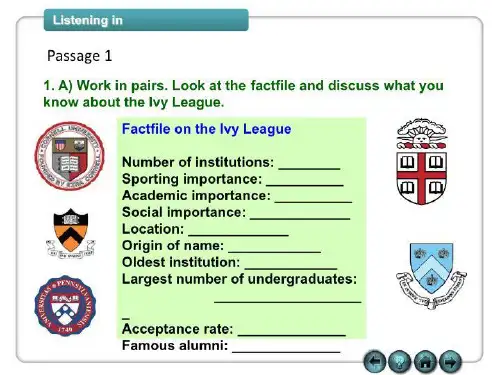

Unit I Evaluating a Job OfferOnce you receive a job offer, you must decide if you want the job. Fortunately, most organizations will give you a few days to accept or reject an offer.There are many issues to consider when assessing a job offer. Will the organization be a good place to work? Will the job be interesting? Are there opportunities for advancement? Is the salary fair? Does the employer offer good benefits? Now is the time to ask the potential employer about these issues — and to do some checking on your own.A good job offers you opportunities to learn new skills, increase your earnings, and rise to positions of greater authority, responsibility, and prestige. A lack of opportunities can dampen interest in the work and result in frustration and boredom.The employer should give you some idea of promotion possibilities within the organization. What is the next step on the career ladder? If you have to wait for a job to become vacant before you can be promoted, how long does this usually take? When opportunities for advancement do arise, will you compete with applicants from outside the company? Can you apply for jobs for which you qualify elsewhere within the organization, or is mobility within the firm limited?When an employer makes a job offer, information about earnings and benefits are usually included. You will want to research to determine ifthe offer is fair. If you choose to negotiate for higher pay and better benefits, objective research will help you strengthen your case.You may have to go to several sources for information. Try to find family, friends, or acquaintances who recently were hired in similar jobs. Ask your teachers and the staff in placement offices about starting pay for graduates with your qualifications. Help-wanted ads in newspapers sometimes give salary ranges for similar positions. Check the library or your school’s career center for salary surveys such as those conducted by the National Association of Colleges and Employers or various professional associations.You also should learn the organization’s policy regarding overtime. Depending on the job, you may or may not be exempt from laws requiring the employer to compensate you for overtime. Find out how many hours you will be expected to work each week and whether you receive overtime pay or compensatory time off for working more than the specified number of hours in a week.Benefits also can add a lot to your base pay, but they vary widely. Find out exactly what the benefit package includes and how much of the cost you must bear.Unit 2 Compromise on Details, Not PrinciplesIt’s no surprise that money is one of the biggest sources of arguments among married couples, and it’s also the number one ca use of divorce in North America. When it comes to money, we often butt heads with our spouse. In fact, what we often overlook is that many times we’re not fighting with our spouse over principle, but details of a certain financial aspect.The word “compromise” has become a dirty word in marriage counseling, because it has the stigma that you’re letting go of your principles and convictions just to please your spouse, and I agree that you shouldn’t compromise your principles and convictions. However, there are ways to compromise without breaking one’s own long-held principles.The idea of “losing the battle to win the war” is to give up a little bit and essentially lose the small battle in order to make the situation right and ultimately “win the war” and ha ve a solid relationship with your significant other.1. Communication is keyStop for a second and talk about what your disagreement is about. If the disagreement is about whether you should buy a car with cash or buy a car with 100% financing, then you have a disagreement over principle. On the other hand, if your disagreement is about how much you should give to a charity or a family member, you’re actually agreeing that you should give, but you’re disagreeing over the detail of that gift.2. How to lose the battleLosing the battle involves compromising a little bit to meet in the middle about the details. If you’re fighting over how much to give to a charity, meet somewhere in the middle. Agree to give more money in months when you have managed to save more, and less in months when your expenses are higher than usual.If you’re fighting over the car financing issue discussed in the previous section, this is obviously a bigger issue since it’s over principles, but still not impossible to get over. You need to explain to each other why you have the stance that you do, and see if there is room for compromise. Perhaps you can agree to pay with cash for the car this time, and consider using financing in future scenarios where you both agree it makes sense.3. Winning the warIf you find a way for you to both partially win, then you’ve won the war, because you both put your pride aside and found a way to make each other happy. If you communicated about it and found a reasonable compromise, then you’ve each “lost”very small battles, but you’ve won the larger war. Your disagreement won’t fester and you’ll make progress without butting heads every time you talk about it.Unit 3 Shakespeare’s TragedyShakespeare wrote tragedies from the beginning of his career. One of his earliest plays was the Roman tragedy Titus Andronicus, which he followed a few years later with Romeo and Juliet. However, his most admired tragedies were written in a seven-year period between 1601 and 1608. These include his four major tragedies Hamlet, Othello, King Lear and Macbeth.As one of the most remarkable playwrights in the world, William Shakespeare was greatly influenced by British traditional literature and culture, which partly originated from ancient Greek and Roman culture. He got inspiration from the European legends and historical stories. And the epics, myths of ancient Greece and Roman, the worship of heroes in the tragedy and even the sublime aesthetic style functioned as significant elements which affected Shakespeare’s dramatic creation. In Aristotle’s theory, a tragedy aims at purgatory through arousing pity and fear. Pity is aroused by unmerited misfortune of people like ourselves. As for Shakespeare, it is no doubt that he successfully aroused the readers’ pity and fear through the miserable lives of the characters in his tragedies and he presented “pity and fear” to the extreme limit.However, what makes Shakespeare a great giant in drama is not how he inherited from the Greek tragedy but how he further developed it.The Greek tragedy creates a series of gods and mankind who have lofty ideals of self-sacrifice for mankind and justice, but at last they areoverwhelmed by the irresistible fate. These heroes, shining with the halo of “god”, are out of our reach. Shakespeare shif ted the heroes from gods to the men with high social status, kings, princes and generals. These men are noble, aristocratic, but live in the real life. Although different from ordinary people, their ideas and actions can be understood and accepted more easily. This may be regarded as the reflection of Renaissance.In Greek tragedy, fate is the central cause of tragedy. The heroes fail to defeat the powerful fate and are engulfed by it. J. W. Goethe pointed out that the ancient tragedies were based on the inevitable fate. However, Shakespeare’s tragedy can be described as stories of exceptional suffering and calamity, leading to the death of a dominant figure of high social standing. Every hero or heroine in Shakespeare’s tragedy has an imperfect character which his or her fall from honor and happiness is due to. Once the weakness takes the dominant place, it shows the irresistible and destructive power, under the control of which the hero is pulled down from high status and he is destined to fail. For example, the excessive pride of Faustus, the overweening ambition of Macbeth, and the uncontrolled jealousy of Othello all attest that fate is determined by character. In this sense, Greek tragedy is the tragedy of fate, whereas Shakespeare’s is the tragedy of fl awed character.Unit 4 French and British EtiquetteThough only separated by a small channel the cultural differences between France and Britain are numerous. Neither the French nor the English, two very proud nations, will take a social mishap kindly. Here are some of their differences in etiquette.ConversationHaving a conversation with French and with English people is quite different. If a French person asks a British person for his opinion about a politician, the situation will be very awkward since in the UK politics is still slightly taboo. Philosophy is regarded as boring and stormy debates are to be avoided at all cost. And yet this is what the French love. In the same way, don’t contradict the other guests just for fun. It is not fun at all in the UK where conciliation is preferred to debates.Don’t refer to money or wealth when you speak to a French person as it will be regarded as extremely vulgar. Pay careful attention to these details and avoid being bad company.Dress codeFrench people are much less audacious than British people regarding fashion: When British people go out, they are not afraid to show off. Gorgeous dresses for ladies and dinner jackets for men are usually the norm for an evening party unless otherwise specified. For black-tie party the attire is very formal and classy: evening dresses for ladies and black-tie for men. For a white-tie party you have to dress up more. It isappropriate for men to wear swallow-tailed coats. In contrast, French people are more discreet. Most of the time parties are more casual and the dress code is not so often mentioned.In addition, British people pay more attention to clothes at work. Whereas in France a man can go to work with odd jacket and trousers, this would be unacceptable in the UK. Attire has to be formal at all times except on Friday which is more casual. Be careful this doesn’t mean that you can wear a simple T-shirt, but you can remove your tie.PunctualityPunctuality is not regarded in the same way around the world. In France punctuality can be approximate, you could even hear about the saying “being 15 minutes late to be polite”. The idea is to let the hosts finish preparing the party without rushing them. In the UK on the contrary punctuality is a golden rule. Some invitations ev en mention “8.00 for 8.30”. It means that the party or the dinner will begin precisely at 8.30 and that you are supposed to be there from 8.00. Being late in that case would be unforgivable, especially if the hostess decided to cook a soufflé!!!Unit 5Martin Cooper and the Cell PhoneApril 3, 2003 marked the 30th anniversary of the first public telephone call placed on a portable cellular phone. Martin Cooper placed that call asgeneral manager of Motorola’s Communications Systems Division. It was the incarnation of his vision for personal wireless communications, distinct from cellular car phones. That first call caused a fundamental technology and communications market shift toward the person and away from the place.Martin Cooper explained his thinkin g and said, “People want to talk to other people — not a house, or an office, or a car. Given a choice, people will demand the freedom to communicate wherever they are, unrestricted by the infamous copper wire. It is that freedom we sought to vividly demonstrate in 1973. As I walked down the street while talking on the phone, sophisticated New Yorkers gaped at the sight of someone actually moving around while making a phone call. Remember that in 1973, there weren’t cordless telephones, let alone cellular p hones. I made numerous calls, including one where I crossed the street while talking to a New York radio reporter — probably one of the more dangerous things I have ever done in my life.”Following the April 3, 1973 public demonstration, using a “brick”-like 30-ounce phone, Cooper started the 10-year process of bringing the portable cell phone to market. Motorola introduced the 16-ounce phone into commercial service in 1983, with each phone costing the consumer $3,500. It took seven additional years before there were a million subscribers in the United States. Today, there are more cellularsubscribers than wire-line phone subscribers in the world, with mobile phones weighing as little as 3 ounces.Martin Cooper’s role in conceiving and developing the first portable cellular phone directly impacted his choice to found and lead ArrayComm, a wireless technology and systems company founded in 1992. ArrayComm’s core adaptive antenna technology increases the capacity and coverage of any cellular system, while significantly lowering costs and making speech more reliable. This technology addresses what Cooper calls “the unfulfilled promise” of cellular, which should be, but still isn’t as reliable or affordable as wired telephony.ArrayComm has also used this technol ogy to make the Internet “personal” by creating a personal broadband system, which delivers high-speed, mobile Internet access that consumers can afford. Martin Cooper had this to say on the changes taking place: “It’s very exciting to be part of a movement toward making broadband available to people with the same freedom to be anywhere that they have for voice communications today. People rely heavily on the Internet for their work, entertainment and communication, but they need to be unleashed.”Unit 6 The Benefits of Buying Books OnlineBooks are one of the best things that you can possess or gift to your loved ones. From a small child to an old adult, every person finds a friend inbooks. But lately, due to busy schedule lifestyles, we often do not get much opportunity to spend time in bookstores. However, with the trend towards Internet marketing, things have become simple. Now, just by logging onto the Internet, you can come across a multitude of online book stores which offer a good collection of books. From fiction to non-fiction, from comics to award-winning works, there are plenty of choices to be seen when making a visit to the online bookshop.Buying books online is a fun and challenging experience. There are hundreds if not thousands of online bookstores to choose from with hundreds to hundreds of thousands of titles, and with the advent of search engines, any kind of used, new or rare books can be found.If one online bookstore does not have what you want, then you will be sure to find another online bookstore that does. For example, if you are interested in buying textbooks or reference books for your dissertation online, you will find websites that are college student oriented, sponsored by universities and colleges across the United States. If you’re interested in used books, you will also find online bookstores that specialize in used and discounted books. Online bookstores cater to the needs of individuals who need items shipped to them for convenience.Carrying such vast numbers of titles, online bookstores list their books conveniently by category. So some of the book categories you may find are: Biography, Comics/Graphic Novels, Children’s Books, Horror,Crime/Thriller/Mystery, Fiction, and a lot more. You may also find collectible, antique, and rare books, CDs and audiocassettes, photography, art and many other categories as well. Online bookstores make searching for specific authors, titles or ISBN numbers easy by allowing you to type in that author, title or ISBN number in a search bar to find what you’re looking for. Online bookstores also have customer service by phone line or online form if you have trouble finding what you’re looking for. Buying books online also gives you the option to purchase books through auction websites, which can discount the costs dramatically. Most book sellers believe in satisfaction guarantees in order to cover any accidentally damaged books. They may also have their own company policies on exchanges and returns. Many times you can find that their customer service is only a mouse click away. This just enhances the fact that buying your books online will not only save you money but also time.Unit 7 The Function of Sport in LifeThe word sport is a contracted form of “disport”, which means to amuse, to divert oneself. It includes play, amusement, entertainments or recreation. It is a word which signifies the outdoor pursuits, athletic exertion as contrasted with intellectual occupation.Sports existed in all past ages and have played an important role in thehistory of mankind.Nations which played an important role in ancient history all felt the necessity of sports and introduced athletic contests in their own domains. What, then, is the function of sport? The fact that athletics, a branch of sport, is of great advantage to life is evident to the experienced student of modern colleges. The argument which established its necessity is opposed only by ignorant people, for it has grown nowadays into an irrefutable fact. Athletics are necessary, if not indispensable for the future success of the nation as well as of the individual. “A sound mind in a sound body” was the motto of the Greeks and the model of the strong, healthy and vigorous Spartans. Their carrying out of the plan was a cause for the long existence of Greece and for its luxuriant literary culture. This model in just the same way should be put into action if we wish to have any success in this world.Athletics refresh the body, calm and enlighten the mind, and develop moral character. As a concrete example let us take a student in his college activities. The student who does exercise is always fresh and vigorous; he seldom gets sick and tired. His jovial character, his good disposition and his interest in life are his chief characteristics.Moreover in exercising, the student gets animated, his blood is purified and consequently his mind becomes more apt to receive the ideas and thoughts found in his lessons. The health which he acquires will help himto work harder and he becomes more successful. A weak person can seldom endure the hardship of school-life, the trouble of memorizing and persevering in his daily lessons. Lastly, when a student is busy with athletics during recess time, his ideas do not deviate any more to the path of impurity, to think of such trivial things and the health and strength which he acquires will help him in overcoming such temptations. Generally a healthy person is endowed with a will stronger than that of a weak person.We see therefore that athletics improve the condition of a person during his entire college course.Sports, in general, have had an important and estimable function in life and will inevitably in future be regarded as the indispensable factor for intellectual and moral growth.Unit 8 Cyber Charter Schools: Public School at Home?If the idea of cyber schools seems futuristic, consider this fact: around 200,000 American students attend school full-time online. Most of these kids are attending what’s known as cyber schools. These schools exist in 27 states and Washington, D.C., according to the most recent national report. Kids who learn through cyber charter schools need little more than a computer, an Internet connection and a residence in the same state as the school. And since these schools are public, the school usuallyprovides the computer and helps pay for Internet access. “Essentially, it’s public schooling at home,” says Matt Arkin, head of Georgia Cyber Academy, which serves more than 4,000 kids statewide. “Our students are held to all public school standards.”Like traditional schools cyber charters serve children from kindergarten all the way through high school. They require the same core classes taught in public schools, like English, science and even physical education. Since virtual charter schools are public, their students are required to take the same state assessment tests as children in traditional public schools. Some classes take place at specific times, while others are self-paced so students can work them into their own schedules.The biggest difference between virtual and traditional schools is that cyber charter students learn at their own pace, since they’re not assigned to a classroom with a bunch of other kids. A fourth grader might take fourth-grade English classes and third grade math, for example. As in traditional schools, students can pick more of their own classes as they get older, choosing from subjects like epidemiology, British literature and graphic design.Arkins says students aren’t entirely on their own just because they don’t hop on a school bus every day. At PA Cyber, kids interact with their teachers and an instructional supervisor who is sort of like a guidance counselor. “We actually surround the students with as many one-to-oneinteractions as we can,” says Andy Petro, supervisor of virtual classroom technology for PA Cyber, which has more than 8,000 students across Pennsylvania. In addition, some virtual charters are developing programs where students can take classes online but also get in-person instruction at learning centers.Since cyber charters are public schools, they can’t turn kids away. That means they’re to serve all kinds of children. “We believe that every student can be successful in this program,” Arkin says. “But in some cases, it’s more of a challenge.”Virtual education isn’t going to work unless the student, parent or both is committed to making it work. Because virtual education is so individualized, it works best when a child’s learning coach takes an active role. “Learning coaches” can be children’s parents, grandparents or guardians. And the nature of virtual schools means students must be able to motivate themselves and work independently.Unit 9 Light up Your Life: How the Weather Affects Our MoodsFor the past three years, I’ve been living in Southern Oregon, where the summers are very hot, sunny and dry, while the winters bring long spells of grey skies and drizzly rain. Between November and March it feels like it rains all the time, or at least stays pretty dark. Luckily, the past few days have brought some bright, sunny days, and that’s been brighteningmy mood, too.I always wondered why people —especially weather forecasters —always had to equate certain weather with being “miserable” or “dreary”.I thought it was pretty much giving our power away to let something as random as the weather affect our moods.But late ly I’ve been thinking more and more about the scientific validity of that. After a bit of digging, I got confirmation of the fact that light (and, by extension, weather) does indeed impact the way we feel. It’s laid out pretty clearly in a little informational e-book called Brighten Your Life.In the book, Dr. Kripke writes, “Think about the dark dungeons of despair, the heart of darkness, the gloominess of a funeral mood. Sadness rules where it is dark,” He goes on to say, “Think about a person who has see n the Light. Think about brilliance. Think how we describe the great joy of love by singing,’You are My Sunshine’. We know that light makes us happier.”These days, we spend more and more time indoors, and Dr. Kripke blames modern urbanization. He points out that when he was a little boy, they played outside often, and walked to school even in the winter. After all, they didn’t have all the video games and electronic toys, and there were only a few channels on TV.But we don’t need to blame technology. In f act, technology provides an answer in Kripke’s book: bright light, which is used to treat depressionand seasonal affective disorder (SAD).So if not technology, what should we blame? Laziness, perhaps, or simply routine habits. But it’s really a catch 22. We don’t feel like going outside, but we feel worse by staying in. I know that I find my head clears and my energy rises when I go outside, even if it is raining. So certainly our kids can benefit from fresh air too, not to mention the Vitamin D we get from the sun.That’s why I’m making it a personal goal this year to spend more time outside, and to take my family with me, regardless of how much my husband and I feel we need to be tied to our computers, working. After all, if you’re going to light up you r life, you might as well do it the natural way. Indoor lights might be good, but the biggest light of all — the sun — is even better.U10 Water PollutionWater pollution is defined as a change in the chemical, physical and biological health of a waterway due to human activity. Ways that humans have affected the quality of the Great Lakes water over the centuries include sewage disposal, pollution through heavy metals and pesticides, overdevelopment of the water’s edge, and air pollution. Under the belief that water could dilute any substance, industries and individuals during the 18th and 19th centuries often used rivers and lakes as garbage cans.Industrial waste water, raw sewage and bodies of dead animals would often be dumped into waterways, without much thought of pollution and downstream neighbors.This practice started changing in the 20th century as people became aware of the importance of clean water to health. However, as more industries and people moved into the Great Lakes region, the more the rivers and lakes became polluted. Today, pollutants enter the Great Lakes in many different ways, but the main three entryways of pollutants are point source, nonpoint source and atmospheric pollution.Point source pollutionWhen pollutants enter the waterway through a specific entry point, such as a drainpipe draining directly into a river, it’s called point source pollution. Industrial water discharges and sewage treatment plants are the main criminals of this type of pollution. Point source pollutants can include many different organic and inorganic substances, including human waste and poisonous metals.Point source pollution can be traced to a specific discharge point and owner; therefore, it has been the easiest source of pollution to control and regulate.Nonpoint source pollutionIn contrast to point source pollution, nonpoint source pollution comes from many different spreading sources and is extremely difficult toregulate and control; therefore, many experts believe that NPS pollution is the top danger facing the Great Lakes today.NPS pollution is mainly caused by runoff, when rain and snowmelt move over the land, picking up pollutants along the way and finally dumping the pollutants into rivers and lakes. Some common NPS pollutants include fertilizers and pesticides from agricultural lands and homeowners; oil, grease and salt from highways; animal and human waste and so on. Atmospheric pollutionAtmospheric pollution is another form of nonpoint source pollution, though instead of polluting via runoff, the pollution falls from the sky. As water moves through the hydrologic cycle, it falls as rain or snow and then evaporates into the air from land and surface water. Pollutants given off into the air, such as through smoke piles, follow this same path, and can be carried through the atmosphere and into waterways hundreds of miles away from its source. Acid rain is the most well-known form of atmospheric pollution. The major sources of atmospheric pollution include coal-burning energy plants and waste incinerators.U11 How to Make Friends for LifeFriendship and friends continue to remain central to our lives. The relationship that we share with our friends is grounded in a mutual concern as our friends help us in shaping up our personalities as well.Research has shown that the quality and nature of your friends are one of the key influencing factors in achieving happiness, self-esteem, and satisfaction. Friends often affect the health and energy of a person as well. More and more people are increasingly turning towards their friends for support and mutual sharing rather than communicating to their relatives; and this sociological phenomenon has escalated the desire to make more friends. Friendship is an impulsive relationship developed between two autonomous individuals marked by a voluntary, emotional and mutual concern, but there are certain steps, which, if implemented can win you friends or at least help you get close to those whom you want to make your friends.The first step to make friends with someone is to make them like you. To let someone know that you are genuinely interested in them, simple gestures like a little smile and calling him by his name can lay the basic foundation. To make the other person feel important you need to be a good listener and encourage the other person to talk. Give your honest and sincere opinion but do not overtly criticize or make fun of him or her. The second step of making someone your friend is to develop a mutual consideration between each other. You need to share his or her perspective and for that it is necessary for you to develop an inclination to see things from the other person’s point of view. To become best of friends you must show a genuine concern and consideration for your。
第三单元Listening in Passage 1Interviewer With us today is Martin Downes, a carpenter, who's 51. A year ago, Martin had a strok e. But he's been lucky enough to make a full recovery from it. Can you tell us how it all began, Ma rtin? Martin I'm very happy to - not that I remember much at all. I was at a customer's house, build ing a cupboard, and the next thing I knew, I woke up in hospital with people in white coats bendin g over me. Interviewer It must have been very frightening. Martin It was. But what was really frig htening was that I couldn't speak. I couldn't say a word. And I couldn't understand much that peopl e said to me. Interviewer How awful! Martin Yeah! I don't know what would have happened to me if I hadn't had my family. But they were there for me, they really were. I had something called ap hasia, where the part of your brain gets damaged that affects your speech and language. But they st arted treatment for the condition almost immediately. This speech and language therapist came to s ee me every day for 12 weeks. They made me do all these exercises. Interviewer What kind of exe rcises? Martin I had to match words and pictures and say their names. You see, I'd also forgotten t he names of a lot of things. She had this thing called a word board and I could point to words and phrases on it that I wanted to say. I had to repeat words up to 20 times - boy, it was hard, so hard. I nterviewer Could you say anything to begin with? Martin I could say three words. "Hi", "Yes" and "No". That was all. And there were a lot of words I couldn't understand -1 had to learn their meani ngs all over again. Interviewer It must have been very frustrating. Martin It was, but I was determi ned to get better. I was in hospital for three and a half months. When I got home I got a special co mputer programme that I worked with every day. And slowly my language came back to me. It wa s a struggle, a big struggle. I had to learn to read and write again too. Interviewer Why do you thin k that you were able to recover completely? It's not that common, is it? Martin I was lucky. I was g iven the right drug at the right time. And I had 12 weeks of therapy, five days a week. That's very i mportant, apparently. Interviewer And now that you're better how do you feel about your life? Mar tin What can I say? I'm just grateful to have my life back.Passage 2Interviewer In 1907 an Italian educator called Maria Montessori opened a school in Rome that tau ght young children using methods that were very different from traditional teaching. Today, the M ontessori method, as it's known, is used in nursery schools in countries such as America, Canada, Britain and Germany. Recent research shows that children educated at a Montessori nursery do bet ter later on at school than other children in all subjects. We asked two Montessori teachers, Claudi a Rosella and Sarah Harrington, to explain what makes their nursery school different. Sarah... Sarah I think the first thing to say is that a Montessori classroom is very quiet, very clean. Everyth ing stays in the same place. So the children are calm and quiet as a result. Interviewer So they're n ot encouraged to be noisy. Sarah No, definitely not... Interviewer Claudia? Claudia Yes, the classro om's very important. Another important principle is that children direct their own learning. They c hoose what they want to do. Interviewer So the teacher doesn't tell the child what to do?Sarah Not at all. While a child is doing an activity we observe them. Then we work with the child for a short time and then leave them to work on their own. Interviewer That sounds excellent. And what about your equipment? It's often made of wood, isn't it? Sarah Yes, and a piece of equipment is often designed for one activity only. Claudia Right. It's so that the child can see if they're gettingsomething right or wrong. Interviewer So they don't need the teacher so much"?Sarah That's right. Another Montessori principle is the importance of physical activity. Children le arn by doing, so when they're learning to read, for example, the letters are made of sandpaper so th at children can feel the shape of the letter. Interviewer Do you think there are disadvantages with Montessori methods? Claudia Yes, there are. Maria Montessori didn't understand how important it is for children to use their imagination. If she was alive today, she would recognize that. But still, t he fact is, her methods are very successful.第五单元Listening in Passage 1Interviewer So - tell us about how you first met. Amy How we first met... Oh, it wasn't very roman tic. David I thought it was very romantic.Interviewer Why don't you begin at the beginning?Amy Good idea. Well, I was 22 and I'd just left uni and I went on holiday to the French Alps with a girlfriend. And someone invited us to go climbing. But my friend got ill so I went without her. T here was this group of about eight guys and two girls. David There were four girls.Amy Alright! Well, anyway, no one had told me that the mountain we were going to climb was - v ertical - and that we were climbing with ropes! I was terrified, absolutely terrified, I just really had n't expected it. David She was terrified! I noticed her immediately. She looked so scared -she was wearing this great hat — but she was white as a sheet. Amy Oh, I don't know about that, but I rem ember I was shaking all over. David came over and started talking to me and telling me how safe it was with the ropes. And he was so sweet, you know I think I fell in love with him right then. David Yeah, it was the same with me ... We roped up and I made sure I stayed next to her ... I kept talking to her and encouraging her. Amy It really helped. I think I would have fallen off the mount ain if you hadn't done that. David Rubbish! You were perfectly safe. Anyway, we got to the summi t — it was a kind of flat area - and Amy just collapsed - she couldn't stand up! Amy It's true, I coul dn't. I felt -1 was just - everyone ignored me except David - everyone. David Quite a few people c ame to talk to you. Amy They didn't! David They did! Amy Well, you talked to me, and that's all t hat mattered. David Thank you! Amy So - David So we climbed back down the mountain. Amy which was just as bad - David and we headed for the nearest village and we both had huge pizzas. Amy I didn't eat a thing! I was still feeling too sick. David You did, you know. Amy You know, y ou have a terrible memory sometimes. David So do you! ... To cut a long story short, we got marri ed six months later and went on a three-week honeymoon to Barbados. Amy Two weeks! David A nd we've lived happily ever after.Passage2Presenter And now let's move on to online dating, a way of meeting a potential partner that's beco ming more and more popular. James O'Hanlan and Claire Goodall are two online dating experts w ho are going to give all you listeners advice about how to use online dating safely and successfully . James ... James OK. The first thing to say is, don't be nervous. A lot of people are and it's very un derstandable. But there's no need to be, provided you follow the rules, which we're going to tell yo u right now. Isn't that right, Claire? Claire Absolutely. James So, let's begin at the beginning. Whe n you join an online dating site, the first thing you do is give somebasic information about yourself. Now, don't be tempted to lie - about your age, for example. If yo u want a good relationship, you need to be honest. If you're not, you'll get found out and that could be painful. Claire Another thing - it's a good idea to use a photo, you'll get many more replies than if you don't. James But use a recent photo, not one that was taken ten years ago!Claire Let's move on to the next stage. You've had some responses响应 and chosen one or two people you'd like to chat with. Now, the most important advice here is, d on't give out any personal information until you're 100 per cent sure you're that happy to do so. Th at includes your real name, your phone numbers, your workplace address and your email address. Use the email facility设备 at the website and only give out your email address when you feel completely safe. James And email for as long as you want, it's a great way of getting to know a person. Then, the next stage is t o talk on the phone. Now that's very revealing, because you'll hear the person's voice, and also bec ause people have to be spontaneous on the phone - they can't think about what they're going to say for half a day, unlike emails. Claire Then, if you're feeling really comfortable, agree to meet. But always choose a public place. Don't go to someone's home. James A cafe or bar is the best choice. Claire And don't forget to tell a friend where you're going and what time you expect to be back. Th at's important. James Another good idea is to ask the same friend to call you during the meeting so that if you want to leave quickly you can say that something urgent's come up and you have to go. That's everything! If you follow this advice you should be perfectly safe. And you may find the m an - James ... or woman — Claire ... of your dreams! James & Claire Happy hunting!第六单元Listening in Passage 1 Speaker 1]Interviewer So, how are you enjoying yourself in St Petersburg? What's it like? Speaker 1 Oh, I th ink it is a very beautiful place. Interviewer What sort of... Is it good for shopping? What do you b uy in St Petersburg? Speaker 1 Yes, there are things you should buy. Of course, vodka is very goo d here and the other thing very expensive is the caviar. It is beautiful. Then there are the dolls. Wh at have do they say? Matrioshka dolls. Interviewer Matrioshka dolls. Those wooden dolls that go i nside each other? Speaker 1 Yes, you take one out and open the top and there is another one. You t ake off the top and there is another. They get very very small inside. Very small. Interviewer OK. Speaker 1 And of course, the chess. Because they are very famous here in this part of the world to play the chess. Interviewer Yes. And what sort of shops are there? Where's it best to shop? Speak er 1 Oh, here there are very good department stores, where you can buy everything that you like, c lothes and everything. And also, lots of small kiosks that are very unique独一无二的, owned by different shopkeepers, you know. And they are all over St Petersburg. Little kiosks a nd also markets that are very good. And there is a very good museum shop at the museum - at the Hermitage Museum. Interviewer And what are the opening hours? Speaker 1 At the museum? Interviewer Well, all shops, generally. What are the opening hours ... for shopping?Speaker 1 Yes. Usually, they open at around 10 o'clock in the morning and I think they are open to 7 o'clock at night; sometimes even longer, to 8 o'clock. Interviewer And how do you, how do you actually buy things? How do you pay for things? I think, there is a slightly different way of doing t his in Russia. Speaker 1 Yes, you point to the thing that you want to buy, which is usually behind t he counter or something like that; and then you go to a cash desk to pay. And then you have to go back to the counter and then you take the thing you have bought. Interviewer It sounds as though it's quite a long process. Speaker 1 It is very interesting. Speaker 2 Interviewer So, how are you en joying it in Cairo? What's, what's the shopping like? Speaker 2 Oh, it's fantastic. And the shopping is absolutely great. Um, you can get everything from fantastic little wooden boxes. You can get ba ckgammon boards. You can get all kinds of leather stuff-sandals and so on. Oh, and the thing that t hey're really famous for here of course, is the water pipes that they call it a sheesha. Interviewer A sheesha. OK. That's the water pipe.Speaker 2 That's right, yes. Yes, they like the smoking here. Interviewer And where are the best pl aces to shop? Speaker 2 Well, I think the best place actually here is to go, if you go to the mediaev al market. It's a commercial centre in the middle of Cairo and - er - they sell lots of fantastic souve nirs there. You can get spices, er, you can get gold and silver, and copper stuff, and - er - they also sell your fruit and veg. Interviewer Uh-huh. When does it open? When are the shops open? Speaker 2 Well, the hours are very good. They open very early in the morning. They stay open till about 10 o'clock at night. You do have to remember, of course, that they take a very long lunch bre ak. So, they are closed for this long time in the afternoon but they, you know, re-open and stay ope n until late. Oh, and the other thing you have to remember is that they - everything is closed on a F riday. Interviewer Right, and how do you pay for things? Do you have to bargain for, for goods? Speaker 2 Well, bargaining is absolutely a sport here. Uh, they, they do prefer cash always. I think some of the tourist shops will take credit cards but only in the tourist shops. When you start the, th e bargaining, you've got to be, well, first of all, you've got to be definite and serious about what yo u're buying. But don't offer anything like the price that they're asking, the original price. You know , go in at about half the price of what they're asking you. Interviewer That's fascinating迷人的. Thanks very much. Thank you. Speaker 2 That's a great place. Speaker 3 Interviewer So, how' s your visit to Venice? Is it good? Speaker 3 Oh, amazing. What a place. It's so unique! Interview er Have you done any shopping? Is it a good place to shopping? Speaker 3 Yes, definitely. They're - you must go and see the glass factories on Murano. They're just something else. Quite expensive but you can get little bits of glass, really nice. Sheets of paper are really nice Interviewer Yeah. Speaker 3 Also, lace is just... exquisite lace. Interviewer Yes. Speaker 3 Carnival masks, also. All hand-painted. Interviewer Yes, Carnival, yes. I've seen this. Speaker 3 Then, the shops are amazin g. Interviewer And where's the best place to shop in Venice? Speaker 3 OK, well, the main shoppi ng street is a street from St Mark's Square to the Academmia Bridge. That's the main bit But if you like food, you have to go to the market at the Rialto Bridge. That's just great food. There's not that many department stores. Interviewer No. Speaker 3 There's just not room for them on the island. Interviewer No. And what time do these shops open and close? What are the opening hours9 Speaker 3 Oh, they open in the morning at about 9 or 9.30. And then they close for lunch 12.30 or 1. They'll reopen again - in the winter, 3.30 to 7.30 and in the summer just a bit later - 4 to 8, say. I nterviewer Right. And how do you pay? Can you use credit cards or do you have to use cash? Speaker 3 Well, you know, just use cash for the smaller items and they accept credit cards most pla ces for the larger ones, but just make sure you get a receipt. Interviewer Yeah. And are the shops o pen all week or is there one day when they ...? Speaker 3 Yeah, oh, actually, Monday, they are trad itionally closed. Interviewer Yeah, they are closed. Right. Thanks. Well. Sounds very interesting.Passage 2Speaker 1 Have you ever gone down to the local supermarket for some milk or bread and come ou t with far morethan you intended打算 to buy? Then you've fallen for the top ten tricks to separate you from your money. Here are the top ten tricks to make you shop. Speaker 2 Number ten. Trolley or basket? Make up your mind. Speaker 1 If you choose a basket, there'll be some heavy goods by the entrance to make you choos e a trolley. If you choose a trolley, there's a chance you'll want to fill it up. Make up your mind wh at you want to buy before you go into the store. Speaker 2 Number nine. Watch out, there are vege tables about. Speaker 1 Supermarkets often put vegetables and fruit near the entrance, so that you f ill your trolley with natural, healthy produce and feel good. The problem is, then you don't feel so bad about filling your trolley with unhealthy and expensive items. Speaker 2 Number eight. If you can't find it, just ask! Speaker 1 You'll notice that essential items like bread or milk are placed all o ver the store, so you'll spend more time looking for them. So if you can't find something, ask for h elp. Speaker 2 Number seven. Take a shopping list and stick to it! Speaker 1 Supermarkets often c hange shelves around, so that you're tempted to buy new products while you're looking for the thin gs on your list. It's easier to resist temptation if you only put in your trolley what you planned to b uy. Speaker 2 Number six. Beware of the checkout! Speaker 1 Supermarkets often place sweets an d magazines at the checkout, because customers who are bored with waiting often add them to thei r basket or trolley. Speaker 2 Number five. Smells good? Don't believe it! Speaker 1 Many superm arkets pump the smell of freshly baked bread into the store through the air conditioning tomake you feel hungry. If you eat before you go, you'll be less tempted to add cakes and snacks to y our trolley. Speaker 2 Number four. How free is FREE? Speaker 1 "Buy one get one free" is a com mon way to make people think they're getting a bargain. But this kind of offer may not be as good as it sounds. Sometimes it's a way of getting rid of old stock. Speaker 2 Number three. Look up, lo ok down. Speaker 1 Eye level is buy level, so don't choose the first product you see, because it's us ually the most expensive. Look for similar products higher up or lower down the shelves. Speaker 2 Number two. Beware of loss leaders. Speaker 1 Large supermarkets often reduce the price of ke y items, such as a popular brand of cereals or the latest films on DVD. They're designed to bring p eople into the shop, because they believe everything will be cheaper. Speaker 2 And our number o ne top tip for supermarket shoppers. Stay at home and shop online. Speaker 1 Many large superma rkets allow you to shop from the comfort of your own home, and will even deliver it to your door. If you shop online, you'll avoid all those expensive supermarket tricks. And even if there's a delive ry charge, it will cost less than going to the supermarket and doing your shopping yourself.。
