连 词
- 格式:docx
- 大小:16.24 KB
- 文档页数:5
连词
一、连词的定义与分类
1.定义
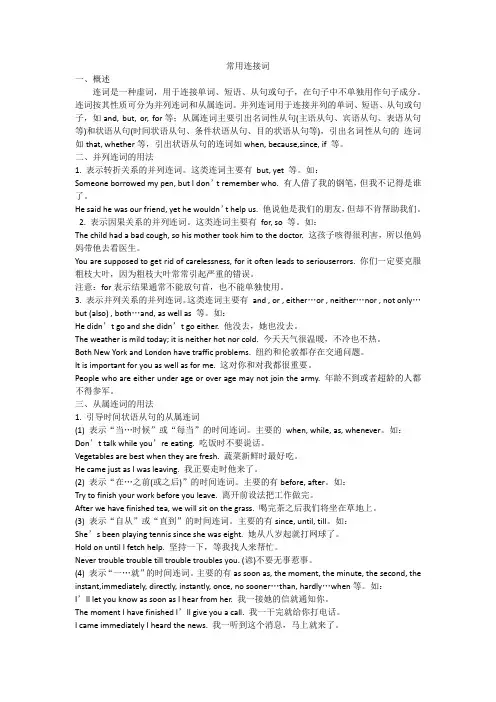
用来连接单词,短语,或句子的词叫连词。
连词是一种虚词,在句中不能单独使用。
2.并列连词
用来连接并列的单词,短语和句子
They sat down and talked about something.
3.从属连词
引导从句
If you work hard, you will succeed.
二、并列连词
1)and “和,以及,而”,表并列
Mary and Lily are both interested in collecting stamps.
2)but ,“但是,然而”,表意思上的转折
She is rich, but she is not kind.
3)or,“或者,否则”,表选择或大约,还可以表示否定的条件相当于“否则”。
Hurry up, or we’ll be late. (等于otherwise)
4)so “因此,所以”,表结果
I didn’t carry glasses with me, so I couldn’t see well.
注意:so不能与because出现在同一个句子中。
5)for “因为”,表原因
I must be off now, for my mother is expecting me.
注意:for不能用于句首,for引导的句子是对前面的原因
作出的解释,因果关系没有because那么直接和紧密。
6)yet “然而,但是,却”,表转折。
You promised to do it for a long time, yet you have done nothing.
注意:yet 通常用来连接一个句子。
7)however “然而,但是,不管用什么方法”,表转折。
He tried very hard, however, he still failed.
注意:however 放中间时,通常用逗号隔开
8)both …and “ …和…,既…也…”,连接的两项必须在结构上对等,不连接句子。
Both he and I are fond of traveling in vacations.
9)either …or “或者…或者,不是…就是”表示两者任选其一,就近原则。
Either he or you are wrong.
10)neither …nor “两者都不,既不…也不”,就近原则。
He is neither in the reading room nor in the classroom.
11)not only … but also “不但…而且”,表递进,就近原则。
This sofa is not only beautiful, but also comfortable.
12)as well as “与…一样”,就远原则。
You as well as I are supposed to respect the old.(谓语动词和第一个主语一致)
13)not...but “不是…而是”
The teacher didn’t scold him,but comforted him.
14) While “而,当…”,表示对比
He is fat while his sister is thin.
15)therefore “因此”,表示结果
I had a headache,therefore I could not go to your party.
三、从属连词
1)引导时间状语从句连词:
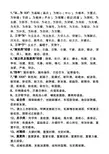
when当…时侯, while在…同时, as当…时, before在…之前, after 在…之后, as soon as一…就, until直到, once一旦,只要.
I was walking in the street when I met an old friend of mine.
While I was doing my homework, someone knocked at the door.
As he grew older, he became more and more handsome.
Never count your chickens before they are hatched.
After the work was done, we had a rest.
I’ll tell him as soon as I see him.
He didn’t go to sleep until he finished his homework.
Once he makes a promise, he will never break it.
2)引导地点状语从句连词:where在哪里,wherever无论在哪里Where there is a will, there is a way.
Wherever he goes, he brings a book with him.
3)引导原因状语从句连词:because因为, since既然, as既然,因为Because he is ill, he is absent today.
Since you say so, I suppose it is true.
As he couldn’t express himself freely, he had to make some gestures.
注意:上面三个词的语气由强到弱
4)引导方式状语从句连词:as像…一样, as if/ as though好像
Do exactly as the doctor says.
They talked as if they had been good friends for years.
5)引导结果状语从句连词:
so that以致于, so…that, 如此…以致such…that 如此…以致Everybody came to the party , so he was very happy.
He was so excited that he could not speak.
I have such a good friend that I will always remember him.
I have had so many falls that I am black and blue all over
注意:so后面接形容词或副词,such后接名词,如果在名词之前有many, much, little, few时,用so, 不用such。
6)引导目的状语从句连词:so that以便, in order that,为了
I will give you all the facts so that you can judge for yourself.
In order that they can have more time for study, they often eat fast food. 7)引导条件状语从句连词:
if如果, unless除非, in case万一, as long as只要
I will come if you invite me.
He won’t sleep unless you tell him a story. (等于if not) In case he comes, let me know.
You can stay in the room as long as you keep clean. 8)引导让步状语从句连词:
although/though虽然, even if/even though即使Although he is old, he is still in good health.
Even if you have a cold, you should complete the job. 注意:although与but 不能同时用于一个句子。