造纸专业英文词汇_
- 格式:docx
- 大小:11.46 KB
- 文档页数:4
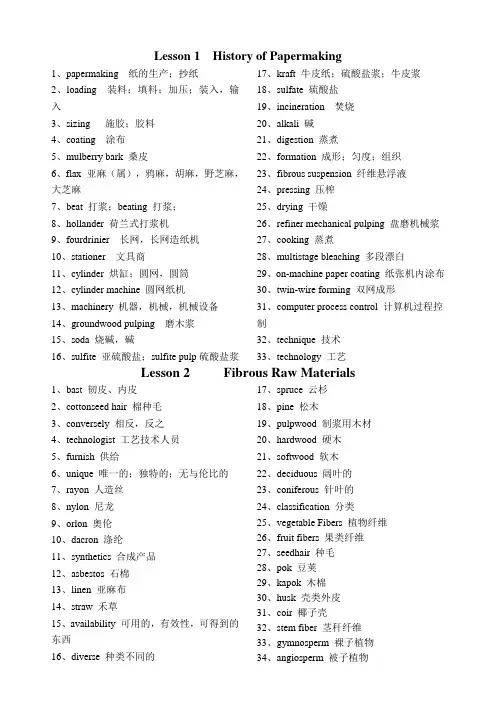
造纸专业英文词汇_
Papermaking is a fascinating industry that has evolved over
thousands of years. From the use of papyrus in ancient Egypt to
the modernization of paper mills, the art of papermaking has
been a crucial element in the growth of civilization. In this article,
we will explore the essential English vocabulary related to
papermaking.
1. Raw materials
The raw materials required for papermaking include wood
chips, recycled paper, and pulp. Wood chips are the most
commonly used raw material in the paper industry and are
obtained from tree trunks that have been debarked and chipped
into small pieces. Recycled paper is another source of raw
material that is commonly used in the production of paper. Pulp is
created by chemically or mechanically breaking down wood chips
or recycled paper.
2. Stock preparation
Stock preparation involves the processing of raw materials to
produce the pulp that is used in the papermaking process. The
primary goal of stock preparation is to create a uniform,
consistent pulp that can be easily formed into paper. Some of the equipment used in stock preparation includes pulping equipment,
refining equipment, screens, and cleaners.
3. Paper machine
The paper machine is the heart of the papermaking process.
It is a massive machine that is capable of producing large amounts
of paper in a continuous process. The paper machine consists of
various components, including forming section, press section, and
dryer section.
4. Forming section
The forming section of the paper machine is where the pulp
is transformed into paper. This section includes the headbox, the
wire section, and the press section. The headbox is where the
pulp is introduced onto the wire section, which is a continuous
belt that carries the pulp through the machine. The press section
is where excess water is removed from the pulp, and the paper is
formed.
5. Press section
The press section of the paper machine is where the paper is
pressed to remove excess water. This section includes various
types of presses, including the suction press, the shoe press, and
the soft-nip press.
6. Dryer section The dryer section is where the paper is dried to its final
moisture content. This section includes a series of steam-heated
cylinders that are arranged in sequence.
7. Calendering
Calendering is a process used to smooth out the surface of
the paper, increase its gloss, and improve its printability. The
calendering process involves passing the paper through a series of
rollers that exert pressure on the paper, compressing and
smoothing it.
8. Coating
Coating is the process of coating the surface of the paper
with various materials to improve its properties. This can include
coatings that make the paper more water-resistant or coatings
that enhance its printability.
9. Finishing
Finishing is the final stage of paper production. It includes a
variety of processes, including slitting, cutting, folding, and
packaging. The finished paper is cut into specific sizes, folded if
necessary, and packaged for shipping.
Conclusion
Papermaking is a complex and fascinating process that
requires knowledge and skill in various fields. With this English
vocabulary related to papermaking, we hope to provide a better understanding of the essential elements of paper production.
Whether you are a student, a researcher, or a layperson,
understanding the language of papermaking will give you insight
into its history, its mechanics, and its relevance to our daily lives.