
Unit1单元语法专题课件人教版英语八年级下册
- 格式:ppt
- 大小:1.81 MB
- 文档页数:26


八年级英语下册单元检测题 (Unit1---Unit5)
听力测试(共20分)
I. 听音选图(本题5小题,每小题1分,共计5分)
根据听到的内容,给下列图片排序,每小题读两遍。
II.情景反应(本题5小题,每小题1分,共计5分)
听句子,选出正确的应答,每小题读两遍。
6. A. He often goes swimming . B. Yes, he does. C. Once a week.
7. A.It’s my pleasure. B.Welcome to Beijing. C. Thank you.
8. A. He’s tired B. She has a toothache . C. I can’t sleep.
9 .A.I am sorry to hear that. B.Bad luck.. C. What’s wrong?
10.A.I’m going by bus . B. I’m going on Friday C. I’m going to Hawaii.
III. 对话理解 (本题5小题,每小题1分,共计5分)
听对话及问题,选择正确答案,每组对话读两遍。
11. The woman goes to the music store_______
A twice a week B once a week C three times a week
12. Jane often ____ on weekends.
A goes fishing B goes shopping C goes exercising
13. Tony shouldn’t tonight.
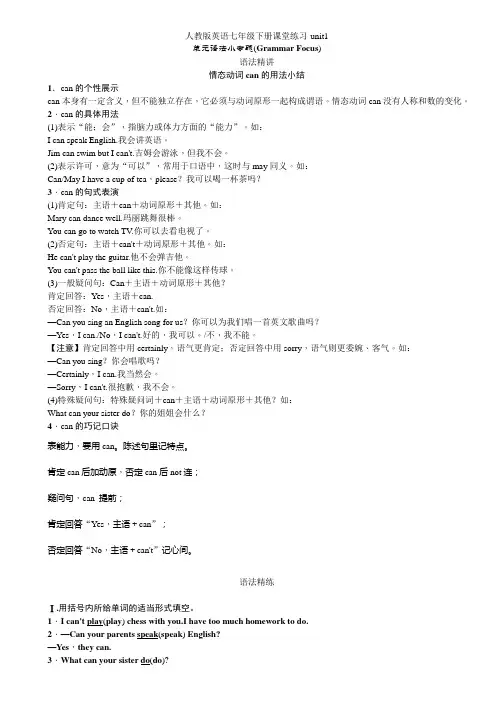
人教版英语七年级下册课堂练习-unit1
单元语法小专题(Grammar Focus)
语法精讲
情态动词can的用法小结
1.can的个性展示
can本身有一定含义,但不能独立存在,它必须与动词原形一起构成谓语。情态动词can没有人称和数的变化。
2.can的具体用法
(1)表示“能;会”,指脑力或体力方面的“能力”。如:
I can speak English.我会讲英语。
Jim can swim but I can't.吉姆会游泳,但我不会。
(2)表示许可,意为“可以”,常用于口语中,这时与may同义。如:
Can/May I have a cup of tea,please?我可以喝一杯茶吗?
3.can的句式表演
(1)肯定句:主语+can+动词原形+其他。如:
Mary can dance well.玛丽跳舞很棒。
You can go to watch TV.你可以去看电视了。
(2)否定句:主语+can't+动词原形+其他。如:
He can't play the guitar.他不会弹吉他。
You can't pass the ball like this.你不能像这样传球。
(3)一般疑问句:Can+主语+动词原形+其他?
肯定回答:Yes,主语+can.
否定回答:No,主语+can't.如:
—Can you sing an English song for us?你可以为我们唱一首英文歌曲吗?
—Yes,I can./No,I can't.好的,我可以。/不,我不能。
【注意】肯定回答中用certainly,语气更肯定;否定回答中用sorry,语气则更委婉、客气。如:
—Can you sing?你会唱歌吗?
—Certainly,I can.我当然会。
—Sorry,I can't.很抱歉,我不会。
(4)特殊疑问句:特殊疑问词+can+主语+动词原形+其他?如:

Unit1 What’s the matter?
一、重点短语归纳
Section A:
have a cold 感冒 have a stomachache 胃痛 have a sore throat 嗓子痛
too much 太多 lie down 躺下 take one’s temperature 量体温
have a fever 发烧 have a headache 头痛 sound like 听起来像
take breaks 休息 go to a doctor 去看医生 get off 下车
to one’s surprise使...惊讶的 Thanks to...多亏 in time 及时
right away 立即;马上 get into trouble 陷入麻烦 fall down 摔倒
Section B:
be interested in... 对...感兴趣 be used to 习惯于...... take risks 冒险
because of 因为 run out 用尽 have problems
breathing 呼吸困难
save one’s life 挽救某人的生命 cut off 切除 get out of 离开;从...中出来
be in control of 掌管 the importance of... ...的重要性 give up 放弃
so...that... 如此...以至于...
二、重点词组用法归纳
1、have a/an +疾病名称 “患....病” (ex: have a cold, have a fever)
2、have a sore +身体部位 “.....痛” (ex: have a sore back, have a sore

单元语法小专题Grammar Focus
语法精讲
一、情态动词should和could的基本运用
1.should 应该
(1)should意为“应该”,常用于表示“要求”“劝告”或“建议”。shouldn't为should的否定形式,意为“不应该,不要”。eg:
You have a cold.You should stay at home for a few
days.你感冒了,你应该在家待几天。
The teachers should be friendly to us.They shouldn't
be always very strict.老师应该对我们友好。他们不应该总是严厉。
(2)should作为情态动词,在句中无主语和人称的变化,后接动词原形。含有should的肯定句变为一般疑问句或否定句时,将should提前或于其后加上“not”即可。eg:
Cathy Taylor should help do some chores at
home.→Should Cathy Taylor help do any chores at
home?→Cathy Taylor shouldn't help do any chores at
home.
2.could意为“能;可能”,用于表示能力,许可及猜测等,具体用法如下:
(1)意为“能;能够”,作can的过去式,表示在过去有能力做某事时使用。eg:
My uncle could speak two foreign languages when he was in college.我叔叔在上大学时能说两种外语。
(2)意为“可以;能”,常用于委婉语气句中,这时通常又用于下面两种情况。
第一种:用于礼貌地向别人请求准许。作此用法时,相当于“may”“can”。could 表示的语气比“may”“can” 要委婉得多。eg: