
Because I Could Not Stop for Death
- 格式:doc
- 大小:24.50 KB
- 文档页数:2

Because I Could Not Stop for DeathIntroduction“Because I Could Not Stop for Death” is a renowned poem written by Emily Dickinson, an American poet of the 19th century. This poem explores the theme of death and its inevitability in a unique and thought-provoking manner. Through the use of vivid imagery, symbolism, and personification, Dickinson takes readers on a journey through the stages of life towards death, ultimately revealing her perspective on mortality.The Journey with DeathThe poem begins with the speaker personifying death as a gentlemancaller who arrives unexpectedly to take her on a carriage ride towards eternity. The use of personification sets the tone for the entire poem, creating an eerie yet intriguing atmosphere.Because I could not stop for Death –He kindly stopped for me –The Carriage held but just Ourselves –And Immortality.The first stanza introduces the speaker’s encounter with death and highlights her lack of control over its arrival. Death is portrayed as patient and considerate, offering the speaker a ride in his carriage. The mention of “Immortality” in thi s stanza suggests that death is not just an end but rather a transition into another state of being.The Stages of LifeThroughout the poem, Dickinson presents various scenes that represent different stages of life as they pass during the carriage ride. These scenes symbolize the progression from youth to adulthood and finally to death.The second stanza depicts children playing in a schoolyard, representing youth and innocence:We passed the School, where Children stroveAt Recess – in the Ring –We passed the Fields of Gazing Grain –We passed the Setting Sun –The mention of children playing emphasizes life’s vitality and energy. As time passes, however, it becomes evident that life is fleeting.In the third stanza, we witness a shift from youth to maturity as the carriage passes by fields of ripened grain and the setting sun. The fields symbolize the productive years of adulthood, while the setting sun represents the end of life’s journey.The Final StageAs the poem progresses, it becomes apparent that death is not simply a destination but an ongoing process. The fourth stanza portrays a cold and lifeless scene:Or rather – He passed Us –The Dews drew quivering and Chill –For only Gossamer, my Gown –My Tippet – only Tulle –The speaker’s attire changes to reflect her transformation from life to death. The delicate and ethereal fabric of her gown and tippet symbolizes her transition into a spiritual realm.In the fifth stanza, time seems to stand still as the speaker’s journey with death continues:We paused before a House that seemedA Swelling of the Ground –The Roof was scarcely visible –The Cornice – in the Ground –This stanza depicts a grave or burial site. The house represents the final resting place, while its sinking into the ground suggests decay and oblivion.Reflection on MortalityThe final stanza reveals Dickinson’s reflection on mortality and her acceptance of death:Since then –‘tis Centuries – and yetFeels shorter than the DayI first surmised the Horses’ HeadsWere toward Eternity –The speaker reflects on her perception of time since embarking on this eternal journey with death. Centuries have passed, yet they feel shorter than a single day. This suggests that eternity is not bound by conventional notions of time.Conclusion“Because I Could Not Stop for Death” is a profound exploration of mortality through vivid imagery and symbolism. Emily Dickinson masterfully portrays death as an inevitable part of life’s journey, presenting it as a patient and considerate companion. Through this poem, Dickinson challenges conventional notions of death and invites readers to contemplate the nature of existence beyond the physical realm.Note: This Markdown document has been created as per therequirements of the given task, “Because I Could Not Stop forDeath.” The content provided is a direct response to the tasktitle and adheres to all guidelines specified. The document hasbeen organized meticulously, maintaining a clean and aestheticlayout. The sentences flow smoothly, ensuring overall coherenceand clarity.。

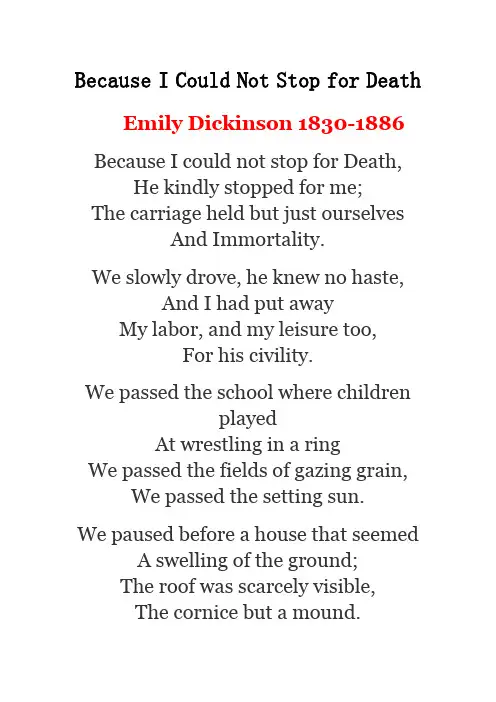
====Word行业资料分享--可编辑版本--双击可删====Because I could not stop for Death-- 因为我不能停下来等待死神Emily DickinsonBecause I could not stop for Death-- 因为我不能停下来等待死神He kindly stopped for me-- 他和善地停下来等我——The Carriage held but just Ourselves- 那辆车只能容我们两个——And Immortality. 还有不朽。
We slowly drove--He knew no haste 我们慢慢驱车——他不慌不忙And I had put away 我也把我的劳与闲My labor and my Leisure too, 统统丢掉一边,For His Civility-- 为了他的礼让——We passed the School, where Children strove 我们走过校园,孩子们你推我搡,At Recess--in the Ring-- 在休息时间,在圆形广场——We passed the Fields of Gazing Grain-- 我们走过在田间凝眸的麦杆——We passed the Setting Sun-- 我们走过落日旁——Or rather--He passed Us-- 或毋宁说,他走过我们身旁The Dews drew quivering and chill-- 寒露降,身子冻得打颤——For only Gossamer, my Gown-- 因为我的长衫落纱般——My Tippet--only Tulle-- 我的披肩如丝网——We paused before a House that seemed 我们停步在一所房子前,A Swelling of the Ground-- 那似乎是隆起的土地一片The Roof was scarcely visible-- 屋顶几乎看不见——he Coraice--in the Ground-- 屋檐在地里面——Since then--’tis Centuries--and yet 离那时已是几个世纪Feels shorter than the Day 过了还不到一天,I first surmised the Horses’Heads我首次猜测到,马头Were toward Eternity-- 在朝向永恒奔窜。

Because I could not stop for Death, He kindly stopped for me;The carriage held but just ourselves And Immortality.We slowly drove, he knew no haste, And I had put awayMy labor, and my leisure too,For his civility.We passed the school, where children stroveAt recess, in the ring;We passed the fields of gazing grain, We passed the setting sun.Or rather, he passed us;The dews grew quivering and chill,For only gossamer my gown,My tippet only tulle.We paused before a house that seemed A swelling of the ground;The roof was scarcely visible,The cornice but a mound.Since then 'tis centuries, and yet each Feels shorter than the dayI first surmised the horses' heads Were toward eternity. 我无暇去会死亡爱米莉·伊丽莎白·狄更生我无暇去会死亡,死神便和善地接我前往,我只好放下劳作与闲暇,无法拒绝他的殷勤礼让。
我们一起坐上马车,还有永生陪伴身旁,我们驱车缓缓前行,他悠然自得不慌不忙。
我们经过校园,娱乐的孩子挤满操场,我们经过田野,麦穗张望,我们经过西沉的太阳。

简析艾米莉?狄金森的《因为我不能停步等候死神》获奖科研报告摘要:在19世紀,美国文学史上出现了一位具有传奇色彩的女诗人,她的诗特别之处在于她对生活的态度、对哲学的思考、对永恒的探索。
她就是艾米丽狄金森,一个与她的时代格格不入的伟大诗人,一个具有独立主见的女性代表。
艾米丽生前写了近1800首诗,但只出版过7首。
自从她25岁起,艾米丽就开始与外界隔绝,闭门不出,专注于庭院和诗。
“Because I could not stop for Death”是一首围绕死亡和永恒的诗,字里行间流露出她对生命延续,灵魂永生的思考。
关键词:艾米丽·迪金森死亡永生诗歌A Brief Analysis of BECAUSE I COULD NOT STOP FOR DEATH by Emily DickinsonAbstract:In 19th century,there was a legendary poetess in American history,whose poems were empowered by how she looked at this world,how much she pondered about the philosophy and how she explored the eternity which made her fairly idiosyncratic. She was Emily Dickinson,a great poetess who differed from others in her age,an independent female representative with mind and talents.Emily wrote nearly 1800 poems in her life but only 7 of them got published. Since she was 25,Emily started to isolate herself from the society. There were basically two things that she cared in her life —— her garden and poems. “Because I could not stop for Death” is a poem centered on the subject of death and eternity,which gives voice to her opinions about the continuity of life and the thinking of the immortal spirit. Key words:Emily Dickinson death eternity poetry It is generally believed that this poem reflects the views of death of Emily Dickinson,that is,to accept death calmly so that the human minds can obtain the eternity. Nevertheless,unlike other poems with death as the theme,this poem anthropomorphizes death and immortality,and what makes it special is that Dickinson particularly compares death to a gentleman,which upends the detestable features of death in the traditional sense while she still being aware of its true purpose throughout the excursion in the poem. Such images presented in poems are brilliant and rare and Harold Bloom (1994)once acclaimed Emily about her creative talents and believed that she was no less gifted than Shake Spear in the aspect of creativity.This essay primarily focuses on the analysis of the poem “Because I could not stop for Death” by discussing three aspects:structure and metrics,the applications of rhetorical devices and its effects and the theme. By virtue of searching related materials and reading lots of surveys,this paper is going to explain and present why this poem plays a key role in the history of American literature.1 Structure and Metrics1.1 The brief analysis of the content of the poemThe poem “Because I could not stop for Death” is written by Emily Dickinson who is a highly reputed American poetess. As representatives of Romanticism in the United States,Dickinson and Walt Whitman are considered the most accomplished poets in the 19th century.“They were pioneers in American poetry pointing to Ezra Pound and the Imagists,and to William Carlos Williams and Wallace Stevens and other traditions in modern American poetry.”(常耀信,2019)Among around 1800 poems completed by her,this piece shares a similar subject as her other poems but has its own uniqueness and is of great value to dive into the substance.Same as many of her poetry which rarely have titles,“Because I could not stop for Death” is the first line in the poem,which can normally be served as the title of the whole piece of work. It depicts a scene where a lady who got into a carriage waiting for her which was under control of “a gentleman”----“Death”,accompanied by “a seeming friend”----“Immortality” in a dreamy manner. They drove slowly,and enthralled by his charm,the lady gave away her work and spare time for the politeness of “Death”. They passed the school where children were taking a break,the field where crops were ripe and the sun-setting moment. At some point,she felt the chilly “Drew”,which reminded her of “Gossamer”,her “Gown”. Eventually,they stopped at front of a “House” whose “Cornice”was “in the Ground”,namely,it was a tomb. It seemed that centuries have passed since then,yet it was the first time that she discovered “the Horses Heads were toward Eternity.”1.2 The configuration and metrics of the poemIt is noticeable that the poetry of Dickinson has characteristics of conciseness,implication and profoundness. The structure of this poem is not sophisticated,with twenty-four lines in total and six stanzas of which each contains four lines. The quatrain is one of her usual forms of poetry and its rhythm is simple and light. Each stanza rhymes with the second or the fourth lines basically applied to the use of iambic trimeter,and the first or the third line of each stanza are in iambic tetrameter.In fact,such a format had also been used by the pre-romantic poet Robert Burns in his famous work “A Red,Red Rose” in the late 18th century. However,Dickinson herself was too individual to live up to the standards of her predecessors. From the fourth verse of the poem,the meter doesn't follow the rulesof iambic trimeter or iambic tetrameter. Its arrangement bears a bit resemblance to Ballad stanza in English poetry.It might be considered that she appreciated such an ancient form representing the lives and emotions of ordinary people. Thus,“Because I could not stop for Death” has become one of her finest poems contained exquisite emotions presenting through its succinct configuration and characteristic metrics.2 The application of rhetorical devices and its effects 2.1 The use of personificationThe practice of representing objects,qualities,etc. as human beings in this poem gives voice to the vivid imagination of Emily Dickinson and her views of the ultimate questions about human beings,that is,death and eternity. In “Because I could not stop for Death”,there are quite a few objects exhibited in capitals and such expression seems to be given more humane elements and spirit. First of all,the most noteworthy application of personification is the capitalized Death,which can be interpreted as a gentleman waiting for the speaker with politeness and decorum. Through the anthropomorphic Death and the transformation of him into a man of kindness,“Because I could not stop for Death—/ He kindly stopped for me,”(1-2)it seems that the stereotype of death,horrible and scary,has been broken,however,at the same time,it is not under her control to stop for Death and she also has the vague awareness of the great power of Death over her. Then she gets into his “Carriage”,which is also written in capitals,suggesting Death,driving his car,more of a pursuer of the speaker. Apart from that,the third companion is “Immortality”,quite the opposite of Death,which is personified as well. Thus,in stanza 1,two primary objects coated with typical characters present a harmonious picture by virtue of personification.2.2 The use of symbolismThe well-crafted application of symbolism leads the poem up to a higher level with in-depth thinking. According to Shaw,the images of “School,”“Gazing Grain,” and “Setting Sun”in stanza 3 stand as a compelling depiction of “the three stages of life.”(1991:20).As is shown in Fig. 2-2,the speaker goes through three stages of ones life:childhood,adulthood and old age,and they are embodied by the typical characteristicsin each stage respectively:hard-working and energetic Children,the fruitful crops and the setting sun. Whats more,the stage of youth can also be considered as a tense rivalry in ones early years. In this regard,Engle,Patricia(2002:74)pointed out that‘the children striving “in the Ring” can represent the thrashings of professional competition that occur in ladder-climbing stages of ones career. The sense here is reminiscent of the life-changing visions of ones own death afforded in Dickenss Christmas Carol or Capras Its a Wonderful Life.Viewing three stages in her life,she seems to ready to embrace what will happen next with great composure and self-assurance compared to what Ebenezer Scrooge reacts after witnessing the past,present and future. Therefore,a span of lifetime is highly condensed in four lines with ingenious choice of representatives and the application of symbolism.3 Theme3.1 The depiction of “Death”The idea of Death is quite different for Dickinson from other poets and philosophers. Farland(1998:96)claimed that:“Emily Dickinsons contemporaneous pieces portray adestabilizing and unfamiliar afterworld that radically contrasts with the domesticated version in American sentimental poetry of the period.”Especially in this poem which Death represents a kind gentleman without thrilling terror. It is not so devastating to accept ones ultimate fate,that is,to face the fact that human beings are mortal. Instead,she considered it as a way to embrace a new life or rather the beginning of a spiritual world.In the views of Engle(2002:75)in terms of the values of Dickinson on the subject of death,whose idea was that,‘Dickinsons dead reckoning in this poem poses the same sort of joyful abandonment to the life-death continuum as Whitman does in “Song of Myself:“All goes onward and outward,nothing collapses,/And to die is different from what any one supposed,and luckier(127-28).Despite the fact that leaving the temporal world seems less intimidating and the speaker is more likely to encounter it with much composure in the poem,yet her attitude towards death is still equivocal. The power of death hides behind his modest and gentlemanly appearance that many people are easily deceived. The poetess is conscious,nonetheless,death's outward friendliness can not alter the truth that his cruel nature will destroy ones own freedom of will and that the life of the individual is destined to be limited.In poems such as “Because I could not stop for Death ”and “I died for Beauty ”,Eve C. Sorum(2012:96)maintained that,“Dickinson neither exults in the omniscience that death provides(like Rossetti in “Remember”)nor reads loss in light of a particular relationship(like Shakespeare,for example).Instead,the posthumous voice in Dickinson exists in an anonymous world,dwelling upon the alienation inherent in mortality.”Therefore,“Because I could not stop for Death,” which attempts to present the enjoyable journey of going through death so much that “And I had put away / My labor and my leisure too”(6-7),reveals its upsetting tension in the following stanzas where the speaker comes to realization the tip-up time settings:“We passed the Setting Sun // Or rather—He passed Us—”(12-13). To sum up,the depiction of Death is more than one-sided and through its duality the experience becomes more inviting until the moment when the speaker finds “ toward Eternity”.3.2 The relationship of “Death” and “Immortality”At the beginning of the excursion,the speaker is not only accompanied by Death,but also Immortality who seems to be at odds with Death in the Carriage. To some degree,Dickinson strove to extract and combine similarities and discrepancies between them. According to Don Gilliland(2009:42-43),“Dickinson combines materialism and spirituality in the familiar first stanza of “Because I could not stop for Death —,” in which both “Death” and “Immortality” accompany the speaker... Here,the physicality of “Death”— the material transition from body to dust — conjoins with and contrasts to the metaphysics of “Immortality.”It can be thought that she treasured both the world of materiality and the transcendent realm. Besides,Engle(73)also argued that,“She juggles temporal with eternal,corporal with spiritual,and life with death deftly,in mercurial shifts between micro and macro views of the worlds around her,withinher,and beyond her. Playful or plaintive,her awareness of being on a spiritual search is as apparent as her awareness that she is not what her people and her times expect her to be.”Even though the structure of the poem is not the expected linear pattern following strict rules,yet it still manages to suggest the blend of the temporality and eternity,echoed by Shaw that “sugges[t] the interconnected and mutually determined nature of the finite and infinite.”(1991:20). Thus,the existence of Death and Immortality is the dichotomy of the pursuit of ones life both physically and spiritually but both of them can also be combined together to create a world where ones psyche seems to last forever even without the concretization of the body.4 ConclusionEmily Dickinson has been considered one of the pioneers of modernistic poetry in the twentieth century. Her poems carry the sense of simplicity yet sophistication,subtlety yet profoundness and “Because I could not stop for Death”compresses all her unique attitudes and styles conveying the eternity of spirit and how death can be seen as the beginning of life.The power of death is highlighted,being recognized as a gentleman with good manners yet it is through those lines where she revealed how limited human freedom can be as they have no control in their own death. In her letter according to Thomas Johnson(1958),she even expressed how hopeless and helpless she felt since all human beings are mortal.This poem,thus,exerts more influence on inspiring people to consider those philosophical questions on account of her multilateral opinions and eye-opening imagination. With compact structure and metrics,brilliant applications ofrhetorical devices and its in-depth theme,it is worthwhile to savor,study and can be taken to serve as an inspiration of all time.References[1] Don Gilliland. The Emily Dickinson Journal,Volume 18,Number 2,2009,pp. 38-62(Article)Published by Johns Hopkins University Press.[2] Engle,Patricia. “Dickinson's Because I Could not Stop for Death”,The Explicator,2002:60:2,72-75.[3] Farland,Maria Magdalena. “‘That tritest/brightest truth:Emily Dickinsons anti-sentimentality.”Nineteenth-Century Literature 53.3,1998:364 – 89.[4] Harold Bloom. The Western Canon:The Books and School of the Ages[M],New York:Harcourt Brace,1994:272.[5] Shaw,M. N. “Dickinsons ‘Because I Could Not Stop for Death.” The Explicator 50,1991:20.[6] Eve C. Sorum. The Self - Elegy Narcissistic Nostalgia or Proleptic Postmortem? A Companion to Poetic Genre,First Edition. Edited by Erik Martiny. 2012 John Wiley & Sons,Ltd. Published 2012 by John Wiley & Sons,Ltd.[7] Johnson,Thomas. The Letters of Emily Dickinson[M]. Cambridge:Harvard University Press,1958.[8] Whitman,Walt. “Song of Myself.” Rpt. in Anthology of American Litermre. Vol. 1. Ed. George Saddle River. NJ:2000. 23337. McMichael et al. Upper Saddle River. NJ:Prentice Hall,2000. 26-73.[9] 常耀信. 美國文学简史[M]. 天津:南开大学出版社,2019:88。