Death Be Not Proud,text John Donne
- 格式:doc
- 大小:28.50 KB
- 文档页数:2
HOLY SONNETS.
X.
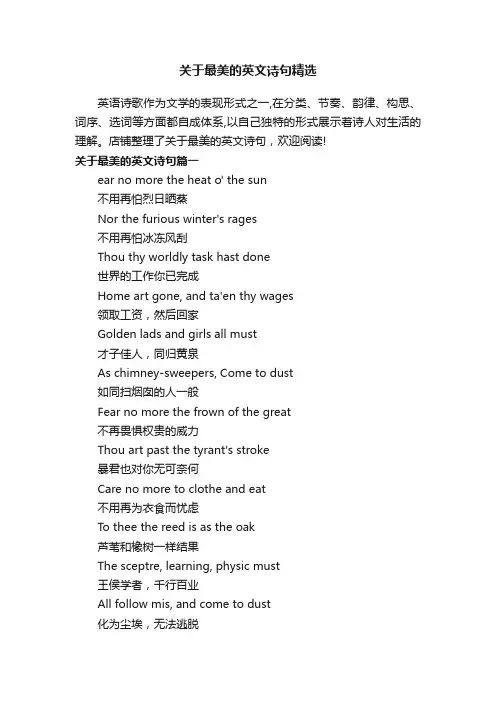
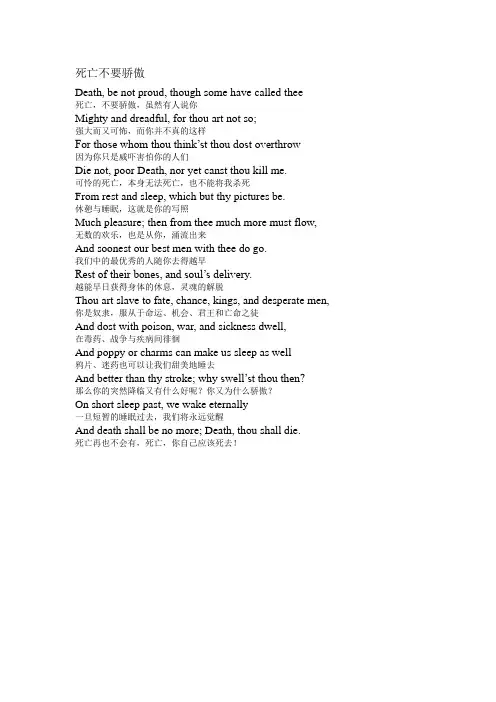
Death, be not proud, though some have called thee Death is personified
Mighty and dreadful, for thou art not so ;
For those, whom thou think'st thou dost overthrow, overthow:does destroy(kill)
Die not, poor Death, nor yet canst thou kill me.
From rest and sleep, which but thy picture[s] be, which is just a picture of you; you are just like
rest and sleep
Much pleasure, then from thee much more must flow,
And soonest our best men with thee do go, [Whom the gods love die young, a phrase
used by Plautus who translated it form an
ancient Greek proverb
Rest of their bones, and soul's delivery. The sooner, the better their bodies get rest and…
Thou'rt slave to Fate, chance, kings, and desperate men,
And dost with poison, war, and sickness dwell, dwell with: mingle/associate with
And poppy, or charms can make us sleep as well,
And better than thy stroke ; why swell'st thou then ?
One short sleep past, we wake eternally,
And Death shall be no more ; Death, thou shalt die.
Rhyming:
Written roughly in Petrarchan pattern, rhyming abba, abba, , cecd, ae(irregular)
Death be not proud: Some critics argue that Donne's speaker is trying to
convince himself that death is not to be feared, and failing dismally;
the poems various arguments do not at all address the speaker's basic fears.
For example, he argues on flimsy evidence that death must be better than
sleep (5-6), then that sleep is better than death (11-12). The last 4 words
of the poem, which should crown the argument, actually undermine it: if
death is nothing to be afraid of, the speaker can hardly use it as a threat.
As John Carey notes, "He stamps his foot with fine dramatic conclusiveness,
and plummets straight through a trapdoor. It spoils the act, but improves
the poem, for it shows how little its reasonings have impinged on the
speaker's basic fears." Carey's insight into this poem is generalized by
R.T Jones: it is frequently claimed that Donne's poetry shows a complete
union of thought and feeling, but Jones argues that what we usually get
is the exact opposite, a sense of conflict or tension between what the heart wants to be true or fears to be true and what the mind knows or can
argue; a sense of the poet always trying to convince himself of something.
We noted this possibility in A Valediction: Forbidding Mourning. Jones
cites D.H. Lawrence's statement that belief is a profound emotion that
has the mind's connivance. On "Death be not proud", he points out that
given his academic training, Donne must have known how bad the arguments
are; that their very badness must be taken as part of the meaning of the
poem. If we accept his contention that when Fate overwhelms you with a
flood or chance directs lightening to your head, or a king has your head
cut off or a desperate man cuts your throat, then death has no choice
but to come to you (and hence is a slave to these things), then perhaps
we will be less scared of Death as an abstraction, whatever that may mean,
but simply transfer our terror, undiminished, to fate, chance, kings,
and desperate men-leaving our predicament, if anything, somewhat worse.
But we would not be thinking in terms of terror at all if we had taken
seriously the earlier arguments, e.g., "from rest and sleep"-we don't take
this seriously because a) we do not really accept that the relation between
death and sleep is in all important respects the same as the relation
between a picture and the thing depicted; and b) we cannot really believe
that if a picture gives us pleasure the thing it depicts must necessarily
give us more pleasure. We have been watching a conjuring trick: we don't
believe the skull has been turned into a rabbit, but we admire the
sleight-of-hand. Others argue that Donne's personification of death is
a rhetorical device, aimed at cutting Death down to size, and the crisp
cross-talk of quip and witticism shows how well he knows he can't really
get away with it. Even if there are moments of real conviction (7-8), a
blustering sophistry dominates. Fear of death is paraded like a captive
slave and publicly routed, but it is never met on the level where it really
presses. Is this because a) the speaker is so thoroughly convinced of the
Christian doctrine of the afterlife that he genuinely has no fear of death
and just wishes to mock it? or b) the fear of death is so powerful within
the speaker that none of the arguments, including the Christian one,
actually convince him deep down?