
情态动词讲与练
- 格式:ppt
- 大小:1.09 MB
- 文档页数:52

小学情态动词的句型转换讲解及练习情态动词是英语语法中的一个重要组成部分,是文章中用于表达推测、猜测、建议等含义的动词。
小学阶段是英语语言研究的重要时期,因此了解情态动词的正确使用十分必要。
什么是情态动词情态动词是一种助动词,常常用于表示某种能力、必要性、愿望、推测等情况。
动词本身表示的是动作或状态,而情态动词则表示说话人的态度或语气。
常见的情态动词有:- can- could- may- might- must- shall- should- will- would情态动词的句型转换在句子中,情态动词的位置可以变化,因此我们可以利用这一点来进行句型的转换。
以下是一些常见的情态动词句型转换:1. 直述句→ 疑问句直述句:They can swim.疑问句:Can they swim?2. 直述句→ 否定句直述句:He should finish his homework.否定句:He should not finish his homework.3. 直述句→ 疑问句+否定句直述句:You may eat the cake.疑问句+否定句:May you not eat the cake?现在我们来做一些练,更好地掌握情态动词的句型转换。
练题1. 直述句:They can play the guitar.疑问句:否定句:2. 直述句:She should go to bed early.疑问句+否定句:3. 直述句:I will finish my homework tomorrow.否定句:疑问句+否定句:练答案1. 直述句:They can play the guitar.疑问句:Can they play the guitar?否定句:They cannot play the guitar.2. 直述句:She should go to bed early.疑问句+否定句:Shouldn't she go to bed early?3. 直述句:I will finish my homework tomorrow.否定句:I will not finish my homework tomorrow.疑问句+否定句:Won't I finish my homework tomorrow?以上是小学情态动词的句型转换讲解及练习,希望能对您有所帮助。

第讲10 情态动词题型一情态动词基本用法的考查1.(2024·江苏省常州市联盟校调研)Altman said the technology could (use) for disinformation, emotional manipulation, or even “target drone strikes.”【答案】be used【解析】考查情态动词及语态。
句意:Altman说,这项技术可以用于虚假信息、情绪操纵,甚至是“无人机打击目标”。
这里为本句谓语动词,出现在情态动词之后,用动词原形;主语为“the technology”,和动词“use”之间为被动关系。
故填be used。
2.(2024·河北省月考)The fact can (confirm) by a quick search on the Internet. This bowl of hot spicy delight seems simple but has contributed to noodle chains across Beijing.【答案】be confirmed【解析】考查情态动词及语态。
句意:这一事实可以通过在互联网上快速搜索得到证实。
分析句子,句中the fact和confirm之间是被动关系,同时该空置于情态动词can之后,故使用情态动词的被动语态。
故填be confirmed。
3.(2024·天津·二模)—Sorry, Tony. I’m too busy to attend the meeting this Saturday.—Well, you ________ attend it if you truly can’t spare the time.A.shouldn’t B.needn’t C.can’t D.mustn’t【答案】B【解析】考查情态动词。
句意:——对不起,托尼。
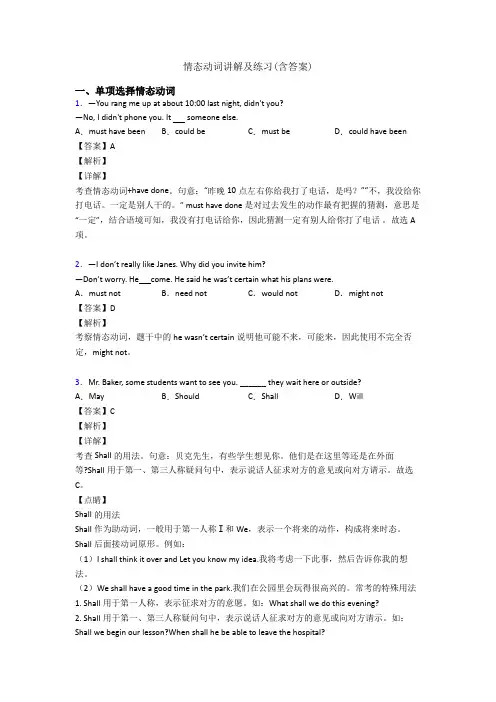
情态动词讲解及练习(含答案)一、单项选择情态动词1.—You rang me up at about 10:00 last night, didn't you?—No, I didn't phone you. It someone else.A.must have been B.could be C.must be D.could have been 【答案】A【解析】【详解】考查情态动词+have done。
句意:“昨晚10点左右你给我打了电话,是吗?”“不,我没给你打电话。
一定是别人干的。
” must have done 是对过去发生的动作最有把握的猜测,意思是“一定”,结合语境可知,我没有打电话给你,因此猜测一定有别人给你打了电话。
故选A 项。
2.—I don’t really like Janes. Why did you invite him?—Don’t worry. He come. He said he was’t certain what his plans were.A.must not B.need not C.would not D.might not【答案】D【解析】考察情态动词,题干中的he wasn’t certain说明他可能不来,可能来,因此使用不完全否定,might not。
3.Mr. Baker, some students want to see you. ______ they wait here or outside?A.May B.Should C.Shall D.Will【答案】C【解析】【详解】考查Shall的用法。
句意:贝克先生,有些学生想见你。
他们是在这里等还是在外面等?Shall用于第一、第三人称疑问句中,表示说话人征求对方的意见或向对方请示。
故选C。
【点睛】Shall的用法Shall作为助动词,一般用于第一人称Ⅰ和We,表示一个将来的动作,构成将来时态。

助动词与情态动词讲解及练习题TPMK standardization office【 TPMK5AB- TPMK08- TPMK2C-助动词与情态动词一、助动词助动词有be, have, do, will, shall。
它们本身没有词义,只和实义动词的一定形式构成复合谓语,用来表示时态和语态,构成否定、疑问及加强语气等。
1、be (am, is, are, were, been)(l)“be + -ing”构成进行时态;(2)“be + 过去分词”构成被动语态;(3)“be + 动词不定式”构成复合谓语:①表按计划安排要发生的事。
The prime minister is to visit Japan next year.总理将于明年访问日本。
②用于命令。
You're to do your homework before you watch TV.你得做完了作业才能看电视。
2、have (has, had)(1)“have+过去分词”构成完成时态。
如:Have you seen the film(2)“have been + -ing”构成完成进行时态。
如:What have you been doing these days 这些日子你一直在干什么?3、do (does, did)(1)“do not + 动词原形”构成行为动词的否定式。
如:His brotherdoesn’t like playing basket.;(2)“Do + 主语 + 动词原形”构成行为动词的一般疑问句。
Does he go toschool by bike every day (3)“do + 动词原形”用于祈使句或陈述句中表示加强语气。
如:I did go to see him, but he wasn’t in我确实去看望他了,但他不在家。
Do do some work. 请一定做点什么;(4)代替前面刚出现的动词以避免重复。