
Unit10 Section B(2a-2c) 人教版七年级英语下册
- 格式:pptx
- 大小:3.90 MB
- 文档页数:34


锦屏中学2016-2017学年下学期七年级
同课异构公开课教案
科目 英语 教师 赵向明 学校 锦屏中学
课题 Unit 10 I'd like some noodles.
Section B(2a-2c)
一、教学内容分析
本部分为Section B的阅读部分,2a-2c的阅读部分介绍了世界各地的人们庆祝生日时不同的饮食文化,内容紧扣单元话题,开阔了学生的视野,还渗透了文化意识的培养。
本部分的教学重点是巩固学生对单元功能和语法结构的理解,通过阅读短文了解不同国家的饮食文化。教学难点是阅读语篇教学,教师不仅要让学生抓住文章的大意细节信息,讲解文章中一些常见又实用的词汇和短语,同时,在教学中还需要渗透中西方文化比较和文化理解的内容。
二、教学目标
知识目标:
1)掌握以下词汇:world, answer, different, cake, candle, age, blow, blow out, if, will, UK,
candy, lucky, popular, cut up idea
2) 能掌握以下句型:
① The answer would be different in different countries.
② The number of candles is the person's age.
③ In China, it's getting popular
能力目标:通过训练,提高阅读的能力,运用不同的阅读技巧完成不同的任务。
情感目标:该部分学习内容贴近学生的生活,谈论的主题涉及食物名称,世界各地的人们庆祝生日时的不同饮食文化,使学生们具有初步的世界文化观念,体会学习英语“在用中学”“在学中用”的乐趣。
三、教学策略选择与设计
Reading strategies
四、教学重点及难点
1. 教学重点:
1) 阅读中出现的重点词组;
2)通过进行说、读的训练,来提高学生们综合运用所学知识的能力。

Unit10 Where did you go on vacation?
Subject English Project Unit10Section A 1a—1c No.
055
Designer
Language goal Talk about past
events
【学习目标】
1、学会谈论过去发生的事件—学习一般过去时的用法
2、掌握规则动词的变换规则
3、熟记一些常用的不规则动词
【准备与热身】
1. What do you usually do on your vacation?
2. Where do you usually go on your vacation?
【展示与呈现】
1. Where did you go on your last vacation?
2. What did you do on your last vacation?
3. How was your last vacation?
4. Listen to the tape, finish 1b
【活动与反馈】
Pairwork
Ask and answer in pairs like 1c
【归纳与总结】
一般过去时是谈论过去最常用的时态,它可以表示短暂且很快就完成的动作或事情,也可以表示时间较长的动作或状态以及重复发生的事情,句子中通常有特定的表示过去的时间状语。
(1)常用的一般过去时的时间状语
just now刚才 the day before yesterday前天 a moment ago一会儿以前
last week(month)上周(月) in the past从前
(2)一般过去时的陈述句和疑问句形式。陈述句形式只是将be动词或行为动词改为一般过去式;而疑问句形式为be动词/助动词do/does的过去式did放在主语之前,回答时用yes或no。
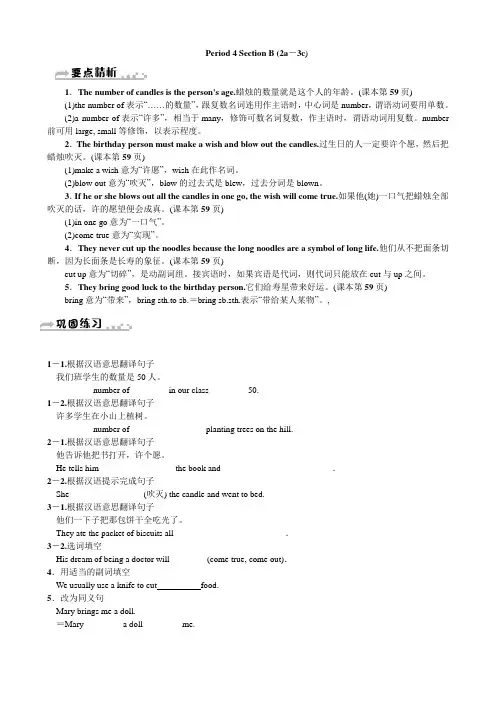
Period 4 Section B (2a-3c)
1.The number of candles is the person's age.蜡烛的数量就是这个人的年龄。(课本第59页)
(1)the number of表示“……的数量”,跟复数名词连用作主语时,中心词是number,谓语动词要用单数。
(2)a number of表示“许多”,相当于many,修饰可数名词复数,作主语时,谓语动词用复数。number前可用large, small等修饰,以表示程度。
2.The birthday person must make a wish and blow out the candles.过生日的人一定要许个愿,然后把蜡烛吹灭。(课本第59页)
(1)make a wish意为“许愿”,wish在此作名词。
(2)blow out意为“吹灭”,blow的过去式是blew,过去分词是blown。
3.If he or she blows out all the candles in one go, the wish will come true.如果他(她)一口气把蜡烛全部吹灭的话,许的愿望便会成真。(课本第59页)
(1)in one go意为“一口气”。
(2)come true意为“实现”。
4.They never cut up the noodles because the long noodles are a symbol of long life.他们从不把面条切断,因为长面条是长寿的象征。(课本第59页)
cut up意为“切碎”,是动副词组。接宾语时,如果宾语是代词,则代词只能放在cut与up之间。
5.They bring good luck to the birthday person.它们给寿星带来好运。(课本第59页)
bring意为“带来”,bring sth.to sb.=bring sb.sth.表示“带给某人某物”。,

.
下载后可自行编辑修改,页脚下载后可删除。 Unit 10 I’d like some noodles.Section B
一、根据句意及汉语提示完成单词。
1.It’s good for children to have some (鱼).
2.People from Shandong love to eat (烙饼).
3.The teacher always wants his students to find (不同的)ways to solve questions.
4.Please put the (蜡烛)in the birthday cake.
5.Who can give the best (答案)to the question?
6.We are so (幸运)to have a good teacher.
7.Li Lei often helps others,so he is very (受欢送的)in our school.
8.Can you (吹)out the candles in one go?
二、用括号内所给名词的适当形式填空。
1.I like (potato)and (tomato).
2.Give him a bowl of (noodle).
3.There are many (strawberry)on the table.
4.He has two (egg)and some (bread)for breakfast.
5.My sister likes (orange),but she doesn’t like (orange)juice.