
人教版八年级上Unit 9 Can you come to my party Section B 3a-3c第五课教学课件(共15张PPT)
- 格式:ppt
- 大小:929.00 KB
- 文档页数:15

Unit 9 Can you come to my party?1、主要词汇动词(V):prepare 使...准备好;hang 悬挂,垂下;catch 赶上,接住(某物);invite 邀请;accept 接受;refuse 拒绝;reply 答复;forward 转寄;delete 删除;Print 打印;名词(N):exam考试;flu流感;weekday 工作日;invitation 邀请;preparation准备工作;glue 胶水;opening 开幕式;concert 音乐会;event 事项;guest 客人;calendar 日历;daytime 白天形容词(adj):available 有空的,可获得的;sad 难过的;surprised 惊讶的;介词(prep):until 直到...为止;without 没有;2、Can you come to my party on Saturday afternoon?星期六下午你可以来我的派对吗?①向别人发出邀请,或者征求他人意见常见句式:Can you do sth?你可以/能做.......吗?Can you swim?Could you do sth?(更加委婉)Could you please turn down the radio?Would you like to do sth?你愿意做某事吗?Would you like to have some tea?Let ’s do sth !让我们来做某事吧!Let ’s prepare for the test together!How/ what about doing sth?做某事如何?How/ what about having a rest?接受邀请的回答:Sure,I ’d love to 当然,我很乐意!Sure,that sounds great!当然,听起来很不错!of course / certainly 当然可以拒绝邀请的回答:Sorry,I ’m not available抱歉,我没有空available. adj. 有空的Sorry,I ’not freeI ’d love to,but ......I ’d love to,but I ’m afraid I can’t,我很愿意,但我害怕/担心我不能......—Would you like to visit the museum?—______A.Yes,please B.Sure,I'd love to C.Sorry,I wouldn't. D.Yes,I would.—Jim, would you like to go hiking with me next Friday?—________. When shall we leave?A. Yes, I’d love toB. Sorry, I can’tC. Yes, I wouldD. No, I wouldn’tTom______(can)come to my party because he is ill.②on Saturday afternoon在星期六下午在表示具体某天时,前面要用介词onOn weekend 在周末On Monday 在星期一On December 1st在12月1号On Wednesday morning/afternoon/evening 在周三早上/下午/晚上—My mother is ill.I have to look after her at home.—______.A.Thank you B.Oh,I don't know C.Bad luck D.I'm sorry to hear that3、prepare for an exam 为考试准备Prepare for... 为...而准备I can’t go with you because I have to prepare for the coming test我不能和你一起去,因为我必须得为即将到来的考试做准备Prepare sb for sth 使某人为某事做好了准备We must prepare ourselves for the meeting我们必须使我们自己为这次会议做好准备Prepare sth for sb 为某人准备好了某物Mom prepares a delicious meal for us 妈妈为我们准备了好吃的饭菜Prepare to do sth 准备做某事I prepare to take a trip in Taiwan 我准备去台湾旅游4、exam 是examination的缩写,意为“考试”Test ,也是“考试”的意思Take / have an exam 参加考试Pass the exam 通过考试/ 考试及格Fail the exam 考试不及格5、go to the doctor 去看医生6、Have the flu 患流感/感冒了Have的原意,“有”Have English class 上英语课Have breadfast 吃早餐Have a cold 感冒have a fever 发烧have a headache头痛Have a cough咳嗽have a sore throat喉咙痛have a toothache牙痛7、Sam isn’t leaving until next Wednesday 萨姆不会离开直到下周三为止萨姆下周三才会离开Until 直到......为止Not......until...... 不会做某事直到......为止直到......才......The noise didn’t stop until midnight 噪音直到午夜才停止She won’t forgive us until we say sorry to her 我们道歉前她是不会原谅我们的I waited until three o’clock 我们一直等到三点钟He lived with his parents until he got married 他结婚前一直和父母住在一起8、Can you hang out with us on Monday night?周一晚上你可以陪我们一起逛逛吗?Hang out with sb 和某人一起闲逛Hang out 闲逛/逛街He likes reading and he often hangs out in the bookstores他喜欢阅读所以经常在书店闲逛Hang,动词,“悬挂”,hang-hungHang the picture on the wall 把这幅画挂在墙上9、I’m afraid not 恐怕不能Afraid,形容词,意为“害怕的”否定时:I ’m afraid not 恐怕不能肯定时:I ’m afraid so 恐怕如此—Can you go to the concert?你能去听音乐会吗?—Sorry. I ’m afraid not 对不起,恐怕不能—Has she missed the bus?她错过公交了吗?—I ’m afraid so 恐怕如此/恐怕是这样没错10、invite,动词,意为“邀请”I nvite sb to sp,邀请某人到某地My pen pal invites me to his hometown 我笔友邀请我去他的家乡Invite sb to do sth,邀请某人做某事Mr.Kim invites us to have dinner with him 金先生邀请我们和他一起共用晚餐Invite(v)→invitation(n)邀请My best friend often invites me ______ delicious food.A.enjoy B.enjoying C.enjoyed D.to enjoy11、accept,动词,接受Accept的近义词是receive,但二者有所区别accept 与receive的区别:accept 意为“接受”指主观上原意接受receive 意为“收到”指客观上收到或拿到某样东西She accepted my apology她接受了我的道歉He received many letters from his family他收到很多来自家里的信件Receive letter from sb 收到某人的信I received his gift yesterday,but I wouldn’t like to accept it昨天我收到了他的礼物,但是我不想接受它12、refuse,动词,拒绝accept 的反义词Refuse sth 拒绝某物He rufused the invitation from Tony 他拒绝了Tony的邀请Refuse to do sth 拒绝做某事You should’t refuse to help her 你不应该拒绝帮助她13、the day before yesterday昨天(过去式)the day after tomorrow 后天(将来时)He went for Beijing the day before yesterday 他昨天去北京了Sarah will go for Beijing the day after tomorrow萨拉后天去北京—My father is coming back on Wednesday.—Oh, today is Monday, so you can see your father ______.A. todayB. the day before tomorrowC. tomorrowD. the day after tomorrow14、weekday 与weekendWeekday 工作日(周一至周五其中一天)Weekend周末(周六至周日)15、What ’s today?直译:今天是什么?引申:今天是什么日子?What ’s today?用来提问今天是几号、星期几。
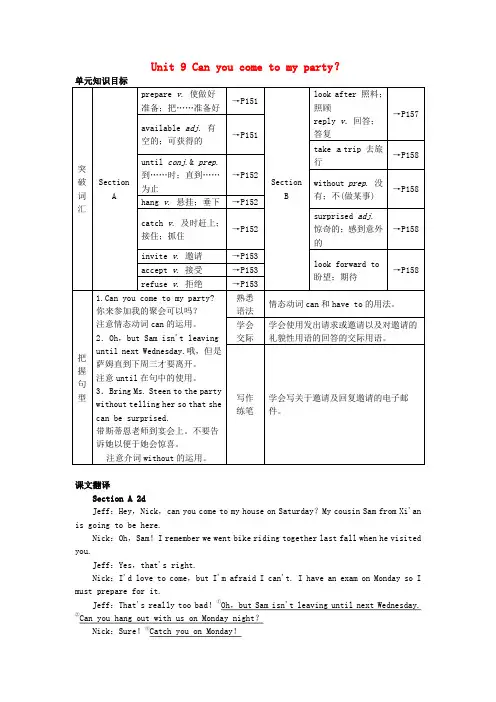
Unit 9 Can you come to my party?突破词汇SectionAprepare v. 使做好准备;把……准备好→P151SectionBlook after 照料;照顾reply v.回答;答复→P157 available adj. 有空的;可获得的→P151take a trip 去旅行→P158 until conj.& prep.到……时;直到……为止→P152without prep. 没有;不(做某事)→P158hang v. 悬挂;垂下→P152catch v. 及时赶上;接住;抓住→P152surprised adj.惊奇的;感到意外的→P158invite v. 邀请→P153look forward to盼望;期待→P158 accept v. 接受→P153refuse v. 拒绝→P153把握句型1.Can you come to my party?你来参加我的聚会可以吗?注意情态动词can的运用。
2.Oh,but Sam isn't leavinguntil next Wednesday.哦,但是萨姆直到下周三才要离开。
注意until在句中的使用。
3.Bring Ms. Steen to the partywithout telling her so that shecan be surprised.带斯蒂恩老师到宴会上。
不要告诉她以便于她会惊喜。
注意介词without的运用。
熟悉语法情态动词can和have to的用法。
学会交际学会使用发出请求或邀请以及对邀请的礼貌性用语的回答的交际用语。
写作练笔学会写关于邀请及回复邀请的电子邮件。
课文翻译Section A 2dJeff:Hey,Nick,can you come to my house on Saturday?My cousin Sam from Xi'an is going to be here.Nick:Oh,Sam!I remember we went bike riding together last fall when he visited you.Jeff:Yes,that's right.Nick:I'd love to come,but I'm afraid I can't. I have an exam on Monday so I must prepare for it.Jeff:That's really too bad!①Oh,but Sam isn't leaving until next Wednesday.②Can you hang out with us on Monday night?Nick:Sure!③Catch you on Monday!杰夫:嘿,尼克,星期六你能来我家吗?我来自西安的表弟萨姆打算到这儿。

人教版英语八年级上册Unit 9《Can you come to my party》教学设计一. 教材分析人教版英语八年级上册Unit 9主要讲述了关于邀请别人参加聚会的情境。
通过本单元的学习,学生能够掌握与聚会相关的词汇和表达方式,学会如何礼貌地邀请别人,并能够用英语进行简单的交流。
本单元的核心句型是“Can you come to my party?”,以及回答“Yes, I can.”和“No, I can’t.”。
二. 学情分析八年级的学生已经具备了一定的英语基础,能够听懂并运用简单的英语进行交流。
他们对学习英语有浓厚的兴趣,并且愿意积极参与课堂活动。
然而,部分学生可能在口语表达和听力方面还存在一定的困难,需要教师的引导和帮助。
三. 教学目标1.知识目标:学生能够掌握与聚会相关的词汇和表达方式,学会如何礼貌地邀请别人,并能够用英语进行简单的交流。
2.能力目标:学生能够听懂并运用核心句型“Can you come to my party?”进行交流,提高口语表达能力。
3.情感目标:学生能够在课堂上积极参与,培养合作意识和团队精神。
四. 教学重难点1.重点:学生能够听懂并运用核心句型“Can you come to my party?”进行交流。
2.难点:学生能够正确使用情态动词“can”来表达自己的能力。
五. 教学方法1.情境教学法:通过创设真实的聚会情境,激发学生的学习兴趣,提高他们的口语表达能力。
2.交际法:通过小组讨论和角色扮演等方式,培养学生的合作意识和团队精神。
3.任务型教学法:通过完成各种任务,引导学生主动参与学习过程,提高他们的自主学习能力。
六. 教学准备1.教学材料:教材、多媒体课件、录音机、磁带或音频文件。
2.教学环境:教室布置成聚会场景,悬挂气球、彩带等装饰物。
七. 教学过程1.导入(5分钟)教师以提问的方式引导学生回顾已学过的与聚会相关的词汇,如“birthday party”、“house party”等。