高一英语Unit-4-Earthquakes-导学案
- 格式:doc
- 大小:109.00 KB
- 文档页数:6
Unit 4 Earthquakes 导学案
2011-2012学年第一学期高一英语绿色课堂
Period 1◆ Warming up, Pre-reading, Reading, &Comprehending
运用说明&学法指导 1.在预习时要把课文通读两遍,先(第一轮)通读教材,完成表层理解题,(其次轮)再勾画出文中的疑难点。2.完成时间30分钟。
Ⅰ.背景呈现
The Tangshan Earthquake also known as the Great Tangshan Earthquake was a natural disaster that
occurred on July 28, 1976. It is believed to be the largest earthquake of the 20th century by death toll. The
epicenter(震中)of the earthquake was near Tangshan in Hebei, People’s Republic of China, an industrial city
with approximately one million inhabitants(居民)
. The number of deaths initially reported by the Chinese government was 655,000.A further 164,000 people
were recorded as being severely injured. The earthquake hit in the early morning at 03:42:53.8 local time
(1976 July 27 19:42:53.8 UTC),and lasted for around 15 seconds. Chinese government’s official sources
stated 7.8 on the Rich magnitude aftershock some 16 hours later, increasing the death toll.
Ⅱ. 教材助读
一.一轮阅读做题目 Fast Reading
※ Skim the text and choose the best answer according to the text.
1. Many strange things happened in the countryside just before the big earthquake EXCEPT
that_.
A. the well walls had deep cracks in them
B. the chickens and the pigs were too nervous to eat
C. fish jump out of ponds
D. birds flew even higher than usual
2. Which of the following is NOT true according to the passage?
A. Many soldiers helped to rescue the people who were trapped under the ruins.
B.If the earthquake had happened during the daytime, it wouldn’t have caused so many deaths.
C.People of Tangshan cared much about the strange events before the earthquake.
D.The earthquake was also felt in Beijing
3. What is the number of people who were killed or injured during the earthquake?
A. 400,000. B. 150,000. C. 10, OOO. D. 50,000.
4. What does the last sentence “Slowly, the city began to breath again.” mean?
A. The trees turned green. B. The city returned to normal gradually.
C. The animals began to breathe. D. People who were trapped came to life.
5. Which of the following can also be as the title of the text?
A. Tangshan Earthquake B. The world at an end
C. How to prevent an earthquake D. New Tangshan
二. 二轮阅读找难点
※ 在文中找出下列单词,短语,重点句型和交际用语,并进行填空和结合语境理解其含义。
1. 单词
⑴burst vi. _ ⑵event n._ ⑶steam n. _ _
⑷quake n. _ ⑸ injure vt. _ ⑹bury vt. _
⑺shelter n. _ ⑻trap vt. _ ⑼electricity n. _
⑽People who began to wonder how long the _ (灾难)would last.
⑾Everywhere they looked nearly everything was _ (毁坏)
⑿The_ (苦难) of the people were _ (极度的).
2. 短语
①不重视_ ②as usual _ ③It seemed as if the world was_ (结束).
④In fifteen terrible seconds a large city_ (变为废墟) ⑤instead of _
3. 句型
It seemed as if the world was at an end.
It seemed as if的含义是_
请你将预习中未能解决的问题和有怀疑的问题写下来,待课堂上与老师和同学探究解决。
导入新课 Warming Up 预习案 Previewing
探究案 Exploring Case Can you name some natural disasters? What damage do they bring to human beings?
Pre-reading:
Earthquake is one of the natural disasters. Please look at some pictures
about Wenchuan earthquake and express your feelings.(老师出示相关图片)
Ⅰ. 质疑探究----质疑解惑,合作探究
探究点1 语篇探究
请你按震前,震中,震后的依次理解课文
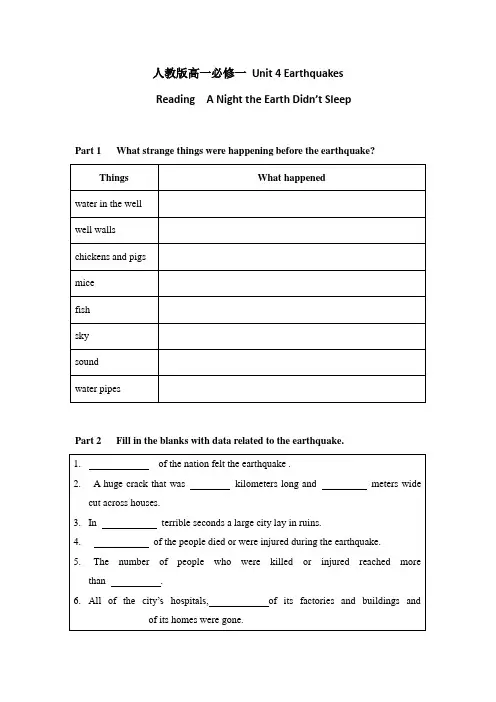
1. Complete the form below.
2. What’s the main idea of the text?
The text mainly talks about a/an _ that happened in _ .
3. Match each paragraph with its main idea.
Paragraph 1 A. Damage during the earthquake
Paragraph 2 B. Recovery after the earthquake
Paragraph 3 C. Signs (前兆) before the earthquake
探究点二 重点句型与长难句
1. It seemed as if the world was at an end!
似乎世界末日来临了!
⑴as if 意为“仿佛;似乎”,相当于as though,常用在动词look,seem
,feel等之后引导表语从句。假如从句表示的状况接近现实,从句用陈述语气;反之,假如从句表示的状况与事实相反,或者是不行能发生,从句用虚拟语气。
① It looks as if it’s going to rain.
天似乎要下雨了。
② It seems as if the meeting never ended.
看起来会议没完没了。
⑵as if/as though 也常引导方式状语从句,如从句表达的不是真实状况,常用虚拟语气
③ He talks as if he knew everything.
听他说话的口气,似乎他什么都知道似的。
④ She left the room hurriedly as if (she was) busy.
她匆忙离开了房间,似乎很忙的样子。
2. Everywhere they looked nearly everything was destroyed.
人们无论朝那里看,几乎一切都被毁了。
⑴everywhere 在该句中做从属连词,引导让步状语从句,意为“无论哪里;不论在什么地方”
①Jordan is warmly welcomed everywhere he goes.
乔丹所到之处都受到热情欢迎。
②I will go everywhere my parents want me to go.
父母要我去哪里我就去哪里。
③Everywhere he goes, he will never forget the terrible experience.
无论他走到哪儿,他恒久都忘不了那次可怕的经验。
⑵everywhere 可用作副词,意为“到处;到处”;在句中做状语。有时也用作名词,意为“每个地方”
① I can’t find y pen though I looked everywhere.