动词的形式和分类分析
- 格式:docx
- 大小:20.01 KB
- 文档页数:7
动词学案
Class: Name:
♦ Teaching Aims:
★ To learn the classifications of the verbs.
★ To master their usage through cooperation and exploration.
♦ Teaching Procedures:
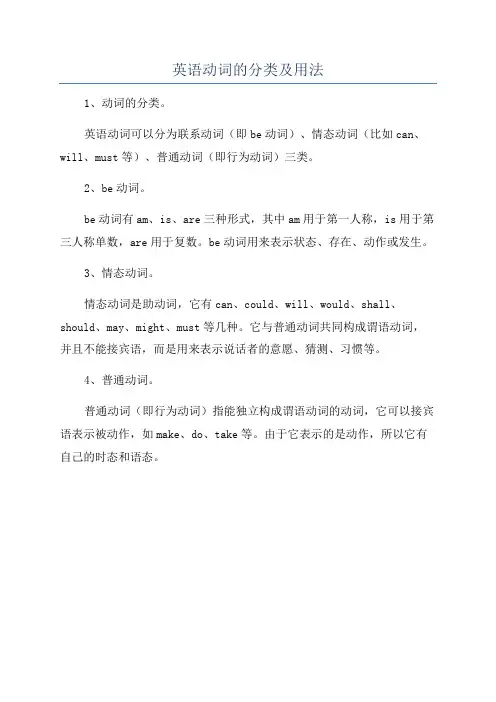
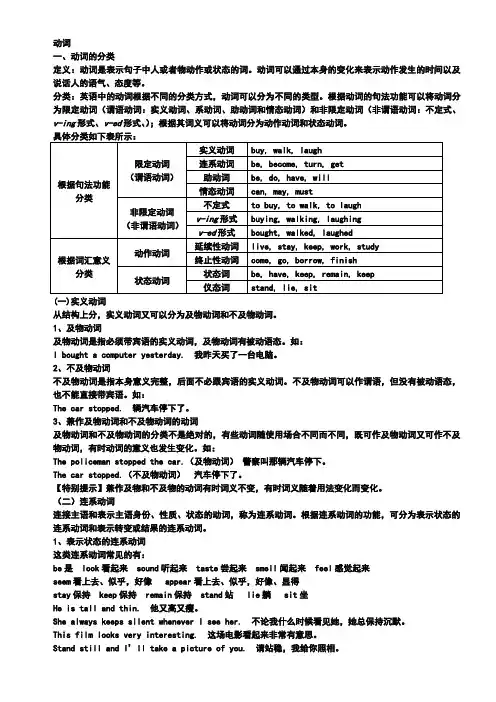
一、动词的分类
1. 实义动词
实义动词时能独立作谓语的动词。根据动词在句子中是否可以 接宾语,可以把实义动词分为
动词和 动词两种类型。按其持续性可分为 动词和 动词。
(1) 及物动词
及物动词本身意义不完整,需要接宾语才能使其意思完整。
① 动词+宾语
My brother is(fly)on the playground.
② 动词+宾语+宾补
The teacher made his students(happiness) by doing some games.
翻译:We call English teacher Zhang Sir.
注意:带省略to的不定式或现在分词作宾补的动词有: make, let, see, watch, notice, hear 等。
③ 动词+双宾语
My mother gives me a new bike.
注意:有些间接宾语(人)放在直接宾语(事物)之后时,间接宾语前要加to。常用的此类词有 bring、
give、hand、 pass、pay、post、return、sell、show、teach、tell、throw、lend 等。
Hand me that book, please.
=Hand.
有些间接宾语(人)放在直接宾语(事物)之后时,间接宾语前要加 for。常用的此类词有 buy、
choose、cook、draw、book、find、get、make、order 等。
My mom bought me a nice backpack.
=My mom.
(2) 不及物动词
不及物动词一般不可以接宾语,但是有些不及物动词与一些介词、副词等词搭配在一起构成短语动
词,它的作用等于一个及物动词。请在横线上加上适当的介词 !
① We arrived the station at five.
② He turned the light when he left.
③ He takes pride doing a job well.
注意:有些动词既可作及物动词也可作不及物动词。 常用的此类动词有 turn、open、close、start、change^
drive、play、meet、win、study 等。
The girl turned her head and smiled. 这个女孩子转过头笑一笑。 She turned and walked back to the classroom.她转过身走回教室。
(3) 延续性动词
延续性动词表示动作是可持续的,如: live, stay, study, work, keep, teach等,可以和时间段连用。
We have lived in China since 2001.
You can keep this book for two weeks.
(4)非延续性动词
非延续性动词表示瞬间动作,如: buy, lend, borrow, die, begin, stop, finish, arrive, join, leave, come, catch等,不能和时间段连用。如果和时间段连用,就要用其他词代替。
He has been here for five days.(arrive)
The film has been on for ten minutes.(begin)
常用瞬间动词相应持续性动词关系如下:
1、 go be away 2、come be here
3、 come back be back 4、leave -be away ( be not here)
5、 buy—— have 6、borrow keep
7、 die be dead 8、begin be on
9、 finish be over 10、 open be open
11 close be closed 12、lose be lost
13 get to know —— know 14、turn on be on
15 get up be up 16、sit down —— sit/be seated
17 join- be in (…)或 be a ••- member
18、 become; --- be
2. 连系动词
连系动词也称为系动词,连系动词有一定词义,但不完整,不能单独做谓语,必须和表语连用,
构成系表结构,表示主语身份、性质、状态。
You are a teacher, but not a good one.
We feel very happy when we know it.
英语经常用到的连系动词有:
(1)状态连系动词:表示主语的状态、性质、身份。 (be)
My father is very strong.
⑵ 持续连系动词:表示继续或保持一种状态或情况。 (stay, remain, keep等)
You must keep healthy.
⑶表象连系动词:用来表示 看起来"的这一概念的词。appear (看起来),seem (看似),look (看起
来)。
Your mother looks much younger than I thought.
⑷感官连系动词:feel (摸起来),taste (尝起来),smell (闻起来),sound (听起来)look (看起来)。
The milk tastes a little sour.
⑸ 转变或结果连系动词:become (变为),get (成为),grow (长得),turn (变得),go (变得)等。 Our village is becoming more and more beautiful.
3. 助动词
助动词本身没有词意,或者意义不完全,不能单独作谓语,只能和别的动词一起在句子中作谓语, 帮助动词构成各种时态、语态等及否定、疑问、强调等。主要的助动词有: be, do, have, shall, will
等。例如:
Will you have a sports meeting next week?
Is your mother cooking ?
Don' t be late for class next time.
4. 情态动词
情态动词一般没有人称和数的变化,在句子中不能单独作谓语,只能和其他动词连用作谓语,表
示说话人的语气和情感。 主要的情态动词有: can, may, must, need, would , could, might, dare等。
使用情态动词要注意以下方面:
(1) 含must的一般疑问句,肯定回答仍用 must,否定回答则用needn '或don ' t have t做示 不必"。 一般不能用
mustn' ,t因为mustn'表示 不可以、禁止”,语气很强。
—Must I finish my homework now?
—No, you needn ' t.
⑵may开头的一般疑问句,肯定回答用 may,否定回答用 mustn'。t
—May I smoke here?
—No, you mustn ' t.
⑶ 表示可能性或推测时,can多用于否定句或疑问句, can't表示 不可能";may多用于陈述句,may
not表示 可能不";must只用于肯定句,表示 定、准是"。
You may be right or may not be right.
The news can ' t be true.
She must be angry.
(4) need用作情态动词主要用于否定句、疑问句和条件句,表示 需要”,也可以作实义动词,后跟名
词、代词、不定式、动词 -ing形式等。need开头的一般疑问句,肯定回答用 must。
You needn ' t come if you are busy.
—Need I come tomorrow? 我明天需要来吗?
—No, you needn ' t. / Yes, you must.没必要。/ 是的,你必须来。
He needs to get some sleep.他需要睡一会。
(5) have to的意思接近 must,但是must强调说话者的主观意愿。 have to强调客观上的必要性,常译
成不得不:’have to可以用于多种时态,其疑问句、否定句都要借助 do构成。
Do you have to leave now? 你现在必须走了 吗?
You don' t have to get up early.你没有必要早起。
⑹be able to表示具体的能力,与 can用法相近,can只有一般现在时和一般过去时, be able to可用
更多的时态。was / were able to侧重有能力而且成功地做成了某事,而 could只表示过去具备某种能 力。 The math problem was hard but I was able to work it out. 这道数学题很难,但我做出来了。
二、动词的形式
1. 动词原形
动词原形就是词典中出现的动词原来的形式。 例如:be (是),work (工作),study (学习),write
(写)等。动词原形用法很多,经常在中考考查的用法有:
(1) 在一般现在时中主语不是第三人称单数形式,其谓语动词接动词原形。例如:
We often watch TV at home after supper.
(2) 感官动词和使役动词后接动词原形作宾语补足语。例如:
Your words make me feel angry.
(3) 在祈使句的开头用动词原形。例如:
Come and buy your books at our book shop.
(4) 在情态动词和 do、will、would等助动词后用动词原形。例如:
Can you swim across this river in an hour?
Did everybody want to go there last Monday?
(5) 常见的后面用动词原形的结构:
Why not do sth.? = Why don 't you do sth.?
had better do sth.
Let sb. do sth.
help sb. do sth.
Why not gothere on foot?
You' d bettefinish your homework before supper.
Let ' pfeay volleyball after school !
2. 第三人称单数形式