
语用学教程课件
- 格式:ppt
- 大小:1.38 MB
- 文档页数:212
语用学概述
①语用学(pragmatics)
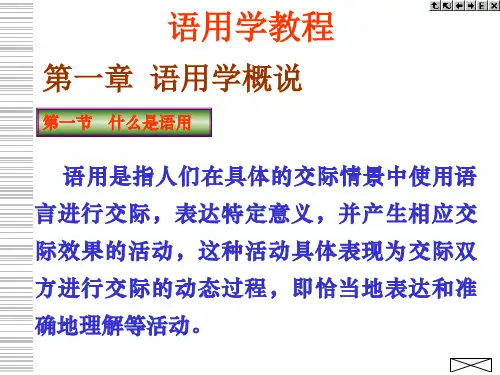
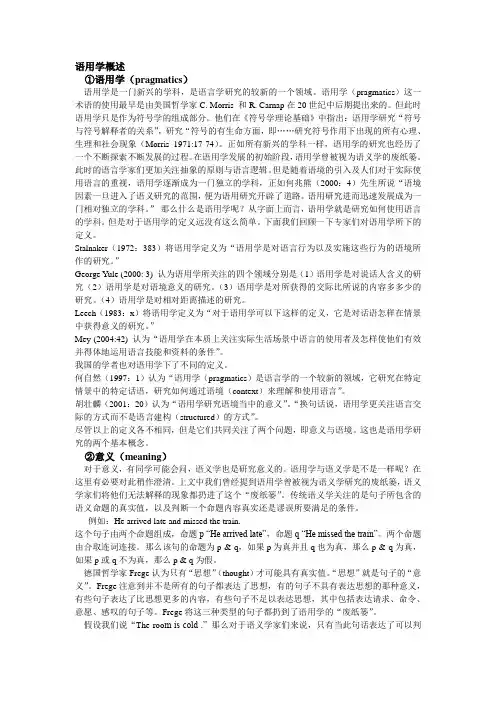
语用学是一门新兴的学科,是语言学研究的较新的一个领域。语用学(pragmatics)这一术语的使用最早是由美国哲学家C. Morris 和R. Carnap在20世纪中后期提出来的。但此时语用学只是作为符号学的组成部分。他们在《符号学理论基础》中指出:语用学研究“符号与符号解释者的关系”,研究“符号的有生命方面,即……研究符号作用下出现的所有心理、生理和社会现象(Morris 1971:17-74)。正如所有新兴的学科一样,语用学的研究也经历了一个不断探索不断发展的过程。在语用学发展的初始阶段,语用学曾被视为语义学的废纸篓。此时的语言学家们更加关注抽象的原则与语言逻辑。但是随着语境的引入及人们对于实际使用语言的重视,语用学逐渐成为一门独立的学科,正如何兆熊(2000:4)先生所说“语境因素一旦进入了语义研究的范围,便为语用研究开辟了道路。语用研究进而迅速发展成为一门相对独立的学科。” 那么什么是语用学呢?从字面上而言,语用学就是研究如何使用语言的学科。但是对于语用学的定义远没有这么简单。下面我们回顾一下专家们对语用学所下的定义。
Stalnaker(1972:383)将语用学定义为“语用学是对语言行为以及实施这些行为的语境所作的研究。”
George Yule (2000: 3) 认为语用学所关注的四个领域分别是(1)语用学是对说话人含义的研究(2)语用学是对语境意义的研究。(3)语用学是对所获得的交际比所说的内容多多少的研究。(4)语用学是对相对距离描述的研究。
Leech(1983:x)将语用学定义为“对于语用学可以下这样的定义,它是对话语怎样在情景中获得意义的研究。”
Mey (2004:42) 认为“语用学在本质上关注实际生活场景中语言的使用者及怎样使他们有效并得体地运用语言技能和资料的条件”。
我国的学者也对语用学下了不同的定义。
何自然(1997:1)认为“语用学(pragmatics)是语言学的一个较新的领域,它研究在特定情景中的特定话语,研究如何通过语境(context)来理解和使用语言”。

Pragmatics
Chapter One Introduction
Warming-up Exercises
1. A little boy comes in the front door.
Mother: Wipe your feet, please.
He removes his muddy shoes and socks and carefully wipes his clean feet on
the doormat.
2. A father is trying to get his 3-year-old daughter to stop lifting up her dress
to display her new underwear to the assembled guests.
Father: We don‟t DO that.
Daughter: I KNOW, Daddy. You don‟t WEAR dresses.
I. Definitions of pragmatics
Other definitions • Pragmatics is the study of language in use or language communication;
the study of the use of context to make inference about meaning.
Contextualist view of meaning: an initial effort to study meaning in a
pragmatic sense.
What does pragmatics study?
Below are four definitions of pragmatics. What elements do they have in
common? Do you notice any differences in emphasis? • Pragmatics studies the factors that govern our choice of language in

Introduction
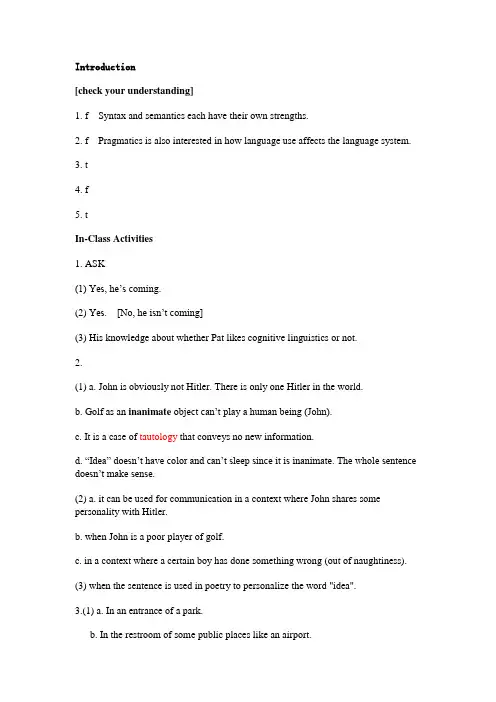
[check your understanding]
1. f Syntax and semantics each have their own strengths.
2. f Pragmatics is also interested in how language use affects the language system.
3. t
4. f
5. t
In-Class Activities
1. ASK
(1) Yes, he’s coming.
(2) Yes. [No, he isn’t coming]
(3) His knowledge about whether Pat likes cognitive linguistics or not.
2.
(1) a. John is obviously not Hitler. There is only one Hitler in the world.
b. Golf as an inanimate object can’t play a human being (John).
c. It is a case of tautology that conveys no new information.
d. “Idea” doesn’t have color and can’t sleep since it is inanimate. The whole sentence
doesn’t make sense.
(2) a. it can be used for communication in a context where John shares some
personality with Hitler.
b. when John is a poor player of golf.
c. in a context where a certain boy has done something wrong (out of naughtiness).
Introduction
[check your understanding]
1. f Syntax and semantics each have their own strengths.
2. f Pragmatics is also interested in how language use affects the language system.
3. t
4. f
5. t
In-Class Activities
1. ASK
(1) Yes, he’s coming.
(2) Yes. [No, he isn’t coming]
(3) His knowledge about whether Pat likes cognitive linguistics or not.
2.
(1) a. John is obviously not Hitler. There is only one Hitler in the world.
b. Golf as an inanimate object can’t play a human being (John).
c. It is a case of tautology that conveys no new information.
d. “Idea” doesn’t have color and can’t sleep since it is inanimate. The whole sentence
doesn’t make sense.
(2) a. it can be used for communication in a context where John shares some
personality with Hitler.
b. when John is a poor player of golf.
c. in a context where a certain boy has done something wrong (out of naughtiness).