
医学英语水平考试
- 格式:pptx
- 大小:1.46 MB
- 文档页数:47

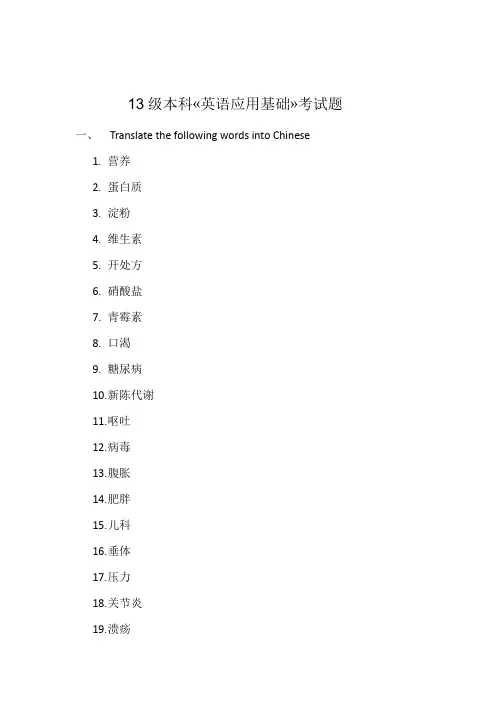
13级本科«英语应用基础»考试题
一、 Translate the following words into Chinese
1. 营养
2. 蛋白质
3. 淀粉
4. 维生素
5. 开处方
6. 硝酸盐
7. 青霉素
8. 口渴
9. 糖尿病
10. 新陈代谢
11. 呕吐
12. 病毒
13. 腹胀
14. 肥胖
15. 儿科
16. 垂体
17. 压力
18. 关节炎
19. 溃疡 20. 瘤
二、Reading comprehension
Tea drinking was common in China for nearly one thousand years
before anyone in Europe had ever heard about tea. People in
Britain were much slower in finding out what tea was like,
mainly because tea was very expensive. It could not be bought
in shops and even those people who could afford to have it sent
from Holland did so only because it was a fashionable curiosity.
Some of them were not sure how to use it. They thought it was
a vegetable and tried cooking the leaves. Then they served them
mixed with butter and salt. They soon discovered their mistake
but many people used to spread the used tea leaves on bread and
中医英语水平考试大纲
(试行)
TCM English Proficiency Test (TCMEPT) (Draft)
中医英语水平考试筹备组
目 录
一、中医英语水平考试概述
1. 考试目的
2. 报考对象
3. 考试语种与分级
4. 中医英语水平考试的设计原则
5. 中医英语水平考试的成绩的使用及适用范围
6. 中医英语水平考试的组织实施(待定)
二、中医英语水平考试中级的语言技能及要求
三、中医英语水平考试中级试卷结构
附录一:中医英语水平考试中级样题及答案(讨论稿)
附录二:中医英语水平考试中级词汇表(讨论稿)
附录三:中医英语水平考试中级可替换题型(讨论稿)
一、中医英语水平考试概述
1、考试目的
2009 年 4 月国务院发布了《关于扶持和促进中医药事业发展的若干意见》,
提出要 “积极拓展中医药服务贸易”、“加强中医药知识和文化对外宣传,促进
国际传播”。根据当前中医药专业人员外语应用水平的实际,在国家中医药管理
局国际合作司的积极倡导和支持下,中华中医药学会翻译分会及其挂靠单位上海
中医药大学积极开展了“中医英语水平考试”项目的前期论证与筹备工作。现国
家中医药管理局国际合作司已经正式授权并委托翻译分会依托其挂靠单位上海
中医药大学组织作为翻译分会会员单位的各中医院校中医外语学科专家学者进
一步推进“中医英语水平考试”筹备项目,通过举办中医药专业外语水平考试及
相应的培训,引导和规范中医药专业外语的培训与考试,从而提高中医药行业的
专业外语水平,培养和造就一大批专业中医药外语人才,为推动中医药走向世界
而做出我们应有的贡献。
2、报考对象
中医药行业不同专业、不同教育层次的人员以及其他专业有志于从事中医外
语相关工作的人员,不受年龄、学历等方面的限制均可以报考本考试。报考中级
的考生公共英语水平宜达到大学英语四级标准,报考高级的考生公共英语水平宜

医学英语考试试题
Company number:【WTUT-WT88Y-W8BBGB-BWYTT-19998】 13级本科英语应用基础考试题
一、 Translate the following words into Chinese
1. 营养
2. 蛋白质
3. 淀粉
4. 维生素
5. 开处方
6. 硝酸盐
7. 青霉素
8. 口渴
9. 糖尿病
10. 新陈代谢
11. 呕吐
12. 病毒
13. 腹胀
14. 肥胖
15. 儿科
16. 垂体
17. 压力
18. 关节炎
19. 溃疡
20. 瘤 二、Reading comprehension
Tea drinking was common in China for nearly one thousand
years before anyone in Europe had ever heard about tea.
People in Britain were much slower in finding out what tea
was like, mainly because tea was very expensive. It could
not be bought in shops and even those people who could
afford to have it sent from Holland did so only because it
was a fashionable curiosity. Some of them were not sure how
to use it. They thought it was a vegetable and tried
cooking the leaves. Then they served them mixed with butter
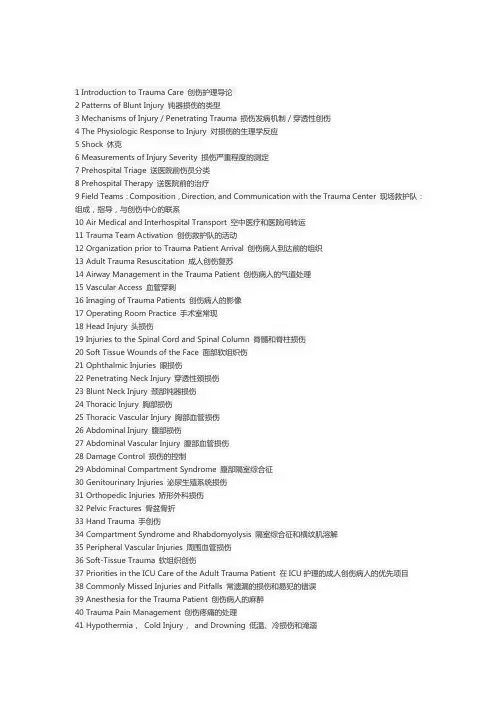
1 Introduction to Trauma Care 创伤护理导论
2 Patterns of Blunt Injury 钝器损伤的类型
3 Mechanisms of Injury/Penetrating Trauma 损伤发病机制/穿透性创伤
4 The Physiologic Response to Injury 对损伤的生理学反应
5 Shock 休克
6 Measurements of Injury Severity 损伤严重程度的测定
7 Prehospital Triage 送医院前伤员分类
8 Prehospital Therapy 送医院前的治疗
9 Field Teams:Composition,Direction, and Communication with the Trauma Center 现场救护队:组成,指导,与创伤中心的联系
10 Air Medical and Interhospital Transport 空中医疗和医院间转运
11 Trauma Team Activation 创伤救护队的活动
12 Organization prior to Trauma Patient Arrival 创伤病人到达前的组织
13 Adult Trauma Resuscitation 成人创伤复苏
14 Airway Management in the Trauma Patient 创伤病人的气道处理
15 Vascular Access 血管穿刺
16 Imaging of Trauma Patients 创伤病人的影像
17 Operating Room Practice 手术室常现
18 Head Injury 头损伤
19 Injuries to the Spinal Cord and Spinal Column 脊髓和脊柱损伤
20 Soft Tissue Wounds of the Face 面部软组织伤