
Unit 9Unit_9_Have_you_ever_been_to_a_museum B selfcheck
- 格式:ppt
- 大小:759.00 KB
- 文档页数:30

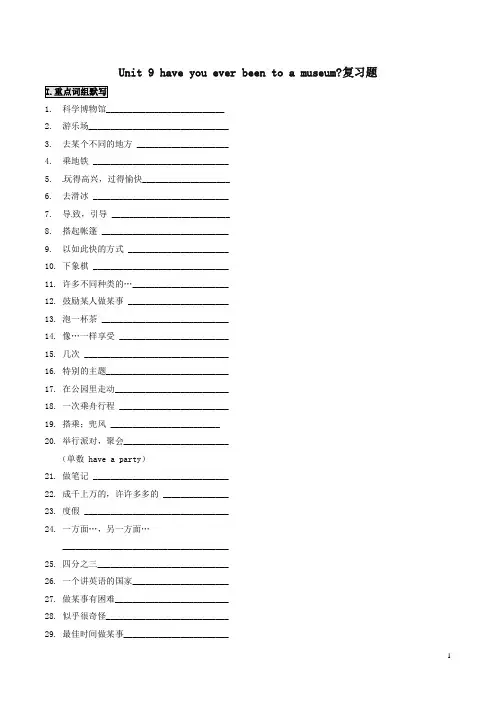
1 Unit 9 have you ever been to a museum?复习题
I.重点词组默写
1. 科学博物馆___________________________
2. 游乐场________________________________
3. 去某个不同的地方 _____________________
4. 乘地铁 _______________________________
5. 玩得高兴,过得愉快____________________
6. 去滑冰 _______________________________
7. 导致,引导 ___________________________
8. 搭起帐篷 _____________________________
9. 以如此快的方式 _______________________
10. 下象棋 _______________________________
11. 许多不同种类的…______________________
12. 鼓励某人做某事 _______________________
13. 泡一杯茶 _____________________________
14. 像…一样享受 _________________________
15. 几次 _________________________________
16. 特别的主题____________________________
17. 在公园里走动__________________________
18. 一次乘舟行程 _________________________
19. 搭乘;兜风 _________________________
20. 举行派对,聚会________________________
(单数 have a party)

Unit 9 Have you ever been to a museum?测试题一.单项选择(本大题有25,每1分,共25分)
1. -have you stayed in this city?-For about six years.
A.How longB.How farC.How soon-Dad, about of our classmates wear glasses.
-Oh, that's terrible. You all should take good care of your eyes.
A.three fourthB.third fourthC.three quarters-How did the accident happen?
-You know,it was difficult to see the road clearly because it .
A.was rainingB.has rainedC.is rainingYou look tired. Stop doing your
homework. Lefs go out and
A. liveB. relaxC. leaveYou are too heavy. I think you must eat meat.
A.try; lessB.try to; moreC.try to; lessWho played chess with you yesterday
afternoon? Mary.
A. didB. doesC. wasDid you a horse yesterday? Yes, I did. And I
also chickens.
A. rode, feedB. ride; fedWhy do you like running so
much, Mr. Green?
Well,its good for my.
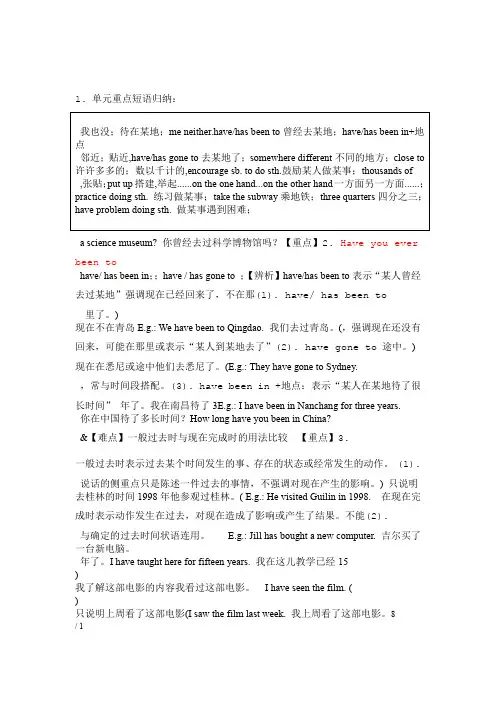
1. 单元重点短语归纳:
我也没;待在某地;me neither.have/has been to曾经去某地;have/has been in+地点
邻近;贴近,have/has gone to去某地了;somewhere different不同的地方;close to
许许多多的;数以千计的,encourage sb. to do sth.鼓励某人做某事;thousands of
,张贴;put up搭建,举起......on the one hand...on the other hand一方面另一方面......;
practice doing sth. 练习做某事;take the subway乘地铁;three quarters四分之三;
have problem doing sth. 做某事遇到困难;
a science museum? 你曾经去过科学博物馆吗?【重点】2. Have you ever
been to
have/ has been in;;have / has gone to ;【辨析】have/has been to表示“某人曾经去过某地”强调现在已经回来了,不在那(1). have/ has been to
里了。)
现在不在青岛E.g.: We have been to Qingdao. 我们去过青岛。(,强调现在还没有回来,可能在那里或表示“某人到某地去了”(2). have gone to 途中。)
现在在悉尼或途中他们去悉尼了。(E.g.: They have gone to Sydney.
,常与时间段搭配。(3). have been in +地点:表示“某人在某地待了很长时间” 年了。我在南昌待了3E.g.: I have been in Nanchang for three years.
你在中国待了多长时间?How long have you been in China?
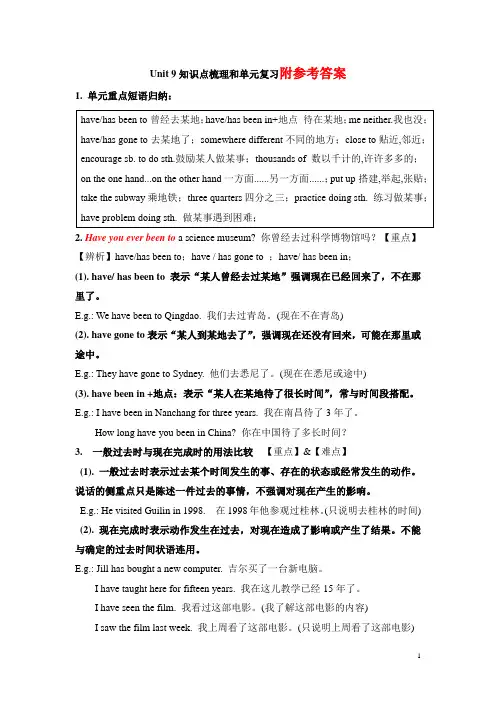
1 Unit 9知识点梳理和单元复习附参考答案
1. 单元重点短语归纳:
2. Have you ever been to a science museum? 你曾经去过科学博物馆吗?【重点】
【辨析】have/has been to;have / has gone to ;have/ has been in;
(1). have/ has been to 表示“某人曾经去过某地”强调现在已经回来了,不在那里了。
E.g.: We have been to Qingdao. 我们去过青岛。(现在不在青岛)
(2). have gone to表示“某人到某地去了”,强调现在还没有回来,可能在那里或途中。
E.g.: They have gone to Sydney. 他们去悉尼了。(现在在悉尼或途中)
(3). have been in +地点:表示“某人在某地待了很长时间”,常与时间段搭配。
E.g.: I have been in Nanchang for three years. 我在南昌待了3年了。
How long have you been in China? 你在中国待了多长时间?
3. 一般过去时与现在完成时的用法比较 【重点】&【难点】
(1). 一般过去时表示过去某个时间发生的事、存在的状态或经常发生的动作。说话的侧重点只是陈述一件过去的事情,不强调对现在产生的影响。
E.g.: He visited Guilin in 1998. 在1998年他参观过桂林。(只说明去桂林的时间)
(2). 现在完成时表示动作发生在过去,对现在造成了影响或产生了结果。不能与确定的过去时间状语连用。
E.g.: Jill has bought a new computer. 吉尔买了一台新电脑。
I have taught here for fifteen years. 我在这儿教学已经15年了。