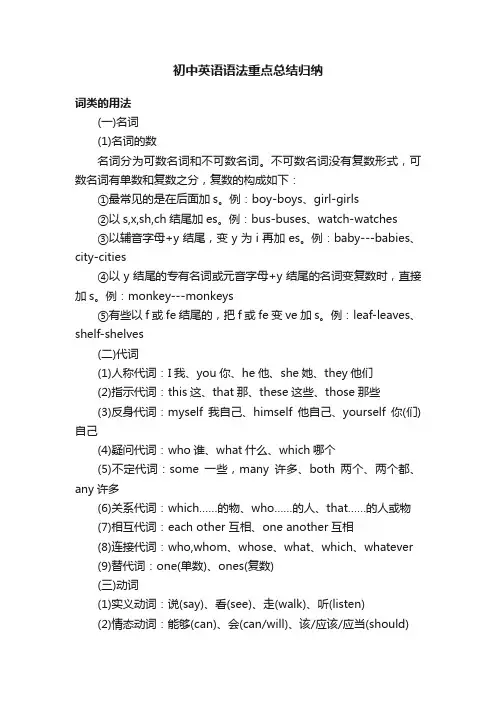
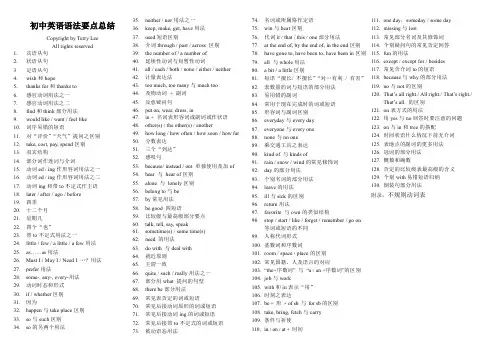
初中英语复习资料-语法及要点总结
- 格式:doc
- 大小:390.00 KB
- 文档页数:18
中学英语要点汇总
Copyright by Mr. Li
All rights reserved
1.宾语从句
2.状语从句
3定语从句
4.wish和hope
5.thanks for和thanks to
6.感官动词用法之一
7.感官动词用法之二
8.find和think部分用法
9.would like / want / feel like
10.词序易错的短语
11.对“评价”“天气”提问之区别
12.take, cost, pay, spend区别
13.双宾结构
14.部分词作连词与介词
15.动词ed / ing作形容词用法之一
16.动词ed / ing作形容词用法之二
17.动词ing和带to不定式作主语
ter / after / ago / before
19.四季
20.月
21.星期
22.“也”
23.带to不定式用法之一
24.(a) little / (a) few
25.及物动词+副词
26.as……as用法
27.prefer用法
28. some-, any-, every-用法
29.动词时态和形式
30.if / whether区别
31.因为
32.表推测
33.so与such区别
34.so的另两个用法
35.neither / nor用法之一
36.keep, make, get, have用法
ed短语
38. through / past / across 区别
39.the number of / a number of
40.延续性动词
41.all / each / both / none / either /
neither
42.计量表达法
43. Must I / May I / Need I …? 用法
44.hundred / thousand / million / billion
45.反意疑问句
46.put on, wear, dress, in
47.虚拟语气部分用法
48. other(s) / the other(s) / another
49.how long / often / soon / far
50.分数表达
51.到达
52.感叹句
53.because/ instead / out (of) 用法
54.too much, too many与much too
55. alone / lonely
56.belong to与be
57.by常见用法
58.部分用in的短语
59.比较级与最高级部分要点
60.talk, tell, say, speak
61.sometime(s) / some time(s)
62.need 的用法
63.do with 与deal with
64.就近原则
65.主谓一致
66.quite / such / really用法之一
67.部分用what 提问的句型
68.there be部分用法
69.常见表否定的词或短语
70.常见后接动词原形的词或短语
71.常见后接动词ing的词或短语
72.常见后接带to不定式的词或短语
73.被动语态用法
74.名词或所属格作定语
75.win与beat区别
76. 代词it / that / this / one部分用法
77.at / by the end of, in the end区别
78.have gone to/have been to / in
79.all / whole用法
80.a bit / a little区别
81.“擅长/ 不擅长”“对…有利/有害”
82. 表数量的词与短语的部分用法
83.易用错的副词
84.常用于现在完成时的词或短语
85.形容词与副词区别
86.everyday与every day
87.everyone与every one
88.none与no one
89.乘交通工具之表达
90.kind of 与kinds of
91.rain / snow / wind的常见修饰词
92.day的部分用法
93.个别名词的部分用法
94.leave的用法
95. ill与sick的区别
96.return用法
97.favourite 与own的类似结构
98.stop / start (begin) / like / forget
(remember) / go on等词或短语用法
99.人称代词形式
100.基数词和序数词
101.room / space / place
102.常见国籍、人及语言的对应
103.易写错词形
104. job与work
105.with和in表示“用”
106.时刻之表达
107.be + 形 + of sb 与 for sb的区别
108. take, bring, fetch与carry
109. 条件与祈使
110. in / on / at + 时间
111. one day,someday / some day
112. missing与lost
113.常见部分名词及其修饰词
114.个别疑问句的常见否定回答
115.fun的用法
116.except / except for / besides
117.常见带to为介词的短语
118.because与why的部分用法
119.no与not的区别
120. That’s all right / All right / That’s
right. 的区别
121. on表方式的用法
122.用yes与no回答时要注意的问题
不规则动词表 中学英语要点汇总
(The 7th edition)
(Copyright by Mr. Li All rights reserved )
1.宾语从句:怎样判断出一个从句是宾语从句?○1 在动词后作宾语(动宾):
Do you know where he comes from? 划线部分是动词know的宾语.
○2.在有些接双宾结构的动词后作宾语:
He asked me when we would leave. 此句中me与从句when-分别是ask的宾语。
○3在介词后作宾语(介宾):Let’s talk about how we solve this problem.
○4在I’m sorry…, I’m afraid…, I’m sure…等结构后的句子也被认为是宾语从句.
宾语从句需注意的时态问题:
○1主句若是一般现在时,从句根据不同情况用不同时态。
He says (that) he will have a walk soon. (soon指将来,从句用将来时)
The teacher asks who is the cleverest in the school. (暗指目前谁最聪明,从句用现在时)
I want to know who came here late this morning. (今早已过去,从句用过去时)
○2主句若是一般过去时,从句也要用过去时。
He wondered if I would come. She told me that her son had got well.
She said that she liked watching TV. We thought Jim was wrong.
○3无论主句是何时态,从句若表客观真理,要用一般现在时。
Mr. Li said the moon is smaller than the earth.
○4宾语从句无论有何引导词,句子都要用陈述句语序。
Could you tell me when you will get back to Wuhan?(不是will you)
Do you know which sweater she is wearing? (不是is she)
2.状语从句:此处所说的状语从句用法仅包括条件(if和unless引导)状语从句和时间(when等引导,见下文)状语从句。状语从句需注意以下问题:
○1主句若是一般将来时、祈使句或含不表过去的情态动词等,则if(如果), unless(除非),when(当…的时候), as soon as(一…就…),before, after, until, till, as(当…的时候)所引导的状语从句用一般现在时。
You may take a rest when you finish doing your work. (主句有情态动词)
Could you look after my son after I leave home?
(情态动词could是为了让语气委婉,并不指过去时,从句仍用一般现在时)
I will go out as soon as it stops raining this afternoon. (主句是将来时) Wait for your brother at the bus station until he arrives. (主句是祈使句)
○2而主句若是一般过去时,从句也要用表过去时的适当时态,如:
I would give the money to the charity if I had a million dollars.
When he got to the park, his classmates had left.
My son ran towards me as soon as he saw me on the street.
3.定语从句:定语从句是指修饰前面名词或代词的句子。从句前面的名词或代词叫先行词,从句中的引导词叫关系代词或关系副词。关系代词who只指人,which只指物。that既可指人又可指物。whose 后必须跟有名词,既指人,也可指物。关系词作主语时,不可省略,作宾语时可省略。whom只指人,只作宾语。关系副词where指“在那里”,when指“在那时”。 (以下所给例子凡斜体字部分均作定语从句。)
She is a girl who / that is beautiful and kind-hearted. The girl who / that is tall is my sister.
(以上关系词作主语,不可省略。)
She is a girl (who / whom / that) I know very well. (关系词做know的宾语,可以省略。)
That boy whose hair is very long is my brother. I own a bike whose price is high.
(关系词whose表所属,后需接名词。前句指人,译为“这个孩子的”;后句指物,译为“这个自行车的”。)
I bought a watch (which / that) I paid 100 yuan for. (指物, 作pay的宾语,可以省略。)