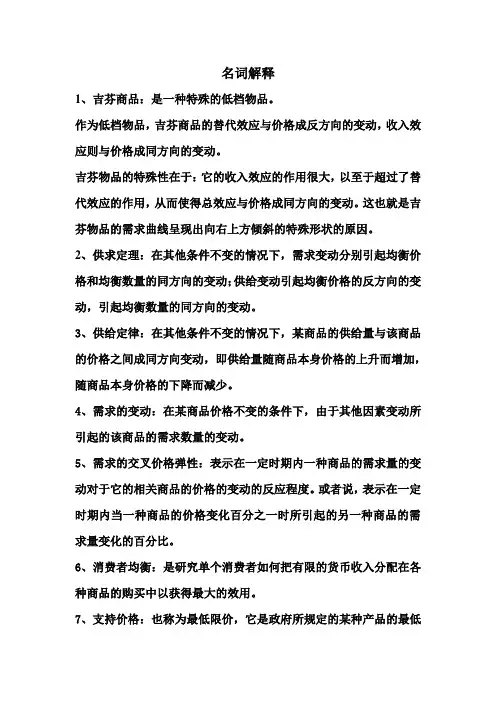
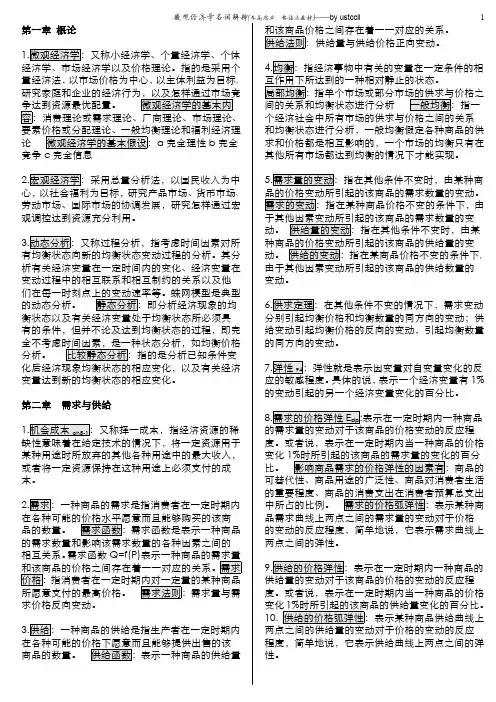
微观经济学-名词解释
- 格式:doc
- 大小:32.00 KB
- 文档页数:4
微观经济名词解释 CHAPTER 1 Scarcity:the limited nature of society’s resources. Economics:the study of how society manages its scarce resources. Efficiency:the property of society getting the most it can from its scarce resources. Equity:the property of distributing economic prosperity fairly among the members of society. Opportunity cost:whatever must be given up to obtain some item. Rational people:people who systematically and purposefully do the best they can to achieve their objectives. Marginal changes:small incremental adjustments to a plan of action. Incentive:something that induces a person to act. Market economy:an economy that allocates resources through the decentralized decisions of many firms and households as they interact in markets for goods and services. Property rights:the ability of an individual to own and exercise control over scarce resources. Market failure:a situation in which a market left on its own fails to allocate resources efficiently. Externality:the impact of one person’s actions on the well-being of a bystander. Market power:the ability of a single economic actor (or small group of actors) to have a substantial influence on market prices. Productivity:the quantity of goods and services produced from each hour of a worker’s time. Inflation:an increase in the overall level of prices in the economy. Business cycle:fluctuations in economic activity, such as employment and production.
CHAPTER 2 Circular-flow diagram:a visual model of the economy that shows how dollars flow through markets among households and firms. Production possibilities frontier:a graph that shows the combinations of output that the economy can possibly produce given the available factors of production and the available production technology. Microeconomics:the study of how households and firms make decisions and how they interact in markets. Macroeconomics:the study of economy-wide phenomena, including inflation, unemployment, and economic growth. Positive statements:claims that attempt to describe the world as it is. Normative statements:claims that attempt to prescribe how the world should be.
Chapter 3 Absolute advantage:the ability to produce a good using fewer inputs than another producer Opportunity cost:whatever must be given up to obtain some item Comparative advantage:the ability to produce a good at a lower opportunity cost than another producer Exports:goods produced domestically合乎国内的and sold abroad Imports:goods produced abroad and sold domestically CHAPTER 4 Market:a group of buyers and sellers of a particular good or service Competitive market:a market in which there are many buyers and many sellers so that each has a negligible impact on the market price Quantity demanded:the amount of a good that buyers are willing and able to purchase. Law of demand:the claim that, other things equal, the quantity demanded of a good falls when the price of the good rises. Demand schedule:a table that shows the relationship between the price of a good and the quantity demanded. Demand curve:a graph of the relationship between the price of a good and the quantity demanded. Normal good:a good for which, other things equal, an increase in income leads to an increase in demand. Inferior good:a good for which, other things equal, an increase in income leads to a decrease in demand. Substitutes:two goods for which an increase in the price of one good leads to an increase in the demand for the other. Complements:two goods for which an increase in the price of one good leads to a decrease in the demand for the other. Quantity supplied:the amount of a good that sellers are willing and able to sell. Law of supply:the claim that, other things equal, the quantity supplied of a good rises when the price of the good rises. Supply schedule:a table that shows the relationship between the price of a good and the quantity supplied. Supply curve:a graph of the relationship between the price of a good and the quantity supplied. Equilibrium:a situation in which the price has reached the level where quantity supplied equals quantity demanded. Equilibrium price:the price that balances quantity supplied and quantity demanded. Equilibrium quantity:the quantity supplied and the quantity demanded at the equilibrium price. Surplus:a situation in which quantity supplied is greater than quantity demanded. Shortage:a situation in which quantity demanded is greater than quantity supplied. Law of supply and demand:the claim that the price of any good adjusts to bring the supply and demand for that good into balance.