
居里夫人英文简介分享资料
- 格式:ppt
- 大小:86.50 KB
- 文档页数:2
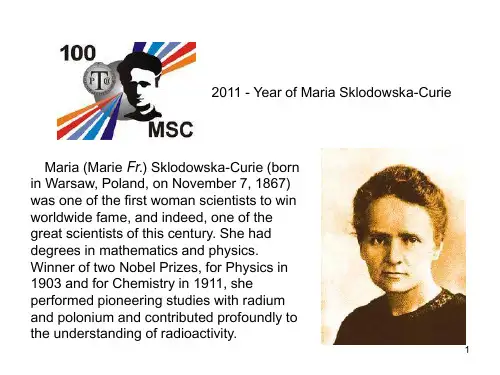

居⾥夫⼈英⽂简介Maria Curie (born in Warsaw, Poland, on November 7, 1867) was one of the first woman scientists to win worldwide fame, and indeed, one of the great scientists of this century. She had degrees in mathematics and physics. Winner of two Nobel Prizes, for Physics in 1903 and for Chemistry in 1911, she performed pioneering studies with radium and polonium and contributed profoundly to the understanding of radioactivityMaria was born in 1867 in Warsaw. For the tsarist aggression,She is very tired of the oppressive education .After graduating from high school ,She used to suffer from a year of mental illness. Maria met another lecturer in Sorbonne—Pierre Curie—her husband ,In 1895,she married Pierre Curie and in 1897,their first daughter Irène borned Perhaps the most famous of all women scientists, Maria -Curie is notable for her many firsts:·She was the first to use the term radioactivity for this phenomenon. ·She was the first woman in Europe to receive her doctorate of science. ·In 1903, she became the first woman to win a Nobel Prize for Physics. The award, jointly awarded to Curie, her husband Pierre, and Henri Becquerel, was for the discovery of radioactivity.·She was also the first female lecturer, professor and head of Laboratory at the Sorbonne University in Paris (1906).·In 1911, she won an unprecedented second Nobel Prize (this time inchemistry) for her discovery and isolation of pure radium and radium components.·She was the first person ever to receive two Nobel Prizes.·She received 15 gold medals, 19 degrees, and other honors.5. puppy loveShe ever fall in love with her student —Kazimier zorawski in tutor family , but zorawski family looked down upon her poor status. His parents disagree with them,Maria lost much for this relationship. She didn’t leave her homeland until receive a letter of separate from Kazimier zorawski.Husbdndshe married Pierre Curie in 1897,he is a friend as well as a teacher, they married and have two daughters. the older became the second women scientist who got the Nobel Reward. and the little wrote the novel 《Madame Curie》.Late—Life loveshe was in love with her husband‘s student—Paul Langevin .but soon the Beau Pere was found by Mrs Langevin. their love letter was announced by Work Newspaper. Maria used to fall in dilemma, Once want to death to the bit-level.。

英语作文居里夫人Madame Curie was a remarkable woman. She was a pioneer in the field of radioactivity and the first woman to win a Nobel Prize. Her contributions to science have had alasting impact on the world.Born in Poland in 1867, Marie Curie moved to Paris to pursue her studies. Despite facing discrimination as a woman in the male-dominated field of science, she persevered and eventually became a professor at the University of Paris.Curie's groundbreaking research on radioactivity led to the discovery of two new elements, polonium and radium. Her work laid the foundation for many future developments in the field of nuclear physics and medicine.In addition to her scientific achievements, Curie was also a devoted mother and wife. She often balanced her research with caring for her family, demonstrating thatwomen can excel in both their professional and personal lives.Tragically, Curie's exposure to radiation during her research ultimately led to her premature death in 1934. However, her legacy lives on, inspiring countless women to pursue careers in science and making the world a better place through her groundbreaking discoveries.In conclusion, Madame Curie's impact on the world cannot be overstated. Her pioneering work in the field of radioactivity has left an indelible mark on the scientific community, and her legacy continues to inspire future generations of scientists.。

英语作文居里夫人 Madame Curie, also known as Marie Curie, was a remarkable scientist who made groundbreaking discoveries in the field of radioactivity. Born in Poland in 1867, she moved to Paris to pursue her studies and became the first woman to win a Nobel Prize and the only person to win Nobel Prizes in two different scientific fields.
Marie Curie's early life was marked by hardship and determination. She faced many challenges as a young woman pursuing higher education, but she persevered and eventually earned degrees in physics and mathematics from the Sorbonne. It was during her time at the Sorbonne that she met her future husband, Pierre Curie, who would become her lifelong collaborator in scientific research.
Together, Marie and Pierre Curie conducted pioneering work on radioactivity, a term that Marie herself coined. Their research led to the discovery of two new elements, polonium and radium, and laid the foundation for the development of nuclear physics and the use of radiation in medical treatments.

居里夫人英语作文Title: The Remarkable Life of Madame Curie。
Madame Curie, also known as Marie Curie, is undoubtedly one of the most influential figures in the fields of physics and chemistry. Her groundbreaking discoveries in radioactivity not only revolutionized scientific understanding but also paved the way for numerous advancements in medicine, industry, and energy. In this essay, we will delve into the remarkable life of Madame Curie, exploring her scientific contributions, personal challenges, and enduring legacy.Born Maria Skłodowska on November 7, 1867, in Warsaw, Poland, Madame Curie overcame considerable obstacles to pursue her passion for scientific inquiry. Despite facing gender discrimination and limited educational opportunities for women in her time, she demonstrated exceptionalintellect and determination. In 1891, she moved to Paris to further her studies at the Sorbonne, where she met PierreCurie, a fellow physicist who would become her lifelong collaborator and husband.Together, Marie and Pierre Curie embarked on a series of experiments that would change the course of scientific history. Their research focused on the phenomenon of radioactivity, a term coined by Marie herself. Through painstaking laboratory work, they discovered two new elements, polonium and radium, and coined the term "radioactivity" to describe the spontaneous emission of radiation from these elements.Their discovery of radium, in particular, had profound implications for both science and society. Radium's unique properties made it a powerful tool in the treatment of cancer, leading to significant advancements in the field of oncology. Additionally, radium's use in luminescent paint revolutionized industries such as watchmaking and aviation, enabling the production of glow-in-the-dark instruments vital for navigation and timekeeping.However, Madame Curie's scientific achievements werenot without personal sacrifices and challenges. Tragically, Pierre Curie died in a laboratory accident in 1906, leaving Marie a widow with two young daughters. Despite her grief, she persevered in her scientific endeavors, becoming thefirst woman to win a Nobel Prize and the only person to win Nobel Prizes in two different scientific fields: physicsand chemistry.Yet, Madame Curie's pioneering work came at a greatcost to her health. Constant exposure to radioactive materials eventually took its toll, leading to severehealth problems later in life. Nevertheless, she remained dedicated to her research, advocating for the responsible use of radioactive substances and the advancement ofscience for the betterment of humanity.Madame Curie's legacy endures to this day, inspiring generations of scientists, particularly women, to pursue careers in STEM fields. Her name is synonymous with perseverance, brilliance, and the relentless pursuit of knowledge. The numerous honors and awards bestowed upon her, including the establishment of the Curie Institute in Paris,serve as testament to her enduring impact on science and society.In conclusion, Madame Curie's life and work exemplify the power of human intellect, resilience, and curiosity. Her contributions to the fields of physics and chemistry have left an indelible mark on the scientific community and continue to shape our understanding of the natural world. As we reflect on her legacy, let us celebrate the life of this extraordinary woman whose discoveries have illuminated the path for generations of scientists to come.。