
中国建筑英文介绍
- 格式:ppt
- 大小:7.43 MB
- 文档页数:11
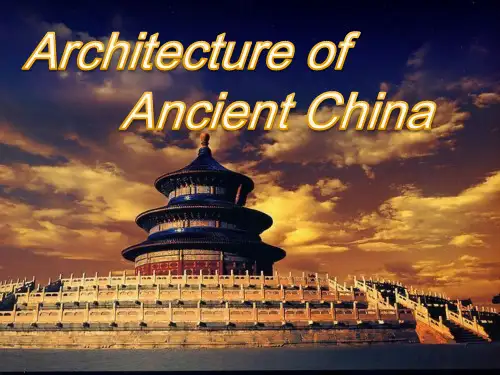

中国古建筑英语介绍Chinese ancient architecture is an important part of traditional Chinese culture, with a long history and unique style. It not only demonstrates the wisdom and creativity of the ancient Chinese people but also reflects the hierarchical system, religious beliefs, and cultural values of ancient China. This article will introduce Chinese ancient architecture from its characteristics, classification, representative works, and protection and inheritance.I. Characteristics of Chinese Ancient Architecture1. Emphasis on symmetry and balance: Chinese ancient architecture pays attention to the layout of symmetry and balance, whether it is palaces, temples, or residential buildings. They strive for left-right symmetry and front-back echoing. This symmetry is not only reflected in the exterior shape of the building but also in the interior spatial layout and decoration.2. Mainly using wood as a building material: Chinese ancient architecture mainly uses wood as a building material,such as beams, columns, purlins, and brackets. Wood has good plasticity and toughness, is easy to process and install, and also has good thermal insulation performance.3. Rich and diverse roof shapes: The roof shapes of Chinese ancient architecture are rich and diverse, such as hip roof, gable roof, suspended roof, and winged roof. These roof shapes not only have practicality but also strong decorative features, reflecting the aesthetic concept of ancient Chinese architecture.4. Carving and painting art: The carving and painting art of Chinese ancient architecture is rich and colorful, such as woodcarving, brick carving, stone carving, and murals. These carved and painted works are both decorative and symbolic, reflecting information about ancient Chinese society's politics, economy, culture, etc.5. Color application: The color application of Chinese ancient architecture emphasizes harmony and contrast, mainly using red, yellow, green, blue, etc. as the main color scheme. Red represents joy, auspiciousness, yellow represents royalauthority, green represents life and hope, blue represents the sky and the sea. The use of these colors not only reflects the aesthetic concept of ancient Chinese architecture but also reflects the cultural values of ancient society.II. Classification of Chinese Ancient Architecture1. Palace architecture: Palace architecture is the place where ancient Chinese emperors lived and handled political affairs, such as the Forbidden City in Beijing and the Shenyang Imperial Palace. These palace buildings are large in scale, majestic in momentum, and have high historical, artistic, and scientific value.2. Temple architecture: Temple architecture is the place where ancient Chinese people worshipped gods and ancestors, such as Tai Mountain Dai Temple and Songshan Shaolin Temple. These temple buildings usually have a solemn and respectful atmosphere, reflecting the ancient people's awe towards gods and ancestors.3. Garden architecture: Garden architecture is the placewhere ancient Chinese people leisured, visited, and enjoyed natural landscapes, such as Suzhou Humble Administrator's Garden and Hangzhou West Lake. These garden buildings focus on creating landscapes of mountains and rivers, emphasizing the harmonious coexistence between humans and nature.4. Residential architecture: Residential architecture is the place where ancient Chinese common people lived, such as Beijing Siheyuan and Shanxi Pingyao Ancient City. These residential buildings have distinct regional characteristics and ethnic styles, reflecting the living habits and cultural traditions of ancient people.5. Religious architecture: Religious architecture is the place where various religious beliefs in ancient China were practiced, such as Buddhist temples and Taoist palaces. These religious buildings usually have high artistic value, such as the Mogao Grottoes in Dunhuang and Longmen Grottoes.III. Representative Works of Chinese Ancient Architecture1. The Forbidden City: Located in the center of Beijing, it isthe imperial palace of Ming and Qing Dynasties in China and also the largest existing wooden structure ancient architectural complex in the world. The Forbidden City is famous for its grand architectural scale, exquisite carving art, and rich collection of cultural relics.2. The Great Wall: Located on the northern border of China, it is a military defense project built by ancient China to defend against northern nomadic invasions. The Great Wall is about 23,000 kilometers long, making it the longest wall in the world and known as the "Ten Thousand Li Great Wall."。


Tengwang Pavilion: A Glimpse into ChineseArchitecture and HistoryNestled in the heart of Nanchang City, Jiangxi Province, China, stands a magnificent edifice that has withstood the test of time, the Tengwang Pavilion. This legendary structure, known for its historical significance and architectural elegance, is a testament to the rich cultural heritage of the Chinese people.The Tengwang Pavilion, also known as the "Pavilion of the Prince of Teng," was originally constructed during the Tang Dynasty as a memorial Hall for the Prince of Teng, Li Yuan, who was a close confidant of Emperor Taizong. Overthe centuries, the pavilion has undergone numerous renovations and reconstructions, each adding to itshistorical depth and cultural significance.The architecture of the Tengwang Pavilion is a blend of traditional Chinese styles, reflecting the harmonious blend of nature and humanity. The pavilion is centered around a courtyard, surrounded by buildings and halls. The roofs are tiled in a unique, curvilinear design, giving theimpression of flowing water, a symbol of prosperity andgood fortune in Chinese culture. The intricate carvings and paintings on the wooden beams and ceilings further enhance the aesthetic appeal of the building.The interior of the pavilion is no less impressive. The spacious halls are adorned with elaborate murals and calligraphy,展示着中国文化的深厚底蕴。
