
wash machine
- 格式:ppt
- 大小:3.54 MB
- 文档页数:10
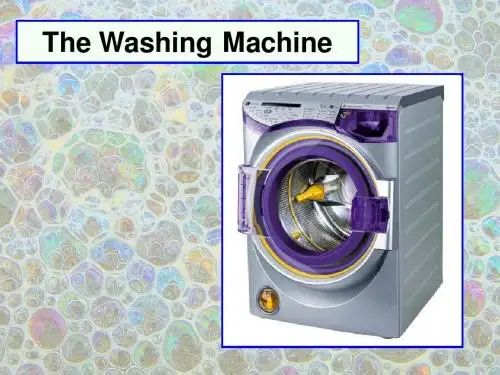

洗衣机洗衣服英语作文In the modern era, the washing machine has become an indispensable appliance in every household. It has not only revolutionized the way we do laundry but also saved us a significant amount of time and effort. This essay will delve into the process of using a washing machine to clean clothes, from sorting to drying.First and foremost, the process begins with sorting the laundry. It is crucial to separate whites from colors and delicate fabrics from heavier materials. This step ensuresthat colors do not bleed onto other garments, and delicate items are not damaged by the vigorous washing cycle.Once the laundry is sorted, the next step is to load the washing machine. It is important not to overload the machine, as this can reduce its efficiency and lead to less than satisfactory cleaning results. The clothes should be evenly distributed to allow the water and detergent to reach all items.Adding detergent is the next critical step. Modern washing machines often have a designated compartment for detergent, which is released at the correct time during the cycle. The amount of detergent used should be based on the load size and the hardness of the water. Some machines also have a setting for this, which can help to ensure the correct amount is used.Selecting the appropriate wash cycle is essential for the cleaning process. Washing machines typically offer a variety of cycles, including quick wash, normal, heavy-duty, and delicate. The choice of cycle should be based on the type of fabric and the level of soiling. For example, a heavy-duty cycle is suitable for heavily soiled work clothes, while a delicate cycle is ideal for silks and other fine fabrics.After the wash cycle is complete, it is time to dry the clothes. Many washing machines have a built-in dryer, which can be a convenient feature. However, it is important to check the care labels on the garments, as some materials may require air-drying or flat-drying to prevent shrinkage or damage.In conclusion, using a washing machine to clean clothes is a straightforward process that involves sorting, loading, adding detergent, selecting the right cycle, and drying. By following these steps, one can ensure that their clothes are not only clean but also well-maintained, prolonging theirlife and keeping them looking their best. The washing machine has truly become a time-saving ally in the realm of household chores.。

洗衣机洗衣服英语作文Sure, here's a composition on washing clothes with a washing machine:Washing Clothes with a Washing MachineIn the modern era, the washing machine has become an indispensable appliance in every household. It not only saves time but also provides a convenient way to clean clothes effectively. Here's a step-by-step guide on how to use a washing machine to wash clothes.Step 1: Preparing the ClothesBefore starting, sort your clothes by color and fabric type. This prevents colors from bleeding and delicate fabrics from getting damaged. Remove any items with zippers or buttons to avoid snagging.Step 2: Loading the Washing MachineOpen the washing machine's door and place the clothes inside. Do not overload the machine as it can affect the washing process and potentially damage the clothes. The clothes should be able to move freely inside the drum.Step 3: Choosing the Right DetergentSelect a detergent suitable for the type of clothes you arewashing. There are different types of detergents availablefor various fabric types and washing cycles. Add the detergent to the compartment designated for it.Step 4: Setting the Washing CycleMost washing machines come with various cycle options such as quick wash, heavy duty, delicate, and so on. Choose the appropriate cycle based on your clothes' fabric and the level of dirtiness.Step 5: Starting the Washing MachineClose the door securely and press the start button. The machine will begin filling with water and start the washing process. You can usually set the desired water temperature and spin speed as well.Step 6: Waiting for the Cycle to CompleteWhile the washing machine is running, you can take a break or attend to other chores. The machine will notify you when the cycle is complete, usually with a beep or a light signal.Step 7: Unloading and DryingOnce the washing cycle is finished, open the door and carefully remove the clothes. They should be damp but not dripping wet. Shake out any items to prevent wrinkles and hang them to dry or place them in a dryer if you have one.Step 8: Cleaning the Washing MachineAfter each use, it's important to clean the washing machine to maintain its hygiene and performance. Wipe the door seal and clean the filter if necessary. Regularly running a cyclewith hot water and a washing machine cleaner can also help.In conclusion, using a washing machine is a simple yet efficient way to keep our clothes clean and fresh. With the right preparation and care, it can save us a lot of time and effort, allowing us to focus on other important aspects of our lives.This composition provides a basic guide on how to use a washing machine to wash clothes, which can be a helpful reference for students learning English.。

GBTHANK YOU FOR PURCHASING A ARISTON PRODUCT .To receive more comprehensive assistance, register the appliance onCONTROL PANELWASH CYCLE TABLE* By selecting the 14 cycle and excluding the spin cycle, the washing machine will drain only. *** For Prewash press the “Temp.” button until the symbol lights up (only 90°).The cycle duration indicated on the display or instruction manual is an estimate based on standard conditions. The actual duration may vary in relation to several factors, such as the temperature and pressure of the incoming water, ambient temperature, amount of detergent, load quantity and type, load balancing and any additional options selected.1) Test wash cycle in compliance with regulation AS/NZS 2040.2: set programme 2 with a temperature of 60°C at 1600 rpm (load of 10 kg).PRODUCT DESCRIPTION1. Top2. Detergent dispenser drawer3. Control panel4. Handle5. Porthole door6. Drain pump (behind the plinth)7. Plinth (removable)8. Adjustable feet (2)DETERGENT DISPENSER DRAWERcompartment 1: Pre-wash detergent (powder)compartment 2: Detergent for the wash cycle (powder or liquid)If liquid detergent is used, it is recommendedthat the removable plastic partition A (supplied) be used for proper dosage.If powder detergent is used, place the partition into slot B.compartment 3: Additives (fabric softeners, etc.)The fabric softener should not overflow the grid.! Use powder detergent for white cotton garments, for pre-washing, and for washing at temperatures over 60°C.! Follow the instructions given on the detergent packaging.1. STEAM HYGIENE / MUTE button2. FINAL CARE / KEY LOCK button3. ON/OFF button4. ACTIVE CARE button and indicator light5. START/PAUSE button6. RAPID / ECO button7. SPIN button8. START DELAY button 9. TEMPERATURE button10. WASH CYCLE SELECTOR KNOBFor washing lightly to normally soiled resilient garments in cotton, linen, synthetic fibres and mixed fibres.Eco CottonSuitable for washing normally soiled cotton garments. At 60°C it is the standard cycle for washing cotton garments, and is the most efficient in terms of combined water and electricity consumption. CottonNormally to heavily soiled and robust cottons .SyntheticsSuitable for washing moderately soiled garments made of synthetic fibres (e.g. polyester, polyacrylic, viscose, etc.) or mixed synthetic-cotton fibres.DelicatesFor washing very delicate garments. It is advisable to turn the garments inside out before washing them. For best results, use liquid detergent on delicate garments.Wool - Woolmark Apparel Care - Green:The “Wool” wash cycle is approved by the Woolmark Company forwashing wool garments classified as “hand-washable”, provided that the wash complies with the instructions appearing on the garment’s label and with those provided by the manufacturer of this washing machine.(M1135)Anti AllergySuitable for removing major allergens such as pollen, mites and cat or dog hair.Anti StainThe programme is suitable to heavily-soiled garments with resistantcolours. It ensures a washing class that is higher than the standard class (A class). When running the programme, do not mix garments of different colours. We recommend the use of powder detergent. Pre-treatment with special additives is recommended if there are obstinate stains.WhiteFor washing normally to heavily soiled towels, underwear, table and bed linen, etc in resilient cotton and linen. Only when the temperature is selected at 90°C the cycle is provided with a prewash phase before main washing phase. In this case it is recommended to add detergent both, in the prewash and main wash section.Steam RefreshThe garments will be damp once the cycle is completed, so we recommend hanging them to dry (2 kg, roughly 3 items). This programme refreshes garments by removing bad odours and relaxing the fibres. Insert dry items only (that are not dirty) and select programme “Steam Refresh ”. Garments will be a little damp at the end of the cycle and can be worn after a few minutes. The “Steam Refresh ” programme makes ironing easier.! Do not add softeners or detergents.! Not recommended for wool or silk garments.Rapid 30 minFor washing lightly soiled garments quickly. This cycle lasts only 30 minutes, saving time and energy.Bed & BathFor washing home linen in a single cycle. It optimises the use of fabric softener and allows for saving time and electricity. We recommend the use of powder detergent.ShirtsUse the special wash cycle to wash shirts in different fabrics and colours to guarantee they receive the best possible care.Spin & DrainSpins the load then empties the water. For resilient garments. If you exclude the spin cycle, the machine will drain only Rinse & SpinRinses and then spins. For resilient garments.DISPLAYThe display is useful when programming the washing machine and provides plenty of information.The duration of the available wash cycles and the remaining time of a running cycle appear in section A (the display will show the maximum duration of the cycle chosen, which may decrease after several minutes, since the effective duration of the programme varies depending on the wash load and the settings chosen); if the DELAYED START option has been set, the countdown to the start of the selected wash cycle will appear.Pressing the corresponding button allows you to view the maximum spin speed and temperature values attained by the machine during the set wash cycle, or the values selected most recently, if these are compatible with the set wash cycle.The “wash cycle phases” corresponding to the selected wash cycle and the “wash cycle phase” of the running wash cycle appear in section B :Main wash Spin + Pump outReferences appeared on the display.The symbol indicates the possibility of inserting an additional garments load with the washing program started (See “Adding Garments” section).The symbol indicates the possibility to silence the key tonesWhile the mute is active, almost all sounds will be turned off. Only the sound signals and the alarms remain active, as well as the sound of the end of cycle.For activate/deactivate the mute press and hold button.DISPLAY INDICATORSFailure: Call ServiceRefer to Troubleshooting section Failure: Water filter cloggedWater cannot be drained; water filter might be blocked Failure: No waterNo or not sufficient inlet water.In the event of any failure, refer to the “Troubleshooting” section.Key LockTo lock the control panel, press and hold the button for approximately 3 seconds. The symbol will light up on the display to indicate that the control panel has been locked (with the exception of the “ON/OFF“ button). This prevents unintentional changes toprogrammes, especially with children near the machine. To unlock the control panel, press and hold the button for approximately 3 seconds .Locked door indicatorWhen lit, the symbol indicates that the door is locked. To prevent any damage, wait until the symbol turns off before opening the door.To open the door while a cycle is in progress, press the START/PAUSE button ; if the symbol is off, the door can be opened.FIRST-TIME USEOnce the appliance has been installed, and before you use it for the first time, run a wash cycle with detergent and no laundry, using the wash cycle 9 (60°).DAILY USEPrepare the laundry by following the suggestions appearing under the “TIPS AND SUGGESTIONS” section.- Press the ON/OFF button .- Open the door. Load the laundry while making sure not to exceed the maximum load quantity indicated in the wash cycle table.- Pull out the detergent dispenser drawer and pour the detergent into the relevant compartments, as described in the “DETERGENT DISPENSER DRAWER” section.- Close the door.- The machine automatically displays the default temperature and spin speed values for the selected cycle, or the most recently used settings if they are compatible with the selected cycle. - Select the desired wash cycle.- Select the desired options.- Press the START/PAUSE button to start the wash cycle; the door will lock ( symbol on).PAUSING A CYCLETo pause the wash cycle, press the START/PAUSE button again. To start the wash cycle from the point at which it was interrupted, press the START/PAUSE button again.OPENING THE DOOR, IF NECESSARYOnce a cycle starts, the symbol turns on to signal that the door cannot be opened. While a wash cycle is running, the door remains locked. To open the door while a cycle is under way, for example, to add or remove garments, press the START/PAUSE button to pause the cycle. If the symbol is not lit, the door may be opened. Press the START/PAUSE button again to continue the cycle.ADDING GARMENTSAn icon on the display will signal when additional garments can be introduced into the washing machine, without decreasing the washing performance. To add garments, first stop the washing machine by pressing the START/PAUSE button then open the door and insert them.Press the START/PAUSE button again to restart the wash cycle from the point at which it was interrupted.CHANGING A RUNNING WASH CYCLETo change a wash cycle while it is in progress, pause the washing machine using the START/PAUSE button, then select the desired cycle and press the START/PAUSE button again.! To cancel a cycle that has already begun, press and hold the ON/OFF button. The cycle will be stopped and the machine will switch off.symbol switches off, the door may be opened. Open the door, unload the laundry and switch off the machine. If you do not press ON/OFF button, the washing machine will switch off automatically after about 15 minutes.OPTIONSSteam HygieneThis option enhances washing performance by generating steam during the wash cycle to remove any bacteria from the fibres, which are treated at the same time. Place the laundry in the drum, choose a compatible programme and select option Steam Hygiene.! The steam generated during the operation of the washing machine may cause the porthole door to become hazy.Rapid / EcoAfter pushing the button for the 1st time, option Rapid is selected and the cycle duration will be reduced.Otherwise after pushing for the 2nd time, option Eco is selected allowing more energy saving.Final CareThe washing machine will perform gentle tumbling through slowrotations of the drum. Final Care option starts after the cycle ends for a maximum duration of 6h and you can interrupt at any time by pressing any button on control panel or turning the knob. Active CareThe detergent, premixed with water, creates an unique emulsion able to better penetrate the fibers of the garments, cleaning stains at evenlow temperatures, preserving both colors and fabrics. These results are obtained also due to the multiple different specific movements of the drum which best take care of the garments. Start DelayTo set a delayed start for the selected cycle, press the corresponding button TemperatureEach wash cycle has a pre-defined temperature. To modify the temperature, press the “Temp.” button. The value will appear on the display.SpinEach wash cycle has a pre-defined spin speed. To modify the spin speed, press the “Spin Speed” button. The value will appear on the display.DESCALE AND CLEAN PROCEDUREAn icon on the display will regularly (roughly every 50 cycles) remind users that is time to run a maintenance cycle to clean the washing machine and combat limescale build-up and bad odours.To delete the descale alert turn the knob or push any button (including ON/OFF button).For optimal maintenance:1. Empty the washing machine drum.2. To help the wash cycle you may want to use either the detergent (i.e. a quantity 10% the quantity specified for lightly-soiled garments) or special additives to clean the washing machine.3. Run the Program 3 Cotton without prewash selecting the hot water option 60°C.TIPS AND SUGGESTIONSDivide the laundry according to:Type of fabric (cotton, mixed fibres, synthetics, wool, garments to be hand-washed). Colour (separate coloured garments from whites, wash new coloured garments separately). Delicates (small garments – such as nylon stockings – and items with hooks – such as bras: insert them in a fabric bag).Empty the pockets:Objects such as coins or lighters can damage the washing machine and the drum. Check all buttons.CARE AND MAINTENANCEBefore performing cleaning and maintenance, switch the washing machine off and disconnect it from the mains power. Do not use flammable liquids to clean the washing machine.Cutting off the water and electricity suppliesClose the water tap after every wash. This will limit wear on the hydraulic system inside the washing machine and help to prevent leaks.Unplug the washing machine when cleaning it and during all maintenance work.Cleaning the washing machineThe outer parts and rubber components of the appliance can be cleaned using a soft cloth soaked in lukewarm soapy water. Do not use solvents or abrasives.Cleaning the detergent dispenser drawerRemove the dispenser drawer by lifting and pulling it outwards. Wash it under running water; this procedure should be effected regularly.Caring for the door and drumAlways leave the porthole door ajar in order to prevent unpleasant odours from forming.Cleaning the pumpThe washing machine is fitted with a self-cleaning pump that does not require any maintenance. Small items (such as coins or buttons) maysometimes fall into the protective pre-chamber situated at the base of the pump.! Make sure that the wash cycle has ended and unplug the appliance.To access the pre-chamber:1. remove the covering panel on the front side of the machine by inserting a screwdriver in the centre and sides of the panel and using it as a lever;2. place a low and wide container under the water filter in order to collect the residual water.3. loosen the drainage pump cover by turning it anti-clockwise: it is normal for some water to leak out;4. clean the inside thoroughly;5. screw the cover back on;6. put the panel back in place, making sure the hooks slot in place before pushing the panel onto the appliance.Checking the water inlet hoseCheck the water inlet hose at least once a year. If it is cracked or broken, it must be replaced: during wash cycles, the high pressure of the water could suddenly split the hose open.! Never use hoses that have already been used.ANTIMICROBIAL SEALThe seal around the porthole door is made from a special mixtureensuring antimicrobial protection, thus reducing bacterial proliferation up to 99.99%.The seal contains zinc pyrithione, a biocidal substance which reduces the proliferation of harmful microbes (*) such as batteries and mould prone to causing stains, unpleasant odours and product deterioration.(*) According to tests performed by the University of Perugia, Italy on : Staphylococcus aureus, Escherichia coll, Pseudomonas aeruginosa, Candida albicans, Aspergillus niger, Penicillium digitatumIn rare cases an allergic reaction may be caused by prolonged contact between seal and skin.ACCESSORIESContact our Technical Assistance Service to check whether the following accessories are available for this washing machine model.Stacking kitWith this accessory you can secure the tumble dryer to the upper part of your washing machine to save space and facilitate loading and unloading of the tumble dryer.TRANSPORT AND HANDLINGDo not lift the washing machine by gripping it from the upper section.Unplug the appliance and close the water tap. Check that the door and detergent dispenser drawer are tightly closed. Detach the filling hose from the water tap then detach the drain hose. Empty all the water remaining in the hoses and secure the latter so that they do not get damaged during transport. Apply the transport bolts back on. Repeat, in reverse order, the transport bolt removal procedure described in the “Installation instructions”.TROUBLESHOOTINGYour washing machine could occasionally fail to work. Before contacting the Technical Assistance Service, make sure that the problem cannot be easily solved using the following list.Anomalies Possible causes / SolutionThe washing machine does not start.The appliance is not plugged into the socket fully, or not enough to make contact. There is no power in the house.The wash cycle does not start.The washing machine door is not closed properly. The ON/OFF button has not been pressed. The START/PAUSEbutton has not been pressed.The water tap has not been opened.A delay has been set for the start time.The Demo Mode is active (see below how to deactivate).The washing machine doesnot fill with water (“”appears on the display).The water inlet hose is not connected to the tap.The hose is bent.The water tap has not been opened.There is no water supply in the house.The pressure is too low.The START/PAUSE button has not been pressed.The washing machinecontinuously loads andunloads water.The drain hose is not fitted between 65 and 100 cm from the floor.The free end of the hose is immersed in water.The wall drainage system is not fitted with a breather pipe.If the problem persists even after these checks, turn off the water tap, switch the appliance off and contact theTechnical Assistance Service. If the home is on one of the upper floors of a building, there may be problems relatingto back-siphonage, causing the washing machine to fill with water and drain continuously. Special anti-siphonvalves are available in shops and help to prevent this inconvenience.The washing machines doesnot drain and the symbol(F9E1) on the display.Clean the pump filter (see Care and maintenance chapter)The drain hose is bent.The drainage duct is clogged.The washing machinevibrates a lot during the spincycle.Transport bolts have been not removed correctly during installation.The washing machine is not leveled.The washing machine is tucked between furniture cabinets and the wall.The washing machine leaks.The water inlet hose is not screwed on properly.The detergent dispenser drawer is obstructed.The drain hose is not properly attached.The symbol blinks and thedisplay visualises an errorcode (e.g.: F1E1, F4...).Switch off the machine and unplug it, wait for approximately 1 minute and then switch it back on again.If the problem persists, contact the Technical Assistance Service.There is too much foam.The detergent is not suitable for machine washing (it should display the text “for washing machines” or “hand andmachine wash”, or the like).Too much detergent was used.“” phase icon blinks, “0”spin speed displayed .Unbalance of laundry load prevented spin cycle, to protect the washing machine.If you want to spin the wet laundry, add more laundry items of different sizes and start “Spin&Drain” programme.Avoid small laundry loads consisting of few big, absorbent pieces of laundry / wash different sizes of articles in oneload.Disable the DEMO MODE : The following actions must be carried out in sequence, without breaks. Switch the machine ON and then switch it OFF again. Press the START/PAUSE button until the buzzer is heard. Switch the machine on again. The “DEMO” indicator flashes and then turns OFF.11358223 You can download the SAFETY AND INSTALLATION INSTRUCTIONS, OPERATING MANUAL by:• Visiting the website • Using the QR code.• Alternatively, contact our Technical Assistance Service (the telephone number is indicated in the warrantyto the inside of the door.。

成功使用洗衣机洗衣服步骤英语作文How to Wash Clothes in the Washing MachineHi there! Today I'm going to teach you how to wash your clothes in the washing machine. It's really important to know how to do this so you can keep your clothes clean and fresh. Washing your clothes regularly also helps them last longer before they get worn out. I just learned how to do this myself, and now I'm an expert washer!The first step is to gather all the clothes you want to wash. Sort them by colors - put all the whites in one pile, then darks in another pile, and brights or light colors in a third pile. It's best to wash similar colors together so they don't bleed onto each other. Things like towels, socks, and underwear can go in any pile. Just make sure to check all the pockets for anything hiding inside before putting clothes in the washer!Next, you need to get the washing machine ready. Most washing machines have a detergent dispenser on the top or front. You'll want to use a liquid detergent or washing powder. Read the directions on the detergent to see how much to use - using too little won't clean your clothes properly, but too much can leave residue behind. Pour the detergent into the dispenser.Some people also like to use fabric softener to make their clothes extra soft and fresh smelling. If you want to use it, pour some into the fabric softener compartment, following the directions on the bottle. Don't ever mix detergent and fabric softener together!Now it's time to load the washing machine drum with your sorted clothes. Don't stuff it too full or the clothes won't get clean. Leave a little room for everything to move around. Ifyou're washing just a few things, use the small load setting.Once everything is loaded, close the lid or door securely. Most washing machines have several cycle settings. For normal loads, you'll probably want to use the regular or casual cycle. If your clothes are really dirty, like after playing sports, use the heavy duty setting. Delicate items like nice blouses or sweaters should go on the delicate or gentle cycle.You'll also need to select the water temperature. Hot water kills germs and gets really dirty clothes clean, but it can shrink or fade fabrics over time. Warm water is a good compromise - it cleans well without being too harsh. Cold water is best for darks to prevent colors from running. Double check your clothing labels if you're unsure which temperature to use.After setting the cycle and temperature, press start. Now the washing machine will start filling with water and sloshing the clothes around. Don't try to open the lid once it's going or you could get sprayed! Just let it run its full cycle which usually takes 30-60 minutes.When the cycle finishes, the machine will drain the dirty water and may spin really fast to help extract excess moisture from the clothes. Once it stops and unlocks, carefully open the lid or door. Grab the wet clothes and transfer them to the dryer if you have one. If you're air drying, hang them up or lay them flat to dry. And that's it - you've successfully washed a load of laundry!Washing clothes seems pretty easy, but there are a few extra tips I've learned. Always check pockets, zippers, Velcro, etc. before washing so they don't get damaged or damage other clothes. Separate heavy items like jeans from lighter clothes so they don't get stretched out. And be careful about washing anything that's dry clean only - check labels carefully.It takes some practice, but washing clothes is an important skill for all of us to learn. Master this chore and you'll have fresh, clean laundry anytime you need it. Your clothes will smellamazing and last way longer too. Pretty soon you'll be a laundry expert just like me!。