
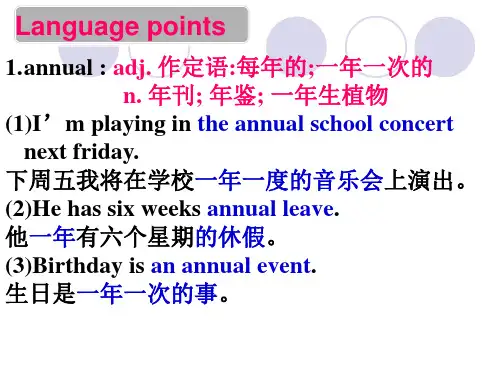
unit 3 under the sea language points
- 格式:ppt
- 大小:519.50 KB
- 文档页数:15
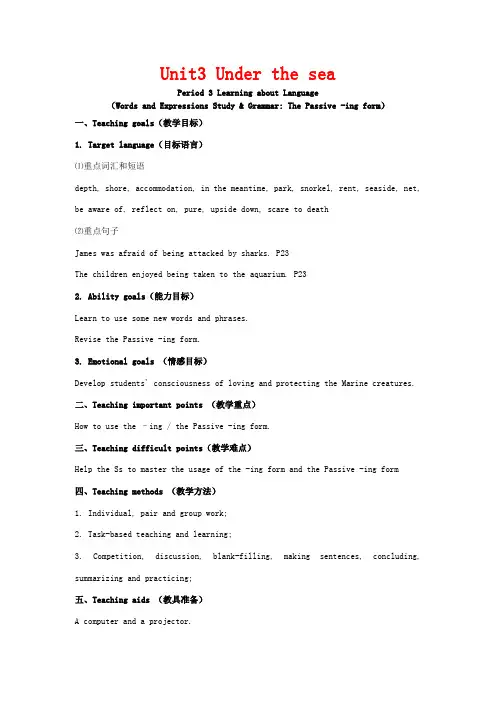
Unit3 Under the seaPeriod 3 Learning about Language(Words and Expressions Study & Grammar: The Passive -ing form)一、Teaching goals(教学目标)1. Target language(目标语言)⑴重点词汇和短语depth, shore, accommodation, in the meantime, park, snorkel, rent, seaside, net, be aware of, reflect on, pure, upside down, scare to death⑵重点句子James was afraid of being attacked by sharks. P23The children enjoyed being taken to the aquarium. P232. Ability goals(能力目标)Learn to use some new words and phrases.Revise the Passive -ing form.3. Emotional goals (情感目标)Develop students' consciousness of loving and protecting the Marine creatures.二、Teaching important points (教学重点)How to use the –ing / the Passive -ing form.三、Teaching difficult points(教学难点)Help the Ss to master the usage of the -ing form and the Passive -ing form四、Teaching methods (教学方法)1. Individual, pair and group work;2. Task-based teaching and learning;3. Competition, discussion, blank-filling, making sentences, concluding, summarizing and practicing;五、Teaching aids (教具准备)A computer and a projector.六、Teaching procedures(教学过程)StepⅠ DiscussionAsk Ss to discuss the questions by looking at the pictures.What have you learned from the reading passage? Have a look at the pictures and say something.【设计意图(Design purpose)】通过图片讨论,复习上节课内容,并引出本节课话题。

话题语言应用——海底世界编稿:牛新阁审稿:王春霞语言积累交际用语表示责备与抱怨:I’m sorry but ... 对不起,但是......I’m afraid .... 恐怕.......That’s not good enough. 那不够好。
I’m feeling annoyed with / unhappy about / unsatisfied with...我对......烦恼/不高兴/不满意。
(注意此句型中形容词与介词的搭配,再如:be/ feel terrified of ... 对......非常害怕)I’d like to talk to the manager. 我想和经理谈谈。
I’d like a (full) refund, please. 我希望(你们)能(全额)退款。
That’s no good for me. 那对我没有好处。
You should do something about it. 这件事你(们)应该处理/采取点措施。
话题语句(1)常见海洋动物(sea animals / sea creatures)【高清课堂:Under the sea语言应用---A tour to the sea!】crab 螃蟹 dolphin 海豚shark鲨鱼e el 鳗;鳝starfish海星jellyfish 水母,海蜇 lobster 龙虾 octopus 章鱼oyster 牡蛎coral 珊瑚(虫)seal 海豹sea lion 海狮walrus 海象 squid 鱿鱼seahorse 海马whale 鲸otter 水獭shrimp虾mussel 蚌sea cucumber 海参turtle海龟sea anemone海葵“I pledge to stop eating shark fin soup and will not do so under all circumstances.” Yao Ming said at a media conference hosted by Wild Aid in London.注意:pledge 保证,许诺shark fin soup鱼翅汤host 主持wild 野生的under all circumstances 无论在任何情况下A quiz about sea animals1. Lobsters, clams (蚌), and oysters have ________. (A)A. hard shellsB. holdfasts(吸盘)C. tentacles(触须)2. The largest animal in the sea is ________. (C)A. the white sharkB. the giant kelpC. the blue whale3. An octopus moves by ________. (C)A. walking on its tentaclesB. sliding on its backC. shooting out a stream of water4. The sea anemone(海葵) is ________. (B)A. a plant that looks like an animalB. an animal that looks like a plantC. the largest flower in the sea5. A seahorse swims by ________. (A)A. moving the fin (鳍) on its backB. moving its tailC. squirting (喷射) water out of its mouth6. Which one is a mammal that lives in the sea? (C)A. a starfishB. an octopusC. a whaleHow much do you know about sea animals? T or F1. Different types of fish live in different parts of the ocean. (T)Some live close to coral reefs. Some live near the surface. Some even live in the deep water close to the bottom of the ocean.2. Sharks are one of the better known predators (食肉动物) in the sea but they don’t have teeth.(F)Many sharks have sharp teeth that are used to catch their food.3. Fish usually travel in schools because they like to be together. (F)The movement of all the fishes may confuse a predator. Plus, there are more eyes to look out for danger.4. Coral reefs are created by dead creatures called polyps (珊瑚虫). (F)Polyps are tiny creatures that form a hard skeleton to protect their bodies.5. Seals spend all of their time in water. (F)They must return to the surface to breathe, just like other mammals.6. A seal can go for 40 minutes without a breath. This allows them to dive to a depth of over 2,000 feet. (T)7. Mother penguins keep the egg on her feet for 60 days without eating anything. (F)Father does the job.8. Jellyfish are creatures that have no bones and they are hidden on the seabed. (F)They are creatures that just float in the ocean.Sea transportation? (海上运输)canoe 独木舟 sailboats 帆船ferry渡轮submarine 潜水艇banana boats kayak 皮划艇jet ski 水上摩托fishing boats 渔船tanker 油船ocean liner 远洋定期客轮■话题语句(2)1. 有关海洋的词汇sea 海ocean 大洋bay 海湾,湾gulf 海湾、鸿沟cape 海角headland 海角,岬cliff 悬崖峭壁strait 海峡reef 礁石sandbar 沙洲tide 潮wave 浪iceberg 冰山delta 三角洲mouth 河口seaquake 海震,海啸low water 最低水位territorial waters 领海,领水current, watercourse 水流rapids 急流port, harbour 港(美语harbor)the Antarctic 南极洲offshore 近海的; 海面上的注:shore,seaside,beach,coast,bank的不同1)shore 指海岸,湖岸,也指近海的一带。

Unit 3 Under the seaI.教学内容分析本单元的中心话题是海底世界。
听说读写活动主要围绕海底的动植物、奇异景观和有关大海的神话绽开的。
Warming Up局部通过探讨海底生物和理解海底世界的途径导入本单元话题。
Pre-reading局部通过探讨图片导入课文并介绍故事背景。
Reading局部讲解并描述了一个虎鲸助人捕鲸、救人脱险的故事。
课文中采纳了大量的动作描写,并运用了大量的-ing形式。
Comprehending局部由三个练习题组成,旨在逐步加深学生对课文的理解。
Learning about Language局部突出了本单元词汇和语法的学习与训练。
本单元的语法是-ing 形式的被动语态。
Using Language局部包括阅读和写作两局部。
课文通过对海的世界奇观妙境的描写,为学生树立了景物描写的典范。
写作局部要求学生仿照课文描写景物。
本局部中,形容词的依次和复合形容词的构成也是学生应理解的内容。
Summing Up局部要求学生对本单元的内容、词语和构造进展总结,有助于学生Learning Tip 局部介绍了合成形容词的构词法,并指导学生在写作中主动利用构词规则组词。
II.教学重点和难点1. 教学重点(1) 本单元的生词和短语;(2) 驾驭运用-ing 形式的被动式;(3) 学会在对话和写作中表达责怪、埋怨以及要求赔偿。
2. 教学难点(1) 帮住学生更多地理解海洋生物,培育学生敬重海洋、爱惜海洋生物的道德品质;(2) 学会仿照课文描写景物;(3) 学会复述故事。
III.教学安排本单元建议分五课时:第一课时:Warming up, Pre-reading, Reading & Comprehending第二课时:Learning about Language第三课时:Reading and discussing (Using Language)第四课时:Reading, discussing and listening (Using Language) & Speaking and writing (Using Language)第五课时:Reading task (Workbook) & Writing task (Workbook)Period 1 Warming up, Pre-reading, Reading & Comprehending Teaching Goals:1. To arouse Ss’ interest in animals and plants living under the sea.2. To develop Ss’ reading ability.3. To appreciate how the writer describes movements.Teaching Procedures:Step 1. Leading-inPurpose: To arouse Ss’ interest in the content of this unit.1. Ask Ss to collect information about sea animals and plants and answer the followingquestion.Can you name some animals and plants living under the sea? What’s you favorite? Speak about it.2. Ask Ss to collect information about whales and answer the following question.(1) Are whales fish? How do you know?(2) What is a killer whale? What do you know about it?Step 2. Warming upPurpose: To get Ss to know something about the content of this unit.1.Get two or three Ss to talk about their favorite animals or plants under the sea. And ask Ss toanswer the following question.From where did you learn this?2. Ask Ss to look at the three pictures of Warming Up on P19 and answer the following questions.(1)What are your favorite sea plants and animals(2)Where can you find them?(3)If possible, would you like to keep some at home?Step 3. Pre-readingPurpose: To get the Ss prepared for reading the text.1.Ask Ss to talk about whales. Teacher may say, “Today, we are gong to read a story of alarge animal living in the sea, a killer whale. Do you think whales are fish? Why do you say so? Then get one of two Ss to talk about whales.”2.Ask Ss to look at the picture of Pre-reading and answer the following questions.(1)what do you think is happening?(2)What is a killer whale? Can you tell me about it?Step 4. Fast readingPurpose: To get Ss to read for the general idea.1.Ask Ss to read the text fast and sum up the main idea of the text and answer the followingquestion.In what person is the text written?Suggested Answer: The text is written in the first person.2.Play the tape and ask Ss to read after it.Step 5. Intensive readingPurpose: To develop Ss’ reading ability of scanning.1.Play the tape again sentence by sentence and ask Ss to underline what they cannot understand.2. Ask Ss to discuss what they have underlined.3. Read the following sentences and ask Ss to find whether they are true or false.4. Ask Ss to make a dialogue according to the questions in Ex1 of Comprehending on P21 and then act it out.Step 6. Language points (1)Purpose: To learn the language points in the text.1. Present the following phrases on the blackboard. Ask Ss whether they are what they have underlined and then ask them to translate them into Chinese. Finally, get them to remember the sentences containing these phrases.2. Lead Ss to deal with the following language points.Step 7. Language point (2)Purpose: To deal with the main sentence structures.1. Ask Ss to find the sentences containing –ing forms and tell what parts they play in the sentences. Then present the following sentences on the blackboard.(1).We ran down to the shore in time to see an enormous animal throwing itself out of water.(2).I saw James being held up in the water by Old Tom.(3).I could see a whale being attacked by a pack of about six other killers.(4).Gorge didn’t like being kept waiting.(5).I could see he was terrified of being abandoned by us.(6).The killers over there are throwing themselves on top of the whale’s blow hole to stop it breathing. And those others are stopping them fleeing out to sea.(7).I looked down into the water and could see Old Tom swimming by the boat, showing us the way.(8).And there was Tom, circling back to the boat, leading us to the hunt again.(9).Gorge told me, pointing towards the hunt.(10).“They are having a good feed on its lips and tongue,” added Gorge, laughing.(11).Gorge told me, pointing towards the hunt.(13).Being badly wounde d, the whale soon died.Suggested Answers:(1)~(3): 宾语补足语(4)~(6): 宾语(7): 宾补,伴随状语(8):状语(9)~(11): 伴随状语2. Collect Ss’ questions in understanding the grammar.Step 8. ExtensionPurpose: To develop Ss’ mentality of harmonious coexistence between man and nature.1. Ask Ss to answer the following questions and discuss them.(1)How do you feel after reading the text?(2)Should whale hunting be banned?2. Ask Ss to make a dialogue according to the result of the discussion.Step 9. Homework1.Rewrite the reading text in the third person. Encourage Ss to use their own words.2.Make sentences with the phrases learnt in the text.Period 2 Learning about LanguageTeaching Goals:1.To revise the passive –ing form.2.To enable Ss to master some new words and expressions.Teaching Procedures:Step 1. Revision1.Ask Ss to speak out the words and expressions learnt in this unit. The student who knows the mostwill be praised.2.Ask Ss to exchange the sentences they made with the phrases.Step 2. Grammar1. Complete the following sentences with the suitable –ing form of the verbs in the brackets.(1)_______(laugh) at in public made him upset.2. Analyze the grammar by explaining the answers.Group 1: In(1)~(10), passive forms of gerunds used as subjects or objects.Note: In (8)~(10), passive forms are not used.Group 2: In (11)~(14), non-finite verbs used as attributives.Convert the past or present participles into attributive clauses.(11).The house (which was) built last year will be our dormitory.(12).The house (which is) to be built next year will be our dormitory.(13).The house (which is) being built now will be our dormitory.(14).The soldier (who is ) being operated on now was wounded in the fight.Group 3: In (15)~(21), non-finite verbs used as adverbials.Convert the past or present participles into adverbial clauses.(15).(If I had been) given more time, I would have done the work better.(16).If you give me more love, you would be more loved.(17).When (she was) asked about her father, the girl cried.(18).(While he was) asking this and that, the doctor took out some medicine.(19)..(After they had been) shown around the school, the leaders went to the hotel.(20).(As it is) being painted, the house can’t be moved in.(21).(As it is) being repaired, the car can’t be used right now.3. Ask Ss to finish Ex1 and Ex2 in Using Structure on P64~65. And then check the answers withthe class.4. Let Ss finish Ex3 in Using Words And Expressions on P63. Leave Ss enough time for thinking.Collect different translations.Step 3. Homework1.Ask Ss to finish Ex1 and Ex2 in Revising Useful Structures on P22 and Ex1 and Ex2 inUsing Words And Expressions on P63.2.Ask Ss to preview the reading text in Using Language on P23 and finish Ex1 on P24according to the reading text.Period 3 Reading and discussing (Using language)Teaching Goals:1.To get Ss to learn how to describe things.2.To get Ss to know something about the formation of compound adjectives.Teaching Procedures:Step 1. Revision1.Ask Ss to speak out sentences with the passive –ing form. The student who speaks out themost will be praised.2.Check the homework with the class and correct Ss’ errors.Step 2. Leading-inPurpose: Get Ss prepared for the text learning.1. Ask Ss to look at the pictures on P23 and ask the following questions.(1) What can you see in the pictures? Are they beautiful?(2) Where do you think we can find them?2. Tell Ss what man in the past thought about the deep sea and lead them to the reading text. Teacher may say, “But in the past, man didn’t know much about the deep sea. He thought there was no living thing in deep sea because there was little light and great pressure. But he was wrong. It is a colorful world full of life. Today, let’s see what it is like under the sea.”Step 3. Fast reading1.Ask Ss to listen to the tape and ask Ss to sum up the main idea of the text2.Ask Ss to read after the tape and finish Ex1 in Reading and discussing on P24.Step 4. Intensive reading1. Ask Ss to read the text carefully and finish Ex2 in Reading and discussing on P24.2. Ask Ss to sum up the main idea of each paragraph and underline what they cannot understand. Step 5. Language point1. Explain the following language points.(1)reflect on (line 1, para 1): think deeply about, considerI need time to reflect on what your request. 我须要时间来考虑一下你的恳求。
