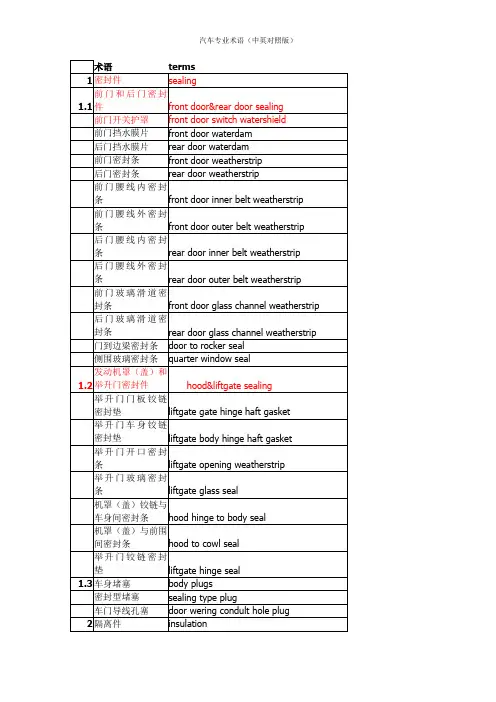
汽车零部件中英文术语Automotive Components: Bridging the Language DivideThe automotive industry is a complex and ever-evolving landscape, where the seamless integration of various components is essential for the smooth operation of vehicles. At the heart of this industry lies a vast array of specialized terminology, often with distinct English and Chinese equivalents. Understanding and navigating these linguistic nuances is crucial for effective communication, collaboration, and the advancement of the industry as a whole.One of the primary challenges in the automotive industry is the need to bridge the gap between the English and Chinese languages. As the industry continues to globalize, the demand for cross-cultural exchange and collaboration has never been higher. Manufacturers, suppliers, and engineers must be able to effectively communicate with their counterparts, regardless of their linguistic backgrounds. This is where the importance of understanding the English and Chinese terminology used in automotive components becomes paramount.Take, for example, the humble spark plug. In English, it is known as a"spark plug," a device that ignites the fuel-air mixture in an internal combustion engine. In Chinese, the equivalent term is "点火塞" (diǎn huǒ sāi). Und erstanding the nuances between these two terms is crucial for ensuring accurate communication and proper identification of the component during the manufacturing, installation, or maintenance processes.Similarly, the term "crankshaft" in English refers to the component that converts the reciprocating motion of the pistons into rotational motion, ultimately driving the wheels of the vehicle. The Chinese equivalent is "曲轴" (qū zhóu). Familiarity with both the English and Chinese terminology is essential for engineers and technicians working in the industry, as it allows for seamless collaboration and the efficient troubleshooting of issues.Beyond individual components, the automotive industry also utilizes a wide range of specialized terminology to describe the various systems and subsystems that make up a vehicle. For instance, the term "transmission" in English refers to the component that transfers power from the engine to the wheels, while the Chinese equivalent is "变速箱" (biàn sù xiāng). Understanding t he differences and similarities between these terms is crucial for ensuring accurate communication and the effective coordination of maintenance and repair procedures.The importance of bridging the language divide in the automotive industry extends beyond the technical aspects of the components themselves. It also encompasses the broader business and regulatory aspects of the industry. Terms such as "original equipment manufacturer" (OEM) in English, which refers to a company that produces parts and equipment that may be marketed by another manufacturer, have their own Chinese counterparts, in this case, "原厂" (yuán chǎng).Navigating the complex web of automotive terminology in both English and Chinese is not merely a matter of translation; it requires a deep understanding of the underlying concepts and the nuances that exist between the two languages. Failure to do so can lead to misunderstandings, delays, and even costly mistakes in the manufacturing, installation, and maintenance of automotive components.To address this challenge, the automotive industry has developed a range of resources and strategies to facilitate effective communication and collaboration. This includes the creation of industry-specific dictionaries and glossaries, as well as the development of standardized terminology and naming conventions. Additionally, many companies and organizations have invested in language training programs to ensure that their employees are equipped with the necessary linguistic skills to effectivelycommunicate with their counterparts, both domestically and internationally.In conclusion, the automotive industry's reliance on a vast array of specialized terminology, with distinct English and Chinese equivalents, highlights the critical importance of bridging the language divide. By fostering a deeper understanding of these linguistic nuances, industry professionals can enhance collaboration, improve efficiency, and drive the continued advancement of the automotive sector. As the industry continues to evolve and globalize, the mastery of both English and Chinese automotive terminology will become an increasingly valuable asset, paving the way for a more interconnected and innovative future.。