
基于低年级课堂的大学英语教师课堂话语分析
- 格式:pdf
- 大小:569.11 KB
- 文档页数:2

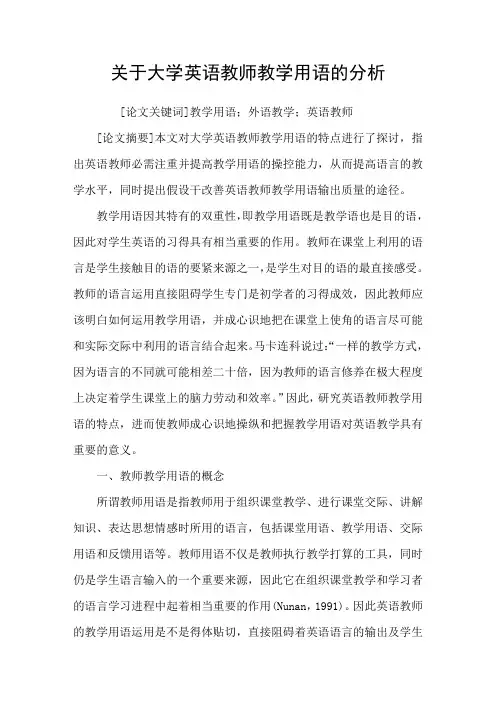
关于大学英语教师教学用语的分析[论文关键词]教学用语;外语教学;英语教师[论文摘要]本文对大学英语教师教学用语的特点进行了探讨,指出英语教师必需注重并提高教学用语的操控能力,从而提高语言的教学水平,同时提出假设干改善英语教师教学用语输出质量的途径。
教学用语因其特有的双重性,即教学用语既是教学语也是目的语,因此对学生英语的习得具有相当重要的作用。
教师在课堂上利用的语言是学生接触目的语的要紧来源之一,是学生对目的语的最直接感受。
教师的语言运用直接阻碍学生专门是初学者的习得成效,因此教师应该明白如何运用教学用语,并成心识地把在课堂上使角的语言尽可能和实际交际中利用的语言结合起来。
马卡连科说过:“一样的教学方式,因为语言的不同就可能相差二十倍,因为教师的语言修养在极大程度上决定着学生课堂上的脑力劳动和效率。
”因此,研究英语教师教学用语的特点,进而使教师成心识地操纵和把握教学用语对英语教学具有重要的意义。
一、教师教学用语的概念所谓教师用语是指教师用于组织课堂教学、进行课堂交际、讲解知识、表达思想情感时所用的语言,包括课堂用语、教学用语、交际用语和反馈用语等。
教师用语不仅是教师执行教学打算的工具,同时仍是学生语言输入的一个重要来源,因此它在组织课堂教学和学习者的语言学习进程中起着相当重要的作用(Nunan,1991)。
因此英语教师的教学用语运用是不是得体贴切,直接阻碍着英语语言的输出及学生交际能力的培育。
在某种程度上,教师用语的数量和质量会阻碍乃至决定课堂教学的成败。
二、英语教师教学用语的特点一样情形下,为了达到教师与学生交流的目的,教师往往利用通过加工、简化的语言从事教学。
回忆以往的研究,第一,Chaudron从语言学的角度指出语言教师的课堂用语在语音、词法、句法和语篇四个方面进行了处置,其特点要紧表现为…:语音方面:发音夸张清楚,停马上刻较长,语速较慢,幸免元音的弱读和辅音的略读,声音较高,较多书面式的标准发音。
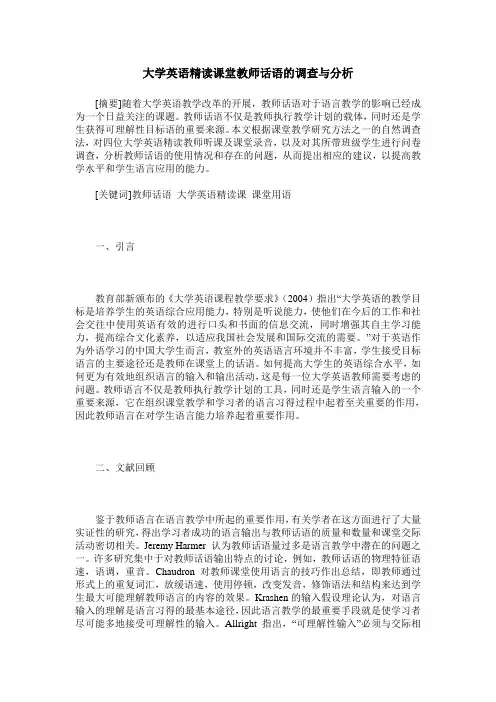
大学英语精读课堂教师话语的调查与分析[摘要]随着大学英语教学改革的开展,教师话语对于语言教学的影响已经成为一个日益关注的课题。
教师话语不仅是教师执行教学计划的载体,同时还是学生获得可理解性目标语的重要来源。
本文根据课堂教学研究方法之一的自然调查法,对四位大学英语精读教师听课及课堂录音,以及对其所带班级学生进行问卷调查,分析教师话语的使用情况和存在的问题,从而提出相应的建议,以提高教学水平和学生语言应用的能力。
[关键词]教师话语大学英语精读课课堂用语一、引言教育部新颁布的《大学英语课程教学要求》(2004)指出“大学英语的教学目标是培养学生的英语综合应用能力,特别是听说能力,使他们在今后的工作和社会交往中使用英语有效的进行口头和书面的信息交流,同时增强其自主学习能力,提高综合文化素养,以适应我国社会发展和国际交流的需要。
”对于英语作为外语学习的中国大学生而言,教室外的英语语言环境并不丰富,学生接受目标语言的主要途径还是教师在课堂上的话语。
如何提高大学生的英语综合水平,如何更为有效地组织语言的输入和输出活动,这是每一位大学英语教师需要考虑的问题。
教师语言不仅是教师执行教学计划的工具,同时还是学生语言输入的一个重要来源,它在组织课堂教学和学习者的语言习得过程中起着至关重要的作用,因此教师语言在对学生语言能力培养起着重要作用。
二、文献回顾鉴于教师语言在语言教学中所起的重要作用,有关学者在这方面进行了大量实证性的研究,得出学习者成功的语言输出与教师话语的质量和数量和课堂交际活动密切相关。
Jeremy Harmer 认为教师话语量过多是语言教学中潜在的问题之一。
许多研究集中于对教师话语输出特点的讨论,例如,教师话语的物理特征语速,语调,重音。
Chaudron对教师课堂使用语言的技巧作出总结,即教师通过形式上的重复词汇,放缓语速,使用停顿,改变发音,修饰语法和结构来达到学生最大可能理解教师语言的内容的效果。
Krashen的输入假设理论认为,对语言输入的理解是语言习得的最基本途径,因此语言教学的最重要手段就是使学习者尽可能多地接受可理解性的输入。

大学英语课堂教师话语调查与分析的开题报告
一、研究背景
在大学英语课堂教学中,教师话语一直是关注的重点之一。
教师话语不仅直接影响学生的理解和学习效果,还反映了教师对课堂的掌控和对学生的态度。
因此,对教师话语的调查和分析对于提高教学质量、促进教师专业化发展有着重要的意义。
二、研究目的
本研究旨在通过调查大学英语课堂教师话语特点、分析教师话语的优缺点,探讨如何促进大学英语课堂教师话语的有效性和充实性,提高教学效果。
三、研究问题
1.大学英语课堂教师话语的类型有哪些?
2.大学英语课堂教师话语的语言特点是什么?
3.分析大学英语课堂教师话语的优缺点。
4.如何促进大学英语课堂教师话语的有效性和充实性?
四、研究方法
本研究采用问卷调查和语料库分析相结合的方法进行研究。
通过给予大学英语教师问卷调查,了解大学英语课堂教师话语的类型和语言特点,并分析大学英语课堂教师话语的优缺点。
同时,利用语料库进行文本分析,探讨如何促进大学英语课堂教师话语的有效性和充实性。
五、论文结构
第一章研究背景和目的
第二章相关文献综述
第三章研究方法
第四章数据分析
第五章结论与建议
参考文献:
1. 赵洁.浅谈大学英语课堂教学中教师话语的作用[J].外语研
究,2018,105(03):36-38。
2. 盛善玲.英语课堂中教师话语分析——以初中英语教学为例[J].教学与管理,2019(09):73-74。
3. 李瑞莲. 大学英语课堂教师话语问题的分析与探讨[J].语文教育研究,2019(07):118-119。

大学英语课堂教师话语研究The use of language in the classroom is an important aspect of teaching and learning. As a key medium for communication, language plays a crucial role in shaping the learning environment and influencing student learning outcomes. In the context of university English classes, the language used by teachers is particularly important, as it can have a significant impact on students'ability to understand and engage with the material. Therefore, a study of teacher talk in university English classes is necessary to understand how language is used to facilitate learning and how it can be improved. This study aims to examine the nature and functions of teacher talk in university English classes, with a focus on the ways in which it supports or hinders student learning. By understanding the role of teacher talk in the classroom, we can identify best practices for effective communication and promote more effective teaching and learning in university English classes.1. Introduction to teacher talk in university English classesTeacher talk, or the language used by teachers in the classroom, plays a crucial role in shaping the learning environment and influencing student learning outcomes. In university English classes, where language is the primary medium for communication and understanding, the use of teacher talk is especially important. This introduction to teacher talk in university English classes aims to provide an overview of the nature and functions of teacher talk, as well as its role in facilitating student learning.Teacher talk can be categorized in various ways, including its purpose (e.g. giving instructions, explaining concepts, asking questions), its form (e.g. direct, indirect), and its function (e.g. controlling, influencing, facilitating). In university English classes, teacher talk may serve a variety of functions, such as providing information, eliciting student responses, and promoting critical thinking.Despite its importance, teacher talk is often understudied in the field of education. A lack of understanding of teacher talk can lead to ineffective communication in the classroom, which can hinder student learning. Byexamining the nature and functions of teacher talk in university English classes, we can better understand how language is used to facilitate learning and identify best practices for effective communication in the classroom.2. The role of teacher talk in facilitating student learningThe role of teacher talk in facilitating student learning is a crucial aspect of teaching and learning in university English classes. Through the use of language, teachers can shape the learning environment and influence student understanding and engagement with the material. In this section, we will explore the ways in which teacher talk can support student learning and the factors that can impact its effectiveness.One of the key ways in which teacher talk can facilitate student learning is by providing clear and concise explanations of concepts and ideas. By using language that is appropriate for the students' level of proficiency and using visual aids and examples to illustrate complex concepts, teachers can help students understand and retain new information. Additionally, teacher talk can help to engage students in the learning process by asking open-ended questions and encouraging participation and discussion.However, the effectiveness of teacher talk in facilitating student learning is not solely dependent on the teacher. Factors such as the students' prior knowledge and motivation, the complexity of the material, and the classroom environment can all impact the effectiveness of teacher talk. By understanding these factors and adapting their language use accordingly, teachers can better support student learning through their talk.In summary, the role of teacher talk in facilitating student learning is multifaceted and complex. By using language effectively and considering the various factors that impact its effectiveness, teachers can support student learning and promote a positive learning environment in university English classes.3. The functions of teacher talk in university English classesTeacher talk, or the language used by teachers in the classroom, serves a variety of functions in university English classes. These functions can be categorized based on their purpose (e.g. giving instructions, explaining concepts, asking questions), form (e.g. direct, indirect), or function (e.g. controlling, influencing, facilitating). In this section, we will examine the various functions of teacher talk in university English classes and the waysin which they support student learning.One of the primary functions of teacher talk is to provide information and clarify concepts. This can involve explaining new ideas, defining terms, and providing examples. By presenting information in a clear and organized manner, teachers can help students understand and retain new material.Another important function of teacher talk is to elicit student responses and promote critical thinking. This can involve asking open-ended questions, encouraging discussion and debate, and providing opportunities for students to share their own ideas and perspectives. By engaging students in this way, teachers can foster a sense of ownership over the material and encourage deeper learning.Teacher talk can also serve a number of other functions in the classroom, such as controlling the flow of the lesson, influencing student behavior, and establishing a positive learning environment. By understanding the various functions of teacher talk and using language effectively, teachers can support student learning and promote a positive classroom culture.4. Identifying best practices for effective teacher talk in the classroom Effective teacher talk is a key factor in promoting student learning and engagement in university English classes. By using language effectively, teachers can shape the learning environment and influence student understanding and motivation. In this section, we will explore best practices for effective teacher talk in the classroom and discuss strategies for improving teacher language use.One important aspect of effective teacher talk is clarity. By using languagethat is appropriate for the students' level of proficiency and avoiding jargon and overly complex language, teachers can help students understand and retain new information. Visual aids, such as diagrams, charts, and videos, can also be helpful in supporting understanding.Another key factor in effective teacher talk is engagement. By asking open-ended questions, encouraging discussion and debate, and providingopportunities for students to share their own ideas and perspectives, teachers can foster a sense of ownership over the material and encourage deeper learning.In addition to these practices, there are a number of strategies that teachers can use to improve their language use in the classroom. These may include seeking feedback from students, engaging in professional development opportunities, and reflecting on their own language use. By implementing these strategies, teachers can improve their effectiveness in facilitating student learning through their talk.In summary, identifying best practices for effective teacher talk in the classroom is an important aspect of teaching and learning in university English classes. By using language effectively and implementing strategies for improvement, teachers can support student learning and promote a positive learning environment.5. The impact of teacher talk on student engagement and motivationThe impact of teacher talk on student engagement and motivation is a significant factor in the effectiveness of teaching and learning in university English classes. By using language effectively, teachers can shape the learning environment and influence student understanding, attention, and motivation. In this section, we will explore the ways in which teacher talk can impact student engagement and motivation and discuss strategies for promoting positive outcomes.One way in which teacher talk can impact student engagement is through its clarity and organization. By using language that is appropriate for the students' level of proficiency and presenting information in a clear and logical manner, teachers can help students understand and retain new material.This can lead to increased engagement and attention in the classroom.Teacher talk can also impact student motivation by promoting a sense of ownership and involvement in the learning process. By asking open-ended questions, encouraging discussion and debate, and providing opportunities for students to share their own ideas and perspectives, teachers can foster a sense of ownership over the material and encourage deeper learning. This can lead to increased motivation and a more positive attitude towards learning.In addition to these practices, there are a number of strategies that teachers can use to promote student engagement and motivation through their talk. These may include using a variety of teaching methods, providing positive reinforcement and feedback, and adapting their language use to the needs and interests of their students. By implementing these strategies, teachers can promote a positive learning environment and support student engagement and motivation.In summary, the impact of teacher talk on student engagement and motivation is a significant factor in the effectiveness of teaching and learning in university English classes. By using language effectively and implementing strategies for promoting positive outcomes, teachers can support student learning and create a positive learning environment.6. Exploring strategies for improving teacher talk in university English classesImproving teacher talk in university English classes is an important aspect of teaching and learning, as effective language use can shape the learning environment and influence student understanding, engagement, and motivation. In this section, we will explore strategies for improving teacher talk in university English classes and discuss the ways in which these strategies can support student learning.One strategy for improving teacher talk is seeking feedback from students. By soliciting feedback from students on their language use, teachers can identify areas for improvement and make adjustments accordingly. This can be done through formal evaluations or more informal methods such as class discussionsor one-on-one conversations.Another effective strategy for improving teacher talk is engaging in professional development opportunities. These may include workshops, seminars, or online courses focused on language use in the classroom. Theseopportunities can provide teachers with new ideas and strategies for improving their language use and facilitating student learning.In addition to seeking feedback and engaging in professional development, teachers can also improve their language use by reflecting on their own practice. This may involve analyzing recordings of their own class sessions, seeking feedback from colleagues, or setting specific goals for improvement.In summary, exploring strategies for improving teacher talk in university English classes is an important aspect of teaching and learning. By seeking feedback, engaging in professional development, and reflecting on their own practice, teachers can identify areas for improvement and make adjustments to support student learning.。