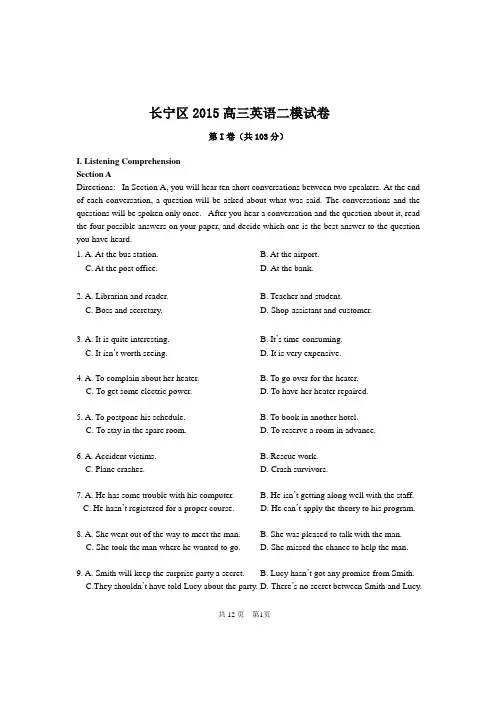
长宁区2015高三英语二模试卷第I卷(共103分)I. Listening ComprehensionSection ADirections: In Section A, you will hear ten short conversations between two speakers. At the end of each conversation, a question will be asked about what was said. The conversations and the questions will be spoken only once. After you hear a conversation and the question about it, read the four possible answers on your paper, and decide which one is the best answer to the question you have heard.1. A. At the bus station. B. At the airport.C. At the post office.D. At the bank.2. A. Librarian and reader. B. Teacher and student.C. Boss and secretary.D. Shop-assistant and customer.3. A. It is quite interesting. B. It’s time-consuming.C. It isn’t worth seeing.D. It is very expensive.4. A. To complain about her heater. B. To go over for the heater.C. To get some electric power.D. To have her heater repaired.5. A. To postpone his schedule. B. To book in another hotel.C. To stay in the spare room.D. To reserve a room in advance.6. A. Accident victims. B. Rescue work.C. Plane crashes.D. Crash survivors.7. A. He has some trouble with his computer. B. He isn’t getting along well with the staff.C. He hasn’t registered for a proper course.D. He can’t apply the theory to his program.8. A. She went out of the way to meet the man. B. She was pleased to talk with the man.C. She took the man where he wanted to go.D. She missed the chance to help the man.9. A. Smith will keep the surprise party a secret. B. Lucy hasn’t got any promise from Smith.C.They shouldn’t have told Lucy about the party.D. There’s no secret between Smith and Lucy.共12页第1页10. A. V olunteers have to connect the community.B. The man has no time to do voluntary work.C. V oluntary work requires devotion of time.D. Many people have signed up for voluntary work.Section BDirections: In Section B, you will hear two short passages, and you will be asked three questions on each of the passages. The passages will be read twice, but the questions will be spoken only once. When you hear a question, read the four possible answers on your paper and decide which one would be the best answer to the question you have heard.Questions 11 through 13 are based on the following passage.11. A. Nick lost the book Ivan borrowed from the library.B. The book Ivan borrowed from Nick was missing.C. Nick and Ivan had conflicts in Ms. Salmon’s class.D. Ivan was asked to return the book before finishing it.12. A. She asked Nick and Ivan to solve the problem by themselves.B. She gave Nick and Ivan the solution to their problem immediately.C. She asked students in social studies class to help solve the problem.D. She persuaded Ivan to pay for the book that Nick lent to him.13. A. A good way to resolve conflicts is to turn to your best friends.B. Nick and Ivan were unsatisfied with the solution to their problem.C. Signing an agreement helped to solve Nick and Ivan’s problem.D. Social studies class can equip students with skills to resolve conflicts.Questions 14 through 16 are based on the following news.14. A. She wanted to have a garden similar to their neighbor’s.B. Her husband would like to have a beautiful backyard.C. She was going to make the rented house her own home.D. The community required them to keep the backyard lovely.15. A. By getting involved in doing voluntary work.B. By picking up mails for their neighbors.C. By keeping an eye on their neighbors’ children.D. By planting trees along the street with others.16. A. Her husband volunteered to work in the neighborhood.B. They took on new responsibilities for their neighbors.C. She was planning to plant a new garden in the backyard.D. She enjoyed the relationship they built with the community.共12页第2页Section CDirections: In Section C, you will hear two longer conversations. The conversations will be read twice. After you hear each conversation, you are required to fill in the numbered blanks with the information you have heard. Write your answers on your answer sheet.Blanks 17 through 20 are based on the following conversation.Complete the form. Write ONE WORD for each answer.Blanks 21 through 24 are based on the following conversation.Complete the form. Write NO MORE THAN THREE WORDS for each answer.II. Grammar and VocabularySection ADirections: After reading the passages below, fill in the blanks to make the passages coherent and grammatically correct. For the blanks with a given word, fill in each blank with the proper form of the given word; for the other blanks, use one word that best fits each blank.共12页第3页(A)We had to climb right up the hill, which is very steep, and, when close under it, it seemed to be high, but we soon reached the top. When we were there, we had lost sight of the lake; and now our road was over a wild land. 25 (go) a little way, we saw before us, at the distance of about half a mile, a very large stone building, with a high wall round it, neither field nor tree near.The wild land was overgrown with grey grass that cattle might feed upon. We could not tell 26 this building was. It appeared 27 ______ it had been built strong to defend from storms; but for what purpose? William called out to us that we should observe that place well, for it was exactly like one of the shelters of the Alps (阿尔卑斯山), 28 (build) for the reception of travelers, and indeed I had thought it 29 be so. This building, from its singular structure and appearance, made the place, which is itself in a country 30 Scotland, remarkable.When we 31 (pass) it and looked back, three pyramidal mountains on the opposite side of Lock Lomond ended the view, 32 in certain kind of weather might be very grand. Our highland companion had not got enough English to give us any information concerning this strange building. What we could only get from her was that it was a “large house”, which was plain enough.(B)All plants need water to grow. Watering plants seems like a simple task but it actually requires many considerations. For example, plants growing in areas with low rainfall or areas33 (expose) to dry wind require more water. On the other hand, plants which have a good adaptation to dry conditions or have the ability to store water in their cells require 34 (frequent)watering. The watering of plants should not be viewed as a minor process in gardening 35 this task plays an extremely important role in ensuring healthy plant growth.Let’s first take a closer look at plants growing in gardens. Since watering is a critical gardening task, 36 accessible water supply is vital. A garden tap with a hose of sufficient length to reach the furthest part of the garden 37 (prefer). This tends to make watering much easier and ensures adequate water is provided for the plants. Most inexperienced gardeners water little 38 very frequently. This is undesirable as it encourages shallow root growth. In addition, watering in full sun causes leaves to lose water quickly from the surface of the soil. Therefore, some experts recommend 39 (install) an automatic watering system.As for plants growing in pots or containers, they tend to lose water rapidly. One way to reduce such a risk is 40 (group) the plants close together to keep moisture. Try to move them to a shady place if you are away from home for a few days. Otherwise, you will return home to see your plants dead.Section BDirections: Complete the following passage by using the words in the box. Each word can only be used once. Note that there is one word more than you need.共12页第4页The fortunate people in the world,the only really fortunate people in the world in my mind, are those whose work is also their pleasure. The class is not a large one, not nearly so large as it is often 41 to be,and authors are perhaps one of the most important elements in its composition. They enjoy in this 42 at least a real harmony of life. To my mind, to be able to make your work your pleasure is the one class distinction in the world worth striving for; and I do not 43 that others tend to envy those happy human beings who find their livelihood in the gay effusions (流露) of their fancy, to whom every hour of labor is an hour of 44 and even a holiday is almost deprivation (丧失). Whether a man writes well or ill, has much to say or little, if he cares about writing at all, he will appreciate the pleasures of composition.To sit at the table on a sunny morning, with four clear hours of uninterruptible 45 , plenty of nice white paper and a pen is true happiness. With the complete absorption of the mind upon a(n) 46 occupation, what more is there than that to desire? What does it matter what happens outside?The House of Commons may do what it likes, and so may the House of Lords. The bottom may be 47 clean out of the American market. The heathen (异教徒) may show 48 anger in every part of the globe. Never mind, for four hours, at any rate, we will 49 ourselves from a common, ill-governed, and 50 world.III. Reading ComprehensionSection ADirections: For each blank in the following passage there are four words or phrases marked A, B, C and D. Fill in each blank with the word or phrase that best fits the context.Early in the age of affluence (富裕) that followed World War II, an American economic analyst declared, “Our enormously productive economy demands that we make consumption our way of life, that we change the buying and use of goods into habits, that we seek our51 satisfaction, our self-satisfaction in consumption. We need things consumed, burned up, worn out, replaced at an ever 52 rat e.” Americans have 53 to the call, and much of the world has followed.Consumption has become a central part of life in industrial lands and is even deeply rooted in social 54 . Opinion surveys in the world’s two largest economies, Japan and the United States, show consumerist definitions of success becoming very popular.Over consumption by the fortunate in the world is an environmental problem 55 in severity by anything but perhaps population growth. Their increasing exploitation of resources 56 to exhaust or unalterably spoils forests, soils, water, air and climate.Ironically (有讽刺意味的), high consumption may be a 57 blessing in human terms, too. The time-honored values of honesty of character, good work, friendship, family and community have often been 58 in the rush to riches.共12页第5页Thus, many people in the industrial lands have a sense that their world of plenty is somehow hollow. With the 59 of a consumerist culture, they also think that they have been 60 attempting to satisfy what are essentially social, psychological and spiritual needs with material things.61 , the opposite of over consumption—poverty— is no 62 to either environmental or human problems. It is much worse for people and bad for the natural world too. Peasants who have nothing left cut-and-burn their way into the rain forests of Latin America, and hungry nomads (游牧民) turn their animals out onto African grassland, reducing it to 63 .If environmental 64 results when people have either too little or too much, we are left to wonder how much is enough. What level of consumption can the earth support? When does having more 65 to add noticeably to human satisfaction?51. A. natural B. spiritual C. cultural D. actual52. A. promising B. promoting C. falling D. increasing53. A. proved B. returned C. responded D. persevered54. A. values B. moralities C. identities D. problems55. A. qualified B. unmatched C. compared D. unprocessed56. A. happens B. manages C. starts D. threatens57. A. mixed B. detected C. counted D. terrified58. A. promoted B. sacrificed C. satisfied D. relieved59. A. improving B. neglecting C. sponsoring D. misleading60. A. fruitlessly B. successfully C. occasionally D. eagerly61. A. As a result B. For instance C. Of course D. From then on62. A. solution B. pollution C. consideration D. contribution63. A. attraction B. rubbish C. homeland D. desert64. A. construction B. destruction C. development D. improvement65. A. remain B. occur C. cease D. happenSection BDirections: Read the following three passages. Each passage is followed by several questions or unfinished statements. For each of them there are four choices marked A, B, C and D. Choose the one that fits best according to the information given in the passage you have just read.(A)Not too many decades ago it seemed “obvious” both to the general public and to sociologists t hat modern society has changed people’s natural relations, loosened their responsibilities to relatives and neighbors, and substituted in their place loose relationships with passing acquaintances (相识之人). However, in recent years a growing body of research has revealed that the “obvious” is not true. It seems that if you are a city resident, you typically know a smaller proportion of your neighbors than you do if you are a resident of a smaller community. But, for the most part, this fact has few significant consequences. It does not necessarily follow that if you共12页第6页know few of your neighbors you will know no one else.Even in very large cities, people maintain close social ties within small, private social worlds. Indeed, the number and quality of meaningful relationships do not differ between more and less urban people. Small-town residents are more involved with relatives than big-city residents are. Yet city residents make up for it by developing friendships with people who share similar interests and activities. Urbanism may produce a different style of life, but the quality of life does not differ between town and city. Nor are residents of large communities more likely to display psychological symptoms of stress or alienation, a feeling of not belonging, than residents of smaller communities are. However, city residents do worry more about crime, and this leads them to a distrust of strangers.These findings do not imply that urbanism makes little or no difference. If neighbors are strangers to one another, they are less likely to sweep the sidewalk of an elderly couple living next door or keep an eye out for young trouble makers. Moreover, as Wirth suggested, there may be a link between a community’s population size and its social heterogeneity(多样性).For instance, sociologists have found much evidence that the size of a community is associated with bad behavior including gambling, drugs, etc. Large-city residents are also more likely than small-town residents to have a cosmopolitan (见识广的) outlook, to display less responsibility to traditional family roles, to vote for leftist political candidates, and to be willing to accept nontraditional religious groups and unpopular political groups. Everything considered, heterogeneity and unusual behavior seem to be outcomes of large population size.66. According to paragraph 1, it was once a common belief that people in modern society ______.A. tended to acquaint themselves with people passing byB. couldn’t develop very close relationships with othersC. bore great responsibilities to neighbors and relativesD. usually had more friends than small-town residents67. One of the consequences of urbanism is that the city residents ______________.A. suffer from the lack of friendshipB. lower the quality of relationshipsC. show little concern for other peopleD. become suspicious of each other68. We can learn from the passage that the bigger a community is, ______________.A. the more open-minded people areB. the more similar its interests isC. the more likely it is to display stressD. the better the quality of life is69. What is the passage mainly about?A. Advantages and disadvantages of living in big cities or small towns.B. Minor differences in interpersonal relations between cities and townsC. The positive role that urbanism has been playing in our modern society.D. The strong feeling of alienation that city residents are suffering.共12页第7页(B)70. How much will a passenger pay if he wants to alter his ticket to three days later?A. 25 % of the original priceB. 20 % of the original priceC. 15 % of the original priceD. 10 % of the original price共12页第8页71. The limit of luggage for a single passenger is ________________.A. One suitcase, one handbag and one 15kgs check-in luggageB. One handbag, two pieces of 15kgs check-in luggage.C. One handbag and two pieces of 30 kgs check-in luggage.D. One suitcase, one handbag and one 30kgs check-in luggage.72. What does the Train Company guarantee?A. Students, children, senior citizens and groups can get 25 % discount of the original price.B. Passengers get the full price of the tickets back if the train is delayed over five minutes.C. Same-day-returns can be fully refunded if they are cancelled two minutes before departure.D. People with Globe-trotter tickets can take any kind of the discounts listed in the brochure.(C)How do predators (猎食动物)affect populations of the prey (猎物) animals? The answer is not as simple as might be thought. The moose (麋鹿)reached Isle Royale in Lake Superior by crossing over winter ice and bred freely there in isolation without predators. When wolves later reached the island, naturalists widely assumed that the wolves would play a key role in controlling the moose population. Careful studies have demonstrated, however, that this is not the case. The wolves eat mostly old or diseased animals that would not survive long anyway. In general, the moose population is controlled by food availability, disease and other factors rather than by wolves.When experimental populations are set up under simple laboratory conditions, the predator often wipes out its prey and then becomes extinct itself. However, if safe areas like those prey animals have in the wild are provided, the prey population drops to low level but not extinction. Low prey population levels then provide inadequate food for the predators, causing the predator population to decrease. When this occurs, the prey population can rebound. In this situation the predator and prey population may continue in this cyclical pattern for some time.Population cycles are characteristic of small mammals, and they sometimes appear to be brought about by predators. Ecologists studying hare populations have found that the North American snowshoe hare follows a roughly ten-year cycle. Two factors appear to be generating the cycle: food plants and predators.The preferred foods of snowshoe hares are tender willow branches. As the hare population increases, the quantity of these branches decreases, forcing the hares to feed on low-quality high-fiber food. Lower birth rates and low growth rates follow, so there is a corresponding decline in hare quantity. Once the hare population has declined, it takes two to three years for the quantity of branches to recover.A key predator of the snowshoe hare is the Canada lynx. The Canada lynx shows a ten-year cycle of abundance (大量) that parallels the abundance cycle of hares. As hare numbers fall, so do lynx numbers, as their food supply decreased.共12页第9页Predators are an essential factor in maintaining communities that are rich and diverse in species. Without predators, the species that is the best competitor for food, shelter, and other environmental resources tends to dominate and exclude the species with which it competes. This phenomenon is known as “competitor exclusion”. However, if the community contains a predator of the strongest competitor species, then the population of that competitor is controlled. Thus even the less competitive species are able to survive. From the stand point of diversity (多样性), it is usually a mistake to eliminate a major predator from a community.73. The author uses the example of the moose and wolves on Isle Royale to _________________.A. provide evidence that predators influence prey populationsB. question the belief in the effect of predators on prey populationsC. demonstrate predator population grows faster than that of the preyD. prove that the studies of isolated populations tend to be useful74. The word “rebound” in the passage is closest in meaning to_____________________.A. reactB. resistC. remainD. recover75. Which of the following is true according to the passage?A. Laboratory results ca n’t explain the changes in predator and prey populations of the wild.B. The growth of hare population may lead to a corresponding increase in its birth rates.C. The experimental environments can promote the growth of predator and prey populations.D. The existence of a major predator in a community is a threat to the diversity of species.76. What can we conclude from the passage about the cycle of the Canada lynx?A. When hare numbers decrease, lynx numbers increase.B. It has a great effect on the number of snowshoe hares.C. It closely follows the cycle of the snowshoe hare.D. It is not directly related to the availability of lynx food.77. What is the best title of this passage?A. What role predators play in keeping competitor species.B. Whether predators have an impact on prey populations.C. A study of the populations of the predator and prey animals.D. Contributing factors of the changes in animal populationsSection CDirections: Read the passage carefully. Then answer the questions or complete the statements in the fewest possible words.共12页第10页Courage is a quality we cherish. Yet only lately has it been studied systematically to try to define what it is and is not, where it comes from and why we love it so much. “Courage helps to define the excellent person,”write George Kateb, a political theorist at Princeton University. “One of the worst criticism in the world is to be called a coward, a quite timid person.”For many people, courage is most readily displayed in battle; for example, the brave soldier running into the line of fire to rescue the injured.Yet George Kateb says that if courage finds its highest expression in war, then the trait (特性) becomes immoral, ennobling killing by insisting that only in battle can people discover the depths of their nobility. Thus, it makes killing a noble thing.Stanley J Rachman of the University of British Columbia studies paratroopers (伞兵) preparing for their first jump. The work revealed three different groups: the fearless who jumped without hesitation; the timid whose fear kept them from jumping; and finally, the ones who reacted physiologically like the timid but acted like the fearless leaper, and jumped.Rachman considered the final group courageous, defining courage as “a behavioral approach in spite of the experience of fear”. Thus, courage becomes the property of anyone who does something that he or she fears.In interviewing 320 children aged from 8 to 13, Peter Muris of Erasmus University, Rotterdam, of the Netherlands and his colleagues found that children also consider courage as the conquering of one’s fears; and more than 70% claimed they had performed brave acts, including stealing money from one’s mother’s purse.Joel Berger, a biologist with the Wildlife Conservation Society in Montana, US, also distinguishes between animals that behave bravely due to a lack of awareness and experience, and those that are aware of a danger but proceed anyway.He recalled the time he and his colleagues had cornered a young bison (野牛) to take blood samples. At that time, an adult male bison was standing guard, refusing to let the scientists approach. “He knew that he could be attacked by us,” said Berger. “I’d call this a courageous, even heroic act.”78. What does George Kateb think of courage?79. Why did Rachman think that the third group were courageous?80. Peter Muris found that most children demonstrated their courage ____________________.81. The writer uses the example of an adult bison to _____________________.(Note: Answer the questions or complete the statements in NO MORE THAN EIGHT WORDS)共12页第11页第II卷(共47分)I. TranslationDirections: Translate the following sentences into English, using the words given in the brackets.1. 人们越来越依赖互联网。