
中南大学 综合英语2005 考研专业课真题
- 格式:pdf
- 大小:1.98 MB
- 文档页数:10

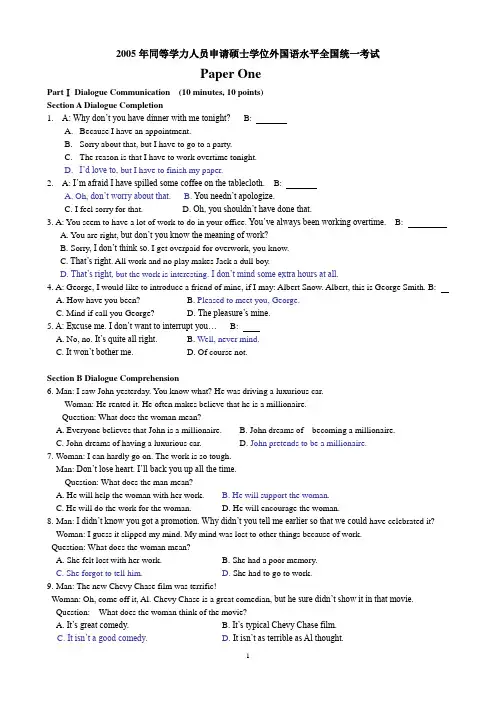
2005年同等学力人员申请硕士学位外国语水平全国统一考试Paper OnePartⅠ Dialogue Communication (10 minutes, 10 points)Section A Dialogue Completion1.A: Why don‟t you have dinner with me tonight?B:A.Because I have an appointment.B.Sorry about that, but I have to go to a party.C.The reason is that I have to work overtime tonight.D.I‟d love to, but I have to finish my paper.2.A: I‟m afraid I have spilled some coffee on the tablecloth.B:A. Oh, don‟t worry about that.B. You needn‟t apologize.C. I feel sorry for that.D. Oh, you shouldn‟t have done that.3. A: You seem to have a lot of work to do in your office. You‟ve always been working overtime. B:A. You are right, but don‟t you know the meaning of work?B. Sorry, I don‟t think so. I get overpaid for overwork, you know.C. That‟s right. All work and no play makes Jack a dull boy.D. That‟s right, but the work is interesting. I don‟t mind some extra hours at all.4. A: George, I would like to introduce a friend of mine, if I may: Albert Snow. Albert, this is George Smith. B:A. How have you been?B. Pleased to meet you, George.C. Mind if call you George?D. The pleasure‟s mine.5. A: Excuse me. I don‟t want to interrupt you…B:A. No, no. It‟s quite all right.B. Well, never mind.C. It won‟t bother me.D. Of course not.Section B Dialogue Comprehension6. Man: I saw John yesterday. You know what? He was driving a luxurious car.Woman: He rented it. He often makes believe that he is a millionaire.Question: What does the woman mean?A. Everyone believes that John is a millionaire.B. John dreams of becoming a millionaire.C. John dreams of having a luxurious car.D. John pretends to be a millionaire.7. Woman: I can hardly go on. The work is so tough.Man: Don‟t lose heart. I‟ll back you up all the time.Question: What does the man mean?A. He will help the woman with her work.B. He will support the woman.C. He will do the work for the woman.D. He will encourage the woman.8. Man: I didn‟t know you got a promotion. Why didn‟t you tell me earlier so that we could have celebrated it? Woman: I guess it slipped my mind. My mind was lost to other things because of work.Question: What does the woman mean?A. She felt lost with her work.B. She had a poor memory.C. She forgot to tell him.D. She had to go to work.9. Man: The new Chevy Chase film was terrific!Woman: Oh, come off it, Al. Chevy Chase is a great comedian, but he sure didn‟t show it in that movie. Question: What does the woman think of the movie?A. It‟s great comedy.B. It‟s typical Chevy Chase film.10. Woman: You haven‟t said a word about my dress, Dave. Don‟t you like it?Man: I‟m sorry I didn‟t say anything about it sooner. I don‟t think I‟ve seen anything like is before.Question: What does the man probably think of the dress?A. It is in fashion.B. It surely is unique.C. It is a bit old-fashioned.D. It surely suits her.Part Ⅱ Vocabulary (10 minutes, 10 points)Section A11.Should English classes be compulsory at the elementary or primary school level in countrieswhere it is not the native language?A. requiredB. necessaryC. selectedD. permanent讲义3.Next semester, Susan must take three compulsory courses.A. formalB. voluntaryC. practicalD. required12.In the end, both attacks and defenses of the free market and conventional economics haveimmense philosophical implications.A. traditionalB. novelC. capital-centeredD. consumption-centered 讲义9. Tiny atomic electric batteries have certain advantages over the ______ storage batteries.A. universalB. inclusiveC. indefinite22. The girl of ten has such exceptional abilities that everyone is jealous of her.A. regularB. specificC. extraordinary13.Applicant will be asked to provide information on how they will disseminate information toother students at their university or college.A. discloseB. deliverC. spreadD. analyze14.In general, the British people belong to one of the more affluent countries of Europe and enjoy ahigh standard of living compared to the rest of the world.A. plentifulB. powerfulC. friendlyD. wealthy15.To absorb a younger work force, many companies offered retirement plans as incentives forolder workers to retire and make way for the younger ones who earned lower salaries.A. rewardsB. opportunitiesC. motivesD. stimuli讲义2. The fun of playing the game was a greater incentive than the prize.A. motiveB. initiativeC. excitementD. entertainment16.Their business flourished at its new location a year later owing to their joint efforts and hardwork.A. prevailedB. failedC. boomedD. shrank讲义:11. The Timber rattlesnake is now on the endangered species list, and is extinct in two eastern states in which it once ______.A. thrivedB. swelledC. prospered17.The pressure on her from her family caused her to resort to the drastic measures.A. turn toB. keep toC. stick toD. lead to18.I shall never forget the look of intense anguish on the face of his parents when they heard thenews.A. stressB. dilemmaC. miseryD. surprise19.If minor disputes are left unsettled, tough ones will pile up sooner or later.A. accumulateB. vanishC. lingerD. emerge20.The police tried in vain to break up the protest crowds in front of the government building.A. unskillfullyB. violentlyC. ineffectivelyD. eventuallyyour department.A. satisfactionB. gratitude D. sincerity讲义:1. I' d like to take this opportunity to extend my heart-felt gratitude to the host.A. increaseB. prolongC. intensifyD. express22.The objective of this popular consultation is to determine, , the final political status of theregion, whether to remain part of the country as a special district, or to part from it.A. once upon a timeB. once and againC. all at onceD. once and for all从前一而再,屡次断然地, 坚决地23.The two countries will assign counter-drug officials to their respective embassies ona basis.A. fundamentalB. similarC. reciprocal 互惠的D. reasonable24.Tennessee‟s population is nearly two-fifths rural, and no single city or group ofcities the state.A. dominatesB. managesC. manipulatesD. controls25.We all know that in a situation like this a cool head is .A. called forB. called offC. called onD. called up讲义:9. A well-written composition ______ good choice of words and clear organization among other things.A. calls onB. calls forC. calls upD. calls off26.The destruction an earthquake causes depends on its and duration, or the amount ofshaking that occurs.A. altitudeB. magnitudeC. multitudeD. aptitude讲义:35. In my opinion, you can widen the ______ of these improvements through your active participation.A. dimensionB. volume D. scope27.The El Nino has affected the regional weather and temperature over much of the tropics,sub-tropics and some mid-latitude areas.A. externallyB. consistentlyC. insistentlyD. internally28.During all these years of absence he had a tender feeling for his mother and the family.A. enclosedB. huggedC. enrichedD. cherished29.The choice for a consumer, therefore, is the choice among the available ones that willenable him or her to maximize utility.A. optimalB. optionalC. opticalD. optimistic30.Mrs. Smith tears when she heard her daughter had died in the road accident.A. broke inB. broke upC. broke throughD. broke intoPart Ⅲ Reading Comprehension (45 minutes, 25 points)Passage OneIt was Friday, the day of the field trip on which Miss Joan would take her class to pick apples.Miss Joan enjoyed picking apples with her students. She smiled as she led her students to the bus that would take them to the Greenly Apple Orchard(果园).The bus ride was bumpy and the kids were a little noisy, but still Miss Joan was smiling.The bus stopped in front of the Greenly Orchard Store and the class got off quickly and quietly. Miss Joan made sure everyone was there. “What a glorious,sunny, apple picking day,” Miss Joan announced with her grandest smile.Mr. Greenly was there to greet them. “Let see, there are eighteen children and two adults atMiss Joan held u p the brochure in her hand. “It says that the price is two dollars each,”she pointed ort. “That‟s what I collected from everyone.”“We‟ve had to raise the price,” Mr. Greenly stated.“You sent me this brochure after we made our reservation,” Miss Joan complained, “and it says two dollars!”“Miss Joan, if you look at the bottom of this brochure,” Mr. Greenly said, “you‟ll notice a very important statement.”Sure enough, in very tiny letters, it said, “Prices are subject to change without notice.”Miss Joan was determined to keep her good mood. She took a twenty dollars bill out of her own purse and handed it to Mr. Greenly with the forty dollars she had in an envelope.“Now children, do you all have your baskets?” Miss Joan called out. “Remember, you can pic k as many apples six apples each.”“I beg your pardon!”Miss Joan was not smiling now. “The brochure says,…ALL YOU CAN PICK‟!”Mr. Greenly pointed to the tiniest letters Miss Joan had ever almost seen. It also says, “Terms and conditions of group reservat ions are subject to change without notice.”Miss Joan‟s good mood was now history. She didn‟t want to set a bad example for her students, so she said in a calm and quiet voice, “We‟re going home, give me our money back, please.”31.How many dollars did Miss Joan hand to Mr. Greenly?A. 20.B. 40.C. 60.D. 1832.The phrase “subject to change without notice” suggests .A.Mr. Greenly could change the terms at will.B.the customers should read the brochure carefullyC.Mr. Greenly could determine what apples to be picked.D.the customers should be informed beforehand.33.The students could not pick as many apples as they would like because .A.they were children.B. there were not enough apples.C. they had made a group reservation.D. they would eat up too many apples.34.“Miss Joan‟s good mood was now history?”(the last paragraph) means .A.Miss Joan had been happy until that moment.B.Miss Joan was no longer interested in history.C.Miss Joan taught her students the history of the orchard.D.Miss Joan was good at concealing her feelings35.What can we learn about Miss Joan from the story?A. She did not read the brochure carefully.B. She made a reservation after seeing the brochure.C. She lost her temper in the end.D. She didn‟t know h ow to complain.Passage TwoBoth civilization and culture are fairly modern words, having come into prominent use during the 19th century by anthropologists(人类学家), historians, and literary figures. There has been a strong tendency to use them interchangeably as though they mean the same thing, but they are not the same.Although modern in their usage, the two words derived from ancient Latin. The word civilization is based on the Latin civis, of a city. Thus civilization, in its most essential meaning, isit would seem that certain insects, such as ants or bees, are also civilized. They live and work together in social groups. So do some microorganisms. But there is more to civilization, and that is what culture brings to it. So, civilization is inseparable from culture.The word culture is derived from the Latin verb colere, till the soil. But colere also has a wider range of meanings. It may, like civis, mean inhabiting a town or village. But most of its definitions suggest a process of starting and promoting growth and development. One may cultivate a garden; one may also cultivate one‟s interests, mind, and abilities. In its modern use the word culture refers to all the positive aspects and achievements of humanity that make mankind different from the rest of the animal world. Culture has grown out of creativity, a characteristic that seems to be unique to human beings.One of the basic and best-know features of civilization and culture is the presence of tools. But more important than their simple existence is that the tools are always being improved and enlarged upon, a result of creativity. It took thousands of years to get from the first wheel to the latest, most advanced model of automobile.It is the concept of humans as toolmakers and improvers that differentiates them from other animals. A monkey may use a stick to knock a banana from a tree, but that stick will never, through a monkey‟s clevernes s, be modified into a hook or a ladder. Monkeys have never devised a spoken language, written a book, composed a melody, built a house, or painted a portrait. To say that birds build nests and beavers(海狸)their dens is to miss the point. People once lived in caves, but their cleverness, imagination, and creativity led them to progress beyond caves to buildings.36. What does the author think of the words “civilization”and “culture”?A. They are identical.B. They are different concepts.C. They can often be used interchangeably.D. They are defined differently by different people.37. According to the author the word “civilization” originally refers to .A. people‟s way of life in citiesB. people‟s ability to live together in citiesC. a type of social organizationsD. an advanced level of social life38. The Latin verb colere originally means “”.A. live in a cityB. develop oneselfC. promote growthD. cultivate the land39. The author believes that creativity .A. is a unique feature of civilized beingsB. brings forth the improvement of toolsC. is the result of human developmentD. helps the advance of culture40. The author mentions monkeys in the last paragraph to show that .A. monkeys are the same as birdsB. people once lived in caves like monkeysC. monkeys can never develop into human beingsD. man is different from other animals such as monkeysPassage ThreeThe huge growth of global “ecotourism”industry is becoming an increasing concern for conservationists with mounting evidence that many wild species do not respond well to contact with human beings. Overexposure to tourists has been linked to stress, abnormal behaviour and adverse health effects in species such as polar bears, dolphins and gorillas(大猩猩),says a report in New Scientist.While regulated ecotourism can help conservation efforts by encouraging people to manage endangered species and their habitats, many projects are poorly designed and unregulated, it says.environmentally friendly policies and operations.”While regulated ecotourism can help conservation efforts by encouraging people to manage endangered species and their habitats, “many projects are p oorly designed and hint they are based on environmentally friendly policies and operations.”Ecotourism is growing by 10 to 30 percent a year and an estimated 20 percent of tourists are thought to visit a conservation-based project. Philip Seddon, of the University of Otago in New Zealand, said that although most tourist projects conformed to basic guidelines on land use and not scaring wildlife, their full impact was rarely considered.“Transmission of disease to wildlife, or subtle changes to wildlife health through disturbance of daily routines or increased stress levels may translate to lowered survival and breeding,” he said. Research at the University of Auckland has shown that dolphins become restless and overactive when many tourist boats are present. When three or more boats are near, the dolphins rest for 0.5 percent of the time, compared with 68 percent when they are accompanied by a single boat. The findings are backed up by studies of dolphins in Britain. Researchers at the University of Manitoba in Canada have found that male polar bears easily disturbed by tourist vehicles, with a possible effect on their heart rate and metabolism(新陈代谢). That could reduce body fat levels and fitness, critical for survival.In Africa, gorillas have picked up parasites introduced to their habitat by tourists and mongooses(蠓)have caught lung diseases from human beings. Experts said that the answer to the problems was better regulation and supervision of ecotourism. The Galapagos Islands, where visitor numbers are strictly controlled, is a good model.41. Ecotourism is meant to .A. have tourists help in the conservation of wildlifeB. have wild species respond well to contact with humansC. make wild species reduce stress and abnormal behaviourD. make conservationists more concerned with wildlife42. According to New Scientist, many ecotourist projects .A. really encourage people to protect wildlife and its habitatB. strictly follow environmentally friendly policiesC. actually lack proper examination and official approvalD. seriously damage the habitats of endangered species43. What will happen to wildlife ul timately if the present “ecotourism” practice goes on?A. It will disturb their life.B. It will affect their health.C. It will increase their stress.D. It will threaten their survival.44. According to the passage, the growth in the global “ecotourism” industry .A. reflects an increasing concern for conservationB. arouses a growing concern for conservationC. coincides with a mounting concern for conservationD. originates from a grater concern for conservation45. According to the passage, a solution to the “ecotourism” problem is to .A. encourage people to manage endangered speciesB. reduce the exposure of wildlife to human beingsC. help wild animals increase their fitnessD. prevent wildlife from catching human diseasesComputers can beat chess champion Gary Kasparov at his game, count all the atoms in a nuclear explosion, and calculate complex figures in a fraction of a second, but they still fail at the slight differences in language translation. Artificial Intelligence computers have large amounts of memory, capable of storing huge translating dictionaries and extensive lists of grammar rules. Yet, today‟s best computer language translators have just a 60 percent accuracy rate. Scientist s are still unable to program the computer with human-like common sense reasoning power.Computer language translation is called Machine Translation, or MT. While not perfect, MT is surprisingly good. MT was designed to process dry, technical language that people find tedious to translate. Computers can translate basic phrases, such as “You foot bone‟s connected to your ankle bone, your ankle bone‟s connected to your leg bone.” They can translate more difficult phrases, such as “Which witch is which?” Computers can also accurately translate “Wild thing, you make my heart sing!” into other languages because they can understand individual words, as long as the words are pre-programmed in their dictionary.But highly sensitive types of translating, such as important diplomatic conversations, are beyond the scope of computer translating programs. Human translators use intuitional meaning, not logic, to process words and phrases into other languages. A human can properly translate the phrase, “The pen is in the pe n(围养禽畜的圈),” because most humans know that it means that a writing instrument is in a small enclosed space. Many times, computers do not have the ability to determine in which way two identical words in one sentence are to be used.In addition to using massive rule-programmed machines, computer programmers are also trying to teach computers to learn how to think for themselves through the “experience” of translating. Even with these efforts, programmers admit that a “thinking” computer might not ever be invented in the future.46. Computers today are capable of .A. defeating the best chess player in the worldB. telling subtle differences between languagesC. translating over 60 percent of difficult textsD. doing human-like common sense reasoning47. According to the passage, which of the following is NOT true?A. Computers can translate dry and difficult phrases.B. Computers can understand sensitive language.C. Computers can translate technical language.D. Computers can understand pre-programmed words.48. The major problem with computer translating programs is that computers .A. can not translate illogical sentencesB. do not have a large enough capacity of memoryC. can not understand grammatical rulesD. do not have intuition to process language49. To improve machine translation, computer programmers are trying to .A. use powerful rule-programmed computersB. teach computers to think by practiceC. have computers compile translating dictionariesD. add explanations of words in computer programs50. The passage suggests that .A. the accuracy rate of machine translation cannot be raisedB. it is impossible for computers to think as humans doC. only technical language is suitable for machine translationD. it is impossible to determine of identical wordsSeveral years ago during the dot-com passion, Manhattan lawyer John Kennedy sometimes wore a dark blue suit to meet potential Internet clients. But he soon realized that his conservative clothes were a strike against him before he even shook hands. So he began to do business in casual, open-shirt clothes.But now the tables have turned. Today Silicon Valley executives are the ones often coming out in suits. No wonder that Fortune 500 executives are dusting off their silk ties and pants.” I would say there is a trend now toward a little more business dress,” said Kennedy. “I find myself wearing suits more.”While there isn‟t a rush toward formal office wear, clothiers and executives say the workplace uniform is heading that way. In many offices, men are wearing jackets, ties and pants more frequently than a year age. Top women executives never went as casual as men, so the shift doesn‟t affect them as dramatically.“Business casual” took several years to catch on. It started with casual Fridays, evolved to casual summers, then became casual everyday. A return to the button-down look also will take time, observers say. Lehman Brothers is one of the few major firms that has officially returned to a formal dress policy, at least for offices that clients visit. Men were told to wear suits and ties and women to wear suits or dresses. The shift is due to a rethinking of work environments and more contacts with clients as the firm has grown.Observers mention many factors driving the trend. Internet companies helped lead the dress-down movement and other industries followed suit to attract workers. But with the collapse of many dot-coms, the relaxed look is becoming a style to avoid. Moreover, as the economy stumbles, more people are hunting for jobs or trying to keep the ones they have, and appearance counts.US President Bush wears a coat and tie in the White House office and expects his staff to dress “professionally,” which some say sets a tome for the nation.Chuck Wardell, managing director of a recruiting firm, believes a lot of employees like a stiffer uniform. “They‟re going to work. They don‟t want to feel like they‟re going to a picnic.”51.”Business casual” was prevalent several years ago because _____.A. the Manhattan law business grew very quicklyB. shaking hands with clients became popularC. the country was fighting the conservativesD. the Internet companies boomed then52. When the “bu siness ca sual” prevailed, _____.A. businessmen wore ties only in workplaceB. businessmen didn‟t wear ties at allC. businesswomen didn‟t wear formally in workplaceD. businesswomen still wore formally everywhere53. The Fortune 500 executives__________.A. set the trend toward more casual wearB. are particular about what they wearC. begin to wear suits more often than beforeD. are usually indifferent to fashion trend54. At the beginning of the “business casual” trend, business people wore casually___________.A. when meeting clientsB. on weekendsC. in summerD. almost every day55. It is implied in the passage that the change of business dress from the casual to the formalreflects_____.A. the changed of people‟s taste in fashionB. the ups and downs of the fashion industryC. the ups and downs of the Internet companiesD. people‟s different preference in business dressPart IV CloseThe United States has historically had higher rates of marriage than those of other industrialized countries. The current annual marriage 56 in the United States ---about 9 new marriages for every 1,000 people ---is 57 higher than it is in other industrialized countries. However, marriage is 58 as widespread as it was several decades ago. 59 of American adults who are married 60 _ form 72 percent in 1970 to 60 percent in 2002.This does not mean that large numbers of people will remain unmarried 61 their lives. Throughout the 20th century, about 90 percent of Americans married at some 62 in their lives. Experts_ 63 that about the same proportion of today‟s young adults will eventually marry.The timing of marriage has varied 64 over the past century. In 1995 the average age of women in the United States at the time of their first marriage was 25.The average age of men was about 27.Men and women in the United States marry for the first time at an average of five years later than people did in the 1950s. 65 ,young adults of the 1950s married younger than did any previous 66 in U.S. history. Today‟s later age of marriage is 67 the age of marriage between 1890 and 1940. Moreover, a greater proportion of the population was married (95 percent)during the 1950s than at any time before 68 .Experts do not agree on why the “marriage rush” of the late 1940s and 1950s occurred, but most social scientists believe it represented a 69 to the return of peaceful life and prosperity after 15 years of severe economic 70 and war.56. A. rate B. ratio C. percentage D. poll57. A. potentially B. intentionally C. randomly D. substantially相当大的58. A. not any longer B. no more C. no longer D. not any more59. A. A proportion B. The proportion C. The number D. A number60. A. declined B. deteriorated C. deduced D. demolished61. A. past B. passing C. throughout D. through62. A. period B. level C. point D. respect63. A. project B. plan C. promise D. propose64. A . unexpectedly B. irregularly C. flexibly D. consistently65. A. Besides B. However C. Whereas D. Nevertheless66. A. descendants B. ascendants C. population D. generation67. A. according to B. in line with C. based on D. caused by68. A. and after B. or after C. or since D. ever since69. A. refusal B. realization C. response D. reality70. A. repression B. aggression C. restriction D. depressionPart V Error Detection71. It is an accepted custom for guests to take their gifts to the wedding reception when the coupleinvited them to attend.72. Some international students use a cassette recorder to make tapes of their classes so that theycan repeat the lectures again.73. Despite of diligent efforts to promote domestic production during the war years, the ContinentalArmy had to rely primarily on captures and imports for much of its military hardware and even for clothing.74. In a sense, farmers began primitive genetic engineering at the dawn of agriculture, which theykept seeds from their best plants, gradually improving the quality of successive generations.。

2005--2021年考研英语阅读理解真题及答案2021年考研英语阅读真题和答案Text 1Everybody loves a fat pay rise. Yet pleasure at your own can vanish if you learn that a colleague has been given a bigger one. Indeed, if he has a reputation for slacking, you might even be outraged. Such behaviour is regarded as 'all too human', with the underlying assumption that other animals would not be capable of this finely developed sense of grievance. But a study by Sarah Brosnan and Frans de Waal of Emory University in Atlanta, Georgia, which has just been published in Nature, suggests that it is all too monkey, as well.The researchers studied the behaviour of female brown capuchin monkeys. They look cute. They are good-natured, co-operative creatures, and they share their food readily. Above all, like their female human counterparts, they tend to pay much closer attention to the value of "goods and services" than males.Such characteristics make them perfect candidates for Dr. Brosnan's and Dr. de Waal's study. The researchers spent twoyears teaching their monkeys to exchange tokens for food. Normally, the monkeys were happy enough to exchange pieces of rock for slices of cucumber. However, when two monkeys were placed in separate but adjoining chambers, so that each could observe what the other was getting in return for its rock, their behaviour became markedly different.In the world of capuchins, grapes are luxury goods (and much preferable to cucumbers). So when one monkey was handed a grape in exchange for her token, the second was reluctant to hand hers over for a mere piece of cucumber. And if one received a grape without having to provide her token in exchange at all, the other either tossed her own token at the researcher or out of the chamber, or refused to accept the slice of cucumber. Indeed, the mere presence of a grape in the other chamber (without an actual monkey to eat it) was enough to induce resentment in a female capuchin.The researchers suggest that capuchin monkeys, like humans, are guided by social emotions. In the wild, they are a co-operative, group-living species. Such co-operation is likely to be stable only when each animal feels it is not being cheated. Feelings of righteous indignation, it seems, are not the preserve of people alone. Refusing a lesser rewardcompletely makes these feelings abundantly clear to other members of the group. However, whether such a sense of fairness evolved independently in capuchins and humans, or whether it stems from the common ancestor that the species had 35 million years ago, is, as yet, an unanswered question.1. In the opening paragraph, the author introduces his topic by[A] posing a contrast.[B] justifying an assumption.[C] making a comparison.[D] explaining a phenomenon.2. The statement "it is all too monkey" (Last line, Paragraph 1) implies that[A] monkeys are also outraged by slack rivals.[B] resenting unfairness is also monkeys' nature.[C] monkeys, like humans, tend to be jealous of each other.[D] no animals other than monkeys can develop such emotions.3. Female capuchin monkeys were chosen for the research most probably because they are[A] more inclined to weigh what they get.[B] attentive to researchers' instructions.[C] nice in both appearance and temperament.[D] more generous than their male companions.4. Dr. Brosnan and Dr. de Waal have eventually found in their study that the monkeys[A] prefer grapes to cucumbers.[B] can be taught to exchange things.[C] will not be co-operative if feeling cheated.[D] are unhappy when separated from others.5. What can we infer from the last paragraph?[A] Monkeys can be trained to develop social emotions[B] Human indignation evolved from an uncertain source.[C] Animals usually show their feelings openly as humans do.[D] Cooperation among monkeys remains stable only in the wild.参考答案:CBACBText 2Do you remember all those years when scientists argued that smoking would kill us but the doubters insisted that we didn't know for sure? That the evidence was inconclusive, the science uncertain? That the antismoking lobby was out to destroy our way of life and the government should stay out of the way? Lotsof Americans bought that nonsense, and over three decades, some 10 million smokers went to early graves.There are upsetting parallels today, as scientists in one wave after another try to awaken us to the growing threat of global warming. The latest was a panel from the National Academy of Sciences, enlisted by the White House, to tell us that Earth's atmosphere is definitely warming and that the problem is largely man-made. The clear message is that we should get moving to protect ourselves. The president of the National Academy, Bruce Alberts, added this key point in the preface to the panel's report: "Science never has all the answer. But science does provide us with the best available guide to the future, and it is critical that our nation and the world base important policies on the best judgments that science can provide concerning the future consequences of present actions."Just as on smoking, voice now come from many quarters insisting that the science about global warming is incomplete, that it's OK to keep pouring fumes into the air until we know for sure. This is a dangerous game: by the time 100 percent people of the evidence is in, it may be too late. With the risks obvious and growing, a prudent people would take out aninsurance policy now.Fortunately, the White House is starting to pay attention. But it's obvious that a majority of the president's advisers still don't take global warming seriously. Instead of a plan of action, they continue to press for more research — a classic case of "paralysis by analysis."To serve as responsible stewards of the planet, we must press forward on deeper atmospheric and oceanic research. But research alone is inadequate. If the Administration won't take the legislative initiative, Congress should help to begin fashioning conservation measures. A bill by Democratic Senator Robert Byrd of West Virginia, which would offer financial incentives for private industry, is a promising start. Many see that the country is getting ready to build lots of new power plants to meet our energy needs. If we are ever going to protect the atmosphere, it is crucial that those new plants be environmentally sound.6. An argument made by supporters of smoking was that.[A] there was no scientific evidence of the correlation between smoking and death.[B] the number of early deaths of smokers in the past decades was insignificant[C] people had the freedom to choose their own way of life[D] antismoking people were usually talking nonsense7. According to Bruce Alberts, science can serve as[A] a protector.[B] a judge[C] a critic[D] a guide8. What does the author mean by "paralysis by analysis" (Last line, Paragraph 4)?[A] Endless studies kill action.[B] Careful investigation reveals truth[C] Prudent planning hinders progress[D] Extensive research helps decision-making9. According to the author, what should the Administration do about global warming?[A] Offer aid to build cleaner power plants[B] Raise public awareness of conservation[C] Press for further scientific research[D] Take some legislative measures10. The author associates the issue of global warming with that of smoking because[A] they both suffered from the government's negligence.[B] a lesson from the latter is applicable to the former.[C] the outcome of the latter aggravates the former.[D] both of them have turned from bad to worse.参考答案:CDADBText 3Of all the components of a good night's sleep, dreams seem to be least within our control. In dreams, a window opens into a world where logic is suspended and dead people speak A century ago, Freud formulated his revolutionary theory that dreams were the disguised shadows of our unconscious desires and fears, by the late 1970s, neurologists had switched to thinking of them as just "mental noise" —the random byproducts of the neural-repair work that goes on during sleep. Now researchers suspect that dreams are part of the mind's emotional thermostat, regulating moods while the brain is "off-line". And one leading authority says that these intensely powerful mental events can be not only harnessed but actually brought under conscious control, to help us sleep and feel better. "It's your dream," says Rosalind Cartwright, chair of psychology at Chicago's Medical Center. "If you don't like it, change it"Evidence from brain imaging supports this view. The brainis as active during REM (rapid eye movement) sleep — when most vivid dreams occur — as it is when fully awake, says Dr. Eric Nofzinger at the University of Pittsburgh. But not all parts of the brain are equally involved, the limbic system (the "emotional brain") is especially active, while the prefronted cortex (the center of intellect and reasoning) is relatively quiet. "We wake up from dreams happy or depressed, and those feelings can stay with us all day," says Stanford sleep researcher Dr. William Dement.The link between dreams and emotions shows up among the patients in Cartwright's clinic Most people seem to have more bad dreams early in the night, progressing toward happier ones before awakening, suggesting that they are working through negative feelings generated during the day. Because our conscious mind is occupied with daily life we don't always think about the emotional significance of the day's events — until, it appears, we begin to dream.And this process need not be left to the unconscious. Cartwright believes one can exercise conscious control over recurring bad dreams. As soon as you awaken, identify what is upsetting about the dream. Visualize how you would like it to end instead; the next time it occurs, try to wake up just enoughto control its course. With much practice people can learn to, literally, do it in their sleep.At the end of the day, there's probably little reason to pay attention to our dreams at all unless they keep us from sleeping or "we wake up in a panic," Cartwright says. Terrorism, economic uncertainties and general feelings of insecurity have increased people's anxiety. Those suffering from persistent nightmares should seek help from a therapist. For the rest of us, the brain has its ways of working through bad feeling. Sleep — or rather dream — on it and you'll feel better in the morning.11. Researchers have come to believe that dreams[A] can be modified in their courses[B] are susceptible to emotional changes[C] reflect our innermost desires and fears[D] are a random outcome of neural repairs12. By referring to the limbic system, the author intends to show[A] it's function in our dreams[B] the mechanism of REM sleep[C] the relation of dreams to emotions[D] its difference from the prefrontal cortex13. The Negative feelings generated during the day tend to[A] aggravate in our unconscious mind[B] develop into happy dreams[C] persist till the time we fall asleep[D] show up in dreams early at night14. Cartwright seems to suggest that[A] waking up in time is essential to the ridding of bad dreams[B] visualizing bad dreams helps bring them under control[C] dreams should be left to their natural progression[D] dreaming may not entirely belong to the unconscious15. What advice might Cartwright give to those who sometimes have bad dreams?[A] Lead your life as usual[B] Seek professional help[C] Exercise conscious control[D] Avoid anxiety in the daytime参考答案:ACDDAText 4Americans no longer expect public figures, whether in speech or in writing, to command the English language with skilland gift. Nor do they aspire to such command themselves. In his latest book, Doing Our Own Thing: The Degradation of language and Music and why We should, Like, Care, John Mcwhorter, a linguist and controversialist of mixed liberal and conservative views, see the triumph of 1960s counter-culture as responsible for the decline of formal English.Blaming the permissive 1960s is nothing new, but this is not yet another criticism against the decline in education. Mr Mcwhorter's academic speciality is language history and change, and he sees the gradual disappearance of "whom", for example, to be natural and no more regrettable than the loss the case-endings of Old English.But the cult of the authentic and the personal, "doing our own thing," has spelt the death of formal speech, writing, poetry and music. While even the modestly educated sought an elevated tone when they put pen to paper before the 1960's even the most well regarded writing since then has sought to capture spoken English on the page. Equally, in poetry, the highly personal, performative genre is the only form that could claim real liveliness. In both oral and written English, talking is triumphing over speaking, spontaneity over craft.Illustrated with an entertaining array of examples fromboth high and low culture, the trend that Mr. Mcwhorter documents is unmistakable. But it is less clear, to take the question of his subtitle, why we should, like, care. As a linguist, he acknowledges that all varieties of human language, including non-standard ones like Black English, can be powerfully expressive — there exists no language or dialect in the world that cannot convey complex ideas, He is not arguing, as many do, that we can no longer think straight because we do not talk proper.Russians have a deep love for their own language and carry chunks of memorized poetry in their heads, while Italian politicians tend to elaborate speech that would seem old-fashioned to most English-speakers. Mr. Mcwhorter acknowledges that formal language is not strictly necessary, and proposes no radical educational reforms — he is really grieving over the loss of something beautiful more than useful. We now take our English "on paper plates instead of china" A shame, perhaps, but probably an inevitable one.16. According to Mcwhorter, the decline of formal English[A] is inevitable in radical education reforms[B] is but all too natural in language development[C] has caused the controversy over the counter-culture[D] brought about changes in public attitudes in the 1960s17. The word "talking" (Line 6, Paragraph 3) denotes[A] modesty[B] personality[C] liveliness[D] informality18. To which of the following statements would McWhorter most likely agree?[A] Logical thinking is not necessarily related to the way we talk.[B] Black English can be more expressive than standard English.[C] Non-standard varieties of human language are just as entertaining.[D] Of all the varieties, standard English can best convey complex ideas.19. The description of Russians' love of memorizing poetry shows the author's[A] interest in their language.[B] appreciation of their efforts.[C] admiration for their memory.[D] contempt for their old-fashionedness.20. According to the last paragraph, "paper plates" is to "china" as[A] "temporary" is to "permanent."[B] "radical" is to "conservative"[C] "functional" is to "artistic"[D] "humble" is to "noble"参考答案:BDABC2021年考研英语阅读真题及答案Text 1In spite of “endless talk of difference,” American society is an amazing machine for homogenizing people. This is “the democratizing uniformity of dress and discourse, and the casualness and absence of consumption “launched by the 19th –century department stores that offered ‘vast arrays of goods in an elegant atmosphere. Instead of intimate shops catering to a knowledgeable elite.” these were stores “anyone could enter, regardless of class or background. This turned shopping into a public and democratic act.” The mass media, advertising and sports are other forces for homogenization.Immigrants are quickly fitting into this common culture, which may not be altogether elevating but is hardly poisonous.Writing for the National Immigration Forum, Gregory Rodriguez reports that today’s immigration is neither at unprecedented level nor resistant to assimilation. In 1998 immigrants were 9.8 percent of population; in 1900, 13.6 percent. In the 10 years prior to 1990, 3.1 immigrants arrived for every 1,000 residents; in the 10 years prior to 1890, 9.2 for every 1,000. Now, consider three indices of assimilation------language, home ownership and intermarriage.The 1990 Census revealed that “a majority of immigrants from each of the fifteen most common countries of origin spoke English “well” or “very well” after ten years of residence.”The children of immigrants tend to be bilingual and proficient in English. “By the third generation, the original language is lost in the majority of immigrant families.” Hence the description of America as a graveyard” for language. By 1996 foreign-born immigrants who had arrive before 1970 had a home ownership rate of 75.6 percent, higher than the 69.8 percent rate among native-born Americans.Foreign-born Asians and Hispanics “have higher rates of intermarriage than do U.S-born whites and blacks.” By the third generation, one third of Hispanic women are married to non-Hispanics, and 41 percent of Asian-American women aremarried to non-Asians.Rodriguez notes that children in remote villages around world are fans of superstars like Amold Schwarzenegger and Garth Brooks, yet “some Americans fear that immigrant living within the United States remain somehow immune to the nation’s assimilative power.”Are there divisive issues and pockets of seething in America? Indeed. It is big enough to have a bit of everything. But particularly when viewed against America’s turbulent past, today’s social indices hardly suggest a dark and deteriorating social environment.1. The word “homogenizing” (Line 2, Paragraph 1) most probably means___A. identifyingB. associatingC. assimilatingD. monopolizing2. According to the author, the department stores of the 19th century___A. played a role in the spread of popular culture.B. became intimate shops for common consumers.C. satisfied the needs of a knowledgeable elite.D. owed its emergence to the culture of consumption.3. The text suggests that immigrants now in the U.S.___A. are resistant to homogenization.B. exert a great influence on American culture.C. are hardly a threat to the common culture.D. constitute the majority of the population.4. Why are Amold Schwarzenegger and Garth Brooks mentioned in Paragraph 5?A. To prove their popularity around the world.B. To reveal the public’s fear of immigrants.C. To give examples of successful immigrants.D. To show the powerful influence of American culture.5. In the author’s opinion, the absorption of immigrants into American society isA. rewardingB. SuccessfulC. fruitlessD. harmful参考答案:CACDBText 2Stratford-on-Avon, as we all know, has only one industry —William Shakespeare—but there are two distinctly separateand increasingly hostile branches. There is the Royal Shakespeare Company (ASC), which presents superb productions of the plays at the Shakespeare Memorial Theatre on the Avon. And there are the townsfolk who largely live off the tourists who come, not to see the plays, but to look at Anne Hathaway’s Cottage, Shakespeare’s birthplace and the other sights.The worthy residents of Stratford doubt that the theatre adds a penny to their revenue. They frankly dislike the RSC’s actors, them with their long hair and beards and sandals and noisiness. It’s all deliciously ironic when you consider that Shakespeare, who earns their living, was himself an actor (with a beard) and did his share of noise-making.The tourist streams are not entirely separate. The sightseers who come by bus- and often take in Warwick Castle and Blenheim Palace on the side—don’t usually see the plays, and some of them are even surprised to find a theatre in Stratford. However, the playgoers do manage a little sight-seeing along with their play going. It is the playgoers, the ESC contends, who bring in much of the town’s revenue because they spend the night (some of them four or five nights) pouring cash into the hotels and restaurants. The sightseers can take in everything and get out of town by nightfall.The townsfolk don’t see it this way and local council does not contribute directly to the subsidy of the Royal Shakespeare Company. Stratford cries poor traditionally. Nevertheless every hotel in town seems to be adding a new wing or cocktail lounge. Hilton is building its own hotel there, which you may be sure will be decorated with Hamlet Hamburger Bars, the Lear Lounge, the Banquo Banqueting Room, and so forth, and will be very expensive.Anyway, the townsfolk can’t understand why the Royal Shakespeare Company needs a subsidy. (The theatre has broken attendance records for three years in a row. Last year its 1,431 seats were 94 percent occupied all year long and this year they’ll do better.)The reason, of course, is that costs have rocketed and ticket prices have stayed low.It would be a shame to raise prices too much because it would drive away the young people who are Stratford’s most attractive clientele. They come entirely for the plays, not the sights. They all seem to look alike (though they come from all over)---lean, pointed, dedicated faces, wearing jeans and sandals, eating their buns and bedding down for the night on the flagstones outside the theatre to buy the 20 seats and 80 standing—room tickets held for the sleepers and sold to themwhen the box office opens at 10:30 a.m..6. From the first two paras , we learn that____A. the townsfolk deny the RSC ’ s contribution to the town’s revenueB. the actors of the RSC imitate Shakespeare on and off stageC. the two branches of the RSC are not on good termsD. the townsfolk earn little from tourism7. It can be inferred from Para 3 that____A. the sightseers cannot visit the Castle and the Palace separatelyB. the playgoers spend more money than the sightseersC. the sightseers do more shopping than the playgoersD. the playgoers go to no other places in town than the theater8. By saying “Stratford cries poor traditionally” (Line 2-3, Paragraph 4), the author implies that____A. Stratford cannot afford the expansion projectsB. Stratford has long been in financial difficultiesC. the town is not really short of moneyD. the townsfolk used to be poorly paid9. According to the townsfolk, the RSC deserves no subsidybecause____A. ticket prices can be raised to cover the spendingB. the company is financially ill-managedC. the behavior of the actors is not socially acceptableD. the theatre attendance is on the rise10. From the text we can conclude that the author_____A. is supportive of both sidesB. favors the townsfolk’s viewC. takes a detached attitudeD. is sympathetic to the RSC参考答案:ABCDDText 3When prehistoric man arrived in new parts of the world, something strange happened to the large animals. They suddenly became extinct. Smaller species survived. The large, slow-growing animals were easy game, and were quickly hunted to extinction. Now something similar could be happening in the oceans.That the seas are being overfished has been known for years. What researchers such as Ransom Myers and Boris Worm have shown is just how fast things are changing. They have looked at halfa century of data from fisheries around the world. Their methods do not attempt to estimate the actual biomass (the amount of living biological matter) of fish species in particular parts of the ocean, but rather changes in that biomass over time. According to their latest paper published in Nature, the biomass of large predators (animals that kill and eat other animals) in a new fishery is reduced on average by 80% within 15 years of the start of exploitation. In some long-fished areas, it has halved again since then.Dr Worm acknowledges that the figures are conservative. One reason for this is that fishing technology has improved. Today's vessels can find their prey using satellites and sonar, which were not available 50 years ago. That means a higher proportion of what is in the sea is being caught, so the real difference between present and past is likely to be worse than the one recorded by changes in catch sizes. In the early days, too, longlines would have been more saturated with fish. Some individuals would therefore not have been caught, since no baited hooks would have been available to trap them, leading to an underestimate of fish stocks in the past. Furthermore, in the early days of longline fishing, a lot of fish were lost to sharks after they had been hooked. That is no longer a problem,because there are fewer sharks around now.Dr Myers and Dr Worm argue that their work gives a correct baseline, which future management efforts must take into account. They believe the data support an idea current among marine biologists, that of the "shifting baseline". The notion is that people have failed to detect the massive changes which have happened in the ocean because they have been looking back only a relatively short time into the past. That matters because theory suggests that the maximum sustainable yield that can be cropped from a fishery comes when the biomass of a target species is about 50% of its original levels. Most fisheries are well below that, which is a bad way to do business.11. The extinction of large prehistoric animals is noted to suggest that____A. large animal were vulnerable to the changing environment.B. small species survived as large animals disappeared.C. large sea animals may face the same threat today.D. Slow-growing fish outlive fast-growing ones12. We can infer from Dr Myers and Dr. Worm’s paper that____A. the stock of large predators in some old fisheries has reduced by 90%.B. there are only half as many fisheries as there were 15years ago.C. the catch sizes in new fisheries are only 20% of the original amount.D. the number of larger predators dropped faster in new fisheries than in the old.13. By saying these figures are conservative (Line 1, paragraph 3), Dr Worm means that____A. fishing technology has improved rapidlyB. then catch-sizes are actually smaller then recordedC. the marine biomass has suffered a greater lossD. the data collected so far are out of date.14. Dr Myers and other researchers hold that_____A. people should look for a baseline that can’t work for a longer time.B. fisheries should keep the yield below 50% of the biomassC. the ocean biomass should restored its original level.D. people should adjust the fishing baseline to changing situation15. The author seems to be mainly concerned with most fisheries’___A. management efficiencyB. biomass levelC. catch-size limitD. technological application.参考答案:CACDBText 4Many things make people think artists are weird and the weirdest may be this: artists' only job is to explore emotions, and yet they choose to focus on the ones that feel bad.This wasn't always so. The earliest forms of art, like painting and music, are those best suited for expressing joy. But somewhere in the 19th century, more artists began seeing happiness as insipid, phony or, worst of all, boring as we went from Wordsworth's daffodils to Baudelaire's flowers of evil.You could argue that art became more skeptical of happiness because modern times have seen such misery. But it's not as if earlier times didn't know perpetual war, disaster and the massacre of innocents. The reason, in fact, may be just the opposite: there is too much damn happiness in the world today.After all, what is the one modern form of expression almost completely dedicated to depicting happiness? Advertising. The rise of anti-happy art almost exactly tracks the emergence of mass media, and with it, a commercial culture in which happiness。
![(NEW)中南大学外国语学院211翻译硕士英语[专业硕士]历年考研真题及详解](https://imgs-1438308264.cos.ap-hongkong.myqcloud.com/20ae85e769dc5022aaea00ae.webp)
目 录2010年中南大学211翻译硕士英语考研真题及详解2011年中南大学211翻译硕士英语考研真题及详解2012年中南大学211翻译硕士英语考研真题及详解2013年中南大学211翻译硕士英语考研真题及详解2010年中南大学211翻译硕士英语考研真题及详解Test of English for MTI CandidatesPart I Diction(15%)Directions: Choose the ONE word or phrase which would best keep the meaning of the underlined part in each of the following. You should write your choices on the Answer Sheet.1.Is vanity one of the seven deadly sins?A. foolishnessB. sanityC. prideD. selfishness【答案】C【解析】句意:虚荣心是七宗罪之一吗?vanity虚荣心。
pride骄傲;自尊心。
二者意思相近,可相互替换。
foolishness愚蠢。
sanity明智,头脑清楚。
selfishness自私。
因此,本题的正确答案为C。
2.The child was uncomfortable under the scrutiny of his grandfather.A. examinationB. weightC. gazeD. attention【答案】A【解析】句意:那个小孩在感到不舒服。
题目中划线词scrutiny意为“监视”。
examination考试;检查,在这里引申为“监察”的意思。
weight压力。
gaze盯。
attention关心,注意。
3.Professor Bright likes to ramble during her lectures.A. mumbleB. ruminateC. wonderD. wander【答案】D【解析】句意:布莱特教授喜欢在她的课堂上走来走去。

每个人都喜欢丰厚的涨薪。
不过如果你知道你的同事涨薪幅度比你大的话,你就不会那么开心了。
而且,如果他有着偷懒的声誉,你可能就会愤怒了。
这样的行为被认为是‘像人’,潜在的含义是其他动物没有这种先进的沮丧情绪。
可是sara和frans的一项研究指出,猴子也有类似的行为。
研究者研究了女性灰猩猩的行为。
他们看起来很可爱。
他们是天生的、合作性的生物,他们乐于分享自己的食物。
最重要的是,就像他们的同性人类一样,比起男性,他们更倾向于关注商品和服务的价值。
这样的特点使他们成为了研究的完美候选者。
研究者用两年时间教会这些猴子用兑换券交换食物。
通常来说,猴子很乐意用一串石头换取一片黄瓜。
然而,当两个猴子被放置在彼此隔离却又相邻的笼子,此时每只猴子都能观察到其他猴子可以用石头换到什么时,他们的行为很明显的有了变化。
在猩猩的世界中,葡萄是种奢侈的商品(比黄瓜更受欢迎)。
所以当一只猴子用它的兑换券换到一个葡萄时,第二只很不情愿的仅仅换了一片黄瓜。
而且,仅仅是有黄瓜存在另一个笼子(没有猴子去吃它)就足够增加母猩猩的怨恨了。
研究者认为猩猩就像人类一样,被社交情绪引导。
在野生环境中,他们是合作的、群居物种。
这种合作只有在每只生物感觉没有被欺骗时才稳定。
看起来对不公正事物的愤慨并不是人类所独有的。
拒绝一个较少的奖励这种行为完全使群体中其他成员的感觉充分体现了出来。
然而,这种公平的感觉是人类和猩猩独立进化出来的,还是根源于叁仟伍佰万年前的某种共同祖先这种疑问,到目前为止还是一个未知。
你还记得当年,科学家声称吸烟会害死我们时,怀疑者坚称我们并不确定这一点?他们说证据并不确凿,科学并不确信?他们还说反吸烟游行会毁掉我们的生活方式,政府不应该参与进来?大部分美国人相信了这种胡说,过去30年,一千万吸烟者提早进入了坟墓。
如今有个相似的情景出现了,科学家一次又一次的提醒我们,全球变暖问题正在逐渐威胁我们。
最新的信息来自白宫发布的国家科学研究机构,提醒我们地球气候绝对变暖了,而原因主要是人为的。