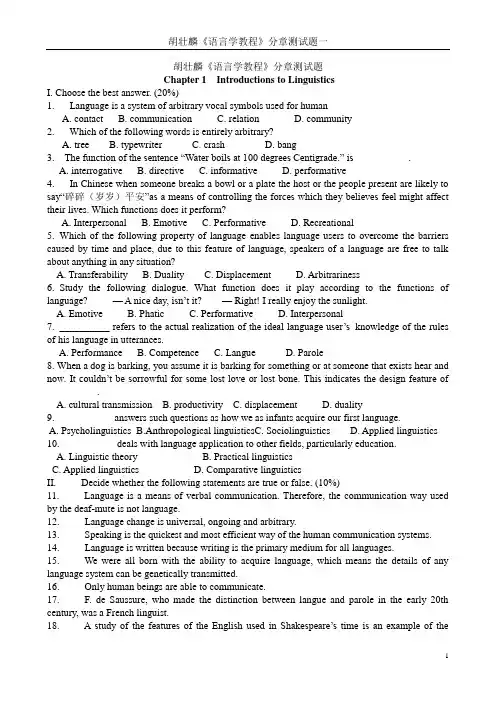
胡壮麟《语言学教程》课后答案胡壮麟《语言学教程》课后答案1. Design feature:are features that define our human languages,such asarbitrariness,duality,creativity,displacement,cultural transmission,etc.2.Function: the use of language tocommunicate,to think ,nguage functions inclucle imformative function,interpersonal function,performative function,interpersonal function,performative function,emotive function,phatic communion,recreational function and metalingual function.3. etic: a term in contrast with emic which originates from American linguist Pike’s distinction of phonetics and phonemics.Being etic mans making far too many, as well as behaviously inconsequential,differentiations,just as was ofter the case with phonetic vx.phonemic analysis in linguistics proper.4. emic: a term in contrast with etic which originates from American linguist Pike’s distinction of phonetics and phonemics.An emic set of speech acts and events must be one that is validated as meaningful via final resource to the native members of a speech communith rather than via qppeal to the investigator’s ingenuith or intuition alone.5. synchronic: a kind of description which takes a fixed instant(usually,but not necessarily,the present),as its point of observation.Most grammars are of this kind.6.diachronic:study of a language is carried through the course of its history.7. prescriptive: the study of a language is carried through the course of its history.8. prescriptive: a kind of linguistic study in which things are prescribed how ought to be,ying down rules for language use.9. descriptive: a kind of linguistic study in which things are just described.10. arbitrariness: one design feature of human language,which refers to the face that the forms of linguistic signs bear no natural relationship to their meaning.11. duality: one design feature of human language,which refers to the property of having two levels of are composed of elements of the secondary.level and each of the two levels has its own principles of organization.12. displacement: one design feature of human language,which means human language enable their users to symbolize objects,events and concepts which are not present c in time and space,at the moment of communication.13. phatic communion: one function of human language,which refers to the social interaction of language.14. metalanguage: certain kinds of linguistic signs or terms for the analysis and description of particular studies.15. macrolinguistics: he interacting study between language and language-related disciplines such as psychology,sociology,ethnograph,science of law and artificial intelligence etc.Branches of macrolinguistics include psycholinguistics,sociolinguistics, anthropological linguistics,et16. competence: language user’s underlying knowledge about the system of rules.17. performance: the actual use of language in concrete situation.18. langue: the linguistic competence of the speaker.19. parole: the actual phenomena or data of linguistics(utterances).20.Articulatory phonetics: the study of production of speechsounds. 21.Coarticulation: a kind of phonetic process in which simultaneous or overlapping articulations are involved..Coarticulation can be further divided into anticipatory coarticulation and perseverative coarticulation.22.Voicing:pronouncing a sound (usually a vowel or a voiced consonant) by vibrating the vocal cords.23.Broad and narrow transcription: the use of a simple set of symbols in transcription is called broad transcription;the use of a simple set of symbols in transcription is called broad transcription;while,the use of more specific symbols to show more phonetic detail is referred to as narrow transcription.24.Consonant: are sound segments produced by constricting or obstructing the vocal tract at some place to divert,impede,or completely shut off the flow of air in the oral cavity. 25.Phoneme: the abstract element of sound, identified as being distinctive in a particular language.26.Allophone:any of the different forms of a phoneme(eg.<th>is an allophone of /t/in English.When /t/occurs in words like step,it is unaspirated<t>.Both<th>and <t>are allophones of the phoneme/t/.27. Vowl:are sound segments produced without such obstruction,so no turbulence of a total stopping of the air can be perceived.28.Manner of articulation: in the production of consonants,manner of articulation refers to the actual relationship between the articulators and thus the way in which the air passes through certain parts of the vocal tract.29.Place of articulation: in the production of consonants,place of articulation refers to where in the vocal tract there is approximation,narrowing,or the obstruction of air.30.Distinctive features: a term of phonology,i.e.a property which distinguishes one phoneme from another.31.Complementary distribution: the relation between tow speech sounds that never occur in the same environment.Allophones of the same phoneme are usually in complementary distribution. 32.IPA: the abbreviation of International Phonetic Alphabet,which is devised by the International Phonetic Association in 1888 then it has undergong a number of revisions.IPA is a comprised system employing symbols of all sources,such as Roman small letters,italics uprighted,obsolete letters,Greek letters,diacritics,etc.33.Suprasegmental:suprasegmental featuresare those aspects of speech that involve more than single sound segments.The principal supra-segmental features aresyllable,stress,tone,,and intonation.34.Suprasegmental:aspects of speech that involve more than single sound segments.The principle suprasegmental features are syllable,stress,tone,and intonation.35. morpheme:the smallest unit of language in terms of relationship between expression and content,a unit that cannot be divided into further small units without destroying or drastically altering the meaning,whether it is lexical or grammatical.36. compoundoly morphemic words which consist wholly of free morphemes,such as classroom,blackboard,snowwhite,etc.37.inflection: the manifestation of grammatical relationship through the addition of inflectional affixes,such as number,person,finiteness,aspect and case,which do not change the grammatical class of the stems to which they are attached.38.affix: the collective term for the type of formative that can be used only when added to another morpheme(the root or stem).39. derivation: different from compounds,derivation shows the relation between roots and affixes.40. root: the base from of a word that cannot further be analyzed without total lass of identity.41.allomorph: any of the different form of a morpheme.For example,in English the plural mortheme is but it is pronounced differently in different environments as/s/in cats,as/z/ in dogs and as/iz/ in classes.So/s/,/z/,and /iz/ are all allomorphs of the plural morpheme.42.Stem: any morpheme or combination of morphemes to which an inflectional affix can be added.43. bound morpheme: an element of meaning which is structurally dependent on the world it is added to,e.g. the plural morpheme in “dog’s”.44.free morpheme: an element of meaning which takes the form of an independent word.45.lexeme:A separate unit of meaning,usually in the form of a word(e.g.”dog in the manger”)46.lexicon: a list of all the words in a language assigned to various lexical categories and provided with semantic interpretation.47.grammatical word: word expressing grammatical meanings,suchconjunction,prepositions,articles and pronouns.48. lexical word: word having lexical meanings,that is ,those which refer to substance,action and quality,such as nouns,verbs,adjectives,and verbs.49.open-class: a word whose membership is in principle infinite or unlimited,such asnouns,verbs,adjectives,and many adverbs.50. blending: a relatively complex form of compounding,in which two words are blended by joining the initial part of the first word and the final part of the second word,or by joining the initial parts of the two words.51. loanvoord: a process in which both form and meaning are borrowed with only a slight adaptation,in some cases,to eh phonological system of the new language that they enter.52.loanblend: a process in which part of the form is native and part is borrowed, but the meaning is fully borrowed.53. leanshift: a process in which the meaning is borrowed,but the form is native.54.acronym: is made up form the first letters of the name of an organization,which has a heavily modified headword.55.loss: the disappearance of the very sound as a morpheme in the phonological system.56. back-formation: an abnormal type of word-formation where a shorter word is derived by deleting an imagined affix from a long form already in the language.57.assimilation: the change of a sound as a result of the influence of an adjacent sound,which ismore specifically called.”contact”or”contiguous”assimilation.58.dissimilation: the influence exercised.By one sound segment upon the articulation of another, so that the sounds become less alike,or different.59.folk etymology: a change in form of a word or phrase,resulting from an incorrect popular nation of the origin or meaning of the term or from the influence of more familiar terms mistakenly taken to be analogous60.category:parts of speech and function,such as the classification of words in terms of parts of speech,the identification of terms of parts of speech,the identification of functions of words in term of subject,predicate,etc.61.concord: also known as agreement,is the requirement that the forms of two or more words in a syntactic relationship should agree with each other in terms of some categories.62. syntagmatic relation between one item and others in a sequence,or between elements which are all present.63.paradigmatic relation: a relation holding between elements replaceable with each other at a particular place in a structure,or between one element present and he others absent.64.immediate constituent analysis: the analysis of a sentence in terms of its immediate constituents---word groups(or phrases),which are in trun analyzed into the immediate constituents of their own,and the process goes on until the ultimate constituents are reached.65.endocentric construction: one construction whose distribution is functionally equivalent,or approaching equivalence,to one of its constituents,which serves as the centre,or head, of the whole.Hence an endocentric construction is also known as a headed construction.66.exocentric construction: a construction whose distribution is not functionally equivalent to any to any of its constituents.67.deep structure: the abstract representation of the syntactic properties of a construction,i.e.the underlying level of structural relations between its different constituents ,such sa the relation between,the underlying subject and its verb,or a verb and its object.68.surfacte structure: the final stage in the syntactic derivation of a construction,which closely corresponds to the structural organization of a construction people actually produce and receive. 69.c-command: one of the similarities,or of the more general features, in these two government relations,is technically called constituent command,c-command for short.ernment and binding theory: it is the fourth period of development Chomsky’s TG Grammar, which consists of X-bar theme: the basis,or the starting point,of the utterance.municative dynamism: the extent to which the sentence element contributes to the development of the communication.72.ideational function: the speaker’s experience of the real world,including the inner world of his own consciousness.73. interpersonal function: the use of language to establish and maintain social relations: for the expression of social roles,which include the communication roles created by language itself;and also for getting things done,by means of the interaction between one person and another..74.textual function: the use of language the provide for making links with itself and with features of the situation in which it is used.75.conceptual meaning: the central part of meaning, which contains logical,cognitive,or denotative content.76.denotation: the core sense of a word or a phrade that relates it to phenomena in the real world.77.connotation: a term in a contrast with denotation,meaning the properties of the entity a word denotes.78.reference: the use of language to express a propostion,meaning the properties of the entity a word denotes.79.reference: the use of anguage to express a proposition,i.e. to talk about things in context.80.sense: the literal meaning of a word or an expression,independent of situational context.81.synonymy: is the technical name for the sameness relation.plentary antonymy: members of a pair in complementary antonymy are complementary to each field completely,such as male,female,absent.83.gradable antongymy: members of this kind are gradable,such aslong:short,big;small,fat;thin,etc.84.converse antonymy: a special kind of antonymy in that memembers of a pair do not constitutea positive-negative opposition,such as buy;sell,lend,borrow,above,below,etc.85.relational opposites:converse antonymy in reciprocal social roles,kinship relations,temporal and spatial relations.There are always two entities involved.One presupposes the other. Theshorter,better;worse.etc are instances of relational opposites.86.hyponymy: a relation between tow words,in which the meaning of one word(the superordinate)is included in the meaning of another word(the hyponym)87.superordinate: the upper term in hyponymy,i.e.the class name.A superordinate usually has several hyponyms.Under animal,for example,there are cats,dogs,pigs,etc,88.semantic component: a distinguishable element of meaning in a word with twovalues,e.g<+human>positionality: a principle for sentence analysis, in which the meaning of a sentence depends on the meanings of the constituent words and the way they are combined.90.selection restriction:semantic restrictions of the noun phrases that a particular lexical item can take,e.g.regret requires a human subject.91.prepositional logic: also known as prepositional calculus or sentential calculus,is the study of the truth conditions for propositions:how the truth of a composite propositions and the connection between them.92.proposition;what is talk about in an utterance,that part of the speech act which has to do with reference.93.predicate logic: also predicate calculus,which studies the internal structure of simple.94.assimilation theory: language(sound,word,syntax,etc)change or process by which features of one element change to match those of another that precedes or follows.95.cohort theory: theory of the perception of spoken words proposed in the mid-1980s.It saaumesa “recognition lexicon”in which each word is represented by a full and independent”recognistion element”.When the system receives the beginning of a relevant acoustic signal,all elements matching it are fully acticated,and,as more of the signal is received,the system tries to match it independently with each of them,Wherever it fails the element is deactivated;this process continues until only one remains active.96.context effect: this effect help people recognize a word more readily when the receding words provide an appropriate context for it.97.frequency effect: describes the additional ease with which a word is accessed due to its more frequent usage in language.98.inference in context: any conclusion drawn from a set of proposition,from something someone has said,and so on.It includes things that,while not following logically,are implied,in an ordinarysense,e.g.in a specific context.99.immediate assumption: the reader is supposed to carry out the progresses required to understand each word and its relationship to previous words in the sentence as soon as that word in encountered.nguage perception:language awareness of things through the physical senses,esp,sight. nguage comprehension: one of the three strand of psycholinguistic research,which studies the understanding of language.nguage production: a goal-directed activety,in the sense that people speak and write in orde to make friends,influence people,convey information and so on.nguage production: a goal-directed activity,in the sense that people speak and write in order to make friends,influence people,concey information and so on.104.lexical ambiguity:ambiguity explained by reference to lexical meanings:e.g.that of I saw a bat,where a bat might refer to an animal or,among others,stable tennis bat.105.macroproposition:general propositions used to form an overall macrostructure of the story. 106.modular:which a assumes that the mind is structuied into separate modules or components,each governed by its own principles and operating independently of others.107.parsing:the task of assigning words to parts of speech with their appropriateaccidents,traditionally e.g.to pupils learning lat in grammar.108.propositions:whatever is seen as expressed by a sentence which makes a statement.It is a property of propositions that they have truth values.109.psycholinguistics: is concerned primarily with investigating the psychological reality of linguistic structure.Psycholinguistics can be divided into cognitive psycholing uistics(being concerned above all with making inferences about the content of human mind,and experimental psycholinguistics(being concerned somehow whth empirical matters,such as speed of response to a particular word).110.psycholinguistic reality: the reality of grammar,etc.as a purported account of structures represented in the mind of a speaker.Often opposed,in discussion of the merits of alternative grammars,to criteria of simplicity,elegance,and internal consistency.111.schemata in text: packets of stored knowledge in language processing.112.story structure: the way in which various parts of story are arranged or organized.113.writing process: a series of actions or events that are part of a writing or continuingdevelopmeng.municative competence: a speaker’s knowledge of the total set ofrules,conventions,erning the skilled use of language in a society.Distinguished by D.Hymes in the late 1960s from Chomsley’s concept of competence,in the restricted sense of knowledge of a grammar.115.gender difference: a difference in a speech between men and women is”genden difference”116.linguistic determinism: one of the two points in Sapir-Whorf hypothesis,nguage determines thought.117.linguistic relativity: one of the two points in Spir-Whorf hypotheis,i.e.there’s no limit to the structural diversity of languages.118.linguistic sexism:many differences between me and women in language use are brought about by nothing less than women’s place in society.119.sociolinguistics of language: one of the two things in sociolinguistics,in which we want to look at structural things by paying attention to language use in a social context.120.sociolinguistics of society;one of the two things in sociolinguistics,in which we try to understand sociological things of society by examining linguistic phenomena of a speaking community. 121.variationist linguistics: a branch of linguistics,which studies the relationship between speakers’social starts and phonological variations.122.performative: an utterance by which a speaker does something does something,as apposed to a constative,by which makes a statement which may be true or false.123.constative: an utterance by which a speaker expresses a proposition which may be true or false. 124.locutionary act: the act of saying something;it’s an act of conveying literal meaning by means of syntax,lexicon,and ly.,the utterance of a sentence with determinate sense and reference.125.illocutionary act: the act performed in saying something;its force is identical with the speaker’s intention.126.perlocutionary act: the act performed by or resulting from saying something,it’s the consequence of,or the change brought about by the utterance.127.conversational implicature: the extra meaning not contained in the literalutterances,underatandable to the listener only when he shares the speaker’s knowledge or knowswhy and how he violates intentionally one of the four maxims of the cooperative principle.128.entailment:relation between propositions one of which necessarily follows from theother:e.g.”Mary is running”entails,among other things,”Mary is not standing still”.129.ostensive communication: a complete characterization of communication is that it is ostensive-infer-ential.municative principle of relevance:every act of ostensive communication communicates the presumption of its own optimal relevance.131.relevance: a property that any utterance,or a proposition that it communicates,must,in the nature of communication,necessarily have.132.Q-principle: one of the two principles in Horn’s scale,i.e.Make your contribution necessary (G.Relation,Quantity2,Manner);Say no more than you must(given Q).133.division of pragmatic labour: the use of a marked crelatively complex and/or expression when a corresponding unmarkeda(simpler,less”effortful”)alternate expression is available tends to be interpreted as conveying a marked message(one which the unmarked alternative would not or could not have conveyed).134.constraints on Horn scales:the hearer-based o-Principle is a sufficiency condition in the sense that information provided is the most the speaker is able to..135.third-person narrator: of the narrator is not a character in the fictional world,he or she is usually called a third –person narrator.136.I-narrator: the person who tells the story may also be a character in the fictional world of the story,relating the story after the event.137.direct speech: a kind of speech presentation in which the character said in its fullest form. 138.indirect speech: a kind of speech presentation in which the character said in its fullest form. 139.indirect speech: a kind of speech presentation which is an amalgam of direct speech.140.narrator’s repreaentation of speech acts: a minimalist kind of presentation in which a part of passage can be seen as a summery of a longer piece of discourse,and therefore even more backgruonded than indirect speech representation would be.141.narrator”srepresentation of thought acts: a kind of categories used by novelists to represent the thoughts of their of characters are exactly as that used to present speech acts.For example,,she considered his unpunctuality.142.indirect thought: a kind of categories used by novelist to represent the thoughts of their characters are exactly as that used to present indirect speech.For example,she thought that he woule be late.143.fee indirect speech: a further category which can occur,which is an amalgam of direct speech and indirect speech features.144.narrator’s representation of thought acts:a kind of the categories used by novelists to present the thoughts of therir characters are exactly the same as those used to represent a speech e.g.He spent the day thinking.145.indirect thought: a kind of categories used by novelist to represent the thoughts of their characters are exactly as that used to present indirect speech.For example,she thought that he would be late.146.fee indirect speech: a further category which can occur,which is an amalgam of direct speech and indirect speech features.147.narrator”s representation of thought: the categories used by novelists to present the thoughts of their characters are exactly the same as those used to represent a speech e.g.He spent the day thinking.148.free indirect thought: the categories used by novelists to represent the thoughts of their characters are exactly the same as those used to represent a speech,e.g.He was bound to be late. 149.direct thought: categories used by novelists to represent the thoughts of their characters are exactly the same as those used to represent a speech..puter system: the machine itself together with a keyboard,printer,screen,diskdrives,programs,etc.puter literacy: those people who have sufficient knowledge and skill in the use of computers and computer software.puter linguistics: a branch of applied liguistics,dealing with computer processing of human language.153.Call: computer-assisted language learning(call),refers to the use of a computer in the teaching or learning of a second or foreign language.154.programnded instruction: the use of computers to monitor student progress,to direct students into appropriate lessons,material,etc.155.local area network: are computers linked together by cables in a classroom,lab,or building.They offer teachers a novel approach for creating new activities for students that provide more time and experience with target language.156.CD-ROM: computer disk-read only memory allows huge amount of information to be stored on one disk with quich access to the information.Students and teachers can access information quickly and efficiently for use in and out of the classroom.157.machine translation: refers to the use of machine(usually computer)to translate texts from one language to another.158.concordance: the use of computer to search for a particular word,sequence of words.or perhaps even a part of speech in a text.The computer can also receive all examples of a particular word,usually in a context,which is a further aid to the linguist.It can also calculate the number of occurrences of the word so that information on the frequency of the word may be gathered.159.annotation: if corpora is said to be unannotated-it appears in its existing raw state of plain text,whereas annotated corpora has been enhanced with various type of linguistic information, 160.annotation: if corpora is said to be unannotated—it appears in its existing raw state of plain text,whereas annotated corpora has been enhanced with various type of linguistic information. rmational retrieval: the term conventionally though somewhat inaccurately,applied to the type of actrvity discussed in this volume.An information retrieval system does not infor(i.e.change the knowledge of)the user on the subject of his inquiry.it merely informs on the existence(or non-existence)and whereabouts of documents relating to his request.162.document representative: information structure is concerned with exploiting relationships,between documents to improve the efficiency and effectiveness of retrieval strategies.It covers specifically a logical organization of information,such as document representatives,for the purpose of information retrieval.163.precision: the proportion of retrieval documents which are relevant.164.recall: the proportion of retrieval documents which are relevant.165.applied linguistics: applications of linguistics to study of second and foreign language learning and teaching,and other areas such as translation,the compiling of dictionaries,etcmunicative competence: as defined by Hymes,the knowledge and ability involved in putting language to communicative use.167.syllabus:the planning of course of instruction.It is a description of the cousr content,teaching procedures and learning experiences.168.interlanguage:the type of language constructed by second or foreign language learners who are still in the process of learning a language,i.e.the language system between the target language and the learner’s native language.169.transfer: the influence of mother tongue upon the second language.When structures of the two languages are similar,we can get positive transfer of facilitation;when the two languages are different in structures,negative transfer of inference occurs and result in errors.170.validity: the degree to which a test meansures what it is meant to measure.There are four kinds of validity,i.e.content validity,construct validity,empirical valiodity,and face validity.171.rebiability: can be defined as consistency.There are two kinds of reliability,i.e.stability reliability,and equiralence reliability.172.hypercorrection: overuse of a standard linguistic features,in terms of bothfrequency,i.e.overpassing the speakers of higher social status,and overshooting thetarget,i.e.extending the use of a form inalinguistic environment where it is not expected to occur,For example,pronouncing ideas as[ai’dier],extending pronouncing post-vocalic/r/ in an envorienment where it’s not supposed to occur.173.discrete point test: a kind of test in which language structures or skills are further divided into individual points of phonology,syntax and lexis.174.integrative test: a kind of test in which language structures or skills are further divided into individual points of phonology,syntax and lexis.。