
Chapt 1.1
- 格式:ppt
- 大小:48.65 MB
- 文档页数:130
Chapter I IntroductionDescribingand Explaining L 2Acquisition1.1Whatis secondlanguage acquisition?Secondlanguage refersto any language that is learned subsequent t othemother tongue.1.2What are the goals ofsecond language?The goals of SLAareto describe howL2 acquisitionproceeds andtoexplainthis process and why some learners seem to bebetter at itthan others.1.3Twocase studiesofL2learners1.3.1 A case studyof an adultlearner1.3.2 A case study oftwochildlearnersWhat do these case studies show us?a. They raise a number of important methodological issues relating t ohow L2acquisition should bestudiedb. They raiseissues relating to thedescription of learner languagec.Theypoint out some of the problems researchersexperience in trying to explain L2acquisition.1.4MethodologicalissuesWhat is that needs to be described?a.Whatitmeans tosay that a learner hasacquiredafeature ofthe target language?b.Whetherlearners have acquired a particularfeature?c.How tomeasure whether acquisition has taken place?(Learner’soveruse oflinguistic forms.)1.5Issues in the descriptionof learner languagea. Learnersmake errors of different kinds.b.Learners acquired alarge number of formulaic chunks,which will influence their performancein communicationand the fluencyof theirunplanned speech.c.Whether learners acquire the language systematically?1.6Issues in theexplanation of L2acquisitionItem learning:formulaic chunksSystem learning: rulesInternal(mentalist)account:External account:Chapter2 theNature of LearnerLanguage2.1Errorsand erroranalysis2.1.1Identifying errors2.1.1.1Compare the learner’s language withthe normal ones.2.1.1.2Distinguish errors andmistakes.Definition: Errors reflectgaps in a learner’s knowledgeMistakes reflect occasional lapsesin performance.Methods:a. Checktheconsistencyof learners’performance.b. Ask them to correct their ownutterance.Errors and mistakes:2.1.2Describing errorsMethods:a.errortype oriented:b. errormaker oriented:Meaning: Classifying errors in these ways can helpus to diagnose learners’learningproblems at any one stageof their developmentand, also to plot how changesinerror patterns occurovertime.2.1.3 Explaining errorsErrors are systematic, predictable,andsome of them are universal:(Learners has constructedsomekind of“rule”,albeit a rule differ ent fromthat of the target language)Eg: omission: leave out the article “the”, leave out the–s in plura lnounsOvergeneralization error:eated---ateTransfer errors reflect learners attempt tomake use of theirL1 knowledge.2.1.4 Error evaluationTypes of errors:Globalerrors: violatethe whole structureofthe sentenceLocal errors: affectonly a single constituent in t he sentence2.2Developmental patterns2.2.1The earlystage ofL2 acquisitionSilent period: childrenmake no attempt tosayanything to begin with.This period makes apreparation for subsequent produc tion.Trials anderrors: Mulaic chunks: theyprovidelearners with themeans ofperformingusefullanguage functionssuchas greetings and requests.Eg:“How do youdo?”“Myname is___”Propositional simplification:leave words outEg:“Me no blue”2.2.2The orderof acquisitionAccuracy order: there isadefinite accuracyorderand that this remains more or lessthe same irrespectiveofthelearner’s mother tongues, age, andwhether ornot they havereceive formallanguage instruction.2.2.3 Sequence of acquisitiona. Theacquisition of a particular grammatical structure,therefore, mustbeseen as a process involving transitional constructions.b.Acquisition follows a U shaped course ofdevelopment.c. The process in whichlearnersreorganize their existingknow ledgeinorder to accommodate new knowledge iscalledrestructuring.2.2.4Some Implicationsa. L2 is systematicanduniversal,reflectingways inwhich interna lcognitive mechanisms controlacquisition, irrespectiveof the personalbackground of learnersorthe settings in which they learn.b. Somelinguistic features are inherentlyeasiertolearnthan others.2.3Variability in learnerlanguagea.Variability is also systematic, that is, learners use their linguistic sour ces in predictableways.b.Learners vary in theiruseof the second languageaccording tolinguistic context (George playing football/ ..all thetime)situational context.(kids/daughter)&psycholinguistic context (prepared/unprepared)c. form-function mappingd. free variation:e.fossilization:石化成因任何现象的出现都不是偶然的,是可以追溯出它的原因的,二语习得过程中出现的中介语石化现象也是有着根本性的原因的。

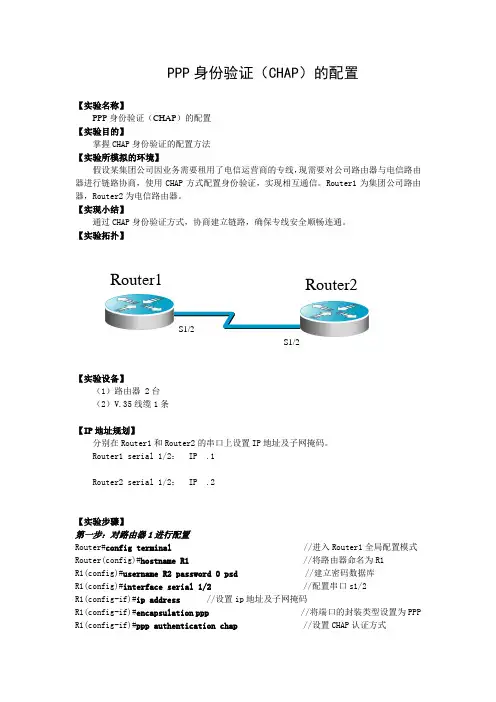
PPP 身份验证(CHAP )的配置【实验名称】PPP 身份验证(CHAP )的配置【实验目的】掌握CHAP 身份验证的配置方法【实验所模拟的环境】假设某集团公司因业务需要租用了电信运营商的专线,现需要对公司路由器与电信路由器进行链路协商,使用CHAP 方式配置身份验证,实现相互通信。
Router1为集团公司路由器,Router2为电信路由器。
【实现小结】通过CHAP 身份验证方式,协商建立链路,确保专线安全顺畅连通。
【实验拓扑】【实验设备】(1)路由器 2台(2)V.35线缆1条【IP 地址规划】分别在Router1和Router2的串口上设置IP 地址及子网掩码。
Router1 serial 1/2: IP .1Router2 serial 1/2: IP .2【实验步骤】 第一步:对路由器1进行配置Router#config terminal //进入Router1全局配置模式 Router(config)#hostname R1 //将路由器命名为R1 R1(config)#username R2 password 0 psd //建立密码数据库 R1(config)#interface serial 1/2 //配置串口s1/2 R1(config-if)#ip address //设置ip 地址及子网掩码R1(config-if)#encapsulation ppp //将端口的封装类型设置为PPP R1(config-if)#ppp authentication chap //设置CHAP 认证方式 Router2 S1/2 S1/2Router1R1(config-if)#no shutdown //激活端口第二步:对路由器2进行配置Router#config terminal //进入Router2全局配置模式Router(config)#hostname R2//将路由器命名为R2R2(config)#username R1 password 0 psd //建立用户名及密码数据库R2(config)#interface s1/2//配置串口s1/2R2(config-if)#ip address //配置ip地址及子网掩码R2(config-if)#encapsulation ppp //将端口的封装类型设置为PPP R2(config-if)#ppp authentication chap //设置CHAP认证方式R2(config-if)#clock rate 64000//为串口配置时钟频率,DCE端必须配置时钟频率,DTE端无需配置R2(config-if)#no shutdown //激活端口【验证测试】1、配置完成之后,登陆R1,输入“ping 1.1.1.2”,如出现下图所示即表示链路协商通过,配置成功2、在上一节的实验中,我们学会了使用debug命令来获取设备间是如何协商的信息。