八年级英语上期末复习情态动词用法
- 格式:doc
- 大小:56.00 KB
- 文档页数:8
初二英语上期末复习:情态动词用法概说助动词(auxiliary)主要有两类:基本助动词(primary auxiliary)和情态助动词(modal auxiliary)。
基本助动词有三个:do, have和be;情态助动词有十三个:may, might;can, could;will, would;shall, should;must, need, dare, used to, ought to。
上述两类助动词的共同特征是,在协助主动词构成限定动词词组时,具有作用词的功能:1)构成否定式:He didn’t go and neither did she.The meeting might not start until 5 o’clock.2)构成疑问式或附加疑问式:Shall I write to him?You have been learning French for 5 years, haven’t you?3)构成修辞倒装:Nowhere can he obtain any information about his sister.Hardly had he arrived when she started complaining.4)代替限定动词词组:A: Who can solve this crossword puzzle?B: Tom can.A: Must you leave right now?B: Yes, I must.一、情态动词的主要特征试比较下列几组句子,看情态动词的特点:1、He borrows some books from the library.他常从图书馆借些书。
He can borrow some books from the library.他可以从图书馆借到一些书。
2、I run fast.我跑得快。
I can’t run fast.我跑得不快。
can’t 不会,不能3、Must he go now?他必须现在走吗?must 必须Did he go last night?他昨晚去了吗?4、They may not be there.他们可能不在那儿。
may 可能They weren’t there.他们不在那儿。
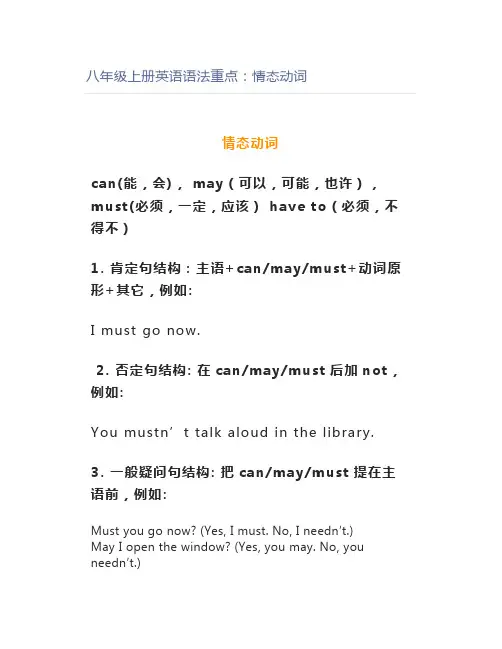
从上述四组句子中,可以看出以下几个特点:1、can、may、must都有各自的词义,表示能力、可能、允诺、愿意、请求等情态,因词义不完全,不能单独作谓语,只能和动词原形一起构成谓语。
2、情态动词没有人称和数的变化。
构成疑问句时,通常放在主语前面(见例3);构成否定句时,not放在这些情态动词之后(见例2)。
可用它们的缩写形式(can’t, cannot, mustn’t等)。
现将情态助动词的各种形式列表如下:二、具体用法(一)can, could 和be able to1、表示能力,例如:I can speak a little Japanese.我会说一点儿日语。
She couldn’t speak Chinese when she came to our school last month.上月她来我校时还不会说中文。
be able to代替can, 也可以表示能力。
但can只有一般现在时和一般过去时(could), 而be able to则有更多的时态形式,例如:You will be able to talk with the foreign teacher in English next week.下星期你将能与外国老师用英语交谈了。
My little brother has been able to write.我的小弟弟已经会写字了。
2、表示允许,准许,这时can与may可以互换,例如:Can/May I borrow your bike tomorrow?明天我可以借你的自行车吗?Yes, of course. You can/may use my bike tomorrow.当然可以。
明天你可以用我的自行车。
You can’t smoke here.你不可以在这儿抽烟。
3、表示客观可能性,用在否定句和疑问句中表示说话人的怀疑、猜测或不肯定。
例如:He cannot/can’t be there.他不可能在那儿。
Can this news be true?这消息可能真实吗?4、could 除表示can的过去式外,在口语中还常代替can,表示非常委婉的请求。
这时could 和can没有时间上的差别。
例如:Could/Can you tell me if he will go tomorrow?你能告诉我他明天是否去吗?Could/Can I ask you something if you are not busy?如果您不太忙,我能否问您一些事情?Could/Can you show me the way to the nearest hospital?您能给我指一下去最近的医院的路吗?(二)may 和might1、表示“准许”和“许可”,这时可与can替换。
例如:May (can) I use your dictionary for a moment?我可以借你的字典用一下吗?May I take these magazines out of the reading room? No, you mustn’t.我可以把这些杂志带出阅览室吗?不,不行。
He asked me if he might go then.他问我他是否可以走了。
2、表示说话人的猜测,认为某事“可能”发生,例如:Where’s John? He may be at the li brary.约翰在哪儿?他可能在图书馆。
Mr. Green hasn’t talked with her. He may not know her.格林先生还未曾与她谈过话,他可能不认识她。
以上例子中的may be是情态动词may加be, 与maybe完全不同。
后者是副词,解释为“或许”。
例如:He may be at home.他可能在家。
Maybe he was at home.或许他在家。
3、might除表示may的过去式外,在口语中还常代替may, 表示非常委婉的请示或实现的可能性较小。
这时might和may没有时间上的差异。
例如:Might (May) I speak to you for a few minutes?我现在可以与你谈几分钟话吗?Might I have a photo of your family?我可以要一张你们的合家照吗?4、用于从句中表示目的,意为“以便能……”、“使……可以”,例如:Open your mouth wide, so that I may see clearly what’s wrong with your teeth.把嘴张大些,以便我能看清楚你的牙齿有什么毛病。
He wrote down my address so that he might remember it well.他把我的住址写了下来,以便能记牢。
5、在用may提问时,否定回答常用mustn’t或may not表示“不行”、“不可以”。
例如:May I go now? No, you mustn’t.我可以走了吗?不,不可以。
(三)must1、must表示说话人的主观意志,表示义务、命令或必要、应当和必须等。
现在式与过去式同形。
例如:I must go to school today.今天我必须上学去。
He told me I mustn’t leave until my mother came.他告诉我,在我母亲回来之前我不许离开。
2、must表示推测,“一定是”、“准是”,例如:They must be very tired. Let them have a rest.他们一定是非常疲劳了。
让他们休息一会儿吧。
Jack doesn’t look well. He must be ill.杰克看上去气色不太好。
他一定是病了。
[难点解释]3、have to 表示“必须”、“不得不”,它不仅能代替must, 用于现在时和过去时以外的其他时态,表示说话人的主观看法,而且又表示客观上的需要。
例如:If we miss the last bus, we shall have to walk home.如果我们末班车,我们将不得不走回家。
The ship started to go down slowly. We must leave the ship.船慢慢地开始下沉了。
我们必须离开这船。
注意:1)用have to表示客观上的需要,意为“不得不”、“只是”;must则表示主观上的必须和说话人的意志2)有些时态用must无法表示,可用have to代替,如will have to(表示将来),had to(表示过去)。
4、在回答must的疑问句时,否定回答常用needn’t表示“不必”,例如:Must I return this book to you in two weeks?这本书我两星期以后必须还你吗?Yes, you must.是的。
No, you needn’t.不,不必了。
(四)need 和dare need(需要)和dare(敢于)既可作情态动词,又可作行为动词。
1、need和dare作情态动词时,只用于否定句或疑问句。
need无形态变化,dare的过去式是dared。
例如:It’s warm today. You needn’t put on your coat.今天天气很暖和,你不必穿上大衣。
Need I post your books to you?要我把书寄给你吗?How dare you say it’s unfair?你怎么胆敢说这不公平呢?She dare not go out alone at night.她晚上不敢一个人出去。
2、need和dare作及物动词时,后常跟动词不定式。
它们有人称、数和时态等形态变化。
在构成否定和疑问形式时与其他及物动词一样,要用助动词do, does或did等。
例如:He didn’t need to go to school today.今天他不必去上学。
They needed an excuse and soon found one.他们需要借口,不久便找到了一个。
(五)ought to 和shouldought to和should作情态度动词用,都是“应该”、“应当”的意思。
ought to语气较强,指客观上有责任、有义务去做某事,或按观念和道理也应对某事负责。