
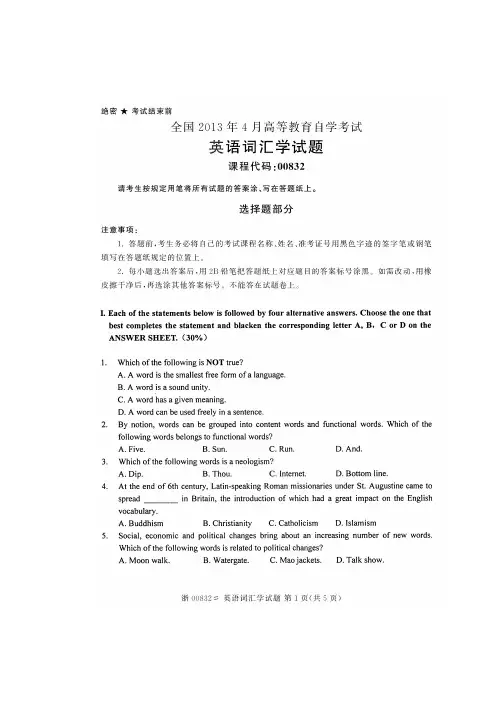
全国2013年4月00832英语词汇学自考试题
- 格式:doc
- 大小:900.00 KB
- 文档页数:5
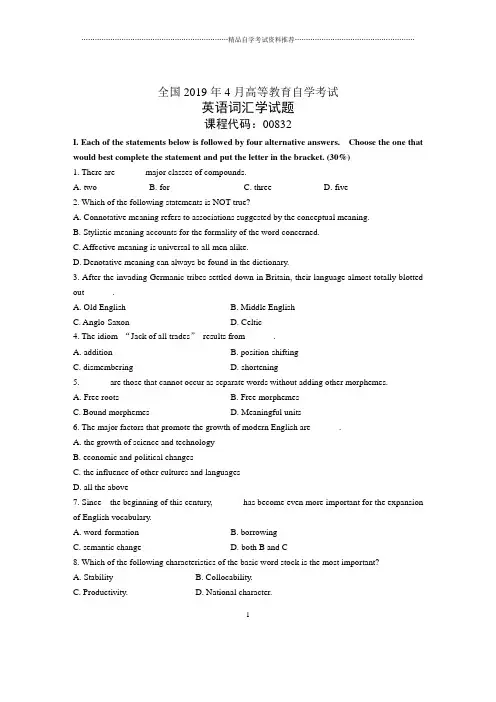
全国2019年4月高等教育自学考试英语词汇学试题课程代码:00832I. Each of the statements below is followed by four alternative answers. Choose the one that would best complete the statement and put the letter in the bracket. (30%)1. There are ______ major classes of compounds.A. twoB. forC. threeD. five2. Which of the following statements is NOT true?A. Connotative meaning refers to associations suggested by the conceptual meaning.B. Stylistic meaning accounts for the formality of the word concerned.C. Affective meaning is universal to all men alike.D. Denotative meaning can always be found in the dictionary.3. After the invading Germanic tribes settled down in Britain, their language almost totally blotted out ______.A. Old EnglishB. Middle EnglishC. Anglo-SaxonD. Celtic4. The idiom “Jack of all trades”results from ______.A. additionB. position-shiftingC. dismemberingD. shortening5. ______ are those that cannot occur as separate words without adding other morphemes.A. Free rootsB. Free morphemesC. Bound morphemesD. Meaningful units6. The major factors that promote the growth of modern English are ______.A. the growth of science and technologyB. economic and political changesC. the influence of other cultures and languagesD. all the above7. Since the beginning of this century, ______ has become even more important for the expansion of English vocabulary.A. word-formationB. borrowingC. semantic changeD. both B and C8. Which of the following characteristics of the basic word stock is the most important?A. StabilityB. Collocability.C. Productivity.D. National character.19. The two major factors that cause changes in meaning are ______.A. historical reason and class reasonB. historical reason and psychological reasonC. class reason and psychological reasonD. extra-linguistic factors and linguistic factors10. The fundamental difference between homonyms and polysemants is whether ______.A. they come from the same sourceB. they are correlated with one central meaningC. they are listed under one headword in a dictionaryD. all the above11. Degradation of meaning is the opposite of ______.A. semantic transferB. semantic pejorationC. semantic elevationD. semantic narrowing12. An idiom consists of at least two words. Each has a single meaning and often functions as one word. This is called ______.A. semantic unityB. structural stabilityC. rhetorical functionD. none of the above13. Which of the following suffixes can be used to form both nouns and adjectives? ______A. -ion.B. -ism.C. -ity.D. -ist.14. More often than not, functional words only have ______.A. lexical meaningB. associative meaningC. collocative meaningD. grammatical meaning15. Linguistic context is also known as ______ context.A. socialB. verbalC. lexicalD. physicalII. Complete the following statements with proper words or expressions according to the course book. (10%)16. In the course book, the idioms are classified according to ______ functions.17. Linguistic context can be further divided into ______ context and grammatical context.18. The ______ languages made only a small contribution to the English vocabulary with a few place names like Avon, kent, Themes.19. Morphemes which are identical with root words are considered to be ______.20. According to semanticists, a word is a unit of ______.III. Match the words or expressions in Column A with those in Column B according to 1) stylistic meanings; 2)language groups; 3)degrees of inflections and 4) onomatopoeic motivation. (10%)A B23( )21. apesA. colloquial ( )22. Old EnglishB. a language of full endings ( )23. IrishC. Italic ( )24. tinyD. very formal and official ( )25. FrenchE. yelp ( )26. cattleF. poetic ( )27. domicileG . Celtic ( )28. abodeH. gibber ( )29. foxesI. a language of leveled endings ( )30. Middle English J. lowⅣ. Study the following words and expressions and identify 1) types of affixes; 2) types of meaning and 3) types of motivation. (10%)31. mismanage( ) 32. elephants-trumpet( ) 33. pretty ⎪⎩⎪⎨⎧flower woman girl( ) 34. forehead( ) 35. bossy( ) 36. sun: a heavenly body which gives off light, heat ( ) 37. anti-establishment( ) 38. subsea ( ) 39. a sea of troubles( ) 40. harder( ) Ⅴ. Define the following terms. (10%)41. idiom42. functional words43. degradation44. bilingual dictionary45. conversion Ⅵ. Answer the following questions. Your answers should be clear and short. Write your answers in the space given below. (12%)46. What factors should one take into account when he chooses a dictionary?47. What are the features of compounds? Give examples.48. Cite ONE example to illustrate what grammatical meaning is.Ⅶ. Analyze and comment on the following. Write your answers in the space given below.(18%)49. Read the following extract and try to guess the meaning of the word in italics. Then explain what contextual clues help you work out the meaning.‘Get me an avocado, please,’Janet said, smacking her lips, but her brother, with a glance up at the branches, said that there were none ripe yet.50. Make a tree diagram to arrange the following words in order of hyponymy.apple, cabbage, food, vegetable, mutton, fruit, peach, meat, beef, orange, spinach, pork, celery4。

《英语词汇学》复习资料以下是我整理的英语词汇学的资料。
我在考的时候主要就是靠这个东东。
希望对还没有过的人有所帮助。
大家请注意:笔记中大多数是以名词解释的形式出现的,这些是绝对的基础,应该一字不漏的背下来。
其实不少简答题也就是几个定义的汇总,再加上个例子就可以拿满分了。
区分两个词的区别,主要还是指明其各自的定义。
第一章1. Word —— A word is a minimal free form of a language that has a given sound and meaning and syntactic function.2. There is no logical relationship between sound and meaning as the symbolic connection between them is arbitrary and conventional. E.g. “woman” means ’Frau’ in German,’Femme’ in French and ’Funv ’in Chinese. On the other hand, the same sound /rait/ can mean right, rite and write,though denoting different things, yet have the same sound.3. The difference between sound and form result from 4 major factors.(At least 80%of the English words fit consistent spelling patterns)a). the internal reason is English alphabet does not have a separate letter to represent each sound in the language.b). Pronunciation has changed more rapidly than spellingc). Influence of the work of scribes/printing freezes the spelling of words in 1500d). Borrowing of foreign language4. Vocabulary —— Vocabulary is most commonly used to refer to the sum total of all the words of a language. It can also refer to all the words of a given dialect, a given book, a given subject and all the words possessed by an individual person as well as all the words current in a particular period of time in history.The general estimate of the present day English vocabulary is over 1 million words.5.Classification of Words—by use frequency, by notion, by origin1). Basic word stock – the foundation of the vocabulary.1. all national character (most important)– natural phenomenamost common things and phenomena of the human body and relations world around us names of plants and animalsaction, size, domain, statenumerals, pronouns, prep. ,conj.2. stability – they donate the commonest thing necessary to life, they are like to remain unchanged. Only relative, some are undergoing some changes. But the change is slow.e.g. arrow, bow, chariot, knight – pastelectricity, machine, car, plane —— now3. productivity – they are mostly root words or monosyllabic words,they can form new words with other roots and affixes.e.g. foot – football, footage, footpath, footer4. polysemy – often possess more than one meaning. Become polysemous.e.g. take to move or carry from one place to anotherto remove5. collocability – quite a number of set expressions, idiomatic usages,proverbial saying and otherse.g. heart – a change of heart, a heart of goldNon-basic vocabulary ——1. terminology – technical termsphotoscanning, hepatitis, indigestion, penicillin, algebra,trigonometry, calculus2. jargon – specialized vocabulary in certain professions.Bottom line, ballpark figures, bargaining chips, hold him back, hold him in, paranoid3. slang —— substandard words often used in informal occasionsdough and bread, grass and pot, beaver, smoky, bear, catch,holler, Roger, X-rays,Certain words are labeled slang because of their usage.4. argot – words used by sub-cultured groupscan-opener, dip, persuadercant, jargon , argot are associated with, or most available to,specific groups of the population.5. dialectal words – only by speakers of the dialectbeauty, chook, cocky, station, auld, build, coo, hame,lough, bog6. archaisms – words no longer in common use or restricted in use. In older poems, legal document and religious writing or speech.7. neologism – newly created words with new meaning e.g. microelectronics, futurology, AIDS, internet, E-mailold meaning acquired new meaning e.g. mouse, monitor2). Content word (notional word)– denote clear notions.Functional word (empty word, form word)– do not have notions of their own, express the relation between notions, words and sentences.a. Content words constitute the main body of the English vocabulary are numerous.Functional words are in a small number.b. Content words are growing.Functional words remain stable.c. Functional words do far more work of expression than content words.3). Native words – are words brought to Britain in the 15 century by the German tribes. Ango-Saxon Words, 50,000-60,000What is true of the basic word stock is also true of native world. More are1. neutral in style (not stylistical specific )2. 2.frequent in use (in academic fields and science French, Latin or Greek are used)(usage 70-90%)Borrowed words (loan words, borrowing)– words taken over from foreign language. 80%According to the degree of assimilation and manner of borrowing, we can bring the loan words under 4 classes.1.Denizens – words borrowed early and now are well assimilated into English language.e.g. port from portus(L) shift, change, shirt, porkcup from cuppa(L)2.Aliens – retained their original pronunciation and spellinge.g. décor(F) blitzkreeg(G) emir, intermez, rowtow, bazaar,rajar, status quo3.translation loans – formed from the existing material in the English language but modeled on the patterns taken from another language.1). Word translated according to the meaninge.g. mother tough from lingua maternal(L)black humor from humor noirlong time no see, surplus value, master piece2). Words translated according to the sounde.g. kulak from kyrak(Russ)lama from lama(Tib)ketchuptea4. Semantic loans – their meaning are borrowed from another languagee.g. stupid old dumpnew sassydream old joy and peacepioneer old explorer/person doing pioneering worknew a member of the young pioneerfresh old impertinent, sassy, cheeky第二章Indo-European language family (Europe, the Near East, India)Balto –Slavic Indo-Iranian Italic GermanicPrussian Persian Portuguese NorwegianLithuanian Hindi Spanish IcelandiePolish Italian DanishBulgarian Roumanian SwedishSlovenian French EnglishRussian GermanAlbanian Armenian Celtic HellenicIrish GreekBretonScottish2. History (时间,历史事件,特征)1) Old English (450-1150) totally 50,000-60,000 wordsThe 1st people known to inhabit England were Celts, the language was Celtic.The second language was the Latin of the Roman Legions.The Germanic tribes called angles, Saxons and Jutes and their language, Anglo-Saxon dominated and blotted out the Celtic. Now people refer to Anglo-Saxon as old English.At the end of 6th century, the introduction of Christianity has a great impact on the English vocabulary.The common practice was to create new words by combining two native words.In the 9th century, many Scandinavian words came into English. At least 900 words of Scandinavian are in modern English, our daily life and speech.特点: highly inflected languagecomplex endings or vowel changes (full ending)2) Middle English (1150-1500) English, Latin, FrenchUntil 1066, although there were borrowings from Latin, the influence on English was mainly Germanic. But the Norman Conquest started a continual flow of French words into English.By the end of the 13th century, English gradually come back into public areas.Between 1250 and 150 about 9000 words of French origin come into English. 75% of them are till in use today.As many as 2500 words of Dutch origin come into English.特点: fewer inflectionsleveled ending3) Modern English (1500-up to now) early modern English (1500-1700)late modern English(1700-up to now)The Renaissance, Latin and Greek were recognized as the languages of the Western world’s great literary heritage.The Industrial Revolution was in the mid-17 century. With the growth of colonization, British tentacles began a stretching out of to every corner of the globe, thus enabling English to absorb words from all major languages of the world.After World War II, many new words have been created to express new ideas, inventions and scientific achievements.More words are created by means of word-formation.thousands and thousands of new words have been entered to express new ideas inventions, and scientific achievements.more words are created by means of word-formation.in modern English, word endings were mostly lost with just a few exceptions English has evolved from a synthetic language to the present analytic language.science and technology terms make up about 45% of new words. words associated with life-style constitute of 24% and social and economic terms amount to over 10% .mention should be made of an opposite process of development i.e. old words falling out if use.特点: ending are almost lost.3. Three main sources new words1.The rapid development of modern science and technology2.Social, economic and political changes3.The influence of other cultures and languages4. Three modes of vocabulary development1. Creation – the formation of new words by using the existing materials, namely roots, affixes and other elements. (This is the most important way of vocabulary expansion.)2. Semantic change - an old form which take on a new meaning to meet the new need.3. Borrowing – to take in words from other languages.(particularly in earlier time)4. (Reviving archaic or obsolete)French 30%, Latin 8%, Japanese Italian 7%, Spanish 6%, German Greek 5%, Russian Yiddish 4%第三章1. Morpheme —— A morpheme is the smallest meaningful unit of a language. (The smallest functional unit in the composition of words.)2.Morph—— A morpheme must be realized by discrete units. These actual spoken minimal carriers of meaning are morphs.3.Monomorphenic words – morphemes are realized by single morphs.4.Allomorph——Some morphemes are realized by more than one morph according to their position. Such alternative morphs are allomorphemes. E.g. the morpheme of plurality (-s) has a number if allomorphemes in different sound context, e.g. in cats/s/, in bags/z/, in matches/iz/.5. Free morphemes or Free root —— The morphemes have complete meaning and van be used as free grammatical units in sentences, e.g. cat,walk. They are identical with root words. morphemes which are independent of other morphemes are considered to be free.6. Bound Morphemes —— The morphemes cannot occur as separate words. They are bound to other morphemes to form words, e.g. recollection (re+collect+ion) collect – free morpheme re-and –ion are boundmorphemes. (include bound root and affix) Bound morphemes are found in derived words.7. Bound root —— A bound root is that part of the word that carries the fundamental meaning just like a free root. Unlike a free root, it is a bound form and has to combine with other morphemes to make words. Take -dict- for example:it conveys the meaning of “say or speak” as a Latin root, but not as a word. With the prefix pre-(=before) we obtain the verb predict meaning “tell beforehand”。

¥English Lexicology(英语词汇学)lexicology aims at investigating and studying the morphological structures of English words and word equivalents, their semantic structures, relations, historical development, formation and usages.英语词汇学旨在调查和研究英语单词和单词的等价物的形态结构,其语义结构、关系、历史发展、形成和用法。
Lexicology is correlated with such linguistic disciplines as morphology(形态学), semantics(语义学), etymology(词源学),stylistics(文体论) and lexicography(词典学)Chapter 1--Basic concepts of words and vocabulary(词的定义): A word is a minimal free form of a language that has a given sound and meaning and syntactic function. (1)a minimal free form of a language (2)a sound unity (3)a unit of meaning (4)a form that can function alone in a sentence词语是语言最小的自由形式,拥有固定的声音和意义以及句法作用。
and meaning(声音与意义): almost arbitrary, “no logical relationship between the sound which stands for a thing or an idea and the actual thing and idea itself” and form(读音和形式):不统一的四个原因(1)the English alphabet was adopted from the Romans,which does not have a separate letter to represent each other (2)the pronunciation has changed more rapidly than spelling over the years(3)some of the difference were created by the early scribes(4)the borrowings is an important channel of enriching the English vocabulary`(5)printing、standardization、dictionary—Old English,The speech of the time was represented very much more faithfully in writing than it is today. 古代英语中的口语比今天更忠实的代表书面语—The written form of English is an imperfect representation of the spoken form。

2013自考试题及答案2013年的自考试题及答案涵盖了多个学科领域,由于自考的科目众多,这里我将提供一个通用的框架和一些示例题目,以帮助考生了解自考试题的类型和答题方法。
# 2013年自考试题及答案概述自考,即自学考试,是针对那些希望通过自学方式获取学历证书的人士的一种考试形式。
自考试题通常包括选择题、填空题、简答题、论述题等类型,旨在全面考察考生对某一学科知识的掌握程度。
# 示例科目:英语一、选择题(每题1分,共20分)1. The word "environment" has the same root as the word "envelope."A. TrueB. False二、填空题(每题1分,共10分)1. The word "photograph" is derived from the Greek words for "light" and "____."三、阅读理解(每题2分,共30分)阅读以下短文,并回答后面的问题。
[短文内容]1. What is the main idea of the passage?2. According to the passage, what are the benefits of using solar energy?四、翻译(英译汉,每题5分,共10分)1. Translate the following sentence into Chinese: "The rapid development of technology has changed our lives in many ways."五、写作(20分)Write an essay on the topic "The Importance of Learning English" with at least 300 words.# 示例科目:数学一、选择题(每题2分,共20分)1. The solution to the equation \( x^2 - 5x + 6 = 0 \) is:A. \( x = 2 \) and \( x = 3 \)B. \( x = -2 \) and \( x = -3 \)C. \( x = 2 \) and \( x = -3 \)D. \( x = 3 \) and \( x = -2 \)二、填空题(每题2分,共10分)1. The derivative of \( f(x) = x^3 + 2x^2 - 5x \) is \( f'(x) = ______ \).三、计算题(每题10分,共30分)1. Calculate the integral of \( \int (4x^2 - 3x + 2) dx \).四、证明题(每题15分,共30分)1. Prove that for any real number \( a \) and \( b \), thefollowing inequality holds: \( (a + b)^2 \leq 2(a^2 + b^2) \).五、解答题(10分)Explain the concept of limits in calculus and provide an example to illustrate it.# 答题技巧1. 仔细阅读题目:确保理解题目要求,避免答非所问。