
Discrete random variables 3 - Web Maths!:离散型随机变量3 Web数学!
- 格式:ppt
- 大小:271.62 KB
- 文档页数:18
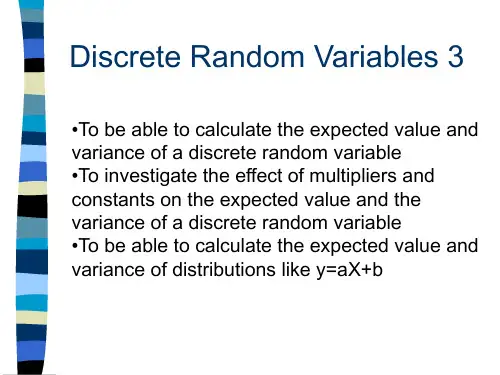

离散型随机变量的均值和方差
离散型随机变量的的期望也就是离散型随机变量的均值的是为了表达一个随机变量取值的中间水平,随机变量的方差刻画了随机变量取值的离散程度。
由于它们反映了随机变量取值的平均水平及稳定性,所以随机变量的均值和方差在市场预测等其他方面有着重要的应用。
离散型随机变量的期望公式:离散型随机变量X的取值为X1、X2、X3……Xn,p(X1)、p(X2)、p(X3)……p(Xn)、为X对应取值的概率,可理解为数据X1、X2、X3……Xn出现的频率高f(Xi)。
则E(X)=X1*p(X1)+X2**p(X2)+……+Xn**p(Xn)= X1*f1(X1)+X2*f2(X2)+……+Xn*fn(Xn)。
离散型随机变量的方差公式:D(X)=E{[X-E(X)]^2}=E(X^2)-(EX)^2。
常见的分布的方差和期望:
1、均匀分布:期望是(a+b)/2,方差是(b-a)的平方/12。 2、二项分布:期望是np,方差是npq。
3、泊松分布:期望是p,方差是p。
4、指数分布:期望是1/p,方差是1/(p的平方)。
5、正态分布:期望是u,方差是&的平方。
6、X服从参数为p的0-1分布,则E(X)=p,d(X)=p(1-p)。

1 / 14 Sample Space 样本空间
The set of all possible outcomes of a statistical experiment is called the sample space.
Event 事件
An event is a subset of a sample space.
certain event(必然事件):
The sample space S itself, is certainly an event, which is called a certain event, means that
it always occurs in the experiment.
impossible event(不可能事件):
The empty set, denoted by, is also an event, called an impossible event, means that it never
occurs in the experiment.
Probability of events (概率)
If the number of successes in n trails is denoted by s, and if the sequence of relative
frequencies /sn obtained for larger and larger value of n approaches a limit, then this limit is
defined as the probability of success in a single trial.
“equally likely to occur”------probability(古典概率)
If a sample space S consists of N sample points, each is equally likely to occur. Assume that

Discrete Random Variables
Expected value of X = E(X) = μ = Population Mean of X = ∑∑=)()(xxfxxP
Expected value of X = Weighted average of potential X values
Var(X) = E(X-μ)2 = σ2 = Population Variance of X = ()()∑∑−=−)()(22xfxxPxμμ
Expected squared deviation from average = Weighted average of (x-μ)2
• Binomial
o X = Number of times “something” happens in n independent trial with constant probability p.
o xnxppxnxnxP−−−=)1()!(!!)(
o E(X) = μ = np
Toss a coin 100 times. E(# heads) = μ = 100(0.5) = 50
• Geometric
o X = Tries until first success
o 1()(1)xPxpp−=−
o E(X) = μ = 1/p
Toss a die until first 5. E(X) = 6611=
• Poisson
o X = Number of totally haphazard, independent events in some span of time or space
o !)(xexPxλλ−=
o E(X) = μ = λ Number of bubbles in sheets of glass
Number of particles emitted from radioactive substance
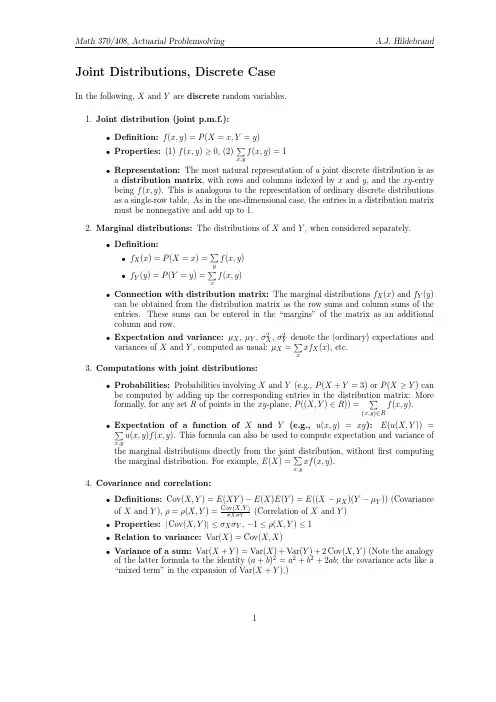
Math370/408,ActuarialProblemsolvingA.J.Hildebrand
JointDistributions,DiscreteCase
Inthefollowing,XandYarediscreterandomvariables.
1.Jointdistribution(jointp.m.f.):
•Definition:f(x,y)=P(X=x,Y=y)
•Properties:(1)f(x,y)≥0,(2)
x,yf(x,y)=1
•Representation:Themostnaturalrepresentationofajointdiscretedistributionisas
adistributionmatrix,withrowsandcolumnsindexedbyxandy,andthexy-entry
beingf(x,y).Thisisanalogoustotherepresentationofordinarydiscretedistributions
asasingle-rowtable.Asintheone-dimensionalcase,theentriesinadistributionmatrix
mustbenonnegativeandaddupto1.
2.Marginaldistributions:ThedistributionsofXandY,whenconsideredseparately.
•Definition:
•fX(x)=P(X=x)=
yf(x,y)
•fY(y)=P(Y=y)=
xf(x,y)
•Connectionwithdistributionmatrix:ThemarginaldistributionsfX(x)andfY(y)
canbeobtainedfromthedistributionmatrixastherowsumsandcolumnsumsofthe