英语连读规则及举例
- 格式:doc
- 大小:98.00 KB
- 文档页数:8
连读英语读音规则和连读技巧第一部分我们将复杂的语音规则总结成五大发音要点,使一般人都能掌握。
它们是:长元音和双元音饱满;短元音急促有力;连音;略音和咬舌头。
一、长元音和双元音饱满只要把元音发饱满(full, plump),你的英语立刻会变得悦耳动听。
那些英美流行歌手就是元音饱满的典范!1. Mike likes to write by the nice bright light at night.麦克喜欢在夜晚明亮的灯光旁写作。
[八次疯狂张嘴,元音极其饱满!]2. Macao came back to China in 1999.澳门于1999年回归祖国。
3. I like the shape of that mountain.我喜欢那座山的样子。
[包含了四个容易混淆的元音:形容山水最恰当!]二、短元音急促有力4. Jim must study a little bit more. Jim必须再多一下一点功夫。
5. Let's get together again.让我们找一天再聚一聚。
三、连音6. I'm working on-it.我正在努力。
[美国总统常用]7. I'll think-it-over.我会仔细考虑的。
四、略音第一条规则:以某音结尾的单词+同音开始的单词--只发一次即可!8. You ate-too much.你吃得太多了。
9. I don't know what-to-do.我不知道该做些什么。
[两个辅音连接,只读后一个]第二条规则:以[t],[d],[k],[g],[p]和[b]+以辅音开始的单词前面的发音“点到为止”,舌头达到发音中位,但不送气!10. Lend-me your black-bag.把你的黑包借给我。
11. I don't-like-people asking me for money.我不喜欢别人问我要钱。
12. Do you want-that-magazine? 你要那本杂志吗?13. Do you need-that-pencil? 你需要那只铅笔吗?14. Ask-Bob-to sit-behind-me.让鲍勃坐在我后面。
15. Would you mind-giving me that-red-book? 你把那本红皮书给我,好吗?五、咬舌头16. There are thirty-three thousand three hundred and thirty-three feathers[羽毛]on that bird's throat.在那个鸟的颈部有三万三前三百三是三根羽毛。
17. Neither father nor mother likes this weather.爸爸妈妈都不喜欢这天气。
[咬五次舌头]18. It's the same thing.都一样!19. Something is better than nothing.有总比没有好!20. Father and mother went through thick and thin.管是顺境还是逆境,父母总是同甘共苦。
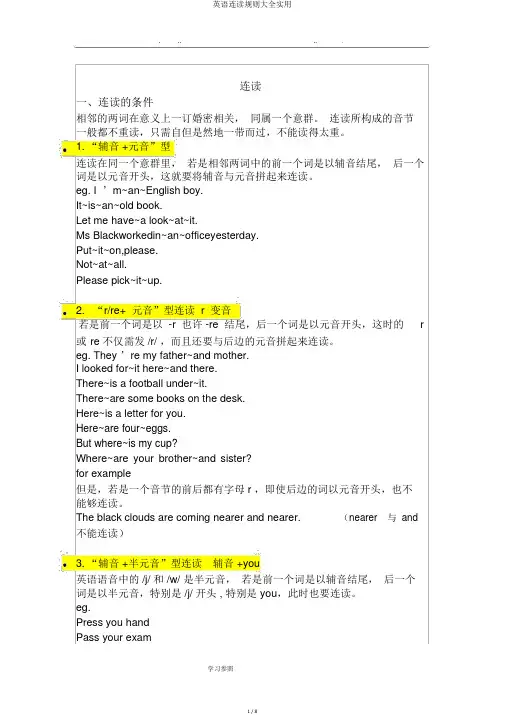
[同甘苦,共患难]连读的条件:相邻的两词在意义上必须密切相关,同属一个意群。
连读所构成的音节一般都不重读,只需顺其自然地一带而过,不可读得太重,也不可音。
(连读符号:~)英语中的连读主要有四种:1)辅音+元音的连读(Consonant + Vowel)2)辅音+辅音的连读3)元音+元音的连读4)T, D, S 或Z + Y的连读(1)“辅音+元音”型连读在同一个意群里,如果相邻两词中的前一个词是以辅音结尾,后一个词是以元音开头,这就要将辅音与元音拼起来连读。
KK音标Voiced(浊辅音): b d g v z r ʤʒðm n ŋj wKK音标Unvoiced(清辅音): p t k f s l ʧʃθh1、I’m~an~English boy. It~is~an~old bo ok. Let me have~a look~at~it.2、Ms Black worked in~an~office last~yesterday.3 I called~you half~an~hour~ago.4 Put~it~on, please.5 Not~at~all.6 Please pick~it~up.hope it就不连读为/hupit/,因为主句I hope是一个意群,后面的从句是另一个意群:字母连读:LA [eh•Lay]读数字时也可以连读:902 5050 [nai•no•too fai•vo•fai•vo]My name is… [my nay•miz] 2because I’ve.[b'k'zäiv] 3pick up on the American intonation… [pi•kəpan the(y) əmer'kəninətənashən]不只是句子中,读字母缩写也可以连读:LA [eh•Lay] 再来几个简单例子:hold on [hol don] turn over [tur nover] tell her I miss her [teller I misser](2)“r/re+元音”型连读如果前一个词是以-r或者-re结尾,后一个词是以元音开头,这时的r或re不但要发/r/,而且还要与后面的元音拼起来连读。
They’re my father~and mother. 2 I looked for~it here~and there. 3 There~is a football under~it. 4There~are some books on the desk. 5 Here~is a letter for you. 6Here~are four~eggs. 7 But where~is my cup? 8 Where~are your bro ther~and sister?但是,如果一个音节的前后都有字母r,即使后面的词以元音开头,也不能连读。
The black clouds are coming nearer and nearer.(nearer与and不可连读)(3)“辅音+半元音”型连读英语语音中的/j/和/w/是半元音,如果前一个词是以辅音结尾,后一个词是以半元音,特别是/j/开头,此时也要连读。
1Thank~you. 2Nice to meet~you. 3 Did~you get there late~again? 4 Would~you like~a cup~of tea?5 Could~you help me, please?“音的同化”—常把/d/+/j/读成/dV/,did you听上成了/dIdVu/,would you成了/wudVu/,could you成了/kudVu/。
you are 会变成类似于your的感觉Liaison Rule :T, D, S, or Z + YT, D, S, or Z :指的是前一个词是以辅音T, D, S, or Z结尾。
Y :指的是 you 或者 your 等。
(1) [t] + Y = [ ʧ ] T+ you = [ʧ jʊ]1Can't~ you do~it? 2Don't ~you like~it? 3Would n't~ you? 4Have n't~ you? 5I'll let ~you know.6Can I get~ you~ a drink? 7Nice to meet~you.8We thought ~you weren't coming.9I'll bet ~you ten bucks he for got.T+ your = [ʧə]1、What's~ your name? [ts] as [t]2、Is that ~ your final answer?2、例外:No, not~ yet. [nɑʧɛt]问:I saw her last year. 如何(2) [d] + Y = [ʤ]1Did~you get there late~again?2、Would~you like~a cup~of tea?3、Could~you help me, please?4、What did~ your fam ily think?5、Did you find ~ your keys?6、We followed ~ your~ in struc tions.7、Where did ~ you send ~ your check?(3) [s] + Y = [ ʃ]Yes, ~ you are.Bless ~ you! Press~ your hands together. Can ~ you dress~yourself?You can pass~ your~ exams this ~year. [ðɪʃɪə] I'll try to guess~ your~ age.Let him gas~ your car for you.(4) [z] + Y = [ʒ]How's your f am ily? How was your trip? Who's your friend? Where's your mom?When's your birth day? She says you're O K. [shi sεʒ ierou kay]Who does your hair?(4)“元音+元音”型连读如果前一个词以元音结尾,后一个词以元音开头,这两个音往往也要自然而不间断地连读到一起。
如果前一个词是由元音[u]结尾,下一个词由元音开头,那么,在[u]后面加上一个辅音[w]如果前一个词是由元音[i]结尾,下一个词由元音开头,那么,在[i]后面加上一个辅音[y]这种连读不能把辅音w或者j发得太重,否则会显得很傻,但是不发这两个辅音的话又会很难念得顺口。
解决的方案:保持[i] or [u]上嘴形. 轻轻顺滑地过渡到下一个开头的元音就行了,即这两个音自然而不间断地连读到一起。
Go~away. Go(w)away.[Go(w)away]I~also need the~other one. I(y)also need thee(y)other one.To have~a friend, be~ a friend. Təhævəfrεn(d),(pause) be(y)əfrεnd(d).I~am Chinese. He~is very friendly to me. She wants to study~English.How~and why did you come here? She can’t carry~it.It’ll take you three~hours to walk there.The question is too~easy for him to answer.Go away. [Go(w)away]在电影Big Fish中,巨人Carl说过这句话。