
Quiz for unit4, Book 1
- 格式:ppt
- 大小:137.50 KB
- 文档页数:8



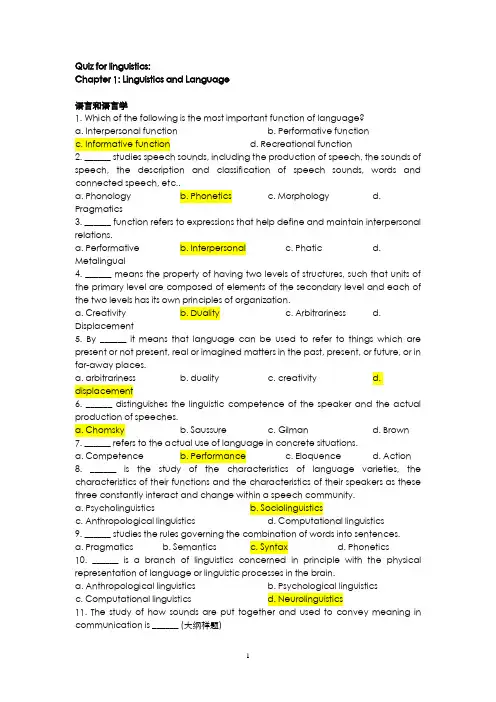
Quiz for linguistics:Chapter 1: Linguistics and Language语言和语言学1. Which of the following is the most important function of language?a. Interpersonal functionb. Performative functionc. Informative functiond. Recreational function2. ______ studies speech sounds, including the production of speech, the sounds of speech, the description and classification of speech sounds, words and connected speech, etc..a. Phonologyb. Phoneticsc. Morphologyd. Pragmatics3. ______ function refers to expressions that help define and maintain interpersonal relations.a. Performativeb. Interpersonalc. Phaticd. Metalingual4. ______ means the property of having two levels of structures, such that units of the primary level are composed of elements of the secondary level and each of the two levels has its own principles of organization.a. Creativityb. Dualityc. Arbitrarinessd. Displacement5. By ______ it means that language can be used to refer to things which are present or not present, real or imagined matters in the past, present, or future, or in far-away places.a. arbitrarinessb. dualityc. creativityd. displacement6. ______ distinguishes the linguistic competence of the speaker and the actual production of speeches.a. Chomskyb. Saussurec. Gilmand. Brown7. ______ refers to the actual use of language in concrete situations.a. Competenceb. Performancec. Eloquenced. Action8. ______ is the study of the characteristics of language varieties, the characteristics of their functions and the characteristics of their speakers as these three constantly interact and change within a speech community.a. Psycholinguisticsb. Sociolinguisticsc. Anthropological linguisticsd. Computational linguistics9. ______ studies the rules governing the combination of words into sentences.a. Pragmaticsb. Semanticsc. Syntaxd. Phonetics10. ______ is a branch of linguistics concerned in principle with the physical representation of language or linguistic processes in the brain.a. Anthropological linguisticsb. Psychological linguisticsc. Computational linguisticsd. Neurolinguistics11. The study of how sounds are put together and used to convey meaning in communication is ______ (大纲样题)a. morphologyb. general linguisticsc. phonologyd. semantics12. Syntax is the study of ______. (2005年真题)a. language functionb. sentence structuresc. textual organizationd. word formation13. Which of the following is NOT a distinctive feature of human language? (2005年真题)a. arbitrarinessb. productivityc. cultural transmissiond. finiteness14. The distinction between parole and langue was made by ______. (2006年真题)a. Hallidayb. Chomskyc. Bloomfieldd. Saussure15. ______ refers to the study of the internal structure of words and the rules of word formation. (2007年真题)a. Phonologyb. Morphologyc. Semanticsd. Sociolinguistics16. Which of the following is NOT a design feature of human language? (2008年真题)a. Arbitrarinessb. Displacementc. Dualityd. Diachronicity17. The study of the mental processes of language comprehension and production is ______.(2009年真题)a. corpus linguisticsb. sociolinguisticsc. theoretical linguisticsd. pysholinguistics18. Language is a tool of communication. The symbol “Highway Closed” on a highway serves ______. (2010年真题)a. an expressive function.b. an informative function.c. a performative function.d. a persuasive function.19. ______ is defined as the study of the relationship between language and mind. (2011年真题)a. Semanticsb. Pragmaticsc. Cognitive linguisticsd. Sociolinguistics20. Saussure distinguishes the linguistic competence of the speaker as ____a. paroleb. languagec. systemd. langue语音学1. ______ is the study of the physical properties of the sounds produced in speech.a. Acoustic phoneticsb. Articulatory phoneticsc. Auditory phoneticsd. Pragmatics2. When ______ is produced, complete closure of the articulators is involved so that the airstream cannot escape through the mouth.a. fricativeb. stopc. affricated. lateral3. In the production of vowels, air is ______ as is the case with consonants.a. not obstructedb. obstructedc. semi-obstructedd. half-obstructed4. The idea of establishing a phonetic alphabet was first proposed by the ______ grammarian Otto Jespersen in 1886.a. Englishb. Americanc. Danishd. French5. The present system of the IPA derives mainly from one developed in the ______ by the British phonetician, Daniel Jones and his colleagues at University of London.a. 1910sb. 1920sc. 1930sd. 1940s6. To be specific, ______ deals with how speech sounds are produced.a. articulatory phoneticsb. acoustic phoneticsc. auditory phoneticsd. phonological phonetics7. All the following are the description of [P] EXCEPT ______.a. stopb. bilabialc. alveolard. consonant8. If a single movement from one element to a second element of the tongue is involved, the combine vowels are called ______.a. monophthongsb. triphthongsc. cardinal vowelsd. diphthongs9. The most famous cardinal vowel system put forward by Daniel Jones defines ______ primary cardinal vowels.a. 7b. 8c. 9d. 1010. The followings belong to affricates EXCEPT ______.a. [ts]b. [l]c. [D]d. [tr]11. According to the part of the tongue which is raised, the vowels can be divided into the following three kinds, EXCEPT for ______.a. frontb. middlec. centrald. back12. A vowel is different from a consonant in English because of _______. (2011年真题)a. absence of obstructionb. presence of obstructionc. manner of articulationd. place of articulation13. If the air stream meets with no obstruction when a sound is pronounced, it is a(n) ______.a. voiced consonantb. voiceless consonantc. voweld. explosive14. The internationally accepted system of phonetic transcription is ______.a. I.P.Ab. I.A.P.Sc. I.S.Sd. S.S.I.P音位学1. ______ refers to two words in a language which differ from each other by only one distinctive sound (one phoneme) and which also differ in meaning.a. Ahonemeb. A minimal pairc. Allophoned. Free variation2. Phonology is the study of ______.a. how speech sounds are madeb. the sound system of languagesc. speech sounds are transmittedd. how speech sounds are received3. The following are the principle suprasegmental features EXCEPT _______.a. syllableb. stressc. toned. phoneme4. Which aspect does NOT belong to the phonological process?a. A set of sounds to undergo the processb. A set of sounds produced by the processc. The length of the sounds in the processd. A set of situations in which the process applies5. ______ refers to the sound which is capable of distinguishing one word or one shape of word from another in a given language.a. Phoneb. Allophonec. Phonemed. Morpheme6. The open syllable refers to the syllable that has no ______.a. codab. onsetc. nucleusd. rhyme7. The meaning-distinctive function of the tone is especially important in what we call tone languages. Which of the following is tone language?a. Englishb. Chinesec. both English and Chinesed. Neither English nor Chinese8. If two phonetically similar sounds are two distinctive phonemes, they are said to form a ______.a. minimal pairb. complementary distributionc. phonemic contrastd. minimal set9. Which of the following is NOT a distinctive feature in English phonology?a. aspirationb. plosivenessc. bilabialityd. voicelessness1. ______ is a unit that cannot be divided into smaller units without destroying or drastically altering the meaning, whether it is lexical or grammatical.a. Phonemeb. Morphemec. Lexemed. Phone2. The words such as dog, nation and close are ______.a. affixesb. free morphemesc. bound morphemesd. compounds3. The words such as “smog” and ”brunch” are called ______.a. abbreviationb. acronymc. back-formationd. blending4. For example, the word bead originally means “prayer”, but later it refers to “the prayer bead”, and finally “small, ball-shaped piece of glass, metal or wood”. It is called ______.a. meaning shiftb. broadeningc. narrowingd. borrowing5. “Kodak” is a/an ______.a. acronymb. blendingc. coinaged. clipping6. Nouns, verbs, adjectives, and adverbs are ______.a. grammatical wordsb. lexical wordsc. both grammatical words and lexical wordsd. neither grammatical words nor lexical words7. Pronouns, prepositions, conjunctions, and articles are ______.a. open-class wordsb. closed-class wordsc. both open-class words and closed wordsd. neither open-class nor closed-class words8. In terms of ______, words can be divided into closed-class words and open-class words.a. meaningb. variabilityc. qualityd. membership9. _____ refers to any morphemes or combination of morphemes to which an inflectional affix can be added. It can be equivalent to a root, or a root and a derivational affix.a. affixb. rootc. stemd. suffix10. In the following words foot/feet, goose/geese, the affixes belong to ______.a. suffixb. infixc. prefixd. root11. Which of the following is NOT a compound word? (大纲样题)a. Landladyb. Greenhousec. Upliftd. Unacceptable12. The word holiday originally meant “holy day”; but now the word signifies “any day on which we don’t have to work”. This is an example of ______. (大纲a. meaning shiftb. widening of meaningc. narrowing of meaningd. loss of meaning13. The word “m otel” comes from “motor + hotel”. This is an example of ______ in morphology. (2010年全真)a. backformationb. conversionc. blendingd. acronym14. ______ refers to the study of the internal structure of words and the rules of word formation. (2007年全真)a. Phonologyb. Morphologyc. Semanticsd. Sociolinguistics1. ______ refers to the study of the rules governing the way words are combined to form sentences in a language, or simply, the study of the formation of sentence.a. Morphologyb. Syntaxc. Phoneticsd. Semantics2. Which one of the following does NOT belong to English cases?a. Nominativeb. Accusativec. Genitived. Dative3. When a word of a certain class determines the form of others in terms of category, it is referred to as _____.a. generationb. governmentc. transformationd. negation4. ______ refers to the extent to which the sentence element contributes to the development of the communication.a. C-commandb. Immediate constituent analysisc. Deep structured. Communicative dynamism5. ______ is a general term for verbal category that distinguish the status of events, etc. in relation to specific period of times, as opposed to their simple location in the present, past, or future.a. tenseb. timec. moodd. aspect6. The relation between elements that form part of the same form, sequence, construction, etc., e.g. between s, p, and r in a form such as spring, or between a subject and a verb in constructions such as Bill hunts is called ______.a. syntagmatic relationb. paradigmatic relationb. positional relation d. relation of subsitutablity7. In English, theme and rheme are expressed by ______.a. subject and objectb. subject and predicatec. predicate and objectd. object and predicate8. Classical Creek and Arabic have a third number: ______, something like the English “both”.a. singleb. pluralc. duald. trial9. Another method to analyze a sentence from the functional perspective is ______, which is proposed by J. Firbas.a. C-commandb. immediate constituent analysisc. deep structured. communicative dynamism10. Those constructions where there is only one head, with the head dominant and the other constituents being modifiers, are ______.a. endocentric constructionsb. exocentric constructionsc. deep structured. surface structure11. What type of sentence is “Mark likes fiction, but Tim is interested in poetry.”? (2008年真题)a. a simple sentenceb. a coordinate sentencec. a complex sentenced. none of the above12. The distinctive features of a speech variety may be all the following EXCEPT ______. (2007年真题)a. lexicalb. syntacticc. phonologicald. psycholinguistic13. Syntax is the study of ______. (2005年全真)a. language functions.b. sentence structures.c. textual organization.d. word formation.语义学1. More specifically, _____ is the study of the meaning of linguistic units, words and sentences in particular.a. pragmaticsb. semanticsc. syntaxd. phonology2. In the semantic triangle by Ogden and Richards, the SYMBOL or FORM refers to ______.a. the linguistic elements (words, phrases)b. the object in the world of experiencec.conceptd. idea3. The words with more or less the same meaning used in different regional dialects are called ______.a. dialectal synonymsb. collocational synonymsc. stylistic synonymsd. complementary antonymy4. The word “table” has at least the six meanings such as “a piece of furniture”, “all the people seated at a table”, etc. It can be called ______.a. polysemyb. antonymyc. homonymyd. hyponymy5. The relation between “dog” and “animal” is that of _____.a. synonymyb. antonymyc. homonymyd. hyponymy6. A special language variety that mixes languages and is used by speakers of different languages for purposes of trading is called _____. (2009年真题)a. dialectb. idiolectc. pidgind. register7. The phenomenon that words having different meanings have the same form is called ______. (2008年真题)a. hyponymyb. synonymyc. polysemyd. homonymy8. The word tail once referred to the “tail of a horse”, but now it is used to mean “the tail of any animal”. This is an example of ______.(2007年真题)a. widening of meaningb. narrowing of meaningc. meaning shiftd. loss of meaning9. The word “kid, child, offspring” are examples of ______. (2006年真题)a. dialectal synonymsb. stylistic synonymsc. emotive synonymsd. collocational synonyms10. The noun “tear” and the verb “tear” are ______.a. homophonesb. homographsc. complete homonymsd. allophones语用学1. Pragmatics is generally the study of natural language understanding, and specifically the study of how ______ influences the interpretation of meanings.a. wordb. contextc. sentenced. language form2. Speech Act Theory is the first major theory in the study of language in use, which originated with the Oxford philosopher ______.a. Herbert Paul Griceb. Dan Sperberc. Deirdre Wilsond. John Langshaw Austin3. A(n) _____ is using a sentence to perform a function.a. Locutionary Actb. Illocutionary Actc. Perlocutionary Actd. In-locutionary Act4. The second major theory in pragmatics is the theory of conversational implicature, proposed by Oxford philosopher ______.a. J. Austinb. Hallidayc. Herbert Paul Griced. Saussure5. The following maxims are the Cooperative Principles Except ______.a. quantity maximb. quality maximc. distance maximd. relation maxim6. Which of the following is NOT the characteristic of Implicature?a. calculabilityb. cancellabilityc. non-detachabilityd. changeability7. Dan Sperber and Deirdre Wilson argue that all Gricean maxims should be reduced to a single principle of ______.a. relevanceb. coordinationc. agreementd. reciprocity8. The notion of ______ is essential to the pragmatic study of language?a. communicationb. contextc. speech act theoryd. words9. When a speaker expresses his intention of speaking, such as asking someone to open the window, he is performing ______. (2009年真题)a. an illocutionary actb. a perlocutionary actc. a locutionary actd. none of the above10. What essentially distinguishes semantics and pragmatics is the notion of ______. (2006年真题)a. referenceb. meaningc. antonymyd. context11. The speech act theory was first put forward by ______. (2005年真题)a. John Searleb. John Austinc. Noam Chomskyd. M.A.K Halliday12. The force of a/an ______ act is identical with the speaker’s intention.a. illocutionaryb. locutionaryc. perlocutionaryd. Prelocutionary其他1. The definition “the act of using, or promoting the use of several languages, either by an individual speaker or by a community of speakers”refers to _____. (2011年全真)a. pidginb. creolec. multilingualismd. bilingualism2. ______ refers to the learning and development of a language. (2010年全真)a. Language acquisitionb. Language comprehensionc. Language productiond. Language instruction3. A special language variety that mixes languages and is used by speakers of differentlanguages for purposes of trading is called ______. (2009年全真)a. dialect.b. idiolect.c. pidgin.d. register.4. The distinctive features of a speech variety may be all the following EXCEPT ______. (2007年全真)a. lexicalb. syntacticc. phonologicald. psycholinguistic5. With the ______, Latin words were added into the vocabulary of the language spoken in Britain.a. invasion of the Romansb. Christianization of Britainc. Scandinavian invasiond. Norman Conquest现代语言学理论和流派1. The Prague School is best known for its contribution to the distinction between phonetics and ______.a. soundb. phonemec. phonologyd. phone2. The founder of the London School is the British linguist ______.a. J. R. Firthb. Hallidayc. Bloomfieldd. Sapir3. Firth insisted that the object of linguistics is language ______.a. in oral useb. in actual usec. in booksd. in media4. The following function of adult’s language EXCEPT ______ are put forward by Halliday.a. the ideational functionb. the interpersonal functionc. the informative functiond. the textual function5. The principle representative of American descriptive linguistics is ______.a. L. Bloomfieldb. Chomskyc. Sapird. Saussure6. The person who is often described as “father of modern linguistics” is ______.a. Firthb. Saussurec. Hallidayd. Chomsky7. The most important contribution of the Prague School to linguistics is that it sees language in terms of ______.a. functionb. meaningc. signsd. system8. ______ is the founder of Transformational Generative Grammar.a. Noam Chomskyb. Hallidayc. Saussured.Brown9. The structural approach to the analysis of language was started by the Swiss linguist ______ in the beginning of the 20th century.a. Chomskyb. Hallidayc. Saussured. Fillmore10. A representative of the Contextualism was ______, the leading British linguist of the period. He held the view that “We shall know a word by the company it keeps”.a. Ogden and Richardsb. J. R. Firthc. Bloomfieldd. Leech11. Bloomfield further strengthened the contextualist view and drew on ______ when trying to define the meaning of linguistic forms.a. sociologyb. behaviorist psychologyc. anthropologyd. physiology12. ______ means that it is impossible for children to acquire some particular language knowledge resulting from the contrast of language data in the process of their L1 acquisition.a. Language facultyb. Language acquisition devicec. Universal grammard. Argument of poverty stimulus。

⾼级英语2quiz答案选择题+选词填空Unit 11.…as Camille lashed northwestward across the Gulf of Mexico.A. strike violentlyB. pass byC. move slowlyD. stride2.…gray clouds scudded in from the Gulf on the rising wind.A. go smoothlyB. go straight and fastC. go up and downD. go violently3.…lifted the entire roof off the house and skimmed it 40 feet through the air.A. hit violentlyB. move lightly overC. go fast and quietlyD. move gradually away4.One wall began crumbling on the marooned group.A. stay brave and alongB. leave hopefulC. stay helplessD. leave helpless and alone5.…and 709 small businesses were demolished or severely damaged.A. destroyB. reduceC. increaseD. beat6.Richelieu Apartments were smashed apart as if by a gigantic fist, and 26 people perished.A. incarnateB. dieC. increaseD. submit7.Debris flew as the living-room fireplace and its chimney collapsed.C. well preserved piecesD. scattered broken pieces8.With two walls in their bedroom sanctuary beginning to disintegrate…A. a warm placeB. shelterC. a clean placeD. a harm place9.Pop Koshak raged silently, frustrate d at not being able to do anything…A. discourageB. bring about good resultC. come out fruitfullyD. worry about the result10.We can prop it up with our heads and shoulders!A. supportB. placeC. suspendD. proposeUnit 31. However intricate the ways in which animals communicate with each other, they do not indulge in anything that deserves the name of conversation.A. difficultB. complicatedC. invalidD. simple2. Suddenly they see the moment for one of their best anecdotes, but in a flash the conversationhas moved on and the opportunity is lost.A. short amusing storyB. long tedious talkC. uninteresting writingD. exciting information3. The conversation had swung from Australian convicts of the 19th century to the English peasants of the 12th century.A. criminalB. aggressorC. captainA. secureB. impureC. odorousD. revival5. The phrase has always been used a little pejoratively and even facetiously by the lower classes.A. sharpB. distastefulC. contemptuousD. penetrating6. The King’s English is a model—a rich and instructive one--but it ought not to be an ultimatum.A. the general opinion about the character, qualities, etc.B. state of being in demandC. something that provokes or annoysD. final statement of conditions to be accepted7. It was an Australian who had given her such a defi nition of “the King’s English,” which produced some rather tart remarks about what one could expect from the descendants of convicts.A. differentB. sarcasticC. loadedD. special8. One could have expected that it would be about then that the phrase would be coined.A. happenB. coincideC. comfortD. invent9. After five centuries of growth, of tussling with the French of the Normans and the Angevins and the Plantagenets and at last absorbing it, the conquered in the end conquering the conqueror. A. have a hard struggle or fight B. raise to a higher gradeC. come to a lower level or stateD. make the greatest possible use of10. When E. M. Forster writes of “the sinister corridor of our age,” we sit up at th e vividness ofthe phrase, the force and even terror in the image.A. not pretendedB. suggesting evilC. happening in the same time1. Let all our neighbors know that we shall join with them to oppose aggression or subversionanywhere in the Americas.A. rebuildingB. successionC. destroyingD. salvage2. Let both sides seek to invoke the wonders of science instead of its terrors.A. call forthB. take downC. put upD. take the form of3. For I have sworn before you and Almighty God the same solemn oath our forebears prescribed nearly a century and three-quarters ago.A. order or directB. produceC. protectD. agree4. We offer not a pledge but a request: that both sides begin anew the quest for peace, before the dark powers of destruction unleashed by science engulf all humanity in planned or accidental self-destruction.A. swallow upB. consider aboutC. clean upD. imprint on5. Together let us explore the stars, conquer the deserts, eradicate disease, tap the ocean depths and encourage the arts and commerce.A. cut into many small partsB. go round in circleC. draw together into a small spaceD. put an end to; destroy6. We observe today not a victory of party but a celebration of freedom.A. celebrateB. preserveC. orateD. help7. …and unwilling to witness or permit the slow undoing of these human rights to which this nation has always beenB. lazinessC. coverD. destruction8. and unwilling to witness or permit the slow undoing of these human rights to which this nation has always been commit ted…A. pledgeB. omitC. refrainD. repeat9. …each generation of America ns has been summoned to give testimony to its national loyalty.A. evidenceB. witnessC. liberationD. trial10. Let both sides, for the first time, formulate serious and precise proposals for the inspection andcontrol of arms…A. predictionB. warm speechC. expectationD. examinationUnit 51. “Can you mean,” I said incredulous ly, “that people are actually wearing raccoon coats again?”A. unbelievingB. increasingC. industriousD. unimproved2. She was not yet of pin-up proportions but I felt sure that time would supply the lack she already had the makings.A. propertyB. portionsC. massagesD. dimensions3. I reeled back, overcome with the infamy of it.A. being famous forB. being shameful4. “I’11 never do that again,” she promised contritely. “Are you mad at me?”A. sadB. honestC. penitentD. overjoyed5. “Right!” I cried exultantly, “One hundred percent right.”A. triumphantB. foreignC. exhaustedD. overflowing6. That Walter Pidgeon is so dreamy. I mean he fractures me.A. break.B. combineC. disagreeD. repeat7. I had long coveted Polly Espy.A. surroundB. coverC. avoidD. desire8. All right. Let’s try Contradictory Premises.A. take outB. be contrary toC. withdrawD. be relevant to9. “Listen,” he said, clutching my arm eagerly.A. grasp tightlyB. hang looselyC. touch softlyD. hold lightly10. Raccoon coats are unsanitary. They shed. They smell bad. They weight too much. They’re unsightly.A. invisibleUnit 61. Today Lysenko’s theory is discredited, and there is now only one genetics.A. doubtB. disgraceC. believeD. disappear2. The world looks more homogenous because it is more homogeneous.A. phoneticB. uniformC. unidentifiedD. linguistic3. It will reappear in different ways until it is not only accepted but universally regarded as an asset.A. storageB. priceC. benefitD. approval4. But the idea of a world car was inevitable.A. preventableB. unavoidableC. unnecessaryD. doubtful5. He is cosmopolitan.A. systematicalB. politicalC. identicalD. international6. …machines soon generated propositions which evaded all tradition.A. explainB. exhaustC. avoidD. intrude7. It has thus undermined an article of faith: the thingliness of things.8. Reminiscing on the early work of Fancis Picabia and Marcel Duchamp…A. ReinforcingB. RecollectingC. RecoveringD. Responding9. It was the automotive equivalent of the International Style.A. versionB. equalC. variationD. variety10. The universalizing imperative of technology is irresistible.A. commandB. orderC. tendencyD. imperilUnit 81. The main features of craftsmanship have been very lucidly expressed.A. cleverlyB. reliablyC. obscurelyD. clearly2. Man, being afraid of his newly won freedom, was obsessed by the need to subdue his doubts and fears by developing a feverish activity.A. cruelB. savageC. excitedD. rash3. No wonder that this puts a premium on slovenly work, on slowdowns, and on other tricks to get the same pay check with less work.A. clean and tidyB. careful and cleanC. careless and untidyC. extinctionD. extraction5. It is a hostility toward work which is much less conscious than our craving for laziness and inactivity.A. craftB. desireC. statueD. design6. There are, of course, many useful and labor saving gadgets.A. applianceB. figureC. planD. handtool7. The craftsman’s way of livelihood determines and infuses his entire mode of living.A. fillB. confuseC. containD. misuse8. Work became, in Max Weber’s terms, the chief factor in a system of “inner-worldly asceticism,” an answer to man’s sense of aloneness and isolation.A. aestheticsB. self-denialC. self-criticismD. ascent9. Work appears as something unnatural, a disagreeable, meaningless and stultifying condition of getting the pay check, devoid of dignity as well as of importance.A. stupidB. amazingC. not stimulatingD. not dull10. P. Drucker, observing workers in the automobile industry, expresses this idea very succinctly.A. clearlyB. successfullyUnit 141. Those ad campaigns celebrating the Big Apple, those T-shirts with a heart design proclaiming “I love New York,” are signs, pathetic in their desperation, of how the mighty has fallen.A. possibleB. passionateC. pitifulD. annoying2. New York was never a good convention city.A. customB. contentionC. conscienceD. consciousness3. To win in New York is to be uneasy; to lose is to live in jostling proximity to the frustratedmajority.A. appropriatenessB. closenessC. approximationD. distance4. Nature constantly yields to man in New York: witness those fragile sidewalk trees gamely struggling against encroaching cement and petrol fumes.A. encompassingB. inducingC. invadingD. poisonous5. A testing of oneself, a fear of giving in to the most banal and marketable of one’s talents, still draws many of the young to New York.A. ordinaryB. excellentC. boringD. extraordinary6. In both these roles it ratifies more than it creates. Wall Street will advance the millions to makea Hollywood movie only if convinced that a bestselling title or a star name will ensure its success.A. producesB. approvesC. opposesA. equipmentB. gadgetsC. facilitiesD. agreements8. So much of well-to-do America now lives antiseptically in enclaves, tranquil and luxurious, that shut out the world.A. sereneB. noisyC. crowedD. transparent9. To him New York- despite its faults, which her will impatiently concede (“so what else is new?”) — is the spoiler of all other American cities.A. concealB. admitC. contendD. condescend10. The place constantly exasperates, at times exhilarates.A. excitesB. regetsC. deniesD. annoys1. A B B D A B D B A A 3.B A A A C D B D A B4.C A A A D A D A B D5. A D B C A A D B A B6.A B C B D C B B B C 8.D C C A B A A B C C14. C A B C A B C A B DUnit 11. She was prepared to ____________ the years of Jack’s jail sentence.2. Mountain gorillas are ___________ extinction.3. If we all ___________, we’ll have it finished in no time.4. There’s a storm coming, so let’s ________________ the hatches.5. Her legs suddenly __________ and she fell to the floor.6. It is ____________ five hours to drive to the railway station.7. She ___________, silenced by the look Kris gave her.8. The front room ____________ books and clothes.1. sit out2. on the verge of3. pitch in4. batten down5. gave way6. a good7. trailed away8. was strewn withUnit 31. He ________ his pocket and brought out a notebook.2. My children _____________________ home cooking.3. Just wait here. I’ll be back ___________.4. I’m afraid their relationship is ___________.5. On icy roads, a four-wheel drive vehicle really ___________.6. Put yourself ___________ the person you are dealing with.1. delved into2. turn their noses up at3. in a flash4. on the rocks5. comes into its own6. in the shoes ofUnit 41. The point __________ is whether you are willing to go abroad or not.2. Helen and Ruth are always ___________ about some little things.3. These results ____________ the coach’s skill and hard work.4. The leadership too often ____________ hard decisions.5. The prosecution must prove ________ that the accused is guilty of the crime.6. Prices _______________ change.7. His family had _________ him ________ without a penny.8. I would advise people to think very carefully about __________themselves ___ working on Sundays.1. at issue2. at odds3. give a testimony to4. shrinks from5. beyond doubt6. are subject to7. cast…off8. committing…toUnit 51. I need to ____________ myself ________ the new regulations.2. Tom didn’t ___________ and told me straight away that I had failed.3. Do you see the point I’m ____________?4. She’s only marrying him to _________________ his money.5. I’ve tried arguing, but it _____me_______.6. He had all the evidence ______________.7. You _____________ tell us now—we’ll find out sooner or later.1. acquaint …with2. mince words3. getting at4. get her hands on5. got … nowhere6. at his finger tips7. might as wellUnit 61. Such behavior ____________ prejudices.2. He ____________________ that he has done this.3. The forests _____________ deer, birds and squirrels.4. Ray and I ate our meal and _______________ the trip.5. Is social inequality the inevitable ___________ economic freedom?6. Is that the best excuse you can ____________ ?1. springs from2. owes it to himself3. abound with4. reminisced about5. corollary of6. come up withUnit 81. Modern economies ________________ educated workers.2. His face was __________ any warmth or humour.3. The truth was known to no one _______________ herself.4. She ______________ the chance to speak to him in private.5. Doctors have to __________ themselves _________ their feelings.6. Gina had _______________ her family.7. Take it easy before you go on stage to ________________!1. place a premium on2. devoid of3. other than4. longed for5. detach …from6. become alienated from7. put up a showUnit 141. They were already a political force to __________.2. The school is widely __________for its excellent teaching.3. The new building is_____________ its surroundings.4. I ___________temptation and had a chocolate bar.5. The job is great ___________salary, but it has its disadvantages.6. He ________ himself ________ all human and lived alone in a remote area.7. The figures are not very good when ____________those of our competitors.8. I watched her walk down the road until she was __________by the darkness.9. He_______________the waiter to bring the bill.10. She was___________her colleagues and regarded as an eccentric woman.1. be reckoned with2. looked up to3. out of phase with4. yielded to5. in terms of6. cut off … from7. measure up against8. swallowed up 9. beckoned to 10. out of step with。