
Nb掺杂二氧化钛纳米管的制备及其氢敏特性
- 格式:pdf
- 大小:1002.02 KB
- 文档页数:5


复合二氧化钛纳米管的制备及光电催化性能研究的
开题报告
一、研究背景与意义
二氧化钛晶体结构完整,光催化性能优异,被广泛应用于水处理、空气净化、污染物降解等领域。
然而,由于其带隙宽度为3.2eV,只能吸收紫外光,利用率较低,限制了其应用范围和效率。
因此,将二氧化钛制备为纳米尺度时,其光催化性能有所提升,但提升幅度较小。
在此背景下,有研究人员利用复合材料的优点,将二氧化钛与其他半导体材料复合制备成纳米管,以期提升其光催化性能。
二、研究内容
本研究将选择二氧化钛作为主要研究对象,采用水热法制备出复合二氧化钛纳米管材料,然后通过傅里叶变换红外光谱(FTIR)、X射线粉末衍射(XRD)、扫描电子显微镜(SEM)、透射电子显微镜(TEM)等手段对复合材料的结构和形态进行表征,分析其组成成分、结构和形态等特征。
同时,对复合材料的光电催化性能进行测试,主要测试项目包括光催化降解有机染料、光吸收谱和热重分析等。
通过相关的测试,分析复合材料的光电催化性能的提高程度及其影响因素。
三、研究意义
本研究将探究复合二氧化钛纳米管的制备工艺及其光电催化性能,为二氧化钛及其复合材料的合成和应用提供了新的思路和方法,有望为解决水处理、空气净化、污染物降解等领域中的环境问题提供一定的理论和实验基础。

二氧化钛纳米颗粒和纳米管的制备及其抑菌性能研究的开题报告一、研究背景及意义随着现代医学的发展,抗生素的应用已经成为人们治疗疾病的重要手段,但随之而来的是抗药性菌株的出现,这给疾病的治疗带来了很大的困难。
因此,探索一种新的抑菌剂就显得十分必要,而纳米材料作为一种新型的材料,具有较高的比表面积和特殊的物理、化学和生物性质,被广泛应用于生物医药领域。
二氧化钛(TiO2)是一种常见的半导体氧化物,具有优异的光催化性能,能够产生强氧化剂,具有良好的抑菌性能,是制备抑菌剂的理想材料。
因此,本研究旨在通过制备二氧化钛纳米颗粒和纳米管,探究其抑菌性能,为解决抗药性菌株的问题提供新的思路和方法。
二、研究内容1.通过水热法制备二氧化钛纳米颗粒和纳米管。
2.对制备的二氧化钛纳米颗粒和纳米管进行表征,包括形貌结构、粒径、荧光特性等。
3.探究二氧化钛纳米颗粒和纳米管在不同浓度下对大肠杆菌的抑菌性能,并比较二者的抑菌效果。
4.通过相关实验验证二氧化钛纳米颗粒和纳米管的抑菌机理,包括细胞膜破坏、氧化应激等。
三、研究方法1.水热法制备二氧化钛纳米颗粒和纳米管:采用水热法制备二氧化钛纳米颗粒和纳米管,通过控制反应条件来调节产品形貌和结构。
2.对制备的二氧化钛纳米颗粒和纳米管进行表征:采用扫描电镜(SEM)和透射电镜(TEM)对样品的形貌和粒径进行表征,荧光光谱仪检测样品的荧光特性。
3.探究抑菌性能:采用涂布法或吸附法将制备的二氧化钛纳米颗粒和纳米管添加到培养基中,对大肠杆菌进行抑菌实验,测定抑菌率和最小抑菌浓度。
4.探究抑菌机理:通过荧光显微镜观察细胞膜的破坏情况,通过氧化应激实验分析释放的氧化剂对大肠杆菌细胞的影响。
四、研究预期成果1.成功制备二氧化钛纳米颗粒和纳米管,并对其形貌结构、粒径、荧光特性进行表征;2.探究二氧化钛纳米颗粒和纳米管的抑菌性能,比较二者的抑菌效果;3.验证二氧化钛纳米颗粒和纳米管的抑菌机理,包括细胞膜破坏、氧化应激等;4.为探索新型的抗菌剂提供新的思路和方法。
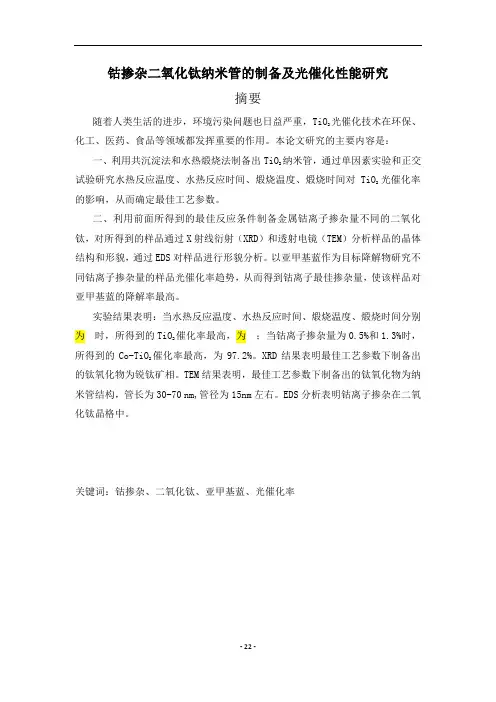
钴掺杂二氧化钛纳米管的制备及光催化性能研究摘要光催化技术在环保、随着人类生活的进步,环境污染问题也日益严重,TiO2化工、医药、食品等领域都发挥重要的作用。
本论文研究的主要内容是:纳米管,通过单因素实验和正交一、利用共沉淀法和水热煅烧法制备出TiO2试验研究水热反应温度、水热反应时间、煅烧温度、煅烧时间对TiO光催化率2的影响,从而确定最佳工艺参数。
二、利用前面所得到的最佳反应条件制备金属钴离子掺杂量不同的二氧化钛,对所得到的样品通过X射线衍射(XRD)和透射电镜(TEM)分析样品的晶体结构和形貌,通过EDS对样品进行形貌分析。
以亚甲基蓝作为目标降解物研究不同钴离子掺杂量的样品光催化率趋势,从而得到钴离子最佳掺杂量,使该样品对亚甲基蓝的降解率最高。
实验结果表明:当水热反应温度、水热反应时间、煅烧温度、煅烧时间分别催化率最高,为;当钴离子掺杂量为0.5%和1.3%时,为时,所得到的TiO2催化率最高,为97.2%。
XRD结果表明最佳工艺参数下制备出所得到的Co-TiO2的钛氧化物为锐钛矿相。
TEM结果表明,最佳工艺参数下制备出的钛氧化物为纳米管结构,管长为30-70 nm,管径为15nm左右。
EDS分析表明钴离子掺杂在二氧化钛晶格中。
关键词:钴掺杂、二氧化钛、亚甲基蓝、光催化率Preparation and Photocatalytic Performance Research of Co-doped TiO2 nanotubesABSTRACTWith the progress of people‘s lives, environmental pollution has become increasingly severe.TiO2 photocatalytic technology have played an important role in the environment, chemical industry, medicine, food and other fields. The main contents of this essay are:1.First of all,prepare the TiO2nanotubesby co-precipitation method and hydrothermal calcination.Then, determine the best process parameters with the method ofstudying the hydrothermal temperature, the hydrothermal reaction time, the calcination temperature and the impacts of calcination time on the TiO2photocatalytic rate by single factor experiment and orthogonal experiment.2.Firstly,take advantage of the best process parameters previously received to prepare the titanium dioxide with different mixed amounts of cobalt metal ion, and then analyze the crystal structure and morphology of the sample by X-ray diffraction (XRD) and transmission electron microscopy (TEM), as well as analyze the morphology of the sample by EDS. Finally, use the methylene blue as target degradation to study photocatalytic rate trend of the samples with different mixed amounts of cobalt ion, so that receive the best mixed amount of cobalt ion, which can make the degradation rate of methylene blue by the sample is highest.The results show that: when the hydrothermal reaction temperature, hydrothermal reaction time, calcination temperature and calcination time are ( ), we can get the highest catalytic rate of TiO2, which is ( ); when the mixed amount of cobalt ion is0.5% or 1.3%, we can get the highest catalytic rate of Co-TiO2,which is 97.2%. The result of XRD shows that the titanium oxide which is prepared with the best optimum parameter is the anatase phase. The result of TEM shows thatthe titanium oxide which is prepared with the best optimum parameter is nanotubes structure, whose tube length is 30-70nm and tube diameter is about15nm.EDS analysis showed that the cobalt ion is doped in the titanium dioxide lattice.Keywords: cobalt-doped, titanium dioxide, methylene blue, photocatalytic rate第一章绪论1.1纳米技术1.1.1纳米技术的概念纳米技术是指能操作尺寸在0.1~100nm的物件的一种新技术,也称毫微技术。

二氧化钛纳米材料的制备陈维庆(贵州大学矿物加工工程082班学号:080801110323)摘要:二氧化钛俗称钛白,是钛系列重要产品之一,也是一种重要的化工和环境材料。
目前制备纳米二氧化钛的方法很多,本文综述了纳米二氧化钛的多种制备方法和生产原理,在总结归纳基础上对各种制备方法进行比较,概述相关的研究进展。
关键词:二氧化钛纳米粒子生产原理Titanium dioxide nanomaterials preparationChenweiqing(Guizhou University mineral processing project 082 classes)Abstract: Titanium dioxide, commonly known as titanium dioxide, titanium series is one of the major product, is also an important chemical and environmental materials. Preparation of nanometer titanium dioxide at present a number of ways, this overview of the variety of preparation methods of nano-titanium dioxide and production principle, on the basis of summarizing and to compare various methods of preparation, review of related research progress. Keyword: Titanium dioxide Nanometer granule Production principle1 前言近20年来,纳米材料以其特殊的性能和广阔的发展前景引起各领域的广泛关注。