春季教案高一第十一讲动词不定式
- 格式:doc
- 大小:86.00 KB
- 文档页数:11
高一英语
1 第十一讲 动词不定式
姓名: 学校: 年级:
【学习目标】
掌握非谓语动词的基本用法。非谓语动词包括不定式,现在分词,过去分词,动名词。
学习重点在于要知道哪些动词后面接不定式,哪些动词后面接动名词。
【知识要点】
1、非谓语动词的句法功能
名称 语 法 功 能
主语 宾语 宾语补足语 表语 定语 状语
不定式 √ √ √ √ √ √
动名词 √ √ √ √
现在分词 √ √ √ √
过去分词 √ √ √ √
非谓语动词的否定式都是在非谓语动词前加not构成。如:
He decided not to do it.他决定不做那件事。
Not having finished his work,I couldn’t go to see the film with you.
因为没有做完作业,所以我不能和你去看电影。
He asked me not to touch this machine.他叫我别碰这台电脑。
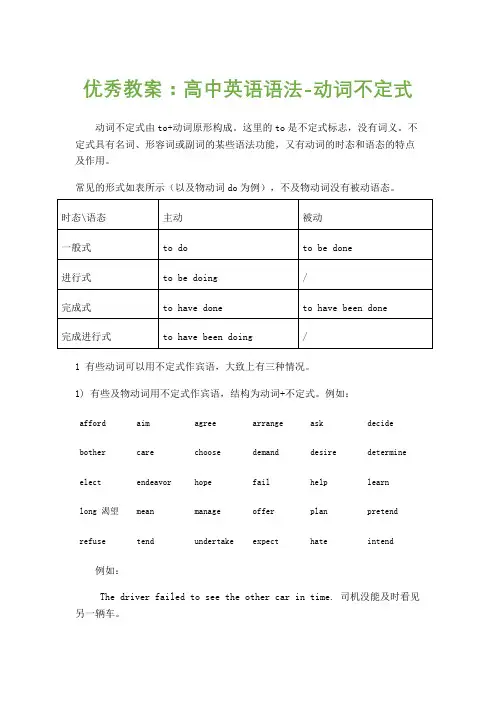
动词不定式
不定式的形式: to do sth
否定式:not + (to) do
(1) 作主语(相当于名词或代词的作用)
To see is to believe. (百闻不如一见) 高一英语
2 (2)★:下列词语常不定式作宾语:afford、promise、refuse 、expect 、hope、learn、offer、wish、want、wait, fail、plan、agree、forget、remember, like、prefer、decide、manage、attempt ,
mean , intend , agree , try、arrange 、determine 、desire , pretend等.
下列动词后可接疑问词+不定式:know, teach、decide、wonder、show、learn、forget、ask、find、out、advise、discuss等。
eg;I don’t know what to do.
(3)不定式作宾补。
①省略to的动词有feel、hear、listen to、make、let、have 、see、watch、notice、observe(一感,二听,三让,四看)等的宾补用动词原形,变被动时要加to,此时的不定式就是主语补足语。
eg:I saw him came into the building.(主动)
He was seen to come into the building.(被动)
②常用带不定式作宾补的几种情况:
主语 + ask / require / tell / order / force / get / want / like/ warn/ encourge/ inspire/ invite + sb.to
do sth.
③主语 + think / judge / suppose / believe / consider /imagine/
consider / feel + sb. + to be/ to have done
④主语 + call on / upon / depend on / wait for / ask for + sb.+ to do sth.
(4)不定式作定语的特殊用法。
①下列词语后常接不定式作定语:chance、wish、right、courage、need、promise、time、opportunity、way、the first、the second、the last、the only等。
He got a chance to enter into university.
②不定式作定语和所修饰的名词在逻辑上有主谓关系。
There is no one to look after her.
③不定式与被修饰的名词在逻辑上有动宾关系,而且不定式中的动词为不及物动词时,其后应跟必要的介词。
She is now looking for a room to live in. 高一英语
3 Please give me a chair to sit on .
(5)不定式作状语的用法。
不定式作状语,修饰动词,在句中表示行为目的、结果、原因。only to do表示出人意料的结果。
We hurried to the classroom only to find none there .
in order(not)to,so as(not)to用来引导目的状语,enough,too, so… as to do, such + 名词… as to do作结果状语,如:
The girl was so kind as to help the old man off the bus.
I’m not such a fool as to believe that.
(6)不定式的完成时的特殊用法。
①表示不定式中谓语动词发生的动作先于主句的谓语动词发出的动作。
The novel was said to have been published.
I regret to have been with you for so many years.
seem、appear、be said、be supposed、be believed、be thought、be known、be reported等动词常用于上面句型。
此外,glad、happy、satisfied、sorry、surprised、disappointed后也接完成时,但要注意与一般时的区别。
I’m sorry to keep you waiting for a minute.对不起,请稍等。(说话时还未等)
I’m sorry to have kept you waiting.对不起,让你久等了。(说话时已等了很久)
②不定式的完成时还可表示“过去本想做某事但未做”的虚拟语气。(A)should like to / would
like to / would love to + 不定式的完成时。(B)was / were to + 不定式的完成时,表示该做某事或想做但未实现。(C)expect / hope / mean / promise / suppose / think / want/ wish + 不定式完成时,表示过去未曾实现的愿望。
(7)不定式的省略。
①同一结构并列由and或or连接。
I want to finish my homework and go home.
I’m really puzzled what to think or say. 高一英语
4 特例:To be or not to be,that is a question.
He is better to laugh than to cry.(表示对比)
②不定式作表语,其前面的主语从句中含有do时,后面的to省略。
What he did was lose the game.
③句中含有动词do时,but、except、besides、such as等后面to可省略。即“前有do,后省to”。
Don’t do anything silly, such as marry him.
④主句含有不定式,后面有rather than后省to。
⑤★Why not、had better、would rather、can’t but(不得不)等词后省to。如:
He could not but walk home.
(8)不定式的替代。
多用在同一句或联系紧密的对话中,为了避免重复,作宾语或主补,宾补的不定式再次出现时,to后的内容常承前省略(只保留to即可)。但如果承前省略的不定式有助动用的have或be任何形式,后应该保留原形be或have。如:
Susan is not what she used to be.
—You came late last night. You ought to have finished your homework.
—I know I ought to have.
常见的有:I’d like / love / be happy to.
(9)下列情况需要注意:
①不定式作定语修饰的名词作give , have, get , buy , lend , want等动词的宾语且句中有不定式的逻辑主语时,有时有被动意义。eg:
Please give me something to eat.
I have a lot of work to do.
②不定式to let(出租),to blame(责备) 常用主动形式表被动。eg:
The house is to let.
Who is to blame for it?
③注意区别作为不定式符号“to”与介词to.
I am looking forward to seeing you soon..我期望尽快见到你。(to 为介词) 高一英语
5 We are used to living this area.我们习惯了在这个地方生活。(to为介词)
I used to get up at 6:oo.我过去常常六点起床。(to 为不定式符号)
常用的以介词to结尾的短语如下:
look forward to期待 object to反对 reject to反对
be(get) used to习惯于 be addicted to(沉迷于) devoted …to把…献给
lead to 导致 prefer…to更喜欢 refer to谈到
④常见的作独立成分的不定式短语:to tell the truth , to be honest (说实话), to begin with , to
start with (开始) , to be frank (坦白的说) eg:
To tell the truth,I don’t like him.说句实话,我不喜欢他。
【典型例题】
1. When asked by the police, he said that he remembered __________ at the party, but not