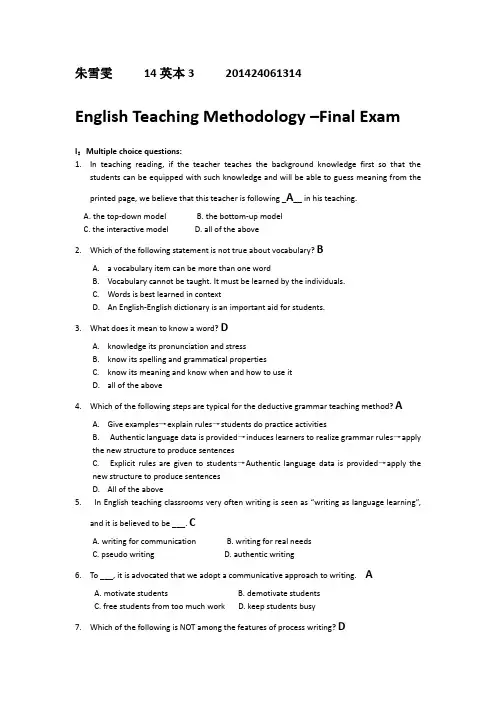
1.第1题In meaningful practice the focus is on the production, comprehension or exchange of ___.A.structuresB.sentencesC.formD.meaning您的答案:D题目分数:2.0此题得分:2.02.第2题In the traditional classroom, very often, too much attention has been paid to ___, with little or no attention paid to practising language skills.A.linguistic competenceB.linguistic knowledgenguage usenguage functions您的答案:B题目分数:2.0此题得分:2.03.第3题One of the reasons of providing the students with a variety of speaking activities is that the variety of activities helps ___.A.keep motivation highB.de-motivate studentsC.memorise the speechD.learn the dialogues by heart您的答案:A题目分数:2.0此题得分:2.04.第4题PPP and TBL are two approaches to language teaching. PPP stands for Presentation, Practice and Production and TBL stands for___.A.Task Book LanguageB.Text Book LearningC.Teacher-Based LearningD.Task-Based Learning您的答案:D题目分数:2.0此题得分:2.05.第5题When we ask the students to do predicting tasks in listening, we should let students read/hear the listening comprehension questions ___.A.before they listenB.while they are listeningC.after their listeningD.none of the above您的答案:A题目分数:2.0此题得分:2.06.第6题Natural language, spoken or written, uses referential word such as pronouns to refers to people or things already mentioned previously in the context. Therefore, the activity …understanding references‟ can be performed in the ___ stage when teaching reading.A.pre-readingB.while-readingC.post-readingnguage-focus您的答案:B题目分数:2.0此题得分:2.07.第7题Role-playing through cue dialogues, role-playing through situation and goals, and role-playing through debates or discussion are examples of ___.A.mechanical practiceB.drilling languageC.pre-communicative activitiesD.social interaction activities您的答案:D题目分数:2.0此题得分:2.08.第8题According to Wang Qiang, pre-listening activities include predicting, setting the scene, ___, and listening for specific information.A.learning new wordsB.learning new grammarC.listening for the gistD.concluding您的答案:C题目分数:2.0此题得分:2.09.第9题The teacher provides a printed summary of a text with some wrong information, and asks the students to correct it. This kind of …false summary‟ activit y can be performed to check comprehension when teaching ___.A.speakingB.readingC.grammarD.writing您的答案:B题目分数:2.0此题得分:2.010.第10题In the traditional classroom, there is often too much focus on linguistic knowledge, with little or no attention paid to ___.A.knowledge of vocabularyB.knowledge of grammar rulesC.practising language skillsD.practising phonetics您的答案:C此题得分:2.011.第11题To help our students pass exams is one of the purposes of our English teaching. Another purpose, which is very important, is to prepare our students to ___.e English in real lifeB.obtain knowledge about languageC.make up sentencesD.get a good job in the future您的答案:A题目分数:2.0此题得分:2.012.第12题The ultimate goal of foreign language teaching is to enable students to use the foreign language in work or life when necessary. Thus we should teach ___; and we should teach language in the way it is used in the real world.A.that part of the language that will be usedB.all parts of the languageC.the language used in works of classical literatureD.spoken language only您的答案:A题目分数:2.0此题得分:2.013.第13题Some people think teaching is a craft; that is, a novice teacher can learn the profession by imitating the experts‟ techniques, just like an apprentice. Others hold the view that teaching is an applied science, based on scientific knowledge and experimentation. Wallace (1991) uses a “reflective model” to demonstrate the development of a teacher, the process of which includes three stages moving from Stage One, language training, to the Goal of ___.A.professional competencemunicative competencenguage proficiencyD.an expert teacher您的答案:A题目分数:2.014.第14题The ___ of language sees language as a linguistic system made up of various subsystems: the sound system (phonology), the discrete units of meaning produced by sound combinations (morphology), and the system of combining units of meaning for communication (syntax).A.structural viewB.functional viewC.interactional viewD.behaviorist view您的答案:A题目分数:2.0此题得分:2.015.第15题The ___ theory believes that learning is a process in which the learner constructs meaning based on his/her own experiences and what he or she already knows.A.structuralB.constructivistC.behavioristD.cognitive您的答案:B题目分数:2.0此题得分:2.016.第16题Communicative Competence consists of knowledge and ability for___.A.rules of rules of pronunciation, vocabulary and grammarB.rules of grammar/form and rules of language useC.pronunciation, words, and grammarD.speaking and writing您的答案:B题目分数:2.0此题得分:2.017.第17题When teaching grammar, if the teacher follows the sequence of teaching activitiesof “teacher‟s presentation of an example →explanation of the rule →students‟practice with given prompts”, Professor Wang Qiang would believe that the teacher is using the ___ method.A.inductiveB.deductiveC.guided discoveryD.task-based您的答案:B题目分数:2.0此题得分:2.018.第18题According to Wang Qiang, pre-listening activities include predicting, setting the scene, listening for the gist, and ___.A.learning new wordsB.listening for specific informationC.learning new grammarD.concluding您的答案:B题目分数:2.0此题得分:2.019.第19题In teaching reading, if the teacher teaches the background knowledge first so that the students can be equipped with such knowledge and will be able to guess meaning from the printed page, we believe that this teacher is following ___ in his teaching.A.the bottom-up modelB.the top-down modelC.the interactive modelD.all of the above您的答案:B题目分数:2.0此题得分:2.020.第20题Jane Willis holds that the conditions for language learning are exposure to a richbut comprehensible language put, ___ of the language to do things, motivation to process and use the exposure, and instruction in language.A.chanceseC.contextD.knowledge您的答案:B题目分数:2.0此题得分:2.021.第21题Communicative Language Teaching (CLT) has expanded the areas covered by the previous approaches or methodologies, that is, CLT covers language content (to incorporate functions), ___ (cognitive style and information processing), and product (language skills).A.learning processB.teaching methodsC.conditionsD.messages您的答案:A题目分数:2.0此题得分:2.022.第22题If we believe that when we are reading, our brain receives visual information and at the same time interprets or reconstruct the meaning, and that the reading process does not only involve the printed page but also the reader‟s knowledge of the language in general, of the world and of the text types, we would follow the ___ in our teaching.A.Bottom-Up ModelB.Top-Down ModelC.Interactive ModelD.all of the above您的答案:C题目分数:2.0此题得分:2.023.第23题Which of the following would you NOT agree with?A.People have different experiences in learning a foreign language. Some find it eB.People learn languages for different reasons.C.People have different capacities in language learning.D.People have the same understanding about language learning.您的答案:D题目分数:2.0此题得分:2.024.第24题The concept of present, past and future time, the expressions of certainty and possibility, the roles of agents, instruments with a sentence, and special relationships between people and objects are examples of language ___.A.functionsB.notionsC.structuresD.behavior您的答案:B题目分数:2.0此题得分:2.025.第25题In the traditional classroom, very often, too much attention has been paid to ___, with little or no attention paid to practising language skills.A.linguistic competenceB.linguistic knowledgenguage usenguage functions您的答案:B题目分数:2.0此题得分:2.026.第26题According to Clark, Scarino and Brownell, the main components of a task include ____.A.exercises, exercise-tasks and tasksB.potential ineffectiveness for presenting new language items, time and learningC.a purpose, a context, a process and a product/outcomeD.Pre-Task, Task Cycle and Language Focus您的答案:C题目分数:2.0此题得分:2.027.第27题According to Wang Qiang, information-gap activities, problem-solving, ___, “Dialo gues and role-plays”, and “Find someone who …” are some types of speaking tasks.A.reading aloud in chorusB.repeating what the teacher has saidC.reciting a dialogueD.“Change the story”您的答案:D题目分数:2.0此题得分:2.028.第28题In the inductive method of teaching grammar, the teacher induces the learners to realise grammar rules ___.A.by telling them the rulesB.by explaining in an explicit wayC.with explicit explanationD.without any explicit explanation您的答案:D题目分数:2.0此题得分:2.029.第29题According to Cheng Xiaotang (in Wang Qiang, 2006), classroom activities can be classified into ____.A.exercises, exercise-tasks and tasksB.presenting new language items, time and learning cultureC.a purpose, a context, a process and a product/outcomeD.Pre-Task, Task Cycle and Language Focus您的答案:A题目分数:2.0此题得分:2.030.第30题Two characteristics of spoken language are spontaneity and ___.A.preparationB.time-constraintC.accuracyD.fluency您的答案:B题目分数:2.0此题得分:2.031.第31题One of the problems in vocabulary learning is that students ___.e context for their vocabulary learningB.try hard to understand the wordsC.treat vocabulary items indiscriminatelye a variety of vocabulary building strategies您的答案:C题目分数:2.0此题得分:2.032.第32题According to the ___ there are a finite number of grammatical rules in the system and with knowledge of these rules an infinite number of sentences can be produced.A.Behaviourist theoryB.Cognitive theoryC.structural viewD.functional view您的答案:B题目分数:2.0此题得分:2.033.第33题Examples of pronunciation perception practice include ___.ing pictures and tongue twistersing minimal pairs, and “Odd one out”C.brainstorming and discussionD.all of the above您的答案:B题目分数:2.0此题得分:2.034.第34题Receptive skills of language include ___.A.listening and readingB.listening and speakingC.reading and writingD.speaking and writing您的答案:A题目分数:2.0此题得分:2.035.第35题When we are teaching pronunciation, ___ and intonation should be taught from the very beginning.A.knowledge about soundsB.phonetic rulesC.phonetic transcriptsD.stress您的答案:D题目分数:2.0此题得分:2.036.第36题According to Wang Qiang the while-listening stage is ___ for the teacher to control, because this is where the students need to pay attention and process the information actively.A.the easiestB.as easy as the pre-listening stageC.as easy as the post-listening stageD.the most difficult您的答案:D题目分数:2.0此题得分:2.037.第37题Communicative Competence consists of knowledge and ability for___.A.rules of rules of pronunciation, vocabulary and grammarB.rules of grammar/form and rules of language useC.pronunciation, words, and grammarD.speaking and writing您的答案:B题目分数:2.0此题得分:2.038.第38题In teaching grammar, substitution and ___ are examples of mechanical practice.ing chain phrases for story tellinging information sheets as promptsC.chain of eventsD.transformation drills您的答案:D题目分数:2.0此题得分:2.039.第39题The ___ view says that knowing how to do what you want to do also involves knowing whether it is appropriate to do, and where, when and how it is appropriate to do it. In order to know this, you have to study the patterns and rules of language above the sentence level to learn how language is used in different speech contexts.A.structuralB.functionalC.interactionalD.behaviorist您的答案:C题目分数:2.0此题得分:2.040.第40题According to the ___ theory of language learning, the key point of the theory of conditioning is that …you can train an an imal to do anything (within reason) if you follow a certain procedure which has three major stages, stimulus, response, and reinforcement‟ (Harmer, 1983:30).A.structuralB.behavioristC.process-orientedD.condition-oriented您的答案:B题目分数:2.0此题得分:2.041.第41题According to Littlewood (1981), discovering missing information, discovering missing features, and following directions are examples of ___.A.mechanical practiceB.drilling languageC.functional communicative activitiesD.social interaction activities您的答案:C题目分数:2.0此题得分:2.042.第42题According to J. Willis (1996), tasks are activities where the target language is used by the learner for a communicative purpose (goal) in order to achieve ___.A.linguistic competencemunicative competenceC.an outcomeD.knowledge您的答案:C题目分数:2.0此题得分:2.043.第43题A question that views on language learning involve is “____?”A.What are the psycholinguistic and cognitive processes of language learningB.Why do human beings have languageC.How a language is different from anotherD.How do people use language when they have a desire to communicate您的答案:A题目分数:2.0此题得分:2.044.第44题When teaching pronunciation, we should ___.A.never use visual aidse explanation rather than demoe dictionaries to show the soundsD.bring variety to the classroom, for example, show British & American pronunciati您的答案:D题目分数:2.0此题得分:2.045.第45题Which of the following activities would BEST help to prepare students for their real life speech in English?A.Doing a drillB.Learning a piece of text or dialogue by heartC.Reading aloudD.Interviewing someone, or being interviewed您的答案:D题目分数:2.0此题得分:2.046.第46题Pre-reading activities include ___, setting the scene, skimming, and scanning.A.predictingrmation transfer activitiesC.reading comprehension questionsD.reproducing the text您的答案:A题目分数:2.0此题得分:2.047.第47题According to Wang Qiang, “Listen and tick”, “Listen and sequence”, “Listen and act”, “Listen and draw”, and “Listen and fill” are activities in the ___ stage of teaching listening.A.pre-listeningB.while-listeningC.post-listeningD.all of the above您的答案:B题目分数:2.0此题得分:2.048.第48题As far as learning pronunciation is concerned, the realistic goals for the students are consistency, intelligibility, and ___.municative efficiencyB.accuracyC.correctnessD.fastness您的答案:A题目分数:2.0此题得分:2.049.第49题In the traditional way of teaching reading, the teacher first introduces new words and structures, then goes over the text sentence by sentence, then asks some questions about the text, and then has the students read aloud the text. In this traditional way of teaching, the teacher is following ___ in his teaching.A.the bottom-up modelB.the top-down modelC.the interactive modelD.all of the above您的答案:A题目分数:2.0此题得分:2.050.第50题Suppose a teacher is teaching his students to read an interesting story about how a doctor makes a joke of a young man. The teacher wants the students to tell part of the story with some key words from the story like “a doctor – village – annoyed; people – stop – street – advice; never paid – never – money – made up his mind –put and end”. In which stage of teaching do you think the teacher should do this?A.At the pre-reading stage.B.At the while-reading stage.C.At the post-reading stage.D.At any of the three stages.您的答案:B题目分数:2.0此题得分:0作业总得分:98。